Category Archives: Radio history

1965 Soviet Spīdola-VEF Transistor Shortwave Portable

1966AugPracticalElec

This ad appeared fifty years ago this month, August 1966, in the British magazine Practical Electronics.

Details are lacking in the ad (such as the exact frequency coverage), but this import from the Soviet Union is probably one of the first shortwave transistor portables. The ad proclaims “another gold for Russia,” and that “the impossible has been done” with an 8 band radio for “hardly more than the cost of an ordinary single wave cheap transistor!”

The frequency coverage isn’t stated, but the set appears to be the VEF Spīdola from one of two Latvian manufacturers, Valsts Elektrotehniskā Fabrika (hence the VEF name) and Radiotehnika, both of Riga, Latvia. The sets were produced primarily for the Soviet Union and Eastern Bloc, but some were exported to Western Europe.

From the drawing in the ad, the set appears to be the Spīdola-VEF model PMK-65, which is described in detail at this Russian language Latvian site.

The set’s name means “shining” and is the name of a beautiful witch in a Latvian myth. The 10 transistor superhet runs off 6 D cell batteries, and covers 150-410 kHz longwave, 520-1600 kHz mediumwave, and several shortwave bands. The model described in the British ad is described as having eight bands, but the original Latvian model, with Cyrilic markings on the dial (but with the “VEF Spīdola” name in Roman text), has five shortwave bands. The dial is calibrated in meters, but the tuning ranges are 4.0-5.8 MHz, 5.85-6.3 MHz, 7-7.4 MHz, 9.4-9.9 MHz, and 11.6-12 MHz.

1965 Spīdola-10 export version, known as the Transistor-10 or Convair-10. Wikipedia photo.

Wikipedia shows an export version of the set, shown here, which is said to be the 1965 export version of the Spīdola-10, known as the Transistor-10 or Convair-10. The set has 6 shortwave bands. It doesn’t cover the lowest shortwave band, and the 41 and 49 meter bands are contained in a single band. In addition to 31 and 25 meters, it also covers the 19, 16, and 13 meter bands. The limited dial markings also use the Roman alphabet, and the abbreviations correspond with English.

The frequency coverage of this set matches up best with the description in the British ad, not only in the number of bands, but in the fact that there are “different transmissions at your fingertips 24 hours a day, even including amateur ‘Hams,’ ‘Pirate’ radio stations, ships, etc.” Since the version shown on the Latvian site only goes up to 25 meters, it’s not really optimized for daytime reception. Also, with the tuning ranges focused on broadcast bands, only the 40 meter amateur band is covered. So I tend to think that the British ad is for the Wikipedia export version, although the drawing in the ad corresponds to the seven-band set for the Soviet market.

SpidolaAn excellent history of the manufacturer of this set can be found at LatvianHistory.com.  The site also contains an excellent history of radio monitoring in Latvia as well as Soviet jamming.  It’s surprising to see mass production of consumer shortwave receivers taking place simultaneously with jamming of the signals destined for those receivers, but that appears to be exactly what the Soviets were doing.  The set shown here on that site (image courtesy of Maris Goldmanis) seems to match up closely with the set being advertised in Britain, although the set shown here has only seven bands and has Cyrillic markings.

From what I’ve been able to read, the Spīdola appears to live up to the advertising hype, and was an excellent portable transistor shortwave receiver, and certainly one of the first.

Click Here For Today’s Ripley’s Believe It Or Not Cartoon


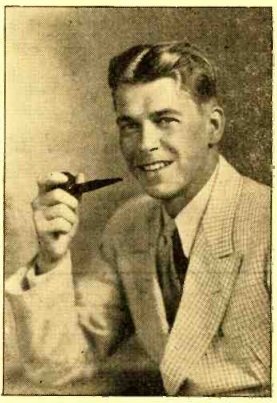
Betty Lou Gerson, 1936

BettyLouGerson1936

Shown here on the cover of the August 29, 1936 issue of Radio Guide is radio actress Betty Lou Gerson.

Then 22 years old, she had originally taught “creative dramatics” and never given much thought to going on the air until she was asked to fill in on a broadcast for a friend who was ill. She quickly decided she liked the microphone and asked for an audition. Almost immediately, she was offered a position and her popularity skyrocketed. In 1936, she had roles in “A Tale of Today” and “The Foxes of Flatbush.”

She was born in Chattanooga, Tennessee, in 1914, and grew up in Florida and Alabama before “coming North” in 1931, a fact which the magazine said “accounted for the wonderful southern drawl you hear when she is not on the air.” Her interests included symphony, opera, cooking, sewing, hiking, and boating.

Most of her career was spent in Radio, and she moved to Los Angeles in the 1940’s, when she appeared in series such as The Whistler and I Love Adventure. In 1950’s, she had a voice role as narrator in Walt Disney’s version of Cinderella, and in 1961 landed what was probably her most famous role, namely the voice of Cruella De Vil in Disney’s One Hundred and One Dalmations.

She had some film roles, including Nurse Andersone along side Vincent Price in The Fly.

She also had some television roles in series such as Perry Mason and The Twilight Zone.  She died in 1999 at the age of 84.

Click Here For Today’s Ripley’s Believe It Or Not Cartoon


Farnsworth Model AT-50, 1941

1941Aug28MilJour

Seventy five years ago today, the August 28, 1941, Milwaukee Journal carried this ad from  Gimbels Department Store for this Farnsworth 7-tube set for $28.88.

The set appears to be Farnsworth Model AT-50.  In addition to covering the broadcast band, it had one shortwave band from 6-17 MHz to pull in war news from Europe.  Despite what the ad says, the tuning range is not continuous, and didn’t cover the lower shortwave band or police band.  It was a superhet with one RF stage, and had a tube lineup of 6SK7, 6A8GT, 6SK7, 6SQ7, 6H6, 25L6GT, and 25Z6GT.  It featured pushbutton tuning with six broadcast band presets.

A surviving example of the set can be found at the Radio Attic Archives.

Click Here For Today’s Ripley’s Believe It Or Not Cartoon


Tuckerton Radio Tower

Photo courtesy of Donald O. Caselli, Tuckerton Historical Society.

Photo courtesy of Donald O. Caselli, Tuckerton Historical Society.

We previously published a photo from 1914 of what was then the world’s largest radio tower at Tuckerton, New Jersey.  The tower was part of the German Goldschmidt System, and was in contact with the German station near Hanover, with the call signs WCI and WGG.  During World War I, the station was taken over by the Navy, and the employees were interned as prisoners of war.  The station was later sold to RCA, which operated it as WSC until the 1950’s.

I received an interesting e-mail from from Donald O. Caselli, the President of the Tuckerton Historical Society.

Among other details, he noted that the tower originally stood 850, and included a top wooden section that later fell off. He also included the newspaper article reproduced below, as well as the photo above of one of the footings.

You can click on the images below to see full-size images of the article.

1992-07-22-SmrTms Tuckerton Wireless Radio Tower 01

1992-07-22-SmrTms Tuckerton Wireless Radio Tower 02

1992-07-22-SmrTms Tuckerton Wireless Radio Tower 03

1992-07-22-SmrTms Tuckerton Wireless Radio Tower 04

Acknowledgment

I would like to thank  Donald O. Caselli, President of the Tuckerton Historical Society, for sharing these images.

Click Here For Today’s Ripley’s Believe It Or Not Cartoon


Al’s Radio Service, Owatonna, MN, 1941

1941AugRadioCraft

This ad for Al’s Radio Service of Owatonna, Minnesota, was reproduced in the Mailbag column of the August, 1941, issue of Radio Craft magazine,

along with a letter from the shop’s proprietor, Alfred J. Beauchamp. He reported being a regular reader of the magazine for eight years, during which time he saw many different service shops pictured. However, he reported that he hadn’t seen one that was as modern, up-to-date and complete as his. He asked the magazine to run his ad as a challenge to other servicemen readers. The editor obliged, but also noted that one motivation might have been “as a free ad?–Hi!”

The ad noted that Beauchamp had recently added to his staff a radio engineer and technician of outstanding ability and training. That individual was presumably Myron C. Jones, whose name appears next to Beauchamp’s in the ad. The ad noted that Al’s repaired all makes of radios, and was an authorized service station for Philco, Motorola, and General Motors car radios. While the shop did not sell radios, it was the only shop in the territory completely equipped to satisfy sound equipment needs, and had public address systems for sale or rent, as well as Dorafone office call systems and other inter-office communication systems.

The shop was located at 128 W. Pearl, Owatonna, Minnesota.

Click Here For Today’s Ripley’s Believe It Or Not Cartoon


Jean Hudson, op. W3BAK, 1936

1936AugAllWaveRadioEighty years ago, the August 1936 issue of All Wave Radio magazine carried this ad for the “Candler Scientific Sound System,” which would “teach you everything necessary to enable you to obtain your ‘Ham’ License quickly, easily, inexpensively.  Tell us what you need.”

Apparently, The Candler System took particular pride in teaching the code, and the ad points to two champions of some code competition, both products of the Candler System.  One of these champions was 9 year old Jean Hudson, who is pictured with her trophy.

Surprisingly, I’ve been able to find very little about Miss Hudson, but I did find an article in the June 1933 issue of Radio Magazine, which reveals that she was actually eight years old when first licensed.

W3BAKAccording to the 1933 article, she was the daughter of Edgar L. Hudson, W3BAK, of Laurel, Delaware, whom the magazine described as a “veteran Morse operator, an ardent radio amateur and one of the world’s proudest dads.” Jean’s brother Roland, 14, was also licensed as W3AXP. And Jean’s older sister, Dorothy, was also preparing for the license.  According to this site, Dorothy was licensed in 1935 as W3IRR.

The only call sign I found associated with Miss Hudson was W3BAK, her father’s call.  So apparently, while she received an operator’s license, she did not hold her own station license.

Born in California, the family moved to Laurel, Delaware, where Jean first showed an interest in radio. Telegraph keys and related equipment fascinated her, and she soon learned to send and receive code. With some tutoring from her father, she studied transmitters, receivers, and the rules and regulations, and on April 26, 1933, she took the test from the radio examiner at Baltimore. She sat on a thick dictionary to reach the examination table, and passed the code test with no difficulty. Her written examination showed a score of 80%.

Jean copied code on a typewriter, and since she touch typed, she could copy 25 words per minute blindfolded. The QSL card for her first contact, April 28, 1933, is shown below.

W3BAKqsl

Jean Hudson in 1935. Short Wave Craft magazine, August 1935.

Jean Hudson in 1935. Short Wave Craft magazine, August 1935.

The 1938 Call Book lists W3BAK as belonging to Edgar, with no listing for W3IRR.  Edgar continues to be listed as late as 1968.   There is no listing for that call in 1974.  In May 1942, Jean Hudson, under the call W3BAK, wrote an article for QST on the subject of amateur radio at summer

Jean Hudson in 1942. QST, May 1942.

Jean Hudson in 1942. QST, May 1942.

camps, and recounts her experience in setting up a station at a girls’ camp in New Hampshire, which she believed to be the only such station in existence.  That article lists her address as 660 Riverside Drive, New York City.  And in the June 1945 issue, she wrote a longer article, “His Last Strike,” recounting the story of Lt. Joseph Hyland, W2ITR, who was killed in action on January 12, 1945.  That article shows her address as 530 E. 90th St., New York, 28.

I was unable to find any reference to Miss Hudson after 1945, and found no indication that she was ever issued her own station license.  If you have any additional information about this pioneer amateur, I would enjoy hearing it.

Click Here For Today’s Ripley’s Believe It Or Not Cartoon


Anzac News Letter, 1941

1941AugManitobaCalling

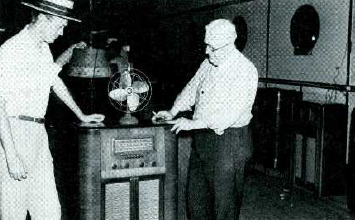
This 1941 photo shows servicemen stationed in Canada from Australia and New Zealand gathered around the radio at 9:00 on a Sunday morning to listen to “The Anzac News Letter,” a weekly program provided by the CBC and the Australian Broadcasting Commission.

The Australian and New Zealand airmen shown here were attending wireless chool in Canada. The program originated in Australia and was sent by cable to Ottawa where it was recorded. The program was well received by the Anzacs. One wrote, “personally, I consider it the most interesting session on the radio, and I feel sure that the majority of Australians in this camp hold similar views. In the normal course of events it takes four to five weeks for the home newspapers to reach camp, so you can imagine how much we appreciate receiving news within twenty-four hours of the events taking place.”

The photo appeared in the August 1941 issue of Manitoba Calling, the magazine and program guide of CKY in Winnipeg, which carried the program.

Click Here For Today’s Ripley’s Believe It Or Not Cartoon


Adding a Transmitter to the Hallicrafters Sky Buddy, 1941

1941AugRadioNews

The Hallicrafters S-19R Sky Buddy receiver came out in 1939. This six-tube receiver tuned the broadcast band up to 44 MHz, and sold for a relatively modest $29.50. The set contained a power transformer. The receiver functioned adequately for hams, in addition to serving as a decent shortwave broadcast receiver.

Lloyd Broderson, W6CLV, of Salinas, California, owned one of these for his station receiver, but decided to add a few improvements, which he documented in an article in the August 1941 issue of Radio News.

His first changes were cosmetic. Apparently dissatisfied with the looks of the black control knobs, he decided to paint them a different color. Similarly, the black screws were replaced with nickel plated screws. Carrying handles were also added. He also replaced the speaker grille with a silver colored version, personalized with his call letters.

His first electrical improvement was the addition of some tip jacks which could allowed the receiver’s power supply to be used for other equipment. These jacks provided a handy source of 6.3 and 220 volts.

With these mundane improvements taken care of, he set about adding a transmitter to the set. He noted that plenty of space was available inside the cabinet, so he added a 40 meter transmitter, employing a 6L6. While his onboard transmitter was for 40, he noted that with different crystal and coil, the same idea could be used on other bands. An end-fed antenna was connected to the transmitter output through a mica condenser.

The transmitter input was limited to about five watts, the limiting factor being the power transformer: “Any attempt to load the 6L6 to more than 25 ma. will result in the transformer becoming excessively warm.” He noted that a larger transformer could be added and the power increased several times. But as many QRP’ers have discovered, the 5 watts proved quite adequate, and the author reported working all U.S. call districts, as well as stations in the possessions.

The final modification was the addition of a code practice oscillator. This was done by keying the BFO with the set tuned to a broadcast station. He noted that “many of the boys now joining the Signal Corps have learned the code by using a similar arrangement.”

The author also reported that the newly minted transmitter-receiver could easily be taken to the field.

Click Here For Today’s Ripley’s Believe It Or Not Cartoon


1941 College Dorm Radio

1941Aug18Life2

On this date seventy-five years ago, Bates Fabrics, Incorporated, ran this ad in the August 18, 1941, issue of Life Magazine to answer the question that was undoubtedly on everyone’s mind: How were college students decorating their dorm rooms? The company put together a College Board consisting of students from the outstanding universities, and they conducted a survey of over 8000 students.

97% of the respondents believed that an attractive room helped any freshman get off on the right foot. Apparently, 3% believed that a dingy room was the way to go. 86% of the students said that they preferred bedspreads with matching draperies, and a third of them already had them. Fortunately, Bates just happened to sell exactly that: matching bedspreads and draperies, and the Life ad highlighted some of their popular designs.

The Yale men shown above preferred the “Cattle Brands” design, which, according to the ad, proved an overwhelming favorite in men’s colleges. And as you can see, these Yale men also had a radio in their dorm room. The radio sitting on the desk appears to be a Zenith model 5-G-401.

This radio was Zenith’s very first portable, sporting a lineup of 1A7, 1N5, 1H5, and 1A5, in addition to a 117Z6 rectifier. The set retailed for $44.95, and could operate off either AC power, as it probably did in the Yale dorm room, or with batteries.

1941Aug18Life1On the Left Coast, the co-eds shown here preferred a “gay, sun-country pattern on homespun ground” for their bedspread and drapes. They apparently preferred to listen to phonograph records on what appears to be a wind-up non-electronic phonograph.

Click Here For Today’s Ripley’s Believe It Or Not Cartoon


1946 Two Valve British Portable

1946AugPW

Seventy years ago, the British magazine Practical Wireless, August 1946, carried the plans for this two-valve medium wave receiver for the beginner. The circuit was a regenerative receiver, followed by one stage of audio amplification sufficient to drive a speaker.

The set was constructed using “baseboard” components on a cabinet made of plywood. The antenna coil was wound around the cabinet and then covered by leatherette. For strong stations, the built-in antenna was sufficient, but the set had provisions for external antenna and ground.

Apparently, even after the ravages of war, some beginners still had a fear of the soldering iron, and the “baseboard” construction did away with the need for soldered connections, as the author explained:

Another reason is that many amateurs still prefer to make use of baseboard components, rather than chassis components. They can understand such parts better; moreover, there is no soldering to do–a ]ob which the beginner greatly dislikes, for he sometimes makes soldered connection to the wrong points. Some constructors cannot solder successfully at all, and to try to connect four wires to a single pin socket on a chasis valve holder is not only irritating to the amateur, but he also knows in his bones that the connections are far from being satisfactory.

But despite the solderless construction, the author is confident: “As soon as the set is switched on, some programme should be heard immediately. Tune in the station properly and gently apply reaction to increase the volume. If nothing is heard, wait a few minutes. A programme may have just finished. Try tuning in the other station.”

If waiting and tuning didn’t do the trick, the author suggests reversing the leads of the tickler coil, which might have gotten reversed.

1946AugPWSchematic

Click Here For Today’s Ripley’s Believe It Or Not Cartoon