Category Archives: Radio history

1966 Two Tube Regen

1966AugPE

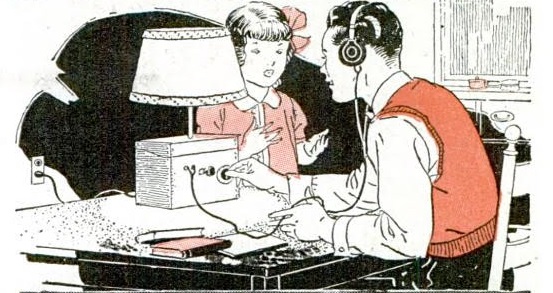
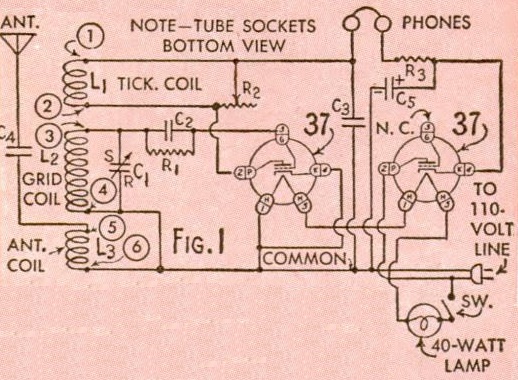
Fifty years ago, the August 1966 issue of Popular Electronics carried the plans for this two-tube shortwave receiver. The set featured band switching, and covered the broadcast band through 30 MHz in four bands. Billed as a “real powerhouse,” the set employed a 12AT7 dual triode, which served as RF amplifier and regenerative detector, followed by a 6AK6 audio amplifier which could drive either a speaker or headphones.

The set ran off AC power, and used a power transformer, which rendered it relatively safe.

1966AugPE2

Click Here For Today’s Ripley’s Believe It Or Not Cartoon


1946 FM Converter

1946AugService

After the War, the FCC moved the FM band from its old home at 42-49 MHz to its current position at 88-108 MHz. This shift delayed the popularity of FM broadcasting, since all prewar FM receivers were rendered obsolete. For the serviceman dealing with frustrated owners of prewar FM sets, one possibility was examined in the August 1946 issue of Service magazine.

The magazine contained the plans for the converter shown here, which would allow owners of the prewar sets to listen to the stations appearing on the new FM band. For simplicity, the converter had its own tuning dial, and the old receiver was left on 43 MHz. The converter consisted of an oscillator containing a single 6SA7. The author noted that this tube wouldn’t function at 100 MHz, but it worked in this circuit since it was merely oscillating at 45-65 MHz, well within its published specifications. By tuning this local oscillator, the result was an IF of 43 MHz, which would be picked up by the old set.

In addition to construction details, some discussion was given to antennas for the new band. The author noted that in most cases, an outdoor antenna consisting of brass, copper, or aluminum tubing about 4-1/2 feet long would suffice. This was mounted outside, horizontally, and fed at the center with twisted pair. For locations with strong signals, an indoor antenna, perhaps an existing curtain rod, would suffice.

1946AugServiceSchematic

Click Here For Today’s Ripley’s Believe It Or Not Cartoon


Ray’s Radio Service, Glendale, CA, 1941

1941JulAugNatlRadioNews

Here’s what the inside of a prosperous radio shop looked like 75 years ago, as shown in the July-August 1941 issue of National Radio News.

It shows Ray’s Radio Service, 108 W. California St., Glendale, California, owned by Ray R. Linganfield. In his letter to the magazine, Linganfield reported that his wife was the inspiration for getting into radio when she asked, “why don’t you try to get into the radio business.” He took a $25 a week job at a music company, and spent all of his remaining time to National Radio Institute’s course. Based upon the practical experience and theory, he found that radio cam very easy.

Soon thereafter, he opened his own repair store and showed a net profit of $1200 in the first six months. He quickly built up the store shown here, and reported grossing over $2000 a month.


Click Here For Today’s Ripley’s Believe It Or Not Cartoon


United Press Shortwave Monitor Station, Valhalla, NY, 1941

1941Aug11BC

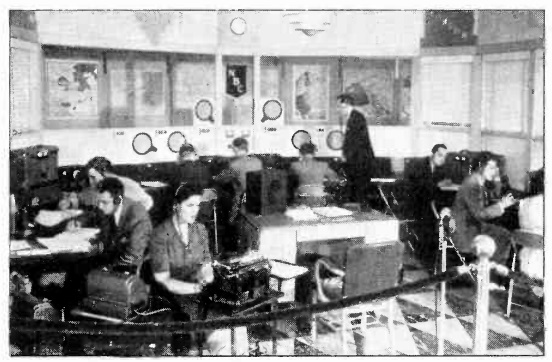
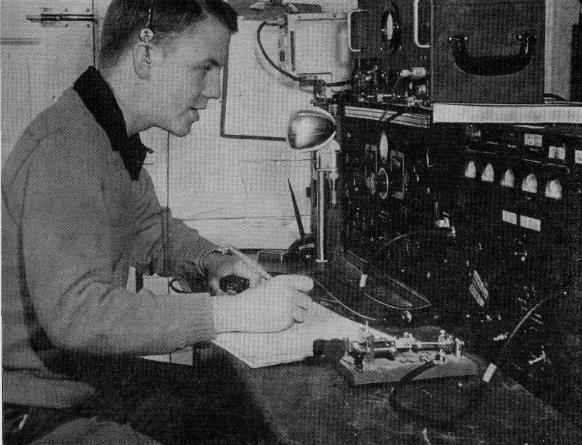
Seventy-five years ago today, this days issue of Broadcasting, August 11, 1941, carried this image of the shortwave listening post and receiving station of United Press at Valhalla, Westchester County, New York.

The magazine noted that the station’s existence had previously been a rather well kept trade secret, but had only recently been revealed by the press agency. The station had originally started in 1933 with a single operator, whose sole duty was to copy a Morse broadcast from Paris. By 1941, the station employed a dozen operators, and received scores of broadcasts daily from 15 to 20 capitals around the world.

The station was connected to the wire service’s network by a high speed printer connection to New York, and on a busy day for European war news, carried as many as 40,000 words per day.

The station was housed in a farm house, with the surrounding acres dotted with receiving antennas.

Click Here For Today’ Ripley’s Believe It Or Not Cartoon


A Radio For Every Recruit, 1941

1941AugustRadioNews

With the United States having its first peacetime draft, there were a lot of inductees away from home needing a way to stay connected and entertained.  The August 1941 issue of Radio News pointed out the opportunity this afforded radio dealers in the form of a “radio for every recruit.”

The article noted that most–but not all–draftees had an income of $21 per month, hardly enough to splurge on a radio.  Instead, the article noted that most sales were made to the families of the soldier.  In fact, one dealer had the fortunate circumstance of having his ad for portable radios happen to appear on the same page of the newspaper listing the names of draftees.  He did record business as the families of those servicemen hurried to his store to buy one of those portables.

Army officials cautioned that it was best for soldiers to wait until after their permanent placement before buying one more belonging to drag around.  But battery portables and compact sets were proving popular, and some men were using radio-recorders to make records to send home instead of letters.

Click Here For Today’ Ripley’s Believe It Or Not Cartoon


1956 Two Transistor Shortwave Regen

1956RadioElect

Sixty years ago this month, the August 1956 issue of Radio Electronics carried the plans for this receiver, which was probably the first, or one of the first, examples of an all-transistor shortwave receiver. Up until this point, high-frequency oscillation had been the stumbling block for a transistorized receiver. But GE had just put on the market the 2N137, and the circuit shown in the article could oscillate up to 12 MHz, and could even function at higher frequencies with less sensitivity.

The transistor had a steep retail price of $6.50, but this was predicted to drop as demand and production grew.

The author described the set as “a real ‘red hot,'” and reported that the dial was usually crowded with hundreds of stations. With an antenna consisting of 8 feet of wire on the floor, the set consistenly pulled in European and Asian stations and could keep pace with many communications receivers. It also performed well on the standard broadcast band.

The set used band switching, and had tuning ranges of 800-1600 kHz, 3.8-6.5 MHz, and 6-13 MHz. Regeneration was adjusted by means of variable inductive coupling, and the author reported smooth operation, even better than most vacuum tube circuits. The tickler coil was mounted on a plastic shaft, and could be rotated from the front panel to adjust the orientation with respect to the antenna coil. One stage of audio amplification (with a 2N107, kept the headphones isolated from the detector and almost eliminated the tendency for movement of the headphone cord to affect tuning.

The author suggested that the use of plug-in coils might push the operation of the set to higher frequencies, but the plans shown were a good starting point for anyone interested in the use of transistors at high frequencies. It resulted in a good portable radio that was both rugged and had very low power drain. He noted that these attributes made the set attractive for emergency or disaster use.

1956RadioElectSchematic

Click Here For Today’s Ripley’s Believe It Or Not Cartoon


1941 Illinois State Police Radio

1941ILStatePoliceRadio

Shown here on the cover of the July-August 1941 issue of National Radio News is one of the operating consoles of the radio system of the Illinois State Police.

Shown are senior operator E. Swaringen and supervisor C.I. Hopper. They are at the zone and interzone console at the Springfield station.

The magazine reported that in its three years of radio operation, the apprehension of criminals had rocketed to record-breaking heights. For example, the percentage of stolen cars recovered had jumped from 13% to a new high of 83%.

Click Here For Today’s Ripley’s Believe It Or Not Cartoon


1936 Stealth Radio

1936AugPS

If you wanted a radio in your living room 80 years ago and wanted to be stealthy, you could construct this five-tube TRF set concealed behind a tapestry, as shown in the August 1936 issue of Popular Science.

The set, in addition to the rectifier, contained one stage of RF amplification, a detector, and two stages of audio amplification.  The antenna was concealed in the silk cord that supported the picture, a power outlet could be installed behind the picture, and the tuning and volume knobs were at the bottom of the frame.

1936AugPS2

Click Here For Today’s Ripley’s Believe It Or Not Cartoon


1941 Popular Science Midget Regen BC Receiver

1941AugPS

Seventy-five years ago this month, the August 1941 issue of Popular Science carried the plans for this midget one-tube broadcast receiver geared to the needs of the outdoor enthusiast.

1941AugPS3According to the magazine, the set was small enough to be carried in a knapsack on hiking trips, but would pull in stations up to 400 miles away at night. It used a single 1T4 miniature pentode and got power from a standard flashlight cell running the filament, with a midget 45 volt battery supplying the B+.

When used in the great outdoors, a long nail could be driven into the earth for the ground connection, with a 40 foot wire tossed over a tree.

1941AugPSschematic

Click Here For Today’s Ripley’s Believe It Or Not Cartoon


1936 “Porcupine” Antenna

1936JulyPS3

Eighty years ago this month, the July 1936 issue of Popular Science included this novel “porcupine” antenna.

for either shortwave or broadcast reception. The magazine noted that where space was at a premium, it could be fastened to the outside frame of a window, since it required no mast, insulators, or dangling wires. The “antenna” consisted of a “clump of short wires that resembles a procupine or bristle brush.”

It seems to me that the outdoor clump of wires would add little or nothing to the reception. In reality, if the antenna worked, it was only because the lead-in wire was functioning as an antenna.  At least it wasn’t advertised as containing oxygen-free wire.
Click Here For Today’s Ripley’s Believe It Or Not Cartoon