Category Archives: Radio history

1957 Springfield Enterprises VHF Transceivers

1957NovPEThis ad from sixty years ago, in the November 1957 issue of Popular Electronics,  was for two little VHF rigs I had never seen before, from a company called Springfield Enterprises of Springfield Gardens, New York. The prices shown in bold print certainly look reasonable. The two-meter version is priced at $6.98, and the six-meter version is $14.98. But the fine print reveals that these are the prices for the chassis only. It is already assembled, but it doesn’t include the microphone, “miniature mike transformer,” headphones, or even the case. With these “accessories,” the price increases.

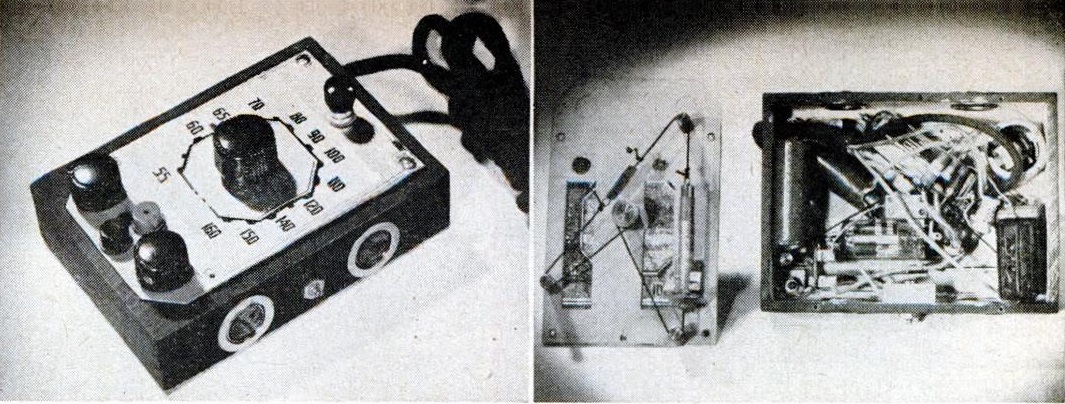
The description is lacking in details, but the two-meter version is a single tube with VFO. It’s probably similar to the transceiver shown previously at this link.

The six-meter version contains a crystal-controlled transmitter with variable frequency receiver, and uses multiple tubes. Both sets were billed as having a range of 1-5 miles with a built-in whip, and “much more with directional beam antenna.”

I’ve never seen any reference to either of these rigs, other than this K3DSM’s website, in which he states that he owned one of the two-meter versions.


1947 One Tube Matchbox Radio

1947OctPS1Seventy years ago this month, the October 1947 issue of Popular Science carried the plans for this simple one-tube receiver mounted on a chassis the size of a matchbox.

The set used few parts beyond the 1S4 tube. Tuning was accomplished by a 175-500 pF trimmer capacitor. The article noted that the small capacitor might not cover the full broadcast band, but suggested small plug-in coils to extend the range.

The set required a 1.5 volt battery for the filament, in addition to a B battery, which could be as low as 4.5 volts.


1947OctPS2


Roy Gould, W6UKX, KFXM Engineer & Engineering Professor

1942Oct26BCSeventy-five years ago today, the October 26, 1942, issue of Broadcasting carried this picture of the transmitter engineer of KFXM, San Bernardino, California, who appears to be dutifully taking some transmitter readings for the log.

Because of wartime labor shortages, the engineer responsible for keeping this station on the air was a fifteen year old high school student, Roy Gould, W6UKX.  (A few days ago, we saw how wartime labor shortages led a group of New York radio servicemen to train high school students to keep their shops open for the duration.)

Gould had received his ham ticket shortly before Pearl Harbor, and had managed to get on the air, with a homemade transmitter and receiver on 10 meter AM, before the war shut down amateur radio for the duration.

Since Gould also held his first class commercial license, he managed to stay on the air by getting a job at the broadcast station, which was at the time running  100 watts at 1240 kHz, sharing air time with KPPC, a Pasadena Presbyterian Church station.

According to the caption of the photo, Gould’s plans after the war were to go to college to “become a radio engineer.”

I was able to track down Mr. Gould–or I should say Professor Gould–and learn that his plans changed somewhat, although his early days in radio were clearly the inspiration for his career.  I received a nice e-mail from him, and also found a 1996 Oral history interview.

In his e-mail, he writes:

Thanks for the links, I have never seen this picture.

I remember those days well. I used to operate the transmitter and on Sunday evenings, record a Mutual Don Lee network program on the big 16″ acetate covered disks for replay at a later time. There was no announcer in the studio on Sunday evenings so I even signed the station off at the end of the day. I also covered remote broadcasts of some of the big bands at the San Bernardino Civic Auditorium, setting up microphones and operating the control box during the broadcast.

I got my ham license W6UKX in early 1941, and did a little operating before WWII shut down ham radio. I let it lapse in the 1950’s when I was in graduate school. However, that call sign was never reissued, so I was able to get it back under the vanity call sign program in the 1990’s. I have a web page, w6ukx.caltech.edu, but for some reason it Is down now. I’ll look into that. [Here’s the 2015 archived version at the Wayback Machine.]

Thanks again for the great photo with the short note. 73.

Roy

Roy W. Gould

Prof. Roy Gould. Caltech photo.

Gould never became a “radio engineer”.  According to his biography at Caltech, he received his undergraduate degree from Caltech in 1949, with graduate degrees from Stanford and Caltech.  He became Professor of Electrical Engineering and Physics at Caltech, and served a stint as the chairman of the school’s Division of Engineering and Applied Science.

According to his Wikipedia entry, he received the 1994 James Clerk Maxwell Prize for Plasmaphysics, and served as the Director of Fusion Research at the Atomic Energy Commission.

In his 1996 interview, Gould credits his early radio experience as the seed for his career.  He reports that in high school, he was “not a very good student.”  But his uncle’s barn was full of old radio equipment and magazines, and he “used to go up there and read these things and look at the equipment, play with it and stuff like that.  I got started in electronics with crazy experiments.”  Of course, we are also advocates of crazy experiments, and students seeking inspiration will find ideas, some crazier than others, in our science fair idea posts.

The shortage of broadcast engineers meant that he was able to get the job at the radio station, which he reported as being more interesting than was going on in school.

The broadcast station where Gould got his start, KFXM, doesn’t appear to be around in its original form.  However, the station and call letters live on as a noncommercial low-power FM station, KFXM-LP.  The old AM station appears to have been a major Top-40 outlet during the 1960’s, and when it went dark, the low power FM station was licensed to The Organization For the Preservation & Cultivation of Radio to carry on the tradition.

After letting his license lapse during grad school, Gould got his ticket after achieving emeritus status, and is again active on HF, including a number of portable DX operations detailed at his website.


1967 Hart-65 One-Tube Transmitter

1967OctPEHart65Readers of this blog might remember the name Hartland Smith, W8VVD, currently licensed as W8QX.  We previously featured his steam powered transmitter, which appeared in Popular Electronics in 1965.  A number of his projects appeared in PE and other magazines, and the one showed here appeared in Popular Electronics 50 years ago this month, October 1967.

It was a transmitter for the novice which put out a very respectable 65 watts on 80 and 40 meters. It was an updated version of the author’s “Hart 25” transmitter which appeared in the magazine in 1955. Despite the increased power, the new version boasted the same price of about $20 for all of the parts.  The 1955 version had used a 6W6 tube to put out about 25 watts, along with a 5Y3 rectifier in the power supply.

The 1967 version employed a 6HB5 TV horizontal amplifier, which was said to be highly efficient at cranking out RF. Tuning was accomplished by the simple expedient of tuning the pi network for maximum brightness of the pilot lamp. Another pilot lamp was provided for monitoring the current to the crystal, since too much current could fracture it. The article noted that smaller HC6/U crystals (and almost any modern crystal designed for solid-state circuits) should not be used because they would overheat, drift, and possibly shatter.

Cathode keying was used, but since the would mean as much as 700 volts across the key, a 6 volt relay was used for safety. The built-in power supply used a semiconductor bridge rectifier.

Smith recommended a full-size dipole antenna for the transmitter, rather than trying to use it with a random wire or multi-band antenna. He did have one insight that I independently discovered years later: “If an 80-meter dipole is too long for your piece of real estate, don’t hesitate to bend it around corners, or even droop the ends. Whatever the final arrangement, make certain that you have a total of 125′ of wire in the air.”  As you can see from my fan dipole from the June 2010 issue of QST, I’m not adverse to introducing a few zig-zags into an 80 meter dipole in order to squeeze it only a city lot.

He notes that the pi network should be adequate for keeping harmonics to a minimum. However, he also advises that if TVI is a problem, a low-pass filter in line with the antenna is in order. With today’s more stringent requirements for spectral purity, it would probably be a good idea to add the extra filtering even in the absence of TVI reports.

He reported that on the air, he worked numerous stations throughout the U.S. and Canada on both 80 and 40 meters. The rig had a “click-free pure d.c. note that was a joy to copy.” It was reported to be “rock-steady” on 80 meters, and “its 40-meter stability compares favorably with that of many low-cost VFO transmitters presently on the market.”

1967OctPEHart65Schematic

Hart-75 Transmitter. QST photo.

Hart-75 Transmitter. QST photo.

In addition to writing articles, Hartland Smith was the proprietor of Hart Industries, which produced a number of kits (and a few wired sets), including the Hart 25.  The 1955 Popular Electronics article included the address for Hart Industries for the kit, which included the pre-punched chassis.  Another Hart Industries kit was the similarly named Hart-75 from 1956. That transmitter was reviewed by Lew McCoy, W1ICP, in the February 1956 issue of QST. Even though the basic circuit was quite different from the PE transmitter (it used a 6AG7 oscillator and 807 final), it did have one common design feature, namely, the use of the relay for keying.

The 1956 model had an interesting twist, in that a DPST relay was used, keying the oscillator and amplifier almost simultaneously. But the circuit used something called “differential keying.” The contacts of the relay were set so that the oscillator came on slightly before the amplifier, and stayed on longer. The result was that chirp was greatly reduced.


1942: Putting High School Students to Work Servicing Radios

1942OctRadioRetailingSeventy-five years ago, these high school students in Watertown, N.Y., were seen as a resource that would help the radio industry deal with wartime labor shortages. An article in the October 1942 issue of Radio Retailing explained the plan by which high school students could be trained to fill the gap. A group of servicemen in northern New York were planning to run an intensive course in radio servicing, open to high school seniors with a year of physics. The course was to be offered five nights per week, two hours each night, for ten weeks, and was taught by local servicemen who would both lecture in the classroom and offer periodic trips to the shop to tackle real receiver problems.

Classes would be small, and after it was completed, one or two students would take over the shop of an owner who had entered the military, running the shop on an evenings-only basis. The student would be paid a weekly wage based upon volume. Repairs would be paid by check or money order. The idea was to keep the shop open as a community service, with enough income to cover the shop’s rent, overhead, and cost of equipment.

The students would continue to attend school during the day and work at night.


1957 Wireless TV Sound

1957OctPS1

Sixty years ago, domestic tranquility was restored in this household, as shown in this picture from the October 1957 issue of Popular Science.  Dad and Junior can watch the fight, while Mom and Little Sister work on the piano lessons.

This major breakthrough was accomplished after extensive testing by the editors of the magazine. Every TV owner had been waiting for the good news: “a simple way for each member of the family to turn the sound off or on, to suit himself, without annoying anyone else.”

The magic that made this possible was the inductive loop. Because the headset was wireless, “there’s no dangling cord to tether you to the console.” The headsets could be made in a couple of hours, and the magazine proposed three varieties.

1957OctPSLoopThe modification of the set and the installation of the loop was an almost trivial matter.  The magazine warned to unplug the set and let it sit for 15 minutes “for the tubes to cool off” (and hopefully for the electrolytics in the power supply to lose some of their charge).  Then, the lead to the speaker was snipped and hooked to the inductive loop, as shown here.  The magazine recommended adding the closed-circuit jack shown in the circuit here, so that the loop could be unplugged on those occasions when the speaker was desired.

The loop could be run under the carpet, as shown here, tucked away near the ceiling, or even placed in the joists in the basement below.  While reception was best when the headsets were at the same level as the loop, the magazine’s tests showed that any of these arrangements would work well.

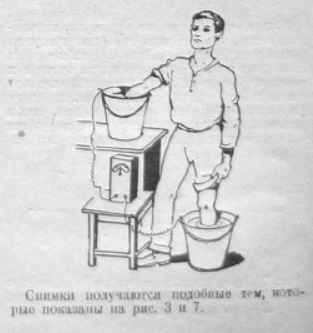
1957OctPS2This loop formed the primary winding of a room-sized audio transformer.  The secondary windings would be in the individual headsets.  For the kids, the magazine recommended the spaceman style shown here, with the assurance that the kids would love them.

As revealed by the diagram below, these headsets were simplicity itself.  The coil was worn around the head, and hooked directly to the headphones.  The magazine suggested that Mom should be put in charge of suitably decorating the loop with colored tape.  No other electronics were necessary for these headphones for the kids.  The output of the coil was sufficient to drive the headphones.

1957OctPSHeadset

Mom and Dad warranted somewhat more discrete looking receivers, and these could be either of the models shown below.  Mom had a version similar to the kids’ version, but the loop was not worn.  It was apparently thought that she could set it in a convenient spot, and it was hooked directly to a small earphone.  The magazine noted that the earphone was so small that it could hardly be seen.  The only problem that might result would be forgetting to take it off before going to bed!

1957OctPSReceivers

Dad is seen using a slightly more complicated version, but still easily within the capabilities of anyone able to wire up a lamp cord.  It used a much smaller coil, amplified with the venerable CK722 transistor.  It was the size of the proverbial pack of cigarettes, and the two penlight batteries would keep it running for a thousand hours.

Those wishing to duplicate this idea today can save a great deal of coil winding time by using a telephone pickup coil instead of winding the coils for the individual receivers.  If a set of high-impedance headphones is available, it could be fed without any electronics.  The CK722 is more or less unobtainium, except at very high prices.  But any small audio amplifier could be put into service.  If you want to make your own, hundreds of circuits are available using the readily available 2N2222 transistor.


Fahnestock Clips: 1947

1947OctRadioNewsFahnestock

It’s been 70 years, so perhaps they’re out of catalogs. But it won’t hurt to print the coupon, send it in, and see if they still have any.  This ad for Fahnestock clips appeared in Radio News in October 1947.

Just in case they’re out of catalogs, there’s no need to worry.  You can still get them at Amazon:


Florence “Dot” Cheers Dawson

1923AustraliaXtalSetShown here in 1923 is 17-year-old Florence “Dot” Cheers of Brunswick, Victoria, Australia, listening to a crystal set accompanied by her young sister Jean. The set had been constructed by their brother Ronald.

Smoky and Dot Dawson, 1952. Wikipedia photo.

Florence went on to become a radio announcer known as “Aunty June” on station 3KZ in the 1930’s and 40’s.  She married Smoky Dawson in the 1940’s, and the two achieved fame in country music in both Australia and the United States.  The video below is a performance by Smoky Dawson.

Smoky Dawson died in 2008, and Dot died in 2010 at the age of 104.

The public-domain photograph, donated by Dr. Christina Cheers, is in the collection of Museums Victoria.


1947 Radio Parts Sales

1942OctRadioNewsCoverShown here as it appeared 70 years ago is the sales room of Concord Radio Corporation in Chicago. The picture appeared on the cover of the October 1947 issue of Radio News, which notes that complete stocks of radio parts, well displayed, were the secrets of the distributor’s success.


Taking a Break With the Radio, 1943

1943BeverlyAnnGrimm

Shown here in 1943 is eleven-year-old Beverly Ann Grimm of Buffalo, New York, taking a break from sweeping to listen to the radio. Beverly was largely forced to take care of herself and her five younger brothers and sisters. Her  mother was widowed, and worked all week as a crane operator with Pratt and Letchworth.  The mother’s name isn’t shown on the photograph caption, but according to the 1940 census, she was Thelma Grimm, and in 1940 lived at 60 Newman Street, Lackawanna, New York.  According to the photo caption, Mrs. Grimm was 26 years old in 1943, but according to the census, she was 26 years old in 1940.

The photographer was Marjory Collins of the Farm Security Administration. The photo, taken here from Wikimedia, was digitized by Yale, and more information is available at this link.  In the photo below, Beverly is shown bringing home the groceries purchased from her mother’s list.

I’m not able to make out the brand of the radio, which makes identifying it difficult.  If anyone has any clues, please let me know!  You can also find more information about this family and some of the artifacts in the pictures at this link.

1943BeverlyAnnGrimm2