Category Archives: Radio history

Charles Atwater, 2JN

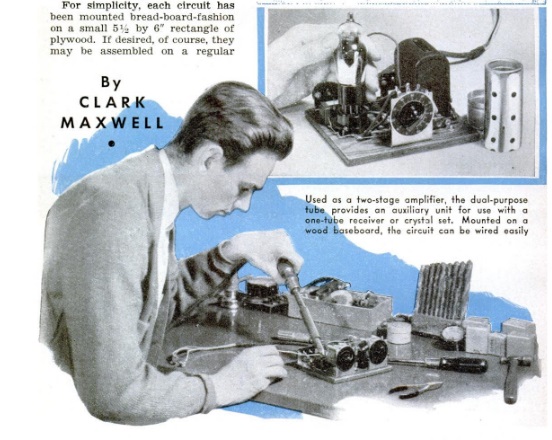
1928AugPSShown here in the August 1928 issue of Popular Science is Upper Montclair, NJ, ham Charles K. Atwater (no relation to Atwater Kent) with his 10 meter transmitter. According to the magazine, Atwater had added another triumph for the hams, namely use of the “remarkably low wave length of ten meters.” With his low powered transmitter, he established two-way contact with two stations on the Pacific coast, and had earlier made contact with Arachon, France.  The French contact was apparently with F8CT, as recounted on this page.

Atwater had been a ham for a while, since he was listed in the 1916 callbook and 1921 callbook with the call sign 2JN, with an address of 40 Oakwood Avenue, Upper Montclair, NJ.

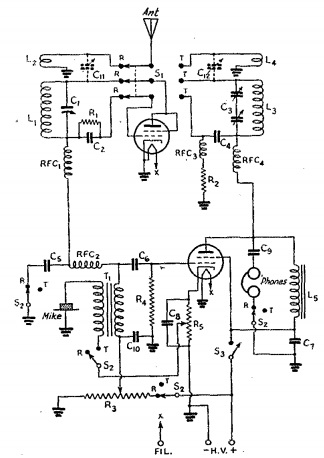
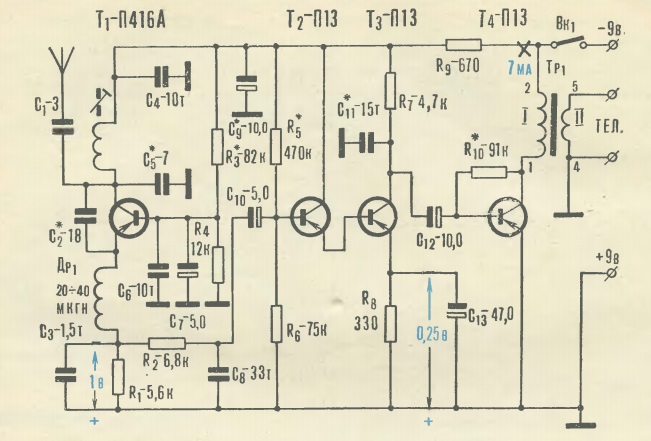
AtwaterQRPHe remained active, as shown by this one-transistor transmitter circuit he submitted (with his call now W2JN) in the December 1955 issue of QST.

According to QCWA, Atwater died in 1980.


1943 200,000 Volt Capacitor

1943Aug23BCThis a 2500 pF (2.5 nF) 200,000 volt capacitor, as shown 75 years ago today in the August 23, 1943, issue of Broadcasting.

The part was manufactured by Federal Telephone & Radio Corp., and the magazine notes that it was constructed without strategic aluminum. The twelve plates were hollow, 3-1/3 inches thick, made of 16 gauge sheet steel welded together at the sides.

According to the magazine, the part was used in the company’s high-powered transmitter laboratories as a “phantom antenna capacitor,” which presumably means that it was part of a very large dummy load.

The same picture also appears in the May 1944 issue of Popular Science,


Do Not Talk To Radio Operators: 1938

1938Aug22LifeThis sensible advice appeared in Life magazine 80 years ago today, August 22, 1938. If someone attempts to distract this Chicago air traffic controller by engaging in idle chit chat, he merely needs to point to the sign.


Dale Evans, 1938

1938AugRuralRadioShown here 80 years ago on the cover of the August 1938 issue of Rural Radio magazine is Dale Evans, relaxing during the dog days of summer. The magazine pointed out that for rural listeners, the clear channel stations promoted by the magazine were especially important. Summer time meant poor reception, and in most cases, that meant that rural listeners depended upon the signals provided by these “one way thoroughfares” of the airwaves.


1958 Soviet Kerosene Powered Radio

1958AugRadioNewsIn the late 1950s, the Soviets were the first to put Sputnik in orbit, and they were the first to put a dog in space. And they also led the Free World in another important area, namely, the kerosene powered radio, as shown here in this leaked photo from the August 1958 issue of Radio & TV News.

The set was designed for export to the Middle East, to allow listeners there to tune into Radio Moscow. The 7-tube set covered 175 kHz through 12.3 MHz in four bands, but it’s main feature was its ability to run off kerosene, thanks to a thermocouple and vibrator power supply. The thermocouple, heated by the kerosene lamp, put out 1.2 volts, which lit the filaments directly, and powered the vibrator supply putting out 90 volts. If normal A and B batteries were available, the set could also be run directly from them.

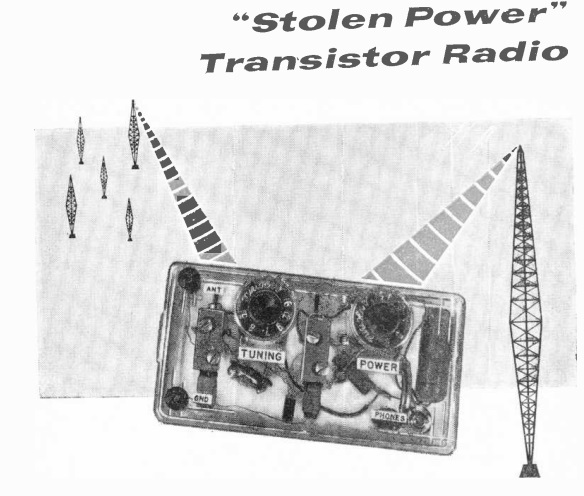
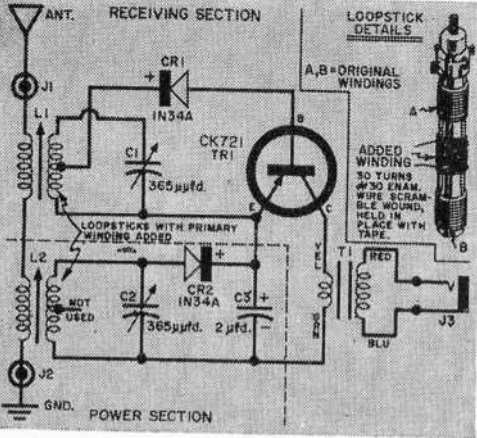
As with Sputnik, the West lagged behind. I recall the 1966 edition of the World Book Encyclopedia carried a “candle powered radio.” You can view the plans for that project at the Wayback machine..  It was a one-transistor set powered by the junction of two dissimilar metals heated by the candle. The American set would probably pull in one or two local stations with a headphone, but the Soviet model would have been able to pull in stations from around the world, with push-pull audio driving a powerful 5 inch speaker for room-filling volume.

The Soviet set was  said to be capable of 8-16 hours operation from a quart of fuel.


1958 Junk Box Special

1958ElecExpHdbkSixty years ago, the 1958 edition of the Electronic Experimenter’s Handbook, an annual put out by Popular Electronics, showed this simple circuit for a broadcast receiver from parts that were probably available in the junk box of any experimenter. Most of the set’s parts could probably be salvaged from a junked All American Five receiver, including two of the tubes. The 35W4 served as rectifier, and a 12AU7 or 12AT7 dual triode was the detector and audio amplifier.


1968 Radio Shack Battery Kit

1968AugRadioTVExpFifty years ago, the August 1968 issue of Radio-TV Experimenter showed this interesting offering from Radio Shack, a hobbyist kit for assembling two D-cell flashlight batteries.

By all appearances, the finished product is identical to the store’s pre-manufactured “heavy duty” carbon-zinc battery. The only difference is the price, as you apparently had to pay a small premium for the privilege of putting it together yourself:  The kit cost $1.25 for two batteries, but the manufactured article, as shown below in the 1968 Radio Shack catalog, were available four for 98 cents.

1968RScatalogbatteries

Despite the slight extra charge, there is something alluring about making a product at home that’s indistinguishable from the factory version (as is the case with this currently available AM-FM radio kit).  For students thinking about making a homemade battery today, see our earlier post about making a reasonably useful battery suitable for emergency use, or this hundred year old idea for making a homemade flashlight, battery and all.


1937 Zenith Robot Dial

1937AugRadioRetailing

In 1937, the Zenith Robot Dial was apparently a big deal, as evidenced by this photo in the August 1937 issue of Radio Retailing.

According to the caption, the display was in the window of Zenith Radio Distributing Corp. in Chicago, and the “ten-foot high dial tuned by a pretty girl stopped traffic.”


1938 Dayton, Ohio, Emergency School of the Air

1938Dec3RadioGuideThis teacher and students  are holding class in 1938 in the studios of WHIO, Dayton, Ohio, as shown in the December 3, 1938 issue of Radio Guide.

The teacher was apparently working without pay, but most of her colleagues weren’t quite so generous. The Dayton Board of Education “ran out of funds,” and the city’s 1300 teachers refused to continue without pay, leaving the 34,000 students without the possibility of public education. The station’s owner stepped in and volunteered the station’s facilities to cope with the emergency.

In cooperation with the superintendent, the station quickly revamped the station’s schedule to broadcast emergency lessons. Four periods of instruction were organized, supplemented by educational programs from the networks. As a result, students were able to spend a couple of hours per day receiving expert instruction. The Emergency School of the Air included classes in English, Biology, Chemistry, General Science, Physics, Vocational Guidance, Latin, French, Spanish, German, Bookkeeping, Geography, American History, Mathematics, Civics, Art, and Music.


1938 Pyro Pantagraph

1938AugRadioCraftThis ad for the Pyro Pantagraph appeared 80 years ago this month in the August 1938 issue of Radio Craft. For a mere $2.75, the enterprising young man or woman could go into business and “burn your way to extra dollars.” The burning tool was designed to burn designs onto leather, wood, cork, bakelite, or even gourds. The electric pencil plugged in to any 110 volt outlet, with “plug and cord furnished as part of equipment.”

Pantograph. Wikipedia animation.

But what made the set special was the pantograph, which allowed designs to be reproduced in the original size, enlarged, or reduced, as illustrated by the animation here.

As far as I know, the Pyro Pantagraph is no longer available, but inexpensive wood burning tools such as the one shown here are readily available, as is a pantograph such as this one.  Most modern pantographs appear to be made of plastic, so you’ll need to figure out a way to affix the burning tool.  And most of the negative Amazon reviews are fixated on the fact that the instructions are in Chinese.  But we’re confident that our readers are smart enough to figure these things out themselves, and have no need for the instructions.  You can still burn your way to extra dollars, or this could be the basis for a most interesting science fair project.