Category Archives: Radio history

Prison Radio, 1928

1928JulyRadioNews

Ninety years ago this month, Ohio State Penintentiary inmante number 52607, Ollie Meloay, penned this article for the July 1928 issue of Radio News detailing the role that radio played for the men serving time. Meloay estimated that there were between 900 and 1000 sets inside the walls, and speculated that there were probably more sets there than in any other equal area in the world.

Loudspeakers were not permitted, so all of the prisoners used headphones. Many cells contained two pairs of headphones to allow both cellmates to listen. The corridors of the cell block contained hundreds of aerials stretched from the cells to the opposite wall 25-30 feet away. Despite the relatively short antennas, the prisoners were able to pull in not only Ohio stations, but those from New York and Chicago. The author noted that many of the African-American men favored southern stations such as KWKH Shreveport.

The warden had no objection, noting that prisoners listening to the radio were unlikely to hatch escape plots or cause trouble. In fact, the harshest punishment the warden could threaten would be to take away a man’s radio.

Most of the sets were “home” made, constructed by the men themselves. The author (who identified himself as a bank robber doing a long sentence) was the owner of a one-tube set. The prison library contained many books on radio, and they were among the most popular.


Harry Hong Sling, Chicago, 1913

1913JulyPopElectricity1913JulyPopElectricity2Shown here in the July 1913 issue of Popular Electricity is Chicago amateur radio operator Harry Hong Sling, a fifteen year old Chinese-American. According to the magazine, he was probably the only wireless amateur to have a station in the Chicago “Loop”. The station shown here was on the fourth floor of the building where he lived, which was probably 324 South Clark Street. The magazine notes that the station’s helix, rotary spark gap, condenser, and telegraph key were constructed by Harry. The mast, shown here, was on the roof of the six story building and boasted a height of 80 feet. The magazine notes that the dome in the background is the Chicago post office.

Based upon this article, it appears that the station was located at 324 South Clark Street, where Harry’s father, Hong Sling, operated a successful grocery business, Sam Lung and Company. The elder Sling purportedly introduced Chop Suey to the Midwest. He was born in China in 1855 and came to the United States in 1875. He first worked for two years as a manual laborer in Wyoming and then moved to Utah where he was a labor contractor and railroad agent. His savings allowed him to invest in businesses in Hong Kong, the United States, Cuba, and Panama.  He moved to Chicago in 1892, and Harry was born on October 28,1898.

According to both the Popular Electricity article and the biography of his father, Harry attended the Jones Public School in Chicago through the eighth grade. Interestingly, after this picture was taken, Harry attended the Lane Technical High School on Chicago’s affluent North Side. The Lane School featured here previously, as the school where Elizabeth A. Bergner, 9DET,  taught radio in 1922.

The Popular Electricity article noted that Harry was to travel to China within a few months to “study the Chinese language and customs, for China is as strange to him as an American boy except as his father and mother have told him about the country by stories and pictures.”


RF Spectrum in 1928

1928JulyRadioBCHere’s a snapshot of what the radio frequency spectrum looked like 90 years ago, from the July 1928 issue of Radio Broadcast magazine.

The standard broadcast band was, at this time, recognizable as covering 550-1500 kHz. The long-time 600 meter marine calling frequency is shown as “aircraft and safety of life” assigned to 500-550 kHz. Other longwave allocations included naval, “transoceanic,” government, and marine.

The 160, 40, and 20 meter amateur bands are in the same places they are today, but with only 80 meters having its current boundaries. 160 meters covered 1500-2000 kHz, with 40 meters spanning 7-8 Mhz. The 20 meter band was a full two MHz wide, covering 14-16 MHz. The old 5 meter band is present at 56-64 MHz, which is a harmonic relationship with the other bands.

Three broadcasters are shown on the shortwave dial. KDKA and WLW had shortwave signals at 4760 and 5760 kHz, respectively. 2XAF (assigned before the international prefixes were adopted) was one of the GE transmitters at Schenectady, NY.


1948 One Tube Receiver

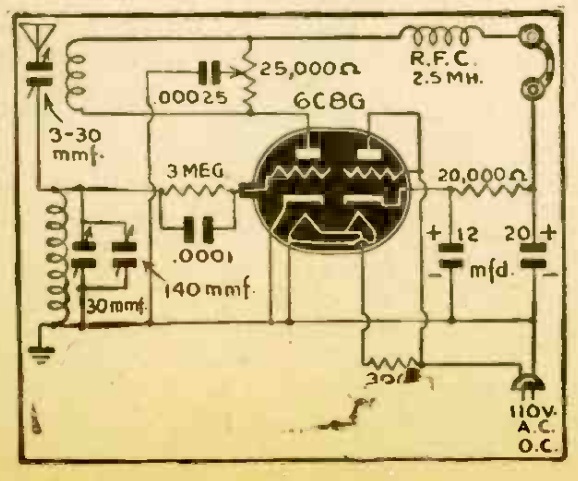
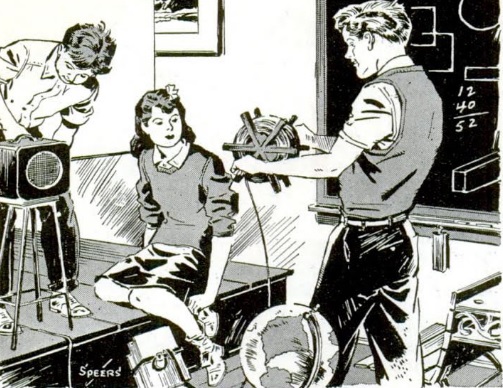
1948JulyPMThe young man shown here, presumably a student at a school that starts with N, has earned the respect of both his female and canine companions by putting together this simple one-tube receiver from the July 1948 issue of Popular Mechanics.

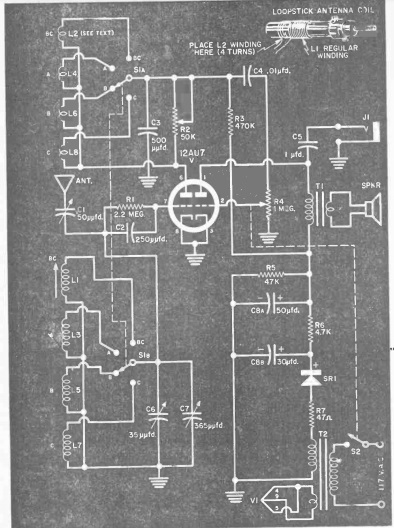
1948JulyPM1While everyone is impressed with the loudspeaker volume filling the room from strong local stations, he has a little secret.  The set was simplicity itself, since it’s really just a crystal set with a 117N7 audio amplifier driving the speaker.  Tuning is accomplished with a slider on the tuning coil within, and the detector is a 1N34 diode.

He put the handsome little set together in an evening, and he’s now pulling in the signals.

1948JulyPMschematic


WCCO Minneapolis, 1943

1943July5BCFor those of us who grew up in Minnesota, or ‘CCO Land, as it was called, an important winter morning ritual was tuning to WCCO to listen for school closing announcements. Thousands of schoolchildren would listen intently for their town to be named, perhaps for the announcement of “buses and school two hours late.” Of course, the grand prize was simply to hear the word “cancelled,” meaning that there would be a carefree day of play in the snow.

This was a longstanding tradition, as shown in this ad in the July 5, 1943, issue of Broadcasting.

In addition to the morning closing announcements, the station reminded advertisers that listeners throughout the state would stay tuned in, perhaps so that mothers could be told that children from a stalled bus were safe and warm at some wayside farmhouse.”

Can you spot the typo in this ad? It’s not a minor error. And yes, if you’re wondering, this ad was printed in 1943. If you find the typo, comment on our Facebook page.


1968 Stereo Headphones

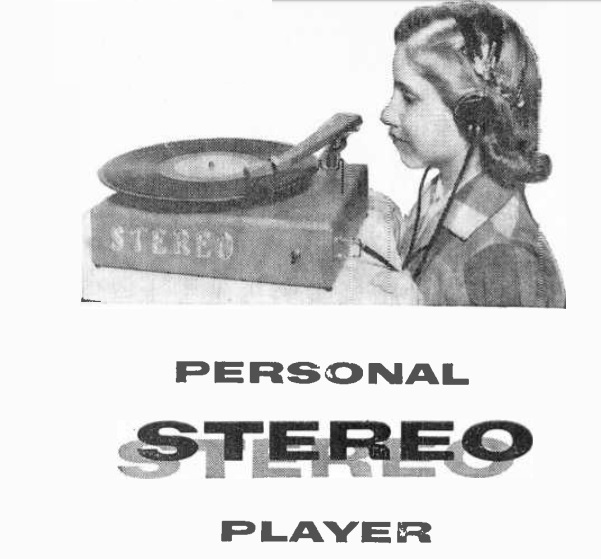
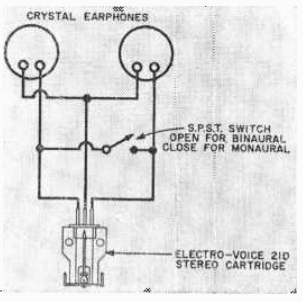
1968JulPEIf you need a pair of stereo headphones today, you can go down to the local dollar store and get a fairly decent pair. But fifty years ago, if you wanted to save a little money, you could make your own pair, as shown here in the July 1968 issue of Popular Electronics.

From the two pictures here, the construction details should be pretty obvious. Put the parts together, wire them up, put them on, and you have stereo headphones for what the magazine described as “99 cents per ear.”


1948 Five Tube Portable/Auto Radio

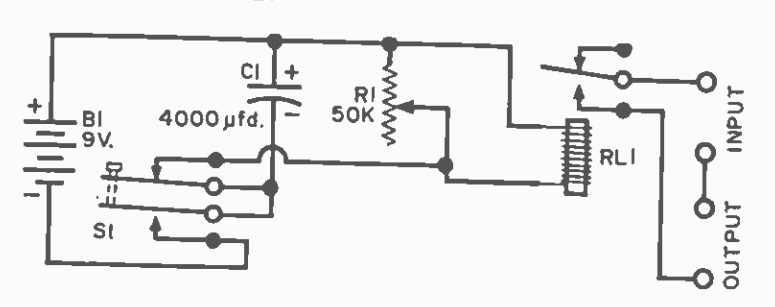
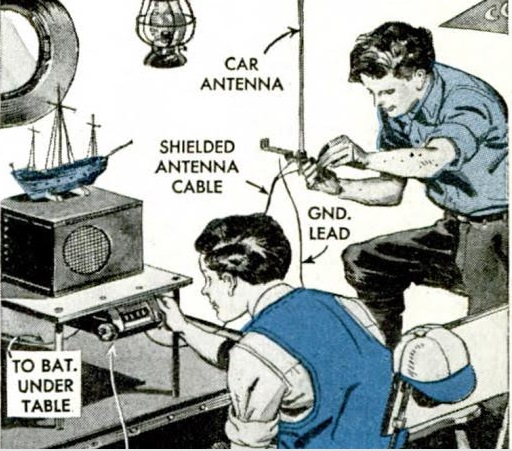
1948JulyPS11948JulyPS3Seventy years ago this month, the July 1948 issue of Popular Science carried the plans for this ambitious project, a five-tube set which could be used either as a portable with an internal 6-volt storage battery, or mounted under the dash, as a car radio. On the go, it would be powered by the car battery and hooked to an external antenna. But at the flip of a switch, it could be unplugged and operated on its internal battery. In either configuration, it had a vibrator power supply inside.

The internal battery could be charged from the car, or directly off AC 1948JulyPS2power. The AC charger consisted of only a selenium rectifier and a hefty “260 ohm 100 watt” resistor to drop the voltage.

The set featured one stage of RF amplification in front of the converter for added sensitivity. Both the battery and vibrator were military surplus for high quality at a low cost.

1948JulyPSschematic


1943 BBC Program Schedule

1943Jun30BBCFor a sampling of what could be heard on the shortwaves during World War II, here is the program schedule of the BBC’s shortwave signal 75 years ago today. This schedule is from the June 30, 1943, issue of the Ottawa Citizen.

For more information about the shortwave bands during the war:


Crosley Model 418 “Vanity,” 1938

1938JuneRadioTodayEighty years ago this month, the June 1938 issue of Radio Today carried this ad for the Crosley model 418 “Vanity,” a compact set featuring pushbutton tuning, retailing for $9.95.

The ad speaks of the brown plastic set in the most glowing of terms, but the electronics inside were very basic, although more than adequate for pulling in local stations. The set contained three tubes (plus a ballast) and was a TRF receiver with regenerative detector. More details can be found at this link.  The schematic seems to show a connection for an external antenna, which would probably prove helpful for all but the strongest stations.

For $12.95, a deluxe version was available, the main difference being that the more expensive set contained “four working tubes,” meaning that it apparently had an extra RF stage.

Either set could be placed with the buttons either at the top or the bottom. In either configuration, the ad noted, the set could also be used as a bookend.


1928 Two Tube All Wave Regen

1928JuneRadioBCNinety years ago this month, the June 1928 issue of Radio Broadcast magazine showed how to put together this all band two tube regenerative receiver, designed by Lieut. W.H. Wenstrom of the U.S. Army Signal Corps. The receiver was dubbed the Cornet after a Navy transmitter of the same name which was said to be simple, reliable, accessible, efficient, and flexible.

1928JuneRadioBC2With the use of plug-in coils, the receiver had a very broad tuning range, from 10 to approximately 2000 meters. One of the triodes was used as regenerative detector, with another serving as audio amplifier. Various tubes could be employed, although the 201-A seems to be the author’s choice.

The author acknowledged that pulling in the short waves probably wouldn’t replace standard broadcasting, since the signals were subject to severe fading. But there was a lot to listen to. KDKA and WGY both had shortwave signals carrying their standard program, and the set was able to pull in England, as well as the less powerful PCJJ in Eindhoven, Holland. Weather broadcasts could be heard from NAA in Washington, then transmitting on 24.9, 37.4, and 74.8 meters. The shortwave bands were also full of harmonics of standard broadcast stations, allowing distant signals to be heard.

Amateurs, especially those on expeditions to the Poles, were a good catch, as were transocean flights by both airplanes and dirigibles.

1928JuneRadioBCschematic