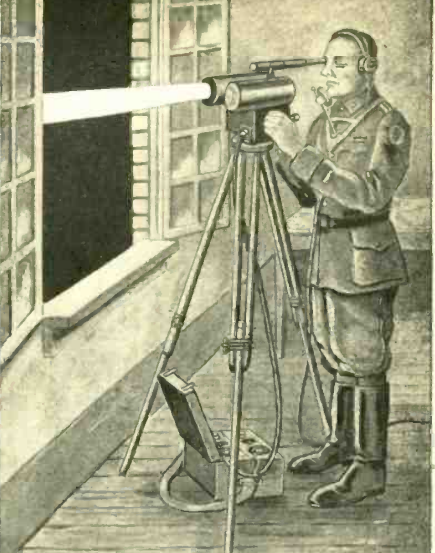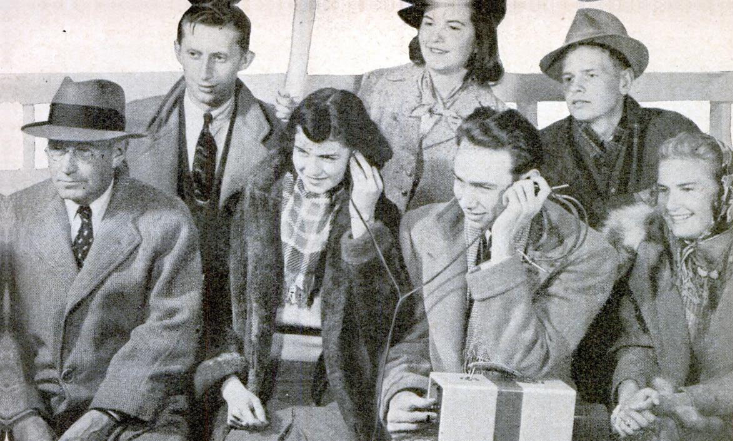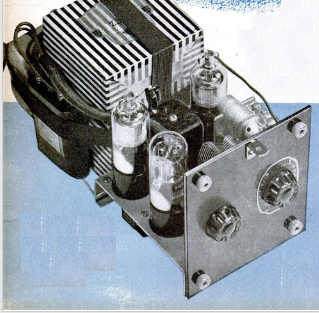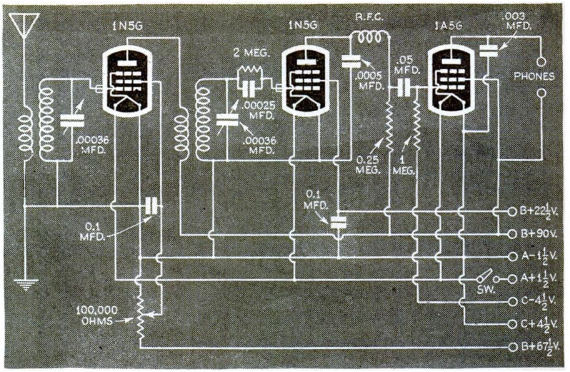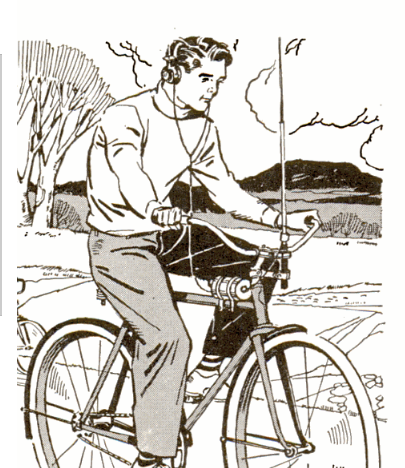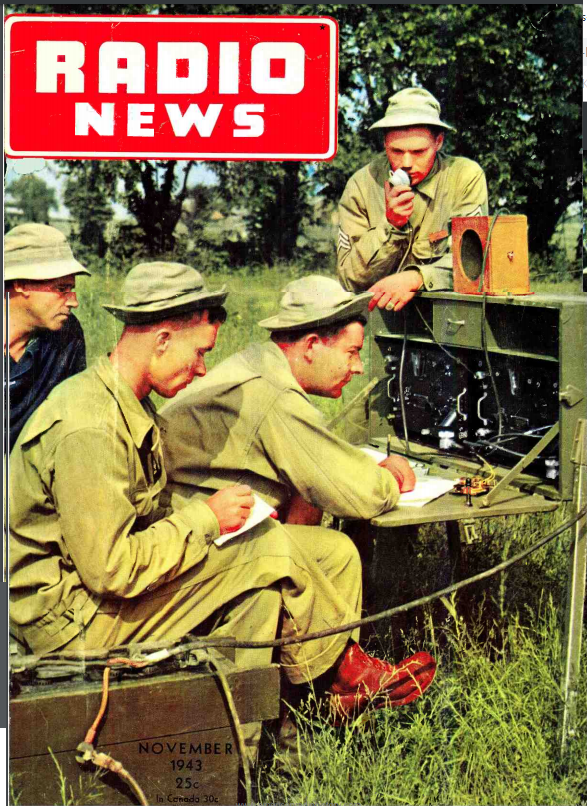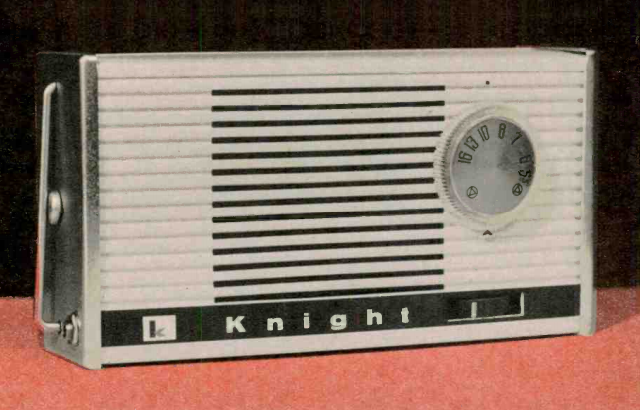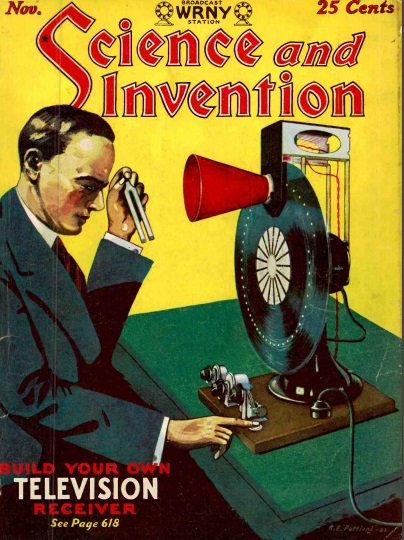
Eighty years ago this month, the cover of the August 1938 issue of Radio Retailing carried this reminder for servicemen that good reception begins with a good antenna.
This ad for WCCO Minneapolis appeared in Broadcasting magazine 75 years ago today, August 30, 1943. It reminded advertisers that the station’s 6-7 AM program, time on which could be booked at the early morning rate, was hosted by Lew Brock, who had a loyal following with the station’s loyal listeners.
According to the ad, former vaudeville star Brock emceed the “Sunrisers” program, which included an orchestra and other musical regulars.
Seventy years ago this month, the August 1948 issue of the Australian magazine Radio Science carried this circuit for a one-tube reflex receiver capable of driving a speaker. The circuit called for a 1C3GT tube, but noted that any one-volt tube could be used with an adjustment of the bias voltage.
Sixty years ago this month, before QRP was cool, the August 1958 issue of Popular Electronics carried the plans for this QRP transmitter for 15, 11, and 10 meters. The set was dubbed the Semiconductor Space Spanner. The two-transistor transmitter had an input power of 96 milliwatts. The author, Don Stoner, W6TNS reported contacts all over the continent and as far away as Hawaii. While some of those contacts were pre-arranged, many were the result of a normal CQ.
The cost of the parts was said to be $19, less crystal. A 40 meter crystal was used on 15 meters, although the circuit pulled the signal somewhat below the exact third harmonic.
The circuit used a 2N371 transistor as oscillator, feeding the 2N370 final amplifier.
If the author’s name looks familiar, readers will recall that he was the designer of an early CB rig which served as the prototype of the Heathkit CB-1 and “Benton Harbor Lunchbox” transceivers for 2, 6, and 10 meters.
Shown here in the August 1928 issue of Popular Science is Upper Montclair, NJ, ham Charles K. Atwater (no relation to Atwater Kent) with his 10 meter transmitter. According to the magazine, Atwater had added another triumph for the hams, namely use of the “remarkably low wave length of ten meters.” With his low powered transmitter, he established two-way contact with two stations on the Pacific coast, and had earlier made contact with Arachon, France. The French contact was apparently with F8CT, as recounted on this page.
Atwater had been a ham for a while, since he was listed in the 1916 callbook and 1921 callbook with the call sign 2JN, with an address of 40 Oakwood Avenue, Upper Montclair, NJ.
He remained active, as shown by this one-transistor transmitter circuit he submitted (with his call now W2JN) in the December 1955 issue of QST.
According to QCWA, Atwater died in 1980.
This a 2500 pF (2.5 nF) 200,000 volt capacitor, as shown 75 years ago today in the August 23, 1943, issue of Broadcasting.
The part was manufactured by Federal Telephone & Radio Corp., and the magazine notes that it was constructed without strategic aluminum. The twelve plates were hollow, 3-1/3 inches thick, made of 16 gauge sheet steel welded together at the sides.
According to the magazine, the part was used in the company’s high-powered transmitter laboratories as a “phantom antenna capacitor,” which presumably means that it was part of a very large dummy load.
The same picture also appears in the May 1944 issue of Popular Science,
This sensible advice appeared in Life magazine 80 years ago today, August 22, 1938. If someone attempts to distract this Chicago air traffic controller by engaging in idle chit chat, he merely needs to point to the sign.
Shown here 80 years ago on the cover of the August 1938 issue of Rural Radio magazine is Dale Evans, relaxing during the dog days of summer. The magazine pointed out that for rural listeners, the clear channel stations promoted by the magazine were especially important. Summer time meant poor reception, and in most cases, that meant that rural listeners depended upon the signals provided by these “one way thoroughfares” of the airwaves.
In the late 1950s, the Soviets were the first to put Sputnik in orbit, and they were the first to put a dog in space. And they also led the Free World in another important area, namely, the kerosene powered radio, as shown here in this leaked photo from the August 1958 issue of Radio & TV News.
The set was designed for export to the Middle East, to allow listeners there to tune into Radio Moscow. The 7-tube set covered 175 kHz through 12.3 MHz in four bands, but it’s main feature was its ability to run off kerosene, thanks to a thermocouple and vibrator power supply. The thermocouple, heated by the kerosene lamp, put out 1.2 volts, which lit the filaments directly, and powered the vibrator supply putting out 90 volts. If normal A and B batteries were available, the set could also be run directly from them.
As with Sputnik, the West lagged behind. I recall the 1966 edition of the World Book Encyclopedia carried a “candle powered radio.” You can view the plans for that project at the Wayback machine.. It was a one-transistor set powered by the junction of two dissimilar metals heated by the candle. The American set would probably pull in one or two local stations with a headphone, but the Soviet model would have been able to pull in stations from around the world, with push-pull audio driving a powerful 5 inch speaker for room-filling volume.
The Soviet set was said to be capable of 8-16 hours operation from a quart of fuel.
Sixty years ago, the 1958 edition of the Electronic Experimenter’s Handbook, an annual put out by Popular Electronics, showed this simple circuit for a broadcast receiver from parts that were probably available in the junk box of any experimenter. Most of the set’s parts could probably be salvaged from a junked All American Five receiver, including two of the tubes. The 35W4 served as rectifier, and a 12AU7 or 12AT7 dual triode was the detector and audio amplifier.