Category Archives: Emergency Preparedness

What To Do If Lost In The Woods At Night, 1946

Eveready1946

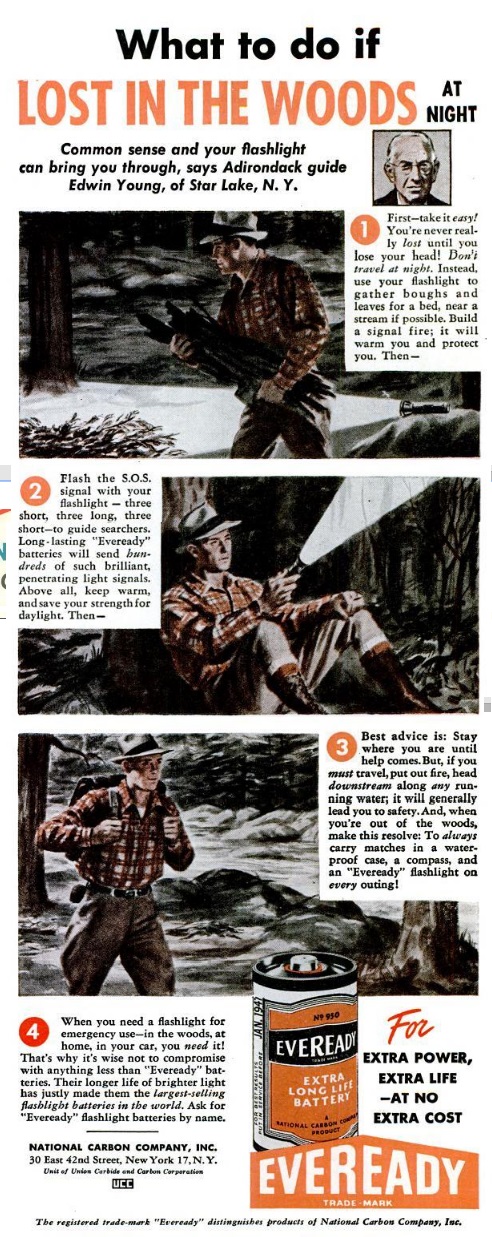
Seventy years ago, this day’s issue of Life Magazine, August 26, 1946, showed you exactly what to do if you were lost in the woods at night, courtesy of this advertisement by Eveready.

According to the ad, as long as you had common sense and an Eveready flashlight loaded with Eveready batteries, you would come through. The first piece of advice was that you’re never really lost until you lose your head. Therefore, the best course of action was not to travel at night. Instead, you should use your flashlight to gather boughs and leaves for a bed, and build a fire.

Once you made your primitive camp, the next course of action was to signal SOS with your flashlight–three short, three long, three short. This would guide searchers, especially if you had Eveready batteries, which would send hundreds of such brilliant penetrating light signals.

When morning came, the best bet was to stay put and wait for help to come. But if travel was necessary, you should douse your fire and follow any running water downstream.

In addition to the Eveready flashlight and batteries, the ad reminded that other survival necessities included matches in a waterproof case and a compass. These needs should be with you on every outing.

Click Here For Today’s Ripley’s Believe It Or Not Cartoon


Direction Finding With An AM Radio

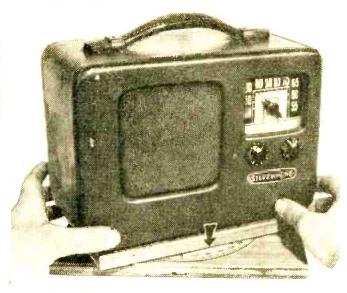
Portable radio mounted on base for direction finding.

Portable radio mounted on base for direction finding.

Sixty years ago this month, the July 1956 issue of Popular Electronics carried an excellent tutorial on how to use a portable AM radio for direction finding.

Most AM radios, both then and now, are very directional in that there is a “null,” or spot where the signal fades out, on each side of the built-in antenna.  You can demonstrate this by tuning to a relatively weak AM station and then slowly rotating the radio.  You will find that there are two spots, 180 degrees apart, where the station disappears or becomes very weak.  If the radio, like most portables, has an internal loopstick antenna, these are the points where the long narrow antenna is pointing directly at (or away from) the station.

You can use this principle to determine your location.  Even with a very cheap radio, you can usually establish your location with astonishing accuracy.

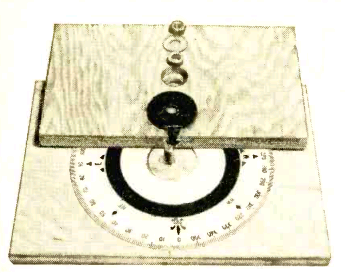
Detail of direction finding mount for portable radio.

Detail of direction finding mount for portable radio.

The Popular Electronics article shows how to construct a rotating mount for your radio.  You strap the radio in place, turn it for the minimum signal, and the pointer on the mount shows the bearing to or from the station in degrees.  For example, if the station’s null is at 45 degrees, then you can draw a line on a map over the station with that same angle from north.  In other words, in this example, running NE-SW.  Your current location is somewhere along that line.

By repeating this process with a second radio station, you will have two lines drawn on the map.  The point at which the two lines intersect is your current location, sometimes to astounding accuracy.

The mount shown in Popular Electronics is for a more or less permanent installation in a boat.  But this is not necessary.  In most portable radios, the antenna is mounted parallel with the outside case, usually with the longest side.  Therefore, it is possible simply to use the radio itself as a straightedge:  Align the map with the Earth, in other words, place the top of the map toward the north.  Then, rotate the radio so that the signal disappears.  With the radio at the same angle, place one edge over the station’s location and draw a straight line on the map.  Your location is somewhere along this line.

Then, repeat the process with a second station.  The point where the two lines come together is your location.  To confirm your location, you can repeat the process with a third station.  If the three lines come together very close to the same point, then you can be quite certain that the location was accurate.  If one of the lines doesn’t seem to agree, then you can repeat the process with a fourth station, and ignore the reading that doesn’t seem to match the others.

With a bit of practice, you can find your location very accurately.  In an urban area, by using 3 or 4 local stations, I have identified my location within a hundred yards or so.  In a rural area, where the stations might be further away, the accuracy will not be quite as great, but you should be able to locate yourself within a fraction of a mile.

The Popular Electronics article contains instructions on disabling the receiver’s automatic volume control (AVC), because in the case of a strong station, the radio might keep playing at full volume even with the station nulled out.  However, it is not necessary to modify the radio.  Most stations, unless they are very strong, will show a null even with the AVC functioning.  And for those stronger stations, you can compensate by tuning the radio slightly off frequency.  For example, if the station you are trying to locate is at 800 and you can’t get a null, you can reduce the signal strength simply by tuning to 810.  You’ll still hear the station with the radio properly oriented, but the signal will be weak enough that you will be able to detect the null.

Of course, for this method to work, you need to know the exact transmitter location of the radio stations you plan to use.  These often differ from the location of the station’s studio and office.  In some cases, they are many miles from the station’s city of license.

Fortunately, in the United States, this information is easy to obtain from the FCC website.  You can search for a particular station, for all stations within a state, or all stations within a certain radius of a given location.  When you click on the station’s call letters, you will be given the exact latitude and longitude of the transmitter.  (Transmitter locations of most AM stations are also shown on aeronautical charts, since pilots still use this method of direction finding.)

Direction finding, even with a very cheap AM radio, can give amazingly accurate results.  It is certainly not as convenient as other methods, such as GPS.  But in an emergency, it should not be overlooked as a backup method to determine your location.  It requires very little equipment (just a radio, map, and pencil).  It also requires a bit of practice beforehand, since you need to learn the characteristics of the radio you will use.  And it requires knowledge of the location of some local transmitters.  But if you can locate those transmitters on your map, you can also locate yourself.

As I mentioned, I’ve been able to determine my own location within a hundred yards by knowing the exact locations of local radio stations.  But even without an exact knowledge of their location, I was able to locate myself, at night, within about 30 miles, simply by using the approximate location of strong distant stations.  For example, I know that WBBM’s transmitter is in or near Chicago.  I know that WSM’s transmitter is in or near Nashville.  I know that CFZM’s transmitter is in or near Toronto.  Even though I did not know the exact locations of these transmitters, when I used this method at night, I was able to locate myself within about 30 miles.  There’s probably little practical application for doing it this way, since it’s unlikely that someone would find themselves not knowing what state they are in.  (However, it should be noted that before the invention of accurate chronometers, most mariners wouldn’t know their location that accurately.)  But it is still rewarding to know that you can determine your location on Earth with such primitive equipment.

Click Here For Today’s Ripley’s Believe It Or Not Cartoon


Product Review: Wise Food Storage “Savory Stroganoff”

One of this site’s advertisers is Wise Food Storage, who recently sent me a free sample to review.  The company supplies dehydrated food for emergency food storage, camping, and backpacking.  On their website, they sell mostly packages consisting of assortments of food, such as the package shown below, which is billed as providing enough food for two people for 72 hours:

72 Hour Kit for 2 PeopleTHe sample I was sent was a single meal, namely their “Savory Stoganoff.”

I was initially a bit skeptical, since my experience has been that most suppliers of “survival” food seem to charge a considerably higher price than one would pay for comparable items at the supermarket.  In many cases, they hide the higher price by making inflated claims as to how long the product will last.  For example, some companies offer a “30 day supply” of food, but if you look carefully, you realize that you would be eating starvation rations for those thirty days.

It was refreshing to see that Wise doesn’t follow this same practice, and the claims on their website are reasonable.  A normal diet consists of about 2000 calories per day.  You can certainly survive on less, but if you want to replicate a normal diet as much as possible during an emergency, you should plan on having about that many calories per day per person.  And Wise seems to use honest figures on their website.   For example, the 72 Hour Kit for 2 People shown above supplies over 13,000 calories, which is indeed enough to feed two people for three days, with their normal caloric intake.  In fact, with a bit of scrimping, it would probably last even longer than advertised.  It is refreshing to see a company that didn’t fall into the trap of making exaggerated claims.  As you shop around, you might see lower prices.  But before you buy, make sure you’re really getting the number of days’ supply that the company is claiming.  In Wise’s case, you are.  In the case of some other suppliers, you are not.

I’m not normally a fan of “kits” for food storage.  From a price point of view, you’re probably better off buying normal food from the supermarket.  You’ll know that they are items you like to eat, the cost will be lower, and the supermarket has many items that can be stored for a long period of time, especially if you rotate them into your family’s normal diet.  On my food storage basics page, I have ideas for emergency food storage using items available at any supermarket.

On the other hand, there is something to be said for buying a well thought out “kit.”  You know that everything is optimized for long-term storage and minimal preparation.  And there’s something reassuring about looking at a single container and knowing that it will give you enough food to eat for X days.  I wouldn’t recommend a kit as your family’s sole source of emergency food, but they do have their place.  In addition to Wise’s 72 Hour Kit, they have a variety of other similar assortments. such as a 1 Month Emergency Food Supply for 1 Person – 56 Servings and a 2 Week supply geared for backpackers.  Again, you can probably put similar kits together yourself at a somewhat lower price, but for some people, the convenience is worth it.

Package of Savory Stroganoff being reviewed.

Package of Savory Stroganoff being reviewed.

Wise’s website doesn’t seem to sell individual meals, but they are available from WalMart.  For example, you can purchase a single package of the “Savory Stroganoff” reviewed here.  The price is quite reasonable, and you can order online and have it delivered to a local WalMart, so there is no shipping cost.

The Savory Stroganoff I reviewed exceeded my expectations.  I wouldn’t describe it as a gourmet meal, but it was reasonably good tasting, easy to prepare, and would be quite adequate during an emergency or while camping.  The nine-ounce package was billed as having a storage life of 25 years.  It was packaged in a heavy plastic pouch with an oxygen absorber inside (and I’ll say more about the oxygen absorber in a moment).  According to the nutrition facts, the package supplies four servings of 250 calories each.  In other words, the one package contains a thousand calories, or about half of one person’s caloric needs for the day.  We did feed four people lunch using the one pouch, and the meal was filling.  Each serving contains 45 grams of carbohydrates, 4.5 grams of fat, and 7 grams of protein, so it’s a reasonably well balanced meal by itself.  The vitamin content is relatively low, supplying 0% of the daily requirement of vitamin A, 2% of the daily requirement of vitamin C, 8% of the calcium, and 8% of the iron.  During a short-term emergency, vitamin deficiency isn’t an issue, but those planning for a longer-term emergency would be well advised to include some multivitamin tablets if relying on this kind of storage food.

The main ingredient is the pasta, along with nondairy creamer and textured vegetable protein.  You can view the full list of ingredients and nutrition facts at the WalMart website.

Preparation was very straightforward, and we followed the instructions on the package exactly.  You start by boiling four cups of water, turning off the heat, and then adding the contents of the package to the boiling water.  We used the stove, but the water could be boiled by any emergency heat source.  Since the only actual cooking is the boiling of the water, there’s really nothing that can go wrong.  You simply cover the pot and wait 12-15 minutes.

The glitch in the instructions was that it didn’t mention the oxygen absorber inside, so we wound up pouring it into the boiling water, where we had to fish it out.  But other than this oversight, the instructions were self-explanatory.

After 15 minutes, you remove the cover, and let it stand for another 2-3 minutes.  We used a normal kitchen pan, but any container with a lid could be used.  In an emergency, to minimize the amount of cleanup, I would boil the water in one container, and then “cook” the food in some kind of disposable container.

The completed Stroganoff.

The completed Stroganoff.

The finished product didn’t look particularly appealing.  Perhaps it would have looked better if we had let it sit a while longer, but it was rather watery.  It looked more like a thick soup than Stroganoff.  It was best served in a cup or bowl and eaten with a spoon.

However, it tasted quite good, and neither my wife and I nor our kids had any complaints.  It did not have the “dehydrated” taste that I feared it would have.  It tasted like noodles and sauce.  There was a bit of seasoning–I noticed that the ingredients included dried onions.  However, it was rather bland, and adding a little bit of salt and pepper improved it considerably.  My daughter added a little bit of Knorr chicken bouillon, and she reported that this made it taste quite good.  So my main advice if you’re going to rely on prepackaged items like this, it would be a good idea to also include familiar seasonings.

In summary, the stroganoff tasted better than I expected without a “freeze dried” taste, and was more reasonably priced than I expected.  It’s more expensive than comparable supermarket items, but much less expensive than comparable items billed as “survival” or “backpacking” food.  I probably won’t order one of Wise’s food “kits,” but I’ll probably purchase a few packages of the stroganoff and other meals to keep in the camper, or just to keep in the house for times when a relatively quick meal is needed.

Full Disclosure:  The product reviewed was supplied to me free of charge by Wise Compnay, one of this website’s advertisers, in exchange for an honest review.  All product links on this page are affiliate links, meaning that if you click on the links and purchase the product, I will receive an advertising fee.

Click Here For Today’s Ripley’s Believe It Or Not Cartoon


Free Shipping on all Wise Food Storage Products!


Piezoelectrics For Your Time Travel and Post-Apocalyptic Needs

Completed piezoelectric speaker from 1968 article.

Completed piezoelectric speaker from 1968 article.

A few weeks ago, I wrote about some plans for homemade microphones from 1945. One was very crude but easy to duplicate. But one was quite sophisticated, and could be made at home by growing a piezoelectric crystal from a saturated solution of Rochelle Salt.

The piezoelectric microphone is particularly intriguing because it should function equally well as a piezoelectric speaker.  For this reason, it has an interesting application, albeit perhaps not one that is immediately practical.

Being Prepared for Inadvertent Time Travel

The knowledge of how to build such a speaker could come in handy in a couple of situations, at least one of which is probably unlikely.  The first situation would be that of inadvertent time travel.  If you get caught in a time warp and sent to the past, it would be wise if you could make the best of a bad situation and be able to “invent” some technological devices.  (And as I’ve previously written, having a WikiReader in your pocket would make the situation much more bearable.)  And as a loyal reader of this blog, it stands to reason that one of the technologies that you could “invent” would be radio.


While there are no documented cases of this ever happening, the science fiction literature is full of examples.  Probably the oldest example is Mark Twain‘s A Connecticut Yankee in King Arthur’s Court.  Other examples include 1632 by Eric Flint and the Island in the Sea of Time series by S.M. Stirling.

Cobbling together a transmitter would be relatively easy, as long as the time period into which you were deposited had some rudimentary industries.  You’ll need some wire for winding coils and putting up an antenna, some metal for building capacitors and a spark gap, some acid for making batteries, and a few other bits and pieces that should be readily available in the Middle Ages.  With a bit of ingenuity, you should be able to come up with a transmitter with a range of hundreds of miles.

And with the exception of one component, a suitable receiver would be relatively easy to make.  Once again, you’ll need some wire for the coil and antenna, a few pieces of metal for fabricating other parts, and something to serve as a detector.  The detector would be quite simple.  The most common material, which would give good results, would be a chunk of Galena (lead ore).  If you find yourself in an area where this mineral is unavailable, there are many substitutes, as discussed in my earlier posts (this one and this one) about “foxhole radios” or my earlier post about emergency wartime crystal sets.

The one part, however, that will be difficult to procure is a suitable earphone.  If you’re lucky enough to be transported back in time after the invention of the telephone, then your problem is partially solved.  A telephone receiver will have an impedance that is too low for your receiver, but by rewinding the coil, you should be able to come up with a suitable headphone.  If the telephone hasn’t been invented yet, you can of course take the honors and invent it.  But if you want to jump ahead to radio technology, you’ll need to fabricate a suitable headphone to hook up to your radio.

This brings us back to the piezoelectric microphone we discussed earlier.   This type of microphone works equally well in either direction:  It can change electrical impulses to sound, as well as working the other way around and changing sound into electrical impulses.  Therefore, if you build a piezoelectric microphone, you can hook it up to your crystal set and listen to that transmitter you put on the air.

As discussed in my earlier post, the piezoelectric microphone/headphone should be relatively straightforward.  All you need, in addition to the scraps of metal you already procured, is a piezoelectric crystal.  And the article linked there gives you the basics of growing one.  In addition to water, all you will need is Rochelle Salt, also known as potassium sodium tartrate tetrahydrate.  This compound was first prepared in 1675 by Pierre Seignette. So if your time travel lands you after that date, you should be able to procure it. Of if it’s about 1675 and you’re anywhere near La Rochelle, France, you would be advised to look up Monsieur Seignette and collaborate with him on the project.

If you arrive before 1675, all hope is not lost. According to this site, you can whip up a batch using the ingredients cream of tartar and washing soda.  Cream of tartar is a byproduct of the wine making process, so it should be available at any time after the invention of wine, which dates back to antiquity.  So as long as those ingredients are available, you should be able to recreate radio.

An alternative method of building the headphone is described in the book The Voice of the Crystal by H. Peter Friedrichs.  This is a magnetic headphone which would require a very fine gauge of insulated wire, but a good jeweler of almost any era should be able to help you procure the components.

Rebuilding Civilization After a Collapse

The other time one would need to recreate radio technology would be after a collapse of society.  There are billions of radios in existence, any many more component parts, so it is very unlikely that you would need to start from scratch.  Even after hundreds of years of dark ages, many relics of our current technological society would still be available to provide usable parts.  This scenario is discussed in detail in the book The Knowledge: How to Rebuild Civilization in the Aftermath of a Cataclysm by Lewis Dartnell, which I previously reviewed.

The most abundant source of headphones for your post-apocalyptic crystal set would probably be the microphones from the billions of cell phones currently in existence.  In most cases, these are probably piezoelectric, and would work well for a crystal set headphone.  (The billions of stereo headphones and earbuds probably wouldn’t be of much use, since they are too low an impedance to work properly with a crystal set.)

Science Fair Project

Even if you don’t anticipate time travel or TEOTWAWKI (The End Of the World As We Know It), a homemade speaker or microphone could be part of a most impressive science fair project.  Even very young students could fabricate the simple three-nail microphone shown in my earlier post.  And more advanced students will be capable of making speakers or microphones that rival commercially available ones.

A More Refined Version of the Piezoelectric Speaker

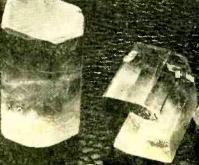
Near perfect crystals from 1968 article.

Near perfect crystals from 1968 article.

The 1945 piezoelectric microphone linked in my original post is probably suitable for all of your time travel or post-apocalyptic needs.  However, a more refined version, shown at the top of this page, is from the May-June 1968 issue of Elementary Electronics.  While the 1945 article probably gives enough detail for the experimenter to grow a crystal and put it to work, the 1968 article goes into much greater detail.  It gives detailed instructions on growing the crystal, and the completed crystals, shown here, turn out nearly perfect.  In particular, the 1968 article gives detailed instructions on starting with a seed crystal and maintaining the temperature of the saturated solution as the crystals form.  While the 1945 article would probably result in a usable crystal looking like a piece of rock candy, the details in the later article result in a crystal that can be further ground to dimensions that would make it quite sensitive.

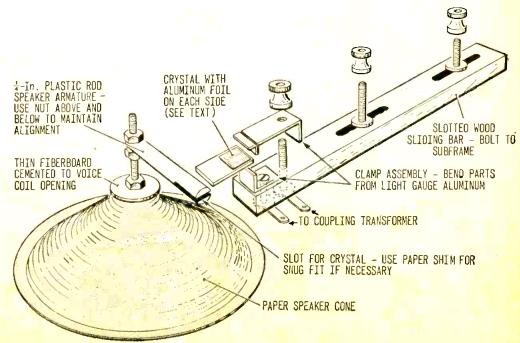
Construction details of 1968 piezoelectric speaker.

Construction details of 1968 piezoelectric speaker.

The construction details of the final speaker are shown above.  The crystal is ground and polished to about 1/16 inch in thickness, and then sandwiched between two pieces of aluminum foil.  (If your time travels take you to a time when aluminum was still considered a precious metal, substitution of other metal shouldn’t present a problem.)  A current applied to the two pieces of foil causes the crystal to vibrate.  The author of the 1968 article used the cone of a defunct 12 inch radio speaker, which could be replaced by some other type of cone.  For use with a crystal set, the large cone might prove a detriment, since the crystal set might not be putting out enough audio to set it into vibration.  Constructing some sort of headphone would probably be more suitable for a crystal set.

The photo above shows a matching transformer, but this would not be necessary for use with a crystal set.  The example shown in the 1968 article was designed to replace a standard low-impedance permanent magnet speaker.  The high impedance of the piezoelectric speaker would be perfectly suited to the output of a crystal set.

For even more details on growing crystals, the author of the 1968 article recommends the book Crystals and Crystal Growing by by Alan Holden and Phylis Morrison, which is still available and in print.  And if you’re just looking to make a crystal set and want to buy a piezoelectric earphone (or other needed parts), you can find them on my crystal set parts page.


Click Here For Today’s Ripley’s Believe It Or Not Cartoon


How To Get Yourself Down From a Cliff

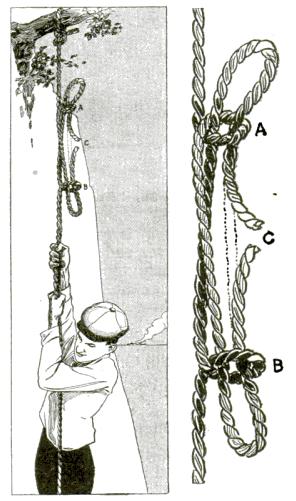
1915SheepshankIf you ever find yourself stranded on a high spot with a rope, you’ll appreciate this trick. Of course, you know that you can tie the rope to something sturdy and then climb down. You probably assumed that you would need to abandon the rope.

But thanks to this trick which appeared in Popular Mechanics a century ago, November 1915, you can now retrieve most of the rope.  The trick is to tie a sheepshank knot, which is normally used to temporarily shorten a rope.  First, you secure the rope.  You then tie the sheepshank close to the top.  You will notice that at point C, the rope is not supporting any part of your weight, so you cut the rope at this point.  Then, being careful to maintain tension on the rope, you descend.  After you’re safely on terra firma, you simply give the rope a shake, and most of it falls down beside you.  You’re on your way, and you have all but a small piece of your rope.

Click Here For Today’s Ripley’s Believe It Or Not Cartoon


Science Fair Ideas: Homemade Batteries from 1965

HomemadeBattery3

When the aspiring young mad scientist is looking for ideas for the science fair, someone invariably suggests making a homemade battery. Making a battery is a fairly simple proposition. All you need are two dissimilar metals and an electrolyte. A common choice for electrolyte is a mild acid such as lemon juice, and copper and zinc make good dissimilar metals. No matter how badly you construct the thing, a little bit of electrical current is bound to flow, and you can probably coax a little bit of light out of a light-emitting diode (LED) or even power a small electronic device such as a digital clock.

A good choice for the kids who aren’t as smart as you are.

In fact, for students with limited scientific abilities, you can just go out and buy yourself a Potato Clock kit. You simply open the box and jab the electrodes into a potato, and the potato juice serves as the electrolyte. It’s completely safe, since I can hardly think of any chemical more benign than potato juice. If you drop the potato on the floor, you don’t need to bother calling the haz mat team. And unless you screw up horribly, the clock will instantly come to life. There’s nothing wrong with the humble potato clock, but if you’re reading this looking for ideas, you probably want to come up with something a bit more spectacular. And while you’re at it, you probably want to use chemicals slightly more dangerous than potato juice.

So you might want to go back in history a bit when adults weren’t quite so concerned with hazardous chemicals, and use something slightly more powerful in making your battery. You can go back in time fifty years, when adults let their responsible children play around with slightly more dangerous chemicals such as household bleach, often referred to by its most popular brand name, Clorox. Not only will you have more fun, but you’ll wind up with a much more powerful battery, suitable for powering much bigger electronic devices.

For details on how to put the battery together, you can go to page 98 the Fall 1965 issue of Elementary Electronics.  That article describes two batteries that you can make at home, both of which are hundreds of times more powerful than the one running that other kid’s potato clock.

Warning:  Bleach really is a dangerous chemical.  You need to be careful with it, and keep it out of the reach of children who are not as smart as you are.  If you get any on your clothes, your mom will be mad.  If you get any in your eyes, you’re facing a major medical emergency.  Your mom is probably right when she tells you, “you can put an eye out with that.”  Ask your parents and/or teacher for permission.  If they balk at the idea, ask them to read the article about how to make the battery.  To show how responsible you are, show them that you read the Material Safety Data Sheet (MSDS).

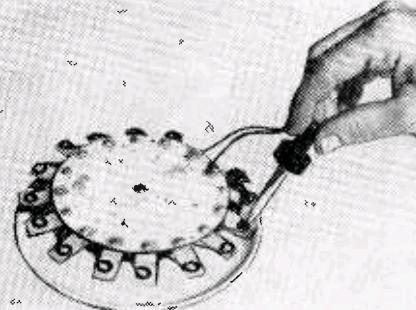
Homemade battery using drops of bleach.

Battery using drops of bleach.

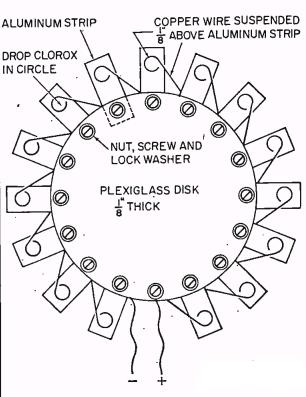
The article shows how to make two batteries.  The first one, while much more powerful than the potato, is “more of a novelty than a practical device.”  It is shown here, and consists of fifteen sets of aluminum strips and copper wires. The metallic pieces are arranged in a circle around a piece of Plexiglas. The copper and aluminum are close together, but not touching.  When ready for use, a drop of bleach is placed on each one.  When the last drop of bleach is added, the connected radio or other device springs to life.  If measured with a voltmeter, the complete battery will put out about 15 volts.  However, this drops when there’s an actual load, and 15 cells is about right to power a radio that normally calls for 9 volts.

Unlike the potato battery, this one will run a radio for several minutes.  But the article concedes that it’s more of a novelty.  Therefore, the article goes on to describe another more powerful battery.  The bigger one is even suitable for use around the house in case of a power outage.  If the power is out and you’ve used up the last battery, there’s probably still a bottle of bleach down in the laundry room, good for hundreds of homemade batteries.

HomemadeBattery2

Homemade battery using ice cube tray.

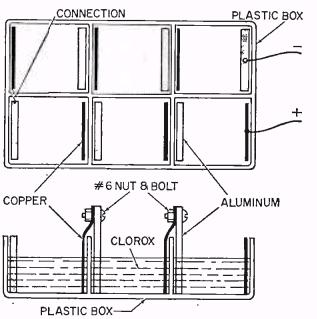
The larger battery is constructed in a plastic ice cube tray.  You use six of the individual compartments, so you can cut the ice cube tray in half and make two batteries.  Each compartment of the tray contains one piece of aluminum and one piece of copper.  You simply fill each compartment with bleach, and you have enough power to run a radio for several hours.  When the battery finally goes dead, you pour out the old bleach and replace it.  You can re-use the battery hundreds of times before the aluminum finally gets worn away completely.

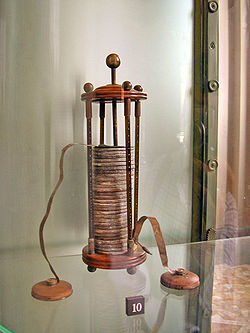
Voltaic pile similar to the 1799 version. Wikipedia photo.

With either battery, you have essentially recreated the work of Allesandro Volta, who invented the Voltaic pile in 1799.  He was eventually able to build a battery large enough to administer an uncomfortable electric shock.  Until the electric generator came along in the 1870’s, anything that required electricity (such as the telegraph or telephone) was powered by batteries similar to those created by Volta.

Armed with this fifty year old article, a bottle of bleach, and a few pieces of scrap metal, you can now make your own Voltaic pile.  You’ll get to use dangerous chemicals.  You can generate significant amounts of electrical power.  Perhaps you can even administer uncomfortable electric shocks to your friends, teachers, and parents.

You’ll have the most interesting project at the science fair.  And the kid who goes home with a participation ribbon for his potato clock is going to be pissed.

Check out my other science fair ideas, some of which are slightly dangerous.

Click Here For Today’s Ripley’s Believe It Or Not Cartoon


Emergency Water Storage in Your Bathtub


Quick Links:


If you have advance warning of a hurricane or other emergency situation, it’s a good preparation to use your bathtub to store emergency water.  Even if you take no steps to sanitize the tub, simply filling it with water is a good idea, since you can use the water for many purposes, such as cleaning. However, unless you clean the tub thoroughly before filling it, you probably don’t want to actually drink the water from the bathtub. Also, the tub is uncovered, so the water can be contaminated. Finally, there’s the possibility that some of the water will leak down the drain. The plug is designed to hold the water long enough to take a bath. If it leaks even a tiny amount, the water could be gone in a few days when you need it.

The products shown here are designed to solve those problems, and they do. For some people, having one of these on hand could be cheap insurance. If you live in hurricane country, you should consider the problem, and having one of these might be part of the solution.

The products shown below are normally available on Amazon.   The first is the AquaPod, and the second is the WaterBob.  However, at the first hint of a hurricane approaching the U.S., they quickly sell out.  If you’re reading this before hurricane season, then it’s a good idea to order now if you think you will need one of these.  If you need a water storage solution and it’s too late to order, continue reading, since this page shows many alternatives.

For a less expensive alternative, see our later post about disposable bathtub liners such as the ones shown here:

Essentially, each of these products is the same: A large plastic bag, made of food-grade plastic, that fits inside your bathtub. The bag itself would burst under the weight of the water, but cradled by the bathtub (which was designed to hold water in the first place), the bag serves simply to keep the water sealed up safely. It also prevents the water from leaking in case the tub’s drain doesn’t have a perfect seal.

Each of these comes with a spout to fill the bag from the tub’s normal faucet. To get the water out, each of them comes with a hand pump to transfer the water to more convenient containers. So overall, each of these products is a good idea, since it gives you a convenient way to store between 65 and 100 gallons of drinking water. For some people, having one of these could be a good solution.

There are a couple of downsides, however, that you should consider. First of all, all of these are really only good for a single use. There’s no way to completely empty it. So once you’ve used it, you need to dispose of it. For that same reason, there’s really no way to test it. I’ve never heard of one of these having a leak. They appear to be well made, and it’s very likely that they will serve the intended purpose. But if it proves to be defective, there’s no way for you to know until the hurricane is bearing down, at which time it’s probably too late to get a replacement.

In addition, there is the matter of cost. While the prices are very reasonable, it’s still something that you hope you never need to use. And it’s possible that you’re reading this hours before a hurricane is expected to strike your area. If you don’t have one of these stored away, it’s probably too late to get one. So it’s important to think about alternatives.


Other Water Storage Alternatives

Obviously, clean water is one of your most critical needs during an emergency. Many emergencies could cut off your supply of tap water.  These could be a local  water line break, a hurricane, a winter storm or blizzaard, or many others.  If one of these is approaching, you should store water in all available containers, whether or not you have one of these. Your kitchen probably contains many pots, pans, and other containers, all of which were designed to hold items for human consumption. Your first order of business should be to fill them with tap water while that water is still safe to drink. Also, if you believe that the water might become unsafe at some point, it’s a good idea to turn off your water heater and turn off the intake valve. Then, you can get safe water from the tap at the bottom. (You’ll probably need to open a hot water tap on a higher floor in order for air to enter the system as you draw out the water.)

In addition, you can probably find additional containers in your recycling bin by making use of soft drink bottles. Simply clean them thoroughly and refill them with water. (Plastic milk bottles probably can’t be cleaned sufficiently to use for drinking water, although they also represent a way to store water for other purposes.)

If you are still expected to have power for a few hours, fill your refrigerator and freezer as completely as possible with water containers.  The ice and cold water will keep the other contents of the refrigerator cold, and it’s another source of clean water.

Even without a special liner, the bathtub can still be used for water storage.  You can clean it thoroughly for use.  Presumably, if you get every last bacteria, then you can simply drink the water.  However, you have no way of knowing whether you cleaned it well enough.  But even if the water is questionable, you could later purify it with bleach.

You’ll also need water for things other than drinking.  So even if you have plenty of drinking water stored elsewhere, filling the tub is cheap insurance.

If you do use the tub without a liner, you’ll want to make sure that the drain is completely closed and makes a good seal.  If you’re not sure, a piece of plastic and caulk can ensure that the tub will remain full.


Emergency Bathtub Water Storage With Garbage Bags

After filling all other containers in the house with water, you can also make your own bathtub liner in one of two ways.  The easiest would be to line the tub with clean plastic sheeting.  Then, simply fill it as usual.  It won’t be covered, but you can take care of that with additional plastic sheeting.

If you don’t have any plastic sheeting, you can also use normal garbage bags.  Of course, such a bag will quickly burst if you just started filling it with water, because it was never designed to hold that much weight.  But it will still keep the water contained.  And the tub will provide the required support.

The process of filling them is not particularly difficult.  Take enough bags to completely cover the surface of the tub.  With a normal household garbage bag, you will probably need four or five.  Place them in the empty tub, and open them up the best you can.  If there is any sharp edge in the tub, such as the drain, it’s best to cover it up with something like a washcloth.

When you have them placed, you’ll need to start filling them.  But you can’t immediately fill one of them all the way, because it won’t hold the weight.  The bag will need to be supported by the tub, and by the other bags.

Therefore, you need to take turns filling them partially, while they’re already in their assigned spot.  You won’t be able to get water from the faucet into the bags at the rear; so you’ll need to come up with another method.  If you have some kind of hose that you can attach to the bathtub faucet (or another nearby faucet), that would be easiest.  Lacking that, you’ll need to use another container.

Fill one bag part way, and then fill the one next to it to the same level.  Once you’ve filled all of the bags to the same level, go back and add more to the first one.  Eventually, all of the bags will be full, and snugly fitting in the tub.


When you pick the bags to use, make sure that you’re using ones that don’t have any kind of insecticide.  This is a case where cheaper is better.

When all of the bags are full, you can tie off the tops to keep them sealed.  Getting the water out will be slightly challenging, but not too difficult.  A pump of some kind would be ideal.  But if you don’t have one, you can simply use another container to remove water as needed.

Just as you filled them evenly, you’ll need to take the water out evenly.  You’ll need to take turns taking water out of different bags so that the water level stays about the same.

If one of the bags springs a leak, that’s not a major emergency.  You won’t be able to use that water for drinking, but it will still be safely contained in the tub for other uses.  And because the other bags are separately sealed, you can still drink that water.
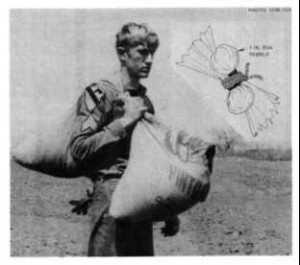
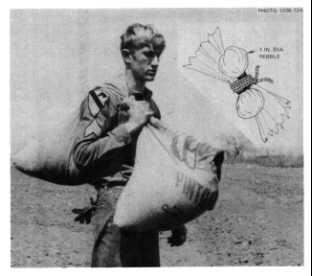
waterstorageIf you need more ideas for storing water in an emergency, a good source of ideas is chapter 8 of Nuclear War Survival Skills.  Despite the title of the book, it is also an excellent source of information for practical ideas for other emergencies.  For example, the illustration here is from that book, and shows a man carrying ten gallons of water in burlap bags lined with a plastic trash bag.  You might not have burlap bags around the house, but you probably have pillowcases, and they will work as well.  You can also use a trash can or heavy cardboard box with a garbage bag as a liner.  (All of these will be heavy once filled, so you’ll want to put them where you need them prior to filling.)

Other Water Containers

Of course, if you know that a storm is coming, rather than relying on expedient solutions, it would be a good idea to have some containers designed for the purpose.  The links below show just a few of the many possibilities:


Other Helpful Links

For more information on emergency preparedness, please visit some of the following pages on my website:

Click Here For Today’s Ripley’s Believe It Or Not Cartoon


Book Review: The Knowledge by Lewis Dartnell

WikiReader.

My website contains a review of the WikiReader. This little device set me back about $20. It’s apparently no longer available on Amazon, but there do seem to be examples available on eBay and elsewhere. It’s a small battery-operated device that contains in its internal memory (with some limitations) the full contents of the English language Wikipedia.

In other words, it contains what its manufacturer called “the Internet without the Internet.” If you’re transported back in time, if you get stranded on another planet or on Gilligan’s Island, or if the world suffers TEOTWAWKI (The End Of The World As We Know It), you’ll no longer have access to the Internet, but you’ll have a pretty good summary of just about any subject. The batteries of the WikiReader will eventually go dead, but before that happens, all you need to do is find the Wikipedia article on the history of the battery, take some good notes, and you’ll be able to whip yourself up a new one when the time comes. Once you’re settled in in your new era, you find an interesting article such as the one on the electrical telegraph, put together a prototype, and then make arrangements to demonstrate it to Julius Caesar or Louis XIV.

The WikiReader has a number of practical limitations, and I rarely use it. But it’s carefully put away just in case I’m involved in inadvertent time travel. In my pocket, I have the important knowledge of the 21st century. If I accidentally get stuck in a time warp, I’m going to make the best of the situation.

It appears that I’m not the only one who thinks that way. I recently got an e-mail from Amazon stating that customers who bought the WikiReader also bought a book with the intriguing title The Knowledge: How to Rebuild Civilization in the Aftermath of a Cataclysm by Lewis Dartnell. The book is available in the usual places, such as Amazon, amazon.ca in Canada, or your local library.

As the title suggests, the book is written for the benefit of some future inhabitant of Earth who needs to reconstruct (or “reboot” as  author Dartnell calls it) civilization after some sort of cataclysm.  The first chapter suggests some possible sources of the disaster, and the second chapter discusses the “grace period.”  After some types of disasters, such as a pandemic (such as happened in Earth Abides by George Stewart or in my own novel Caretaker), the survivors of the disaster have at their disposal the spoils of the earlier civilization.  It’s a relatively simple matter to eat canned food, set up generators, and take advantage of what was left behind.  In some cases, such as pandemic, that grace period might extend for generations.  In other cases, such as nuclear war, there will be fewer benefits available from the earlier civilization, and survivors will need to get to work right away tending to their immediate needs.

Dartnell doesn’t dwell a great deal on the grace period, since he correctly notes that numerous other survival manuals have been written.  What he spends most of his time talking about is rebuilding a technological civilization after the grace period has ended.  With a few exceptions (such as how to make soap), he doesn’t provide enough detail about any given technology in order to show exactly how they’re done.  But Dartnell does give enough clues in order to point survivors in the right direction.

For example, in the section on radio communication, he describes how to build a crystal radio, and he gives enough detail to allow the future archaeologist to recreate one.  He gives some of the theory, but no unnecessary theory.  In our current timeline, for example, it probably would have been impossible for society to come up with radio without first having an understanding of Maxwell’s Equations.  Instead, Dartnell gives only enough theory to make the thing work.  After building a few radios, the post-apocalyptic society would eventually come up with Maxwell’s Equations on its own.  So future history would follow the same general course, but in the opposite order from ours in some instances.

In addition to the plans for the receiver, Dartnell also gives enough detail so that someone could probably come up with a workable spark-gap transmitter.  I think the stumbling block for the future inventor would be coming up with an earphone sensitive enough to work with the receiver described.  Armed with theory in our own civilization, the telephone was created first, which gave the required prior technology.  Dartnell does qualitatively describe both a magnetic and piezoelectric earphone, but either one would require a great deal of trial and error.  In our own history, a skilled inventor would know enough theory to realize that sound would come out of a telephone receiver if hooked up properly.  If it didn’t work the first time, he would eventually figure out that he needed to make it more sensitive by adding more windings to the coil.  The post-apocalyptic inventor would have more trial and error.  But if he or she had enough faith in the book (perhaps because he knew that the soapmaking description was correct), that might provide the incentive to keep experimenting.  (Dartnell does provide the future inventor with Edison’s admonition that genius is 1% inspiration and 99% perspiration.)

Similarly, Dartnell gives enough clues to invent the triode tube.  There isn’t nearly enough detail to make one, but he tells just enough about the Edison effect so that a gifted future scientist could verify it, and some hints as to how this effect could be harnessed to provide amplification.  Dartnell mentions in passing that oscillation is possible, although I hope the future scientist figures out that feedback is necessary in order to get the thing to produce radio signals.

In order to jump-start science, Dartnell provides a few simple experiments to prove non-intuitive concepts, such as the Earth spinning on its axis (Foucault’s Pendulum) and revolving around the sun (stars rising four minutes earlier each night).   In case the surviving society has lost track of time, he shows how to establish the year, either by the proper motion of Barnard’s Star or changes in the night sky due to the Earth’s axial precession.  The book contains convenient charts showing the reader the year (as well as a map and picture to locate the Svalbard Global Seed Vault).

In short, the future reader will get a lot of useful information from this book.  In most cases, the ideas contained in the book will need additional details, but Dartnell points the future inventor on the right path for either experimentation, or at least a clue as to which ancient texts he or she should try to recover.  (The book contains an extensive bibliography to help the future inventor in that quest.)

Chances are, nobody would read a book entitled, “The History of Science and Technology.”  But when you get to the end, you realize that’s exactly what you read.  In detailing the easiest course for future civilization, he necessarily recreates our own.  There will, of course, be some differences.  For example, most readily accessible deposits of fossil fuels will be gone for the next civilization.  But he offers a number of workarounds.  And since the current nitrate supplies of our early civilization (see The Guano Islands Act for an interesting discussion of a seemingly mundane commodity) are also depleted, he goes into more detail regarding the relatively simple chemistry required to fix nitrogen from the air.  On the other hand, aluminum requires a great deal of industry to refine.  But in the case of a future society, even hundreds of thousands of years in the future, our dumps will provide ample mines of high-grade ore that will need little more than melting down and re-casting.

In short, if you bought a WikiReader after reading my review, then, yes, Amazon was right.  You’ll want a copy of Dardnell’s book as well.

More information, including a discussion forum, is at the book’s website:  the-knowledge.org

   Buy this Book on Amazon:
USA:                              Canada:

Click Here For Today’s Ripley’s Believe It Or Not Cartoon



Hurricane Betsy, 1965

Hurricane Betsy satellite image, 4 Sept 1965. Wikipedia photo.

Hurricane Betsy satellite image, 4 Sept 1965. Wikipedia photo.

Fifty years ago today, Hurricane Betsy started bearing down on the United States. On August 27, 1965, the storm formed as a tropical depression off the coast of French Guiana and started moving northwesterly. It caused only minimal damage to the Leeward Islands before heading over open waters for several days. It achieved hurricane intensity on August 30. On September 5, 1965, the hurricane stalled over the Bahamas, where it inflicted the worst damage since 1929, before resuming a westward track. It made its initial landfall in Key Largo, Florida, before reemerging in the warm waters of the Gulf of Mexico, where it continued to gain strength.

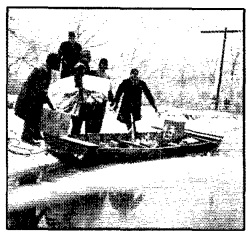
Flooding in New Orleans. Wikipedia photo.

Flooding in New Orleans. Wikipedia photo.

On early September 10, it made landfall again near Houma and Grand Isle, Louisiana, with winds of 155 mph. The eyewall was in the New Orleans area for over eight hours, with winds in the range of 120 mph. It caused a strom surge into Lake Pontchartrain and considerable flooding and levee breaches in New Orleans, lasting ten days. Near Baton Rouge, the storm caused the sinking of a barge loaded with enough chlorine to kill 40,000 people, necessitating mass evacuations in the harbor area.  In New Orleans, most antennas were down, and 90% of the city was without power.

The November, 1965, issue of QST reported on how Radio Amateurs responded to the storm. K5AOE set up on the 8th floor of City Hall, where considerable traffic was handled on 75 meters. This included health and welfare traffic, and also a dedicated medical net. Fifteen mobile stations, each assigned to a doctor, were set up at shelters, and there was constant traffic as conditions were reported and medical supplies requested. The FCC declared a communications emergency for the duration.

The Hurricane Watch Net was formed informally during Hurricane Betsy as stations came on the air to provide communications to and from affected areas. Since then, the net has continued to operate with a more formal structure any time a hurricane is within 300 miles of projecte landfall or otherwise threatening any populated area.


Click Here For Today’s Ripley’s Believe It Or Not Cartoon


1965 Emergency Broadcast System Simulated Script

Terrorism Section Content Nuclear Blast 1.3.0.0
A January 1965 report prepared for the Office of Civil Defense reported on several simulated fallout shelter exercises conducted in the Pittsburg area to investigate various shelter management factors. For example, in one study, the designated shelter manager arrived late. In another study, the effects of total darkness upon shelter operation were studied.


In three of the experiments, the stress level was increased by periodically playing simulated emergency broadcast system messages. The script of those broadcasts is particularly interesting, since it gives an insight into what civil defense planners thought might be a plausible scenario for a nuclear attack on the United States, and how news would be communicated to the public.

Here is the text of the nineteen radio broadcasts that might have been heard during a nuclear war:

EMERGENCY BROADCAST SYSTEM SCRIPT
EBS #1, Friday, 7:00 PM

ATTENTION. ATTENTION. This is the Emergency Broadcast System. Take shelter immediately. Take shelter immediately. This is not a drill.
Repeat: This is not a drill. An enemy attack is being launched against
the United States. Take shelter immediately and stay tuned to this
frequency for further instructions.

THE ABOVE MESSAGE IS TO BE REPEATED THREE TIMES, WITH 15-SECOND INTERVALS.

EBS #2, Friday, 7:10 PM

ATTENTION. ATTENTION. This is the Emergency Broadcast System. We have just been informed that the city is now on the emergency power system. Please inform the control center if your shelter is without light-., Repeat: The city is now on the emergency power system. Please inform the control center if your shelter is without lights. We also have ….. we also have word here that there has been no confirmed report of a missile strike in this area.  There has been no confirmed report of a missile strike in this area.

EBS #3, Friday, 7:15

(Phone is heard ringing in background.)

ATTENTION. ATTENTION. This Is the Emergency Broadcast System. A missile attack has been launched against the United States. Reports about the attack are fragmentary and unconfirmed. The strategic missile bases west of the Mississippi appear to have borne the brunt of the attack. As of this moment there has been no official report of a nuclear detonation in our immediate vicinity. Fallout has begun to descend on the western portions of our city and is expected in other areas imminently. Do not communicate with the emergency operations center unless absolutely necessary.

.
EBS #4, Friday, 8:00 PM

ATTENTION. ATTENTION. This is the Emergency Broadcast System. Stay tuned for an important message. (DISTANT VOICE: Okay, stand by now. We’ve got a remote from Washington.) Static ——- Noise. Another voice: This is a report from the emergency national command post in Washington. The President and his key civilian and military aides have been safely evacuated to the emergency seat of government. This evening at 6:35 PM the enemy launched an attack against the strategic retaliatory forces of the United States and its NATO allies. An intelligence warning allowed us to launch a portion of our land-based missile force against the enemy’s remaining strategic forces.
Polaris missiles have also been launched. In addition, our airborne alert and a portion of our ground alert aircraft forces have been sent against the enemy’s non-missile strategic forces. Our damage assessment reports indicate that many of our SAC bases have been destroyed or severely damaged. A number of communities near SAC bases have also suffered great damage. The fallout monitoring network reports that radiation is heavy in the western portion of our country and is increasing in the midwest and eastern portions of our nation. Although there have been several nuclear detonations in the east, it appears as if these have been the result of errant missiles, rather than a planned attack against population centers.  The President, whom, I repeat is alive and well, will address the nation as soon as his command duties permit. This is the end of the Priority One report. Local EBS stations may resume Priority Two broadcasting.

EBS #5, Friday, 8:30 PM

ATTENTION. ATTENTION. This is the Emergency Broadcast System. Short wave monitoring has disclosed that our air strike forces are currently launching attacks on the enemy homeland. These forces are utilizing a new….. what?  What do you mean it’s not for release? (Another voice: Priority One. Now.. for heaven’s sake! Announcer: Well what the hell …… 1)

THIS MATERIAL CUT OUT.

EBS #6, Friday, 8: 50 PM

Has this one been cleared?
ATTENTION. ATTENTION. This is the Emergency Broadcast System. We have Just received word that the President has been evacuated to sea in the floating Whitehouse. The location of this ship is unknown. The floating Whitehouse is a battle cruiser, fully equipped for command and control functions. Our government has survived the attack. I repeat, our government has survived the attack.

EBS #7, Friday, 9:30 PM

ATTENION. ATTENTION. This is the Emergency Broadcast System, We have just been informed that a message is to be delivered from the governor’s office in Harrisburg. Please stand by,

This is a report from the governor’s office in Harrisburg. The state of
conditions in Pennsylvania is serious, but not critical. Erie has been
severely damaged by what is believed to have been a stray missile. No other cities have reported being hit, but the fallout level is rapidly increasing, particularly in western Pennsylvania. Apparently neighboring states have borne the brunt of the attack, particularly those in the western portions of the country. All citizens should seek shelter immediately. Do not attempt to evacuate your area until you are instructed to do so. Local law enforcement personnel should remain in their respective areas. State police have been assigned to more critical areas, and additional state aid will become available and be assigned when fallout levels permit.

EBS #8, Friday, 10:15 PM

ATTENTION. ATTENTION. This is the Emergency Broadcast System. Fallout began to descend on the Pittsburgh area several hours ago and radiological monitoring reports indicate that radiation levels are dangerously high in many parts of our city. No one should attempt to leave shelters. Repeat: No one should attempt to leave shelters. Youngstown, Ohio and Erie, Pennsylvania have suffered severe damage as a result of nuclear detonations.
As of the moment there have been no nuclear blasts in our immediate area.  The municipal power has been temporarily disrupted in some parts of the city. Power should be restored shortly. No further official reports on our retaliatory attacks on the enemy homeland are available. Unofficially, the absence of any significant second wave of enemy attack, plus the size of our surviving strategic force, allows cautious optimism that we will suffer no further major damage from any attack. Until further word is transmitted by this station, everyone must remain in shelters.

EBS #9, Friday, 10:30 PM

ATTENTION. ATIENTION. This is the Emergency Broadcast System. In order to evaluate the damage to Pittsburgh, the emergency operations center requests every shelter to gather the following information and to report it to the local emergency operations center. Is this a fallout or a blast shelter? How many persons are in the shelter? How many of these persons are injured? How many persons are suffering from radiation sickness? What is the condition, of your equipment? Is your shelter structure damaged? Do you have adequate electricity?
Do you have adequate ventilation? What is the state of your food supplies? What is the state of your water supply? Do you have any illness other than radiation sickness? As soon as we have received reports from district control centers we will relay such information on to you. When emergency missions are possible, disaster teams will be sent to those shelters which need medical supplies, food and water. Attempts will also be made to report specific areas of damage in our city. Please stay tuned for additional announcements.

EBS #10, 11:30 PM

ATTENTION. ATTENTION. This is the Emergency Broadcast System. Wee have hundreds of people in the area who do not have shelter with an adequate protection factor. They must be moved to other shelters in order to survive.
Please advise the emergency operations center as to the number of additional people you can take into your shelter. This is imperative. Please inform the emergency operations center as to the number of additional people you can take into your shelter.

EBS #11, Saturday. 1:30 AM

ATTENTION. ATTENTION. This is the Emergency 3roadcast System. Radiological monitoring teams report that the radiation levels in the Pittsburgh area are still high. However, there is no additional accumulation of radioactive dust. The fallout on the ground is beginning to decay. It is simply a matter of waiting out this decay time before we can undertake further civil defense measures.  Everyone is to remain inside until further notice. Please do not leave your shelters.

EBS #12, Saturday, 2:15 AM

ACCIDENTALLY OVERHEAR A SHORT WAVE BROADCAST. “Hello Tower…. to checkpoint two…. ” Static and short wave noise.

EBS #13, Saturday, 3:00 AM

LOUD STATIC AND SHORT WAVE NOISE.

ATTENTION. ATTENTION. This is the Emergency Broadcast System.

EBS #14, Saturday, 3:45 AM

ATTENTION. ATTENTION. This is the Emergency Broadcast System. Reports have been received that there are bands of looters wandering about the city.  Attempts have been made to loot shelters in this area. Be alert to this situation and act accordingly. Security police will begin patrolling the area as soon as the radiation level permits.

EBS #15, Saturday, 4:15 AM

ACCIDENTALLY OVERHEAR SAC PLANE MESSAGE. Sounds like:
“Angels 46 — Same heading — Roger, Angels 52 — Fuel 30 … ”
Much static.

EBS #16, Saturday, 6:00 AM

ATTENTION. ATTENTION. This is the Emergency Broadcast Svytem. Stay tuned for an important message. Okay, stand by to switch.
MUCH STATIC ———– “Please stand by.”
This is a Priority One report from the emergency national command post in Washington. It appears that the enemy attack is over. There have been no further reports of missile strikes since early last evening. Radio monitoring indicates no further enemy air activity. Damage assessment reports indicate that the brunt of this attack was borne by western states. Many of our SAC bases have been destroyed or severely damaged. Communities near SAC bases have also been severely damaged. The central and eastern portions of the country have escaped extensive damage although stray missiles have struck some of the smaller population centers. Fallout is moving across the country in an easterly direction, carried on westerly winds. All citizens should remain in shelters until instructed otherwise by local civil defense commands. The President and key members of his cabinet are still aboard the U. S. S. Northampton. The President will address the American people as soon as his command duties permit.

This is the end of the priority ….. this is the end of the Priority One report. Local EBS stations may resume priority two broadcasting.

EBS #17, Saturday, 7:30 AM

ATTENTION. ATTENTION. This is the Emergency Broadcast System. Emergency teams have been established and have begun to operate in various sections of Pittsburgh. There is a shortage of able-bodied men to serve on work details in Shadyside, East Liberty, Bloomnfield, and Morningside. Will all shelters submit to the emergency operations center the names of able-bodied volunteers who may be asked to leave shelters before radiation levels are completely safe for permanent exit. Phone the names into the emergency operations center. Further information will be provided as to when and where the rescue volunteers will report.

EBS #18, Saturday. 10:00 AM

ATTENTION. ATTENTION. This is the Emergency Broadcast System. Weather monitoring teams report that there is a severe storm approaching the Pittsburgh area. What’s that? It appears that this storm is bearing with it a radioactive dust cloud and we expect the levels of radiation to increase severely. Some shelters do not have adequate protection facilities against this cloud. There is a possibility that some shelters will have to mobilize and be moved. (PAUSE) We will contact these shelters by phone within the next few minutes. Please do not call the emergency operations center. If your shelter is one of these that has to be mobilized and be moved, we will contact you. Please stand by.

EBS #19, Saturday 3:00 PM

ATTENTION. ATTENTION. This is the Emergency Broadcast System. Radiological calculations of fallout levels in Pittsburgh indicate that permanent exit from some shelters will be possible in the near future. At the present time recovery teams are surveying the city to locate and to prepare facilities for post-shelter operations. It is imperative that you do not attempt to leave your shelter without prior notice from the emergency operations center. There are still many dangerous radiological “hot spots” in the city. Therefore, regardless of the radiological readings in your immediate vicinity, wait for official notification. from your government in the emergency operations center.

THE END

For more insight into 1960’s civil defense, my website contains a scan of the 1962 St. Paul, MN, civil defense operational plan, which includes the manual that shelter managers would use in the operation of a fallout shelter.

Click Here For Today’s Ripley’s Believe It Or Not Cartoon