Category Archives: Emergency Preparedness

FCC Reduces GMRS License Fee: Implications for Emergency Communications

2018 Update: This page was written in 2015, after the FCC reduced the fee for the GMRS license. GMRS remains a good option for many emergency communications applications.

You can obtain a GMRS license by mail or online. As with many bureaucratic activities, it’s somewhat more complicated than necessary, but not particularly difficult. The fee for the ten year license is currently $70. Just follow these steps:

Applying for the License Online:


You can read the full instructions at this page on the FCC website.  It’s basically a two-step process.  First, you will need to set up an account on the FCC Universal Licensing System (ULS).  When you do, you will receive an “FRN” (FCC Registration Number) and password.  If you have future business with the FCC, you’ll use this same account.  You will sign up at this page on the FCC website.

After you have the ULS Account set up, you will go to this page on the FCC website to start the application.  All of the questions on the application should be self-explanatory.

Applying for the License By Mail:

To apply by mail, you will actually need to send three separate forms from the FCC website:

Download form 605 first, since it contains most of the general instructions.  For more information, the full instructions can be found on page 9 of this FCC document.


On May 20, 2015, the FCC announced that it reduced the license fee for GMRS radio licenses.

This change has a significant implication for those looking for an inexpensive method of family communication, especially for emergency preparedness. The change allows hams and others to potentially provide an important service to their neighbors, at a very low cost.  To see how it’s important, we need to look at the history of GMRS radio, and the related FRS radio service.

FRS Radio

Inexpensive FRS radios.

In 1996, the FCC created the Family Radio Service (FRS), which allowed unlicensed use of UHF radios on 14 channels. millions of such radios were sold, and even the most inexpensive versions (often under ten dollars) provide quite reliable communications over short distances (less than a mile).

The FCC imposed a number of technical requirements for these radios. First of all, the maximum power allowed was 500 milliwatts (1/2 watt). In most cases, this low power is not a significant limitation. The most important limitation, however, was that the antenna had to be permanently mounted to the radio, with no method of connecting an external antenna.

This is a very significant limitation because on the UHF frequencies used by these radios, the main factor in determining distance is the height of the antenna. This is because UHF radio waves behave almost the same as light waves: they travel in a line of sight. Radio waves have some ability to penetrate obstructions, but this is very limited. Therefore, an FRS radio really has about the same range as a flashlight. If you can’t see the other radio, then you probably won’t be able to communicate with it. (Again, the radio waves can penetrate some obstructions, but this ability is very limited.)

If you have a flashlight in your hand, then you can’t be seen very far away, because the light beam will hit obstructions. And an FRS radio works under the same principle: Your signal won’t get out very far because it will hit obstructions. On the other hand, if you climbed a mountain with the flashlight, then it could be seen for many miles, because you would be up clear of the obstructions. And an FRS radio would work the same way. If you were on top of a mountain, then you would be able to communicate many miles, as long as the person at the other end was able to see the mountain off in the distance.

It’s usually not practical to climb a mountain to extend the range of your radio. However, it’s not the location of the radio that is important. The critical factor is the location of the antenna. There’s a reason why radio and TV stations spend money building expensive towers, and that reason is to increase the height of their antenna.

But this is not possible with FRS radios, because they are not allowed to have external antennas or any way to connect an external antenna. Therefore, their range was extremely limited.

One manufacturer cleverly exploited a  loophole to market an FRS radio with the functional equivalent of an external antenna. Radio Shack sold an FRS radio with an external microphone. The radio itself was sealed inside a unit that mounted to the top of a vehicle with a strong magnet. The antenna was permanently attached to the radio, so it met the FCC rules. But all of the controls were mounted on the microphone, which could be used inside the car. Having the antenna (and radio) on top of the car significantly extended the range of the unit.

GMRS

The General Mobile Radio Service (GMRS) dates back to the 1960’s. Initially, the equipment was very expensive, but it provided a very versatile method of communications. The rules allowed up to 50 watts, and external antennas were the norm. GMRS could provide reliable communication over many miles. Depending on local conditions (in particular, antenna height), a range of 20-50 miles would be quite common. But the equipment was rather expensive, and GMRS was never adopted to its full potential. Fifteen channels are assigned to GMRS. A license is required, and the license carried a fee. Given the versatility of GMRS, this was actually quite a bargain, especially considering that the equipment would cost hundreds of dollars.

When FRS radio was created in 1996, the situation soon changed. Seven of the fourteen FRS channels were shared with GMRS. In other words, an FRS user could talk to GMRS radios on channels 1-7. But there were relatively few GMRS users, and this option was rarely utilized. While they were compatible, the two services served different needs. GMRS used expensive equipment to communicate over fairly long distances. Most of the millions of FRS radios that were sold were used for very short-range communication, or even as children’s toys. While having the shared channels was probably a good idea, I don’t think the FCC anticipated how popular FRS radio would become, or how inexpensive the radios would be. The net effect was that the seven shared channels became cluttered with FRS users, and were generally avoided by GMRS users.

Some manufacturers, however, started marketing around the new possibilities. They started selling 15-channel portable GMRS radios, and the prices kept coming down. These units had the best of both worlds: They could use higher power than the FRS radios, but they could still communicate with the cheaper radios on 7 channels. And most importantly, they had provision for an external antenna. Therefore, they had the greater potential range of a GMRS radio.

When prices of such radios got less expensive, many users (probably most) started ignoring the licensing requirement. This is understandable, since from their point of view, they had in their hands a slightly better FRS radio, which probably cost less than $90. It made little sense to pay an additional $90 for a license, especially if they used only channels 1-7. While a license was technically required on these channels, it would be essentially impossible to tell whether the user was using a license-free FRS radio or a GMRS radio for which a license was required.

Meanwhile, the price of these radios kept getting lower and lower, and manufacturers had to come up with a marketing angle. They started by printing on the package the range of the radio in miles. Remember, the range of the radio is limited by the location of the antenna. If you are standing in a valley, the range will probably be less than a mile. If you’re standing on top of Mount McKinley, then the range will be hundreds of miles. And in general, the quality of the radio has very little to do with it. So the manufacturers started inflating the range estimates for their radios. These claims were not false–they were merely misleading.  After all, if you climbed Mount McKinley with the radio, you would easily get the advertised range.

So one manufacturer would be selling a radio with a “one mile” range, which would probably be a reasonable estimate in normal use. But another manufacturer could take a nearly identical radio to a small hill and truthfully state that it had a two-mile range. Another manufacturer could take his identical radio to a slightly larger hill and truthfully claim a range of three miles. The products didn’t need to improve–the manufacturer just needed to find a bigger hill.

Chances are, the “30 mile” radio wasn’t any better than the “2 mile” radio right next to it on the shelf. But understandably, consumers were more likely to buy the “30 mile” radio.

Soon, distance claims were strained to the point of incredulity, and the marketing people needed to come up with a different angle. Some manufacturers were selling 14-channel FRS radios. Some manufacturers were selling 15-channel GMRS radios. There were really only two differences. First of all, the 15-channel GMRS radios required a license, but this requirement was routinely ignored. The only real advantage that the 15-channel GMRS radios had was that they could be used with an external antenna, the one thing that would really increase their range. But most people used these radios only as portable walkie-talkies, and most people didn’t realize that they could get significant range by use of an outdoor antenna. So the ability to use an external antenna was never a selling point.

At some point, some manufacturer realized that they could distinguish their product by selling a 22-channel radio. The radio would be a combined FRS-GMRS radio that could use the 7 shared GMRS-FRS channels, the 7 FRS-only channels, and the 8 GMRS-only channels. This was legal, as long as the radio met the requirements for both services. They had to use the lower power on the FRS-only channels. (And I suspect that most of them simply used the lower power on all channels.) But more importantly, the combined unit had to have a permanent antenna, with no possibility of hooking up an outside antenna. In other words, the marketing angle of “more channels” had the result of taking away the one advantage of GMRS: The ability to use an external antenna.

Very few consumers appreciated the advantage of an external antenna, and most of the “inferior” 15-channel radios soon departed the market in favor of the “improved” 22-channel models. On the shelf, the competing products were distinguished mostly by the meaningless “mileage” claims on the package. Understandably, most purchasers didn’t bother to get the $90 license for their $20 radio. The license wasn’t even required for channels 8-14, and they could be used with virtually impunity on channels 1-7, even though a license might technically be required there.  There was no real advantage in using channels 15-22 where the license was required.

Millions of these radios were sold, and most of them were probably put away when the owners realized that the mileage claim on the package was meaningless.

Family Communications Tool

I’ve never bothered getting a GMRS license, mostly because of the $90 fee. While it would occasionally be nice to have, it’s really not worth it. As an amateur radio operator, I can get the same results with amateur radio. But occasionally, having a GMRS capability would be helpful. For example, a GMRS radio would make it possible to communicate with the kids within a mile or so.

In general, it’s not necessary to have both antennas at a high location.  Remember, an FRS radio is like a flashlight.  It can’t be seen very far away by someone else standing on the ground.  But it can be seen if the other person is at a high location.  Therefore, to turn it into a reliable method of family communication, it’s only necessary to have one good antenna at home, or on a vehicle.  The other person can be using an inexpensive FRS radio with a built-in antenna, but there will still be acceptable range.

Potential for Emergency Communications
And in an emergency, it would be possible to communicate with neighbors with an FRS radio. Several years ago, someone proposed a “National SOS Radio Network” to educate owners of FRS radios as to their possibilities for emergency communications, but the group’s website is now defunct and there appears to be no more effort to publicize the idea. It was a very good idea, although very limited in scope: After a disaster which wiped out other forms of communications, people would have the capability to talk to their neighbors, as long as they knew other people would be listening on the same emergency channel.

The DC Emergency Radio Network was a similar plan, but it also appears to be defunct.

Again, it’s not necessary for both sides of the transmission to have a good antenna.  But if one person in the neighborhood has a good antenna, then the other neighbors will be able to communicate with that person in an emergency, even with “toy” radios.  And if that person is capable of worldwide communication without commercial power (as I am), then the whole neighborhood is suddenly linked to the outside world.

It should be noted that an FRS radio would be a poor first choice for summoning help in an emergency.  It’s unlikely that anyone would be monitoring at any given time, and when I get my GMRS license, I have no plans to continuously monitor for potential emergencies.

But after a widespread emergency, such as a blizzard or earthquake, normal telephone service or even cell phone service might be unavailable.  After such an emergency, neighbors might have a need to communicate.  This wouldn’t necessarily be to summon assistance.  It might just be a matter of wanting to check on other neighbors.

If one neighbor has a GMRS station and can plan to monitor after other communications facilities are unavailable, this would provide a link to nearby neighbors with nothing more than a “toy” FRS radio.  If they know to turn it on in case of an emergency, and to what channel, then it seems to me that this could fill an important need after a disaster.

Getting a GMRS License and a Radio

Since I wanted to avoid the $90 fee, I’ve considered mounting an FRS radio in a weatherproof container outside, with the microphone, speaker, and power supply mounted inside. This could be used legally without the $90 license, and would function about as well as a licensed GMRS station.

With the fee reduced, it’s now more reasible to simply get a GMRS radio and the license.

Unfortunately, the very common and inexpensive 22-channel radios are useless for my intended purpose, since they don’t allow an external antenna. Fortunately, there are a few of the 15-channel radios available, and they do allow an external antenna connection.

One possibility, of course, is one of the many cheap Chinese handheld radios that are available. For example, my Baofeng UV-5R is capable of transmitting on the GMRS frequencies. Unfortunately, however, this is not a legal option. GMRS equipment needs to be specifically certified for GMRS use, and this radio is not. (In addition, the wideband receiver of the Baofeng desenses quite badly with an external antenna, and probably wouldn’t perform very well on receive.)

One of the Wouxun Chinese handheld radios appears to have received FCC certification for GMRS use, but I’ve been unable to find this model for sale.

One possibility would be a professional-grade transceiver such as the Icom IC-F21 GM, but that would entail more expense than I wanted. Cobra also makes a combination GMRS-Marine radio. This is somewhat out of my price range, but it could be a good choice for someone looking for a marine radio.

Fortunately, there are apparently a few manufacturers who didn’t get the memo about the marketing advantages of 22 channels, so there are a handful of the 15-channel GMRS transceivers available. At one time, the best bet was the Audiovox GMRS1535. This is a consumer-grade “blister pack” radio and sold at “blister pack” prices.

According to a couple of reports, the antenna appears to be removable with an SMA connector. If this is the case, then this radio can be used with an external antenna.  However, many of these radios do not have a detachable antenna.  The one I ordered had a permanent antenna.  Therefore, it appears that Audiovox made two versions of the same model.  Unless you can look at the radio you are buying, you can’t assume that the Audiovox has the option for an external antenna.

Currently, the best available option for a GMRS radio with external antenna appears to be the Midland MXT105.    This is a 5-watt radio.  It includes an external magnetic mount antenna with a cable of about 20 feet.  For most users, this antenna could be mounted on a metallic surface and give good results.  For better results, a more permanent antenna can be used.

This radio runs off 12 volts.  For many emergency applications, powering it with a battery would be the best option.  Another alternative would be a power supply such as this one.

This radio will be able to communicate with FRS radios.  Since it has an external antenna, you should get good results, even in connection with inexpensive FRS radios.  You can buy the MXT105 at Amazon or WalMart.  Many WalMart stores will have the radio in stock, but to make sure, you can order online at this link, and then pick the radio up at the store the same day.

Another possibility is the Blackbird RR5000, a 15-channel GMRS transceiver that appears to have provision for an external antenna.

Most of my readers have the technical wherewithal to set up a GMRS radio, and you should consider taking this step in order to serve your community in case of emergency.  If you’re a ham, you’ll probably recall that the Amateur’s Code says that your “station and skills are always ready for service to country and community.”  It seems to me that with a very small investment, you could be prepared to do just that.

For more information on the basics of emergency communications, please visit my emergency communications page, which is also available as a  Kindle book.


Emergency Telephone Hookup

PhoneIntercom

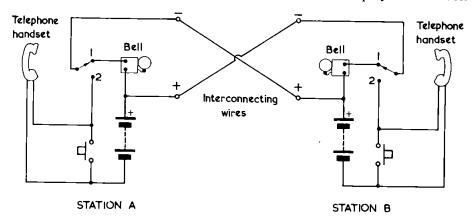
It’s a relatively trivial matter to hook up two telephones so that you can talk from one to another. Virtually any old telephone can be used, and it’s simply a matter of placing a battery (the voltage is not critical) in series. So if you need to hook up two telephones to talk, it’s about as easy as it gets.

It’s more difficult, however, to figure out a way to make the other telephone ring. The telephone itself operates off DC. The ringer sounds when an AC voltage is applied. And there’s no particularly simple way of generating that AC voltage. The easiest way to solve the problem is to run a second circuit with a bell, buzzer, or light. If you want to talk to the other station, you push a button, a bell (separate from the phone) sounds at the other end, and the other person picks up the phone.

The ingenious arrangement shown above shows a way to wire it all up so that a single circuit can handle both the bell and the telephone line. When one station wants to call, he pushes the button to signal the other station. Then, both sides put the switch on position 2, and they can talk. This circuit, and all the details for constructing it, are found in the April 1966 issue of Radio Constructor, a British electronics magazine.

Click Here For Today’s Ripley’s Believe It Or Not Cartoon


1955 CONELRAD Receiver

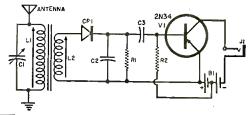
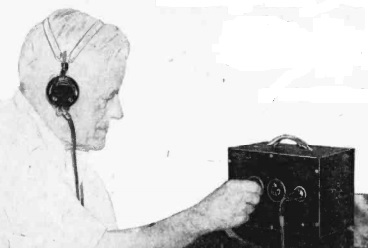
1955ConelradRXUnder the headline, “Are You Ready For CONELRAD?”, the April 1955 issue of Radio News carried the plans for this small CONELRAD receiver which could be easily carried in a pocket or glove compartment. The circuit is very similar to the Conelrad receiver carried by Boys’ Life the following year.  This receiver also consists of a crystal set followed by a one-transistor audio amplifier.

The article describes CONELRAD, and notes that “the responsibility of the individual citizen and particularly of the electronic technician and experimenter would be to provide themselves and their families well ahead of time with some means for receiving Conelrad broadcasts under any or all emergency conditions.” The article noted that receivers should be exactly calibrated, to avoid losing valuable seconds fumbling around trying to find 640 and 1240 on the dial. The article suggests using a signal generator to calibrate and mark the dial before an emergency.

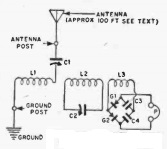
1955ConelradSchematicIt then offers the circuit shown here, since it would be “highly advisable to have available at all times a portable battery-operated radio. The average portable radio is fairly cumbersome to carry about over any appreciable distance and its power requirements are high enough to make it impossible to keep in operation continuously.

The author notes that his original plan was to have one transistor serve as the detector, but had some difficulty in designing the circuit, due to the low input impedance of most transistors. Therefore, like the author of the Boys’ Life design, he settled on a diode detector, with one stage of audio amplification.

Unlike the Boys’ Life model, which was mounted in a cigar box, this one is mounted snugly in a small plastic box. The author notes that “as most old crystal set men will recall, a fairly long antenna and a good ground are required for best results.” Therefore, he recommended taping 25-50 feet of fine wire to the case for use as an emergency antenna.

Click Here For Today’s Ripley’s Believe It Or Not Cartoon


Fallout Shelter Communications Studies of the 1960’s

FalloutShelterCommunicationsStudy

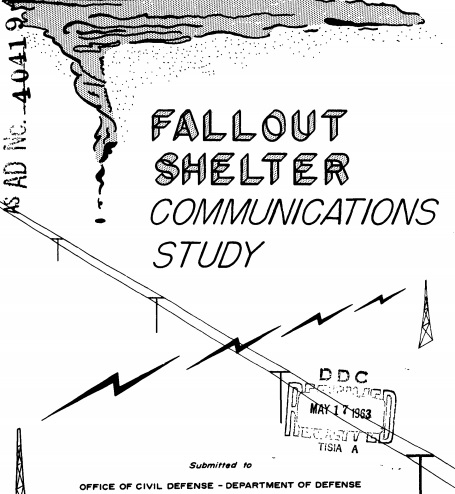
One of the shortcomings of the fallout shelter program of the 1950’s- 1970’s was the lack of communications from shelters to the outside world. The 1962 Fallout Shelter Plan for St. Paul, MN, for example, stated that “many designated shelters will be in places with access to existing telephones. When telephones are available and operable they will serve as basic communications.” The plan also stated, but apparently with no thought as to who would be responsible, “plans should be made to insure that at least one battery operated AM radio receiver plus extra batteries will be made available in the shelter for reception of emergency broadcasting information.”

When I was a student in elementary school, I noticed these gaps. One year, during a tornado drill (that had been scheduled well in advance), I was quite pleased to see that one of the teachers had with him down in the basement a battery-operated radio. It was rather reassuring to see it, since I knew we wouldn’t be cut off totally from the outside world in the event of an emergency, since we would still be able to receive whatever emergency instructions might be forthcoming from the radio.

My reassurnce was dashed that afternoon, however, when I saw that same teacher walking home, carrying his portable radio. It was apparently his personal radio, which he brought to school in preparation for the scheduled drill. In other words, it wouldn’t be around in the event of an actual emergency. If the power were out, we would, indeed, be cut off from the rest of the world.

On another occasion, the school administration was going to have an additional twist on the drill. Instead of heading to the designated shelter when the school’s own bells sounded the warning, each class was instead going to act when the sirens outside went off. When we heard the siren, we were to head for the basement.

Unfortunately, the closest siren was miles away, and wasn’t very loud where we were. Undaunted, my classroom teacher had a solution to the problem. Shortly before the scheduled test, she opened a window at the back of the room, and a designated student sitting near that window was tasked with listening for the siren. The plan went off without a hitch. He heard the siren and warned the class, and we all headed for the shelter. Of course, it occurred to me that the window wasn’t normally left open. In an actual emergency, nobody would have heard the siren.

The 1962 St. Paul shelter plan realized many of these shortcomings, and stated that “two-way radio is being considered as back-up to telephone communication.” It also considered the possibility of using amateur radio. Under the heading of “other desirable equipment” was “portable transmitting-receiving equipment belonging to members of units of RACES (Radio Amateur Civil Emergency Service). Plans will be made to have designated ‘hams’ take their portable equipment to shelters upon receipt of warning.”

I’m not aware of any specific plans worked out to use RACES in fallout shelters. However, on the national level, there was indeed some planning taking place for two-way radio equipment in shelters. Even though some planning was done, as far as I’m aware, this was never put into place.

In a 1962 report entitled “Fallout Shelter Communications Study,” the engineers conducting this study used Montgomery County, Maryland, as an example, and determined what kinds of communication would be appropriate between the fallout shelters and Emergency Operating Center (EOC) in what the study considered to be a fairly typical county.  The report concluded that the telephone system should serve as the primary communications network for these needs, but also recognized the desirability of two-way radio, and came up with a budget of $391,000 for the county.  Each shelter’s radio was budgeted at a minimum of $250, with another $50 set aside for the antenna.


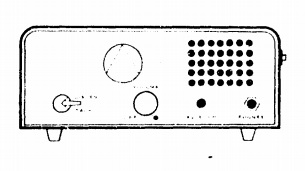
FalloutShelterTransceiverSpecifications for equipment were contained in a 1964 report prepared for the Office of Civil Defense by the same engineering firm. The sketch here of a prototype transceiver for shelter use is from that report.  This report provided specifications for the equipment in each shelter.  The radio for use in the shelters is shown here, and could be either VHF or UHF, in the 150, 460, or 950 MHz band.

A key concern in the design specifications was the fact that the radios would be left unattended for long periods of time.  Therefore, non-corrosive properties were important, and ferrous metals were to be avoided to the extent possible.

Power supply could be either 120 volts AC, or 12 volts DC.  The problems of storing batteries for long periods of time was a challenge, and consideration was given to storing dry batteries.  In addition, batteries from vehicles could be used.  Presumably, they would be brought into the shelter in an emergency.  If the battery needed replacing, presumably a short excursion out to the parking lot could be made when radiation levels decreased.

Ease of operation by untrained personnel was also a concern.  The unit did not have an external microphone.  Instead, both the microphone and speaker were built in, with a push-to-talk switch on the panel.  The only other control on the panel would be the volume control and power switch.  The unit was to have a squelch control, which would be accessible from the front panel.  However, it would be preset, requiring a screwdriver to make any adjustments.  It did include a headphone jack for private listening.

The cost for equipment was estimated at between $250 and $420 per shelter, with an additional $10 to $100 for the antenna, which would be installed prior to the emergency.

It was recommended that the radios be licensed as local government service, perhaps on the same frequencies as other municipal services.  It was anticipated that any necessary drills might be conducted on weekends, causing minimal interference to the other governmental users.

Visit my website for more free emergency preparedness and civil defense materials


The Real Reason Scouting Is Important

MeasureDistancePeople sometimes ask what is the most important thing that youth learn from Scouting. They usually expect to hear something along the lines of that it “builds character.” In some cases, it is probably true that Scouting builds character, but I honestly can’t point to too many people who would have wound up being bad characters if they hadn’t been in Scouting.

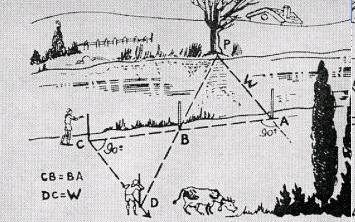
A better reason why Scouting is important is summed up in this diagram, which appeared in Boys’ Life magazine 70 years ago, February 1945.  That’s not to say that measuring the width of a river is a particularly important skill in the scheme of things. In fact, I don’t recall ever being taught this particular method. But it’s illustrative of something I did learn, without knowing that it was being taught. What I really learned was that when I’m faced with some obstacle, it is usually possible to achieve the desired result, by applying a little bit of thought. But the first step is to know that there is a solution to the problem. Once a person realizes that, then finding the actual solution (or more often, one possible solution out of many) is usually pretty simple.

In this illustration, the Scout needs to know the distance across the river. The article, written by William “Green Bar Bill” Hillcourt, explains the method being used here. He starts at point A, which is directly across the river from a given point with a convenient object, in this case, a tree. He then walks along the river a set distance, such as 100 paces, and places a stick at that point. He then keeps walking that same distance. When he reaches the point marked C, he walks at a right angle, and keeps going until he’s along the same line containing the tree and the stick. At that point, the distance he’s walked away from the river is equal to the width of the river.

There are certainly other methods to figure out the distance, another one of which is also shown. But one method, which seems to be the most commonly used these days, is to consult outside information. It’s usually possible to ask someone who knows the answer. And it’s even possible to go to Google Maps, look at the image, and get the exact width. Those are very valid methods, and in many cases, they are more convenient and better methods. But the Scout learns that they are not the only methods. Even if outside assistance is not available, it is possible to figure things like this out on your own, without outside help.

I never really realized this until a few years back, when I started hearing from RV’ers that they couldn’t possibly camp in a non-electric site. I happen to enjoy the convenience of electric power, and if it’s available, I gladly take advantage of it. But I don’t view it as a necessity. When pressed, these people invariably come up with the same rationale for needing electricity: They need it in order to plug in their electric coffee maker.

Now, I drink a lot of coffee, and I probably drink more coffee than most of those people. So I understand their need for coffee. But I also realize one thing that they don’t know: I know that there are many methods of making coffee that don’t involve the friendly local electric utility. In response to their concerns, I even created a website entitled “How To Make Coffee Without Electricity.”  That website is written in a somewhat tongue-in-cheek style. But it’s also full of information that people don’t know, even though I always assumed that it was just common sense. It’s probably common sense to me because I was in Boy Scouts. I know that I can figure out the width of a river even if Google Maps is unavailable. So it stands to reason that I can figure out how to make coffee even if the power happens to be out.

There must be a lot of people who weren’t Scouts. Whenever a hurricane is bearing down on some part of the English-speaking world, my coffee page starts to get hundreds of hits. A day or two before the storm, these are from desktop computers. The day after the storm makes landfall, the number of hits increases, but most of them are from mobile devices. In other words, the power goes out, and only then they realize that they don’t know how to make a cup of coffee. I’m glad their mobile device is still working, and I’m glad that Google is still working, and I’m happy to impart my lifesaving knowledge that it is, indeed, still possible for them to make a cup of coffee.

But I worry about these people if Google ever becomes unavailable for some reason. Maybe they should have been Boy Scouts. I’m sure these people are of fine character, and they didn’t need Scouting to build it. But learning the lesson that self-reliance is usually possible probably would have served them well.

Click Here For Today’s Ripley’s Believe It Or Not Cartoon


Another Crystal Set for CONELRAD Reception

EmergencyXtalSetRadioTVExperimenter1955

60 years ago, CONELRAD was the system planned for keeping the American public informed in the event of a nuclear attack. As I’ve explained previously, the idea was for designated broadcast stations to operate on 640 or 1240 kHz. Stations would not transmit station identification, transmissions from individual stations would be short, and enemy bombers would be presented with a cacophony of signals useless for navigation purposes.

But power might be out. Battery-operated sets were rare, and most of those that existed sucked through expensive batteries quickly, since they had to power the filaments of the tubes. Undaunted, radio enthusiasts realized that a crystal set could be put to use. As I previously reported, Boys’ Life magaine touted a crystal set that could be put to use in an emergency.
Another Boys’ Life article included a CONELRAD receiver with one transistor that could run on two penlight batteries. And in a pinch, that set could be used without a battery, operating as a simple crystal set. And during the 1956 CONELRAD test, a Heathkit crystal set performed surprisingly well at receiving the emergency broadcasts, even outperforming commercial tube and transistor radios.

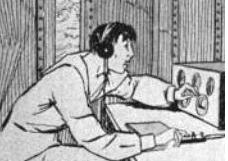
EmergencyXtalSetRadioTVExperimenter1955SchematicAnother example of crystal sets for emergency use is shown here, in the 1955 edition of Radio-TV Experimenter.  Author George P. Pearce (probably shown in the illustration above) describes the need:

If flood, tornado or air raids cause power failures, could you get emergency directions from the Conelrad stations the government has at 640 and 1240 on the dial? Even battery-powered sets couldn’t operate over an extended period of weeks, so why not build a crystal set that needs no power except the broadcast signal.

The author describes this set, which uses two 1N35 diodes along with two .001 uF capacitors in a voltage-doubler circuit. It uses basket-wound high-Q coils to pull in weak signals. It recommends a 100 foot antenna and good ground. He also suggests the use of the house wiring as an antenna, using a lamp cord, capacitor, and plug going in to the 120 volt house wiring. This ought to work, but if the power is on, you would be putting a lot of faith in that capacitor not being leaky as you put the headphones hooked to that antenna onto your head, just like they place the electrode of an electric chair.

The author notes that there’s nothing to wear out, and his set has operated for over three years.

Click Here For Today’s Ripley’s Believe It Or Not Cartoon


Sleep Alert: Warning the Public of Nuclear Attack at Night

A 1969 report prepared for the Office of Civil Defense details a proposal that was never adopted for a program called CHAT: Crisis Home Alerting Technique. In recognition of the fact that this military acronym wouldn’t be of much use with the public, a more descriptive name was proposed for dealings with the public: Emergency Broadcast System Sleep Alert.

The Emergency Broadcast System was designed to alert the public through normal broadcast stations of enemy attack. Sirens were available in many areas, but large portions of the population would be unable to hear them, especially at night. And at night, most Americans would be asleep, and not listening to radio or television. A nighttime attack would catch Americans by surprise, unless they were sleeping in shifts to listen to the news.


In a “bolt out of the blue” attack, the problem of nighttime alerts remained problematic. But during periods of strategic crisis, such as the Cuban Missile Crisis, CHAT or “Sleep Alert” provided an answer. During such a crisis, Americans could get their sleep, but also be able to receive warning. Upon determining that a crisis existed which might require warning the population, the President would activate the system, and the public would be notified to tune to participating stations in their area. The President would then make the following announcement, probably at 11:00 PM Eastern Time:

In a moment my voice will begin to fade; merely turn your volume up until you can hear me again. This is part of a system which will permit you to receive later emergency information. Please leave your receivers on constantly; when you wish to sleep, turn the volume down to a comfortable level, and I will be able to reach you my means of your radios and televisions.

The stations would then reduce their modulation to 10-20%. VHF TV stations would reduce the audio to zero. Viewers tuning in after 11:00 would know that they were tuned in, because they would see a message on the screen explaining that the station was operating in the sleep-alert mode. In addition, the detent tuning of VHF television receivers would ensure that the viewer was properly tuned in.

AM radio stations presented a problem, because listeners tuning in after 11:00 would need to know that their radio was tuned in to the proper station. Therefore, it was decided that “subdued materials” could be broadcast. The report noted that “the more exciting up-tempo kinds of music or the strident, demanding voice delivery techniques employed at many rock and roll stations” should be avoided. Instead, the program would be soft music or perhaps a clock ticking, with occasional station identification by “an announcer speaking softly but with calm authority” with the following message:

You are listening to the Emergency Broadcast System Sleep Alert. Stay tuned for a possible emergency warning from the United States Government. Adjust your radio volume to a level at which you can sleep. This station will resume broadcasting more loudly if warning is necessary. See your newspaper for more information.

Station personnel would then monitor the AP and UPI wires for warning messages. Stations without wire service would monitor Emergency Broadcast System primary stations. In the event of that fateful message, the station would turn up the volume to normal modulation, meaning that all of the listeners would confront a radio playing at full blast, which would presumably be enough to wake them. The station would then transmit a loud alert signal, followed by the following message:

Attack–Attack. The United States is Under Nuclear Attack. I repeat–the United States is under nuclear attack. Take shelter. Take shelter immediately. You are in danger–you can save your life if you take shelter immediately. This is the emergency broadcast system.

Assuming that there was no attack during the night, the station would gradually increase its modulation at 7:00 AM, and resume normal programming.  CHAT was viewed as an interim measure, and had the advantage of not requiring any new equipment either on the part of broadcasters or the public. The plan was to replace it eventually with a more reliable system. But as a stopgap, it had the advantage of being able to be adopted readily. It was, however, never adopted.

It was at least a decade before the first 24-hour warning system came into effect, in the form of alerts broadcast on NOAA weather radio in the mid-1970’s. However, it was always subject to question how well NOAA weather radio was integrated into the national warning system. However, NOAA now makes clear that it will broadcast Presidential alerts during a national emergency, and it appears to be well integrated into the National Warning System. Modern NOAA weather receivers, such as the one shown here, take advantage of digital encoding (SAME), which will limit the number of false alarms for weather events in surrounding areas.

Click Here For Today’s Ripley’s Believe It Or Not Cartoon


CONELRAD Test, July 20, 1956

Milwaukee Civil Defense Director Don E. Carleton and Col. Anthony F. Levno assess damage after simulated attack on Milwaukee. Milwaukee Journal, Jul. 20, 1956.

Milwaukee Civil Defense Director Don E. Carleton and Col. Anthony F. Levno assess damage after simulated attack on Milwaukee. Milwaukee Journal, Jul. 20, 1956.

At 3:10 PM Eastern Standard Time on July 20, 1956, CONELRAD conducted its first (and as far as I can tell, only) nationwide test. At that time, all radio and television stations left the air for 15 minutes, and the only broadcast signals coming from the United States were those of the CONELRAD system on 640 and 1240 kHz.

CONELRAD  was obsolete almost as soon as it was put into effect, but the idea was that during an enemy attack, attacking bombers must be deprived of the ability to use American broadcast stations for direction finding and navigation. Aviation routinely made use of AM stations for navigation, and the locations of broadcast stations and their frequencies are still printed on aviation charts. It was a reasonable concern, but it became much less critical when the bomber was replaced by the ICBM as the main component of both Soviet and American strategic war planning.

CONELRAD was created by President Truman in 1951, and hung on until 1963, when it was replaced by the Emergency Broadcast Sytem, in which participating stations continued to broadcast on their normal frequency.

Under CONELRAD, all stations in the U.S. would operate on the same two frequencies.  The navigator of an enemy bomber tuning to either of those frequencies would be confronted with hundreds of stations on the same frequency, rendering them useless for navigation.  And each station would transmit for only a few seconds or minutes.  In smaller markets with only one station, the station would quickly give instructions, and then sign off for a few minutes.  In larger cities, the stations would be linked together by telephone lines.  A continuous program could be sent, but it would switch quickly from one transmitter to another, hopelessly confusing enemy bombers.

But for those 12 years, CONELRAD was the method by which Americans would be warned of war, and in 1956, it was put to a test.  At 3:10 PM Eastern Time, each participating station was to transmit the program which had been delivered by record.  The introduction to this broadcast can be heard at the following YouTube video:

In many cities, such as Chicago, the CONELRAD test was conducted in conjunction with other civil defense exercises.  The Chicago Tribune for July 20, 1956, details some of the preparations being made there.  The next day’s paper  reports 325,000 simulated deaths in the Land of Lincoln.

There was surprisingly little reporting on how well the test went: Namely, whether the public was actually able to hear the broadcasts. One of the few actual tests was carried out by Radio News magazine, and reported in the October 1956 issue.

The magazine arranged receiving sites at four locations around the New York area. They were in a steel building in Brooklyn, a steel building in Manhattan, a home about 25 miles from the city, and a home about 50 miles from the city. At each location, writers for the magazine had multiple receivers ready for the test. They then rated the percentage of the broadcast they were able to receive intelligibly.

An outdoor antenna proved to be the greatest asset. At the home 25 miles from the city, the editor reported a 100% satisfactory signal using a Hallicrafters S-40 hooked to an outside TV antenna, and also with a Heathkit crystal set with a 100 foot outdoor antenna. At the same location, a Westinghouse battery portable without external antenna gave only 75% satisfactory reception.

In Brooklyn, the best performer turned out to be the Regency TR-1 transistor portable,
which gave a 100% reliable signal, but with continual retuning as the signal shifted from one transmitter to another. At the same location, the Knight tube portable was only 75% satisfactory, with the remaining signal too weak without reorienting and retuning the radio.

In Manhattan, the transistor portable, a Zenith Royal 500, outperformed the tube portable, with 85% satisfactory reception compared to 65%.

50 miles from the city, a Grundig tube portable gave 85% satisfactory reception, outdoing the Zenith portable, which had only 60% reliability. At this more distant location, the main problem came from interference from stations in other cities’ CONELRAD networks.

It is somewhat surprising that so much “retuning” was necessary. Presumably, the stations all had a crystal for their assigned frequency (the article didn’t state whether New York was using 640 or 1240), so it’s unlikely that the individual transmitters were drifting. More likely, some of the individual transmitters were slightly off frequency, resulting in the need to retune when the signal switched from one to another.

The article did stress the importance of having nondirectional antennas, something that was lacking in most AM portables. Most of the receivers, other than those using outdoor antennas, had to be reoriented when the signal switched transmitter locations. The article noted that extreme sensitivity wasn’t necessarily a good thing, because of the danger of interference from adjacent networks. These two factors explain why the crystal set had such good results in the test.

Click Here For Today’s Ripley’s Believe It Or Not Cartoon


SNAP Challenge 2015: The Final Day

Leftover staple items.

Leftover staple items.

Today marks the seventh and final day of my 2015 SNAP Challenge, where I’ve eaten for a week on less than $31.50, the average amount received by recipients of SNAP benefits, formerly known as food stamps. My actual expenditures were $27.99, which was up a bit from last year, but still well within the guidelines. As an added challenge this year, I concentrated mostly on foods that are suitable for emergency food storage.

20150124_180632Breakfast today consisted of oatmeal. For lunch, I finished the nachos and had another serving of biscuits and gravy.  Supper, shown here, consisted of the remaining burritos, and a quesadilla made with the remaining cheese sauce and tortilla.

Most of my leftover food is shown above. I still have at least a pound each of the flour and sugar, half a pint of the cooking oil, and half a pound of margarine. So I could easily subsist a few more days on what I have. But since the challenge ends at midnight, I’ll just rotate those remaining items back into our normal household pantry, and think about what I can do for future challenges.

20150124_180008As I did last year, I celebrated the end of the Challenge by baking a cake, shown here, using  this recipe.  About the time I was supposed to take it out of the oven, I realized that I had forgotten to include the margarine called for in the recipe.  Even though the cake wasn’t as good as last year, it was surprisingly good despite this omission.

I should note that the recipe called for two eggs, and I only had one.  Over the last year, there has apparently been inflation in the price of eggs.  Last year, a dollar bought eight, but this year, I only had six eggs.  Therefore, I had to include one egg from the normal household supply.  But I’ll be sharing more than half the cake with the rest of the family.

I have five hours to go, but there’s no question that I’ll survive.  I still have about a dozen cookies to tide me over, as well as several biscuits.  I also have about a fourth of my can of coffee remaining.  In normal use, my 10.5 ounce can wouldn’t have lasted the week, but with a bit of rationing, I had plenty.

I’ll probably have some concluding thoughts in a few days, but this concludes my SNAP Challenge for the year.  Tomorrow, we’ll resume our normal programming, and look at why a Boy Scout a hundred years ago took it upon himself to have a Merit Badge requirement changed.

Click Here For Today’s Ripley’s Believe It Or Not Cartoon


SNAP Challenge 2015: Day 5

20150122_160043I didn’t really have breakfast this morning, other than coffee.  Lunch consisted of leftover Ramen noodles, with some of the mixed vegetables mixed in, along with the leftover pig in blanket from a couple of nights ago.

Since I didn’t have much of a lunch, I also had an afternoon snack consisting of the nachos shown above.  I’m concentrating on storage food for my challenge this week, and the chips aren’t a particularly good long-term storage item.  But they do have a reasonably long shelf life, and they’re the kind of thing one might find around the house in an emergency.  For long-term storage, they could, of course, be made with stored ingredients.  Yesterday, I discussed how tortillas could be made from Maseca and water.  The tortillas can be cut into chips and deep fried to make tortilla chips.

Canned cheese sauce.

The  canned cheese sauce, on the other hand, is an excellent storage item.  A few days ago, I used it to make a passable pizza.  It wasn’t intended for that purpose, and although it made a fairly good pizza, the result was unusual looking.  But today, I was using the sauce for its intended purpose, and it made a very good snack.

The cheese sauce is relatively expensive (about $2.50 per can), so it’s probably not an economical option if you plan to use it regularly on a long-term basis.  However, having a few cans in your pantry can allow you to make some good comfort food in case of emergency.

For long-term storage, a very good option for some of your dairy needs is Honeyville powdered cheese.  This product appears to be very similar to the cheese powder that comes with boxed macaroni and cheese.  For about $21, you get a lot of this powdery substance, a can containing 41 servings of 140 calories each.  It can be used for things such as macaroni and cheese (although the boxes of macaroni and cheese are probably cheaper), and also makes a quite good cheese sauce.  I’ve found that the consistency is thicker than cheese sauce, so it actually makes a better dip.

According to the instructions on the can, you simply add hot water.  It’s not salted, so you will want to add salt.  And I’ve found that the final result is better if you add a little bit of milk and butter or margarine.

A few cans of the  cheese sauce are certainly helpful for emergency storage.  But over the long term, the Honeyville powdered cheese would allow you to augment your dairy storage with something with an essentially infinite shelf life.

20150122_180510

Supper is shown above.  I made another batch of biscuits and had biscuits and gravy, using the gravy mixicon and water.  I also had some of the canned vegetablesicon and a couple of slices of the Armour Treet.  I washed it down with coffee and Kool-Aid.  I am very full after this dinner which consisted entirely of canned and dried ingredients.

I also have plenty of leftovers, such that I don’t think I’ll need to do much cooking for the final two days of the SNAP Challenge.  I have leftover burritos, pizza, and biscuits and gravy in the refrigerator, but I also have additional ingredients in case I want to try something else.  I’ve almost finished my second batch of cookies, so I’ll probably make one more batch.  The largest downfall for most SNAP Challenge participants seems to be the failure to recognize the people often eat between meals.  And having the cookies available makes the challenge much more manageable. icon


Click Here For Today’s Ripley’s Believe It Or Not Cartoon