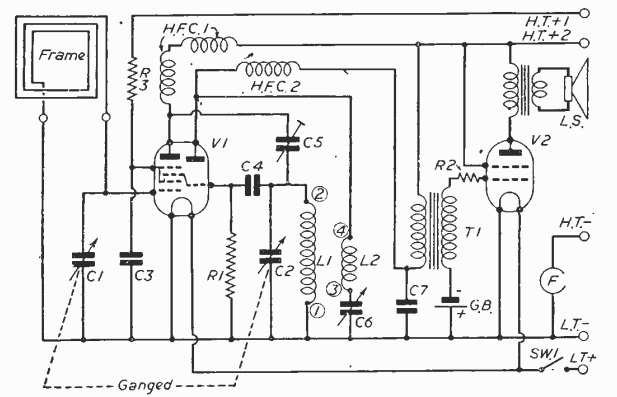
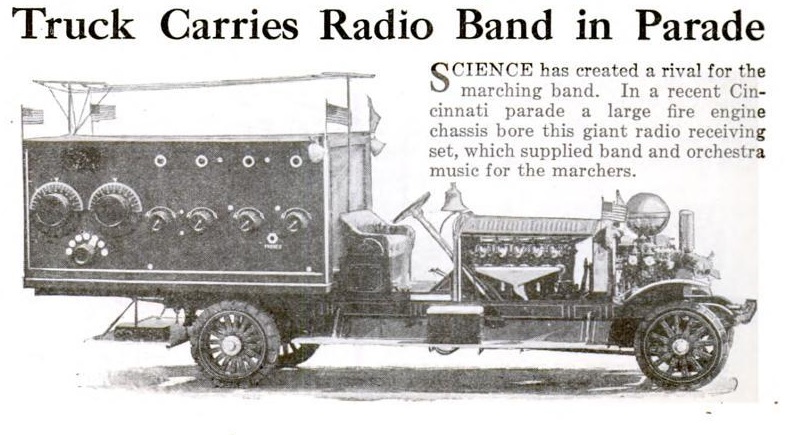
 We’re not sure where the speaker is, but a hundred years ago, this radio truck was going to replace the marching band in parades. It appeared in the December 1923 issue of Popular Science.

We’re not sure where the speaker is, but a hundred years ago, this radio truck was going to replace the marching band in parades. It appeared in the December 1923 issue of Popular Science.
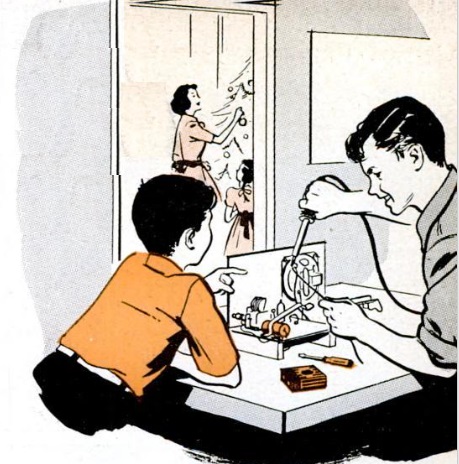
 Mom and little sister are busy decorating the Christmas tree, but Dad and Junior are doing something even more exciting: They’re putting together this simple one-tube radio, following the plans in the December 1953 issue of Popular Mechanics. While the circuit is simplicity itself, it’s powerful enough to provide loudspeaker volume. It’s designed for young builders to put together, perhaps, like here, with a little bit of help from Dad. The magazine billed the set as “Safe, Simple, and Sensitive.” Safety came from the use of batteries. Simplicity was the result of a wooden chassis and panel, and sensitivity was ensured with an efficient circuit.
And the set was more than just a novelty for kids: The magazine pointed out that it was a good idea to have a battery-operated set as a standby receiver for power failures or other emergencies.
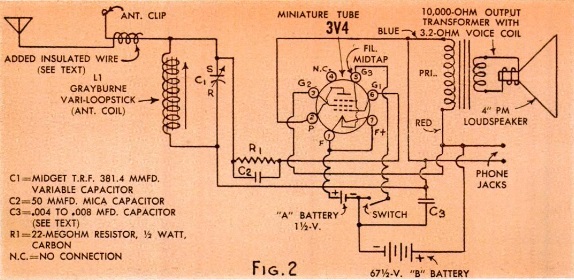
The set uses a regenerative detector using a 3V4 tube. The feedback goes through C3, which is a fixed capacitor. The article notes that some experimentation might be required to get the value just right. The author used a .004 μF capacitor, but the article noted that if signals were too weak, this should be increased. On the other hand, if the set whistled due to feedback, then the value should be reduced.
A short indoor antenna could be used. If a long outdoor antenna was used, then it was coupled capacitively with a loop of wire, since this would improve the set’s selectivity.
The end result was that Junior would have a set that he built himself, or perhaps with a little help, and the family would have a battery set for use in emergencies.
The author of the article is Lothar Stern, who went on to write Electronics Made Easy,
which was published by Popular Mechanics in 1956. He was with the magazine until 1960,
when he went to Motorola, where he authored Fundamentals of Integrated Cirucits in 1968.
According to a review of that book in QST for December 1968, it was “one of the most complete texts on basic integrated circuits and their applications that has been published, and a valuable addition to any electronics man’s technical library.”
Some links on this site are affiliate links, meaning that this site earns a small commission if you make a purchase after using the link.
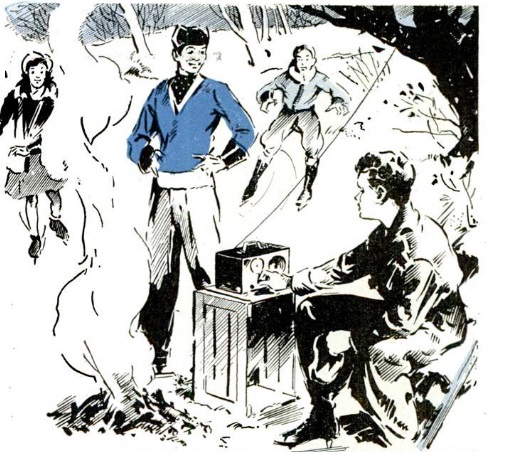
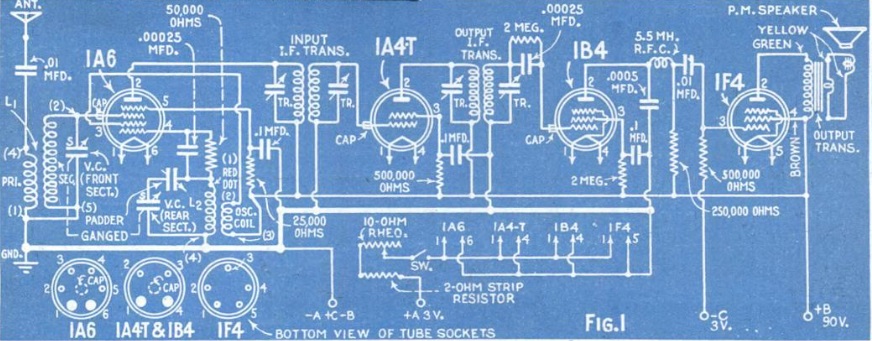
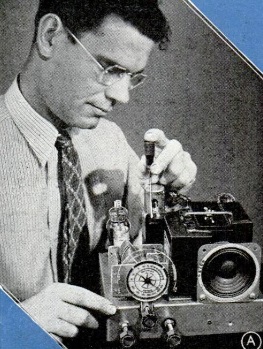 The young men in this picture would, in just a few years, be on their way overseas to fight the Germans and the Japanese, but in 1938, they were relaxing outside, and enjoying a radio broadcast thanks to the four-tube superheterodyne receiver described in the December 1938 issue of Popular Mechanics.
The magazine pointed out that many earlier so-called portables weren’t very portable at all, due to their size. But this one weighed in at only ten pounds, including batteries. The performance was said to be above average, and the drain on the battery was low. It drew only 8 mA from the 90 volt B battery, and 300 mA from the A battery.

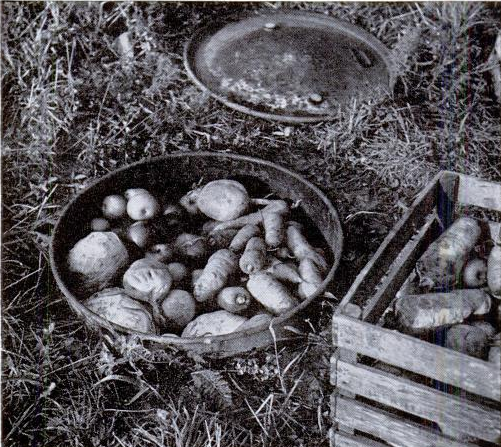 Eighty years ago, many Americans were enjoying plentiful meals without worrying about rationing points, thanks to their victory gardens. And the December 6, 1943, issue of Life magazine offered some pointers about how to store the bounty of those gardens for the winter. Above is an image of a well-appointed root cellar. The magazine noted that a well-ventilated corner of the cellar, where the temperature remained between 35 and 50 degrees was ideal. And some of those fruits and vegetables are put up in some of the four billion Mason jars that were currently in use in the country.
For those without a cellar, the magazine offered some ideas such as the one shown at the left for storage of root vegetables. In this one, a barrel is buried in the yard. After filling, it’s covered with straw, and then soil. On nice days during the winter, it is opened, and food for the next two or three weeks is removed.
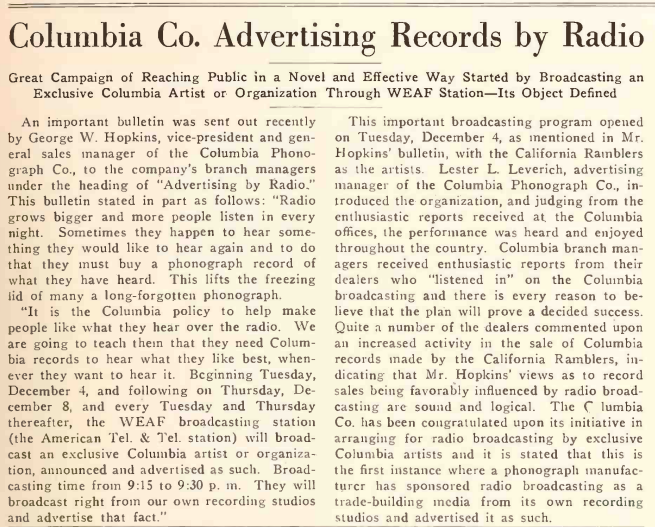 A hundred years ago tonight on the radio, you could listen to the California Ramblers performing over WEAF, New York. But it wasn’t just any broadcast, as seen from the clipping above, from the January 1923 issue of Talking Machine World. Due to the radio. Columbia records noted that the lid of many a long forgotten phonograph had been frozen. They fought back with radio, and purchased time on WEAF every Tuesday and Thursday at 9:15. Each broadcast featured a Columbia recording artist, and was broadcast right from the recording studio. If people liked what they heard, they could buy a record, enabling them to listen to it whenever they liked.
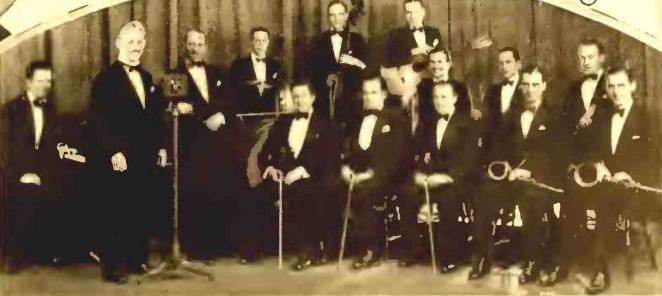
According to Columbia, listeners around the country had tuned in. The group is shown here, in 1931, in the June 1931 issue of What’s On The Air. You can hear them in their 1925 recording of “Five Foot Two Eyes of Blue”, below.
Some links on this site are affiliate links, meaning that this site earns a small commission if you make a purchase after using the link.
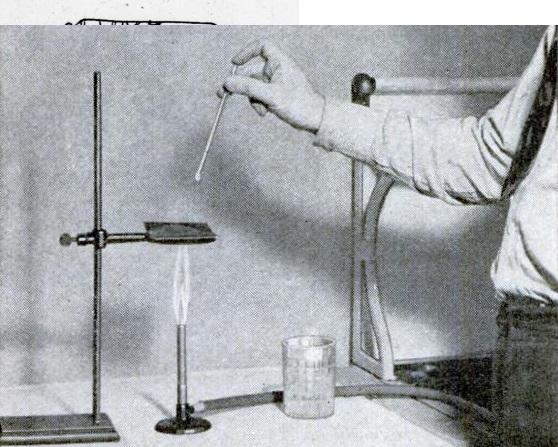 If Junior has a science fair project that’s due soon, and he or she likes playing with fire, then this simple project form 85 years ago is just the thing to take home the blue ribbon.
Like any good science fair project, this one answers a question, namely, “will a drop of water evaporate faster on a red-hot piece of metal, or on one that is only moderately hot?” The classmates, and probably the teacher, will undoubtedly place their bets on the one that’s red hot, but Junior will prove them wrong.
The reason is that on the red hot surface, a cushion of steam forms, and the drop of water mostly retains its shape as it dances about. But if the surface is only moderately hot, the water spreads out and evaporates immediately.
Most schools have probably turned off the gas to the bunsen burners in the science lab, but you can bring your own from home. You can get this handy propane bunsen burner from Amazon. In fact, the science teacher will probably be a little bit jealous and want to get one for themself. The school probably has the lab stand, but if not, you can also get that on Amazon.
This project appeared in the December 1938 issue of Popular Science.
Some links on this site are affiliate links, meaning that this site earns a small commission if you make a purchase after using the link.
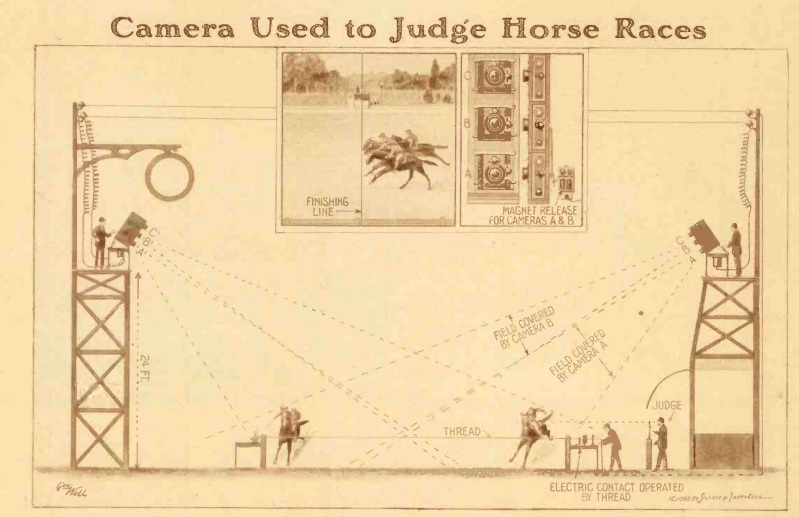 The concept of a “photo finish” has been around for a century, as shown by this Illustration in the November, 1923, issue of Science and Invention.
This setup was in place at the Maisons-Laffitte Racecourse near Paris. The horses crossing the finish line broke a thread, which would trip the shutter of the cameras above. The photos would be ready in four minutes to decide a close race.
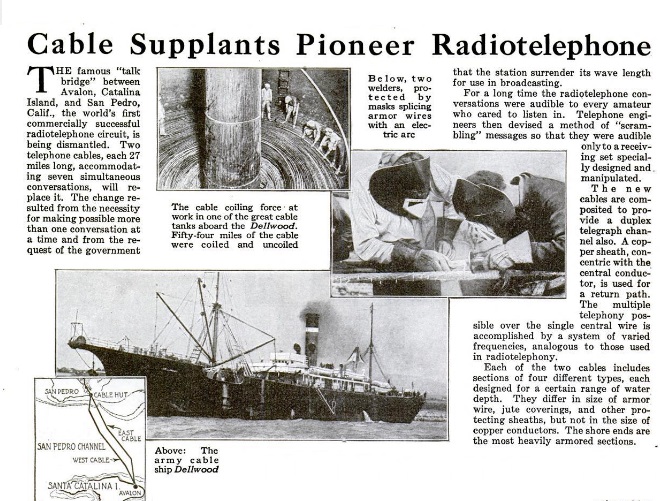 We previously reported the construction, in 1921, of a radiotelephone link between California and Santa Catalina Island, 26 miles across the sea (40 kilometers, for those in leaky old boats). That link was in use for only two years, as reported here in the November 1923 issue of Popular Science.
In 1923, a cable was installed for both telegraph and telephone connections, both of which were multiplexed to allow multiple conversations. One advantage of the new system, alluded to in the original article, was that radio conversations could be listened in to. While some scrambling was put in place, the signals were transmitted over the air. In addition, the radio license was surrendered, and that wavelength made available for broadcasting.
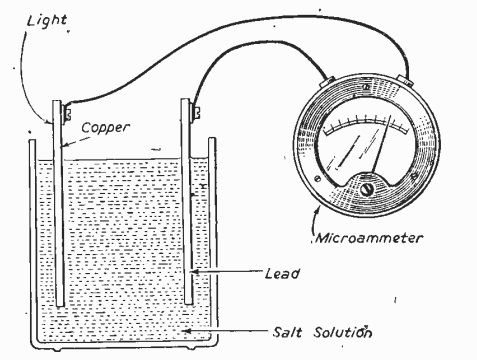 Today, we have another science fair project suitable for students who like to use dangerous chemicals. It’s a homemade photoelectric cell. It won’t provide large amounts of current, but it is measurable, and it can probably be used to receive a signal from a modulated beam of light, simply by connecting it to an audio amplifier (similar to this previous project).
The cell consists of a beaker of water in which a “pinch” of salt has been added. Into this are inserted strips made of copper and lead. The copper is heated with a torch to oxidize it, after which it is scrubbed with nitric acid. There is some current even in darkness, but when the copper strip is exposed to light, the current increases.
The project appeared in the November 1948 issue of Practical Wireless.
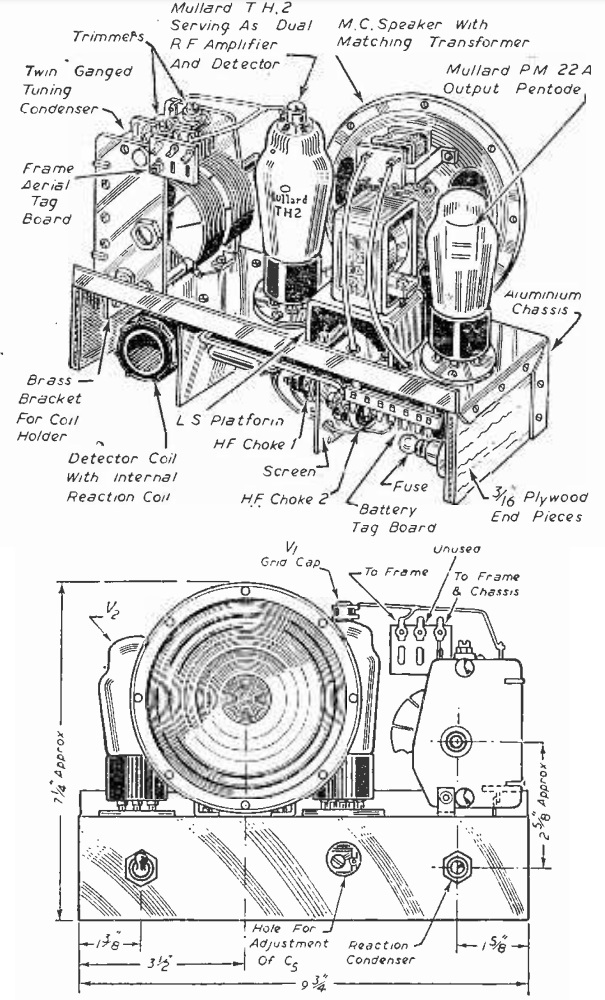 The plans for this two-tube British bedside portable appeared 75 years ago this month in the November 1948 issue of Practical Wireless. The set was designed to pull in the BBC Light and Home Service programs with loudspeaker volume, using commonly available components. It ran on battery power, and used two tubes. Because a small frame antenna would be used, the author realized that at least one stage of RF amplification would be necessary. Therefore, the first tube was a dual tube, servicing as RF amplifier and detector. Another tube served as AF amplifier to drive the speaker.