
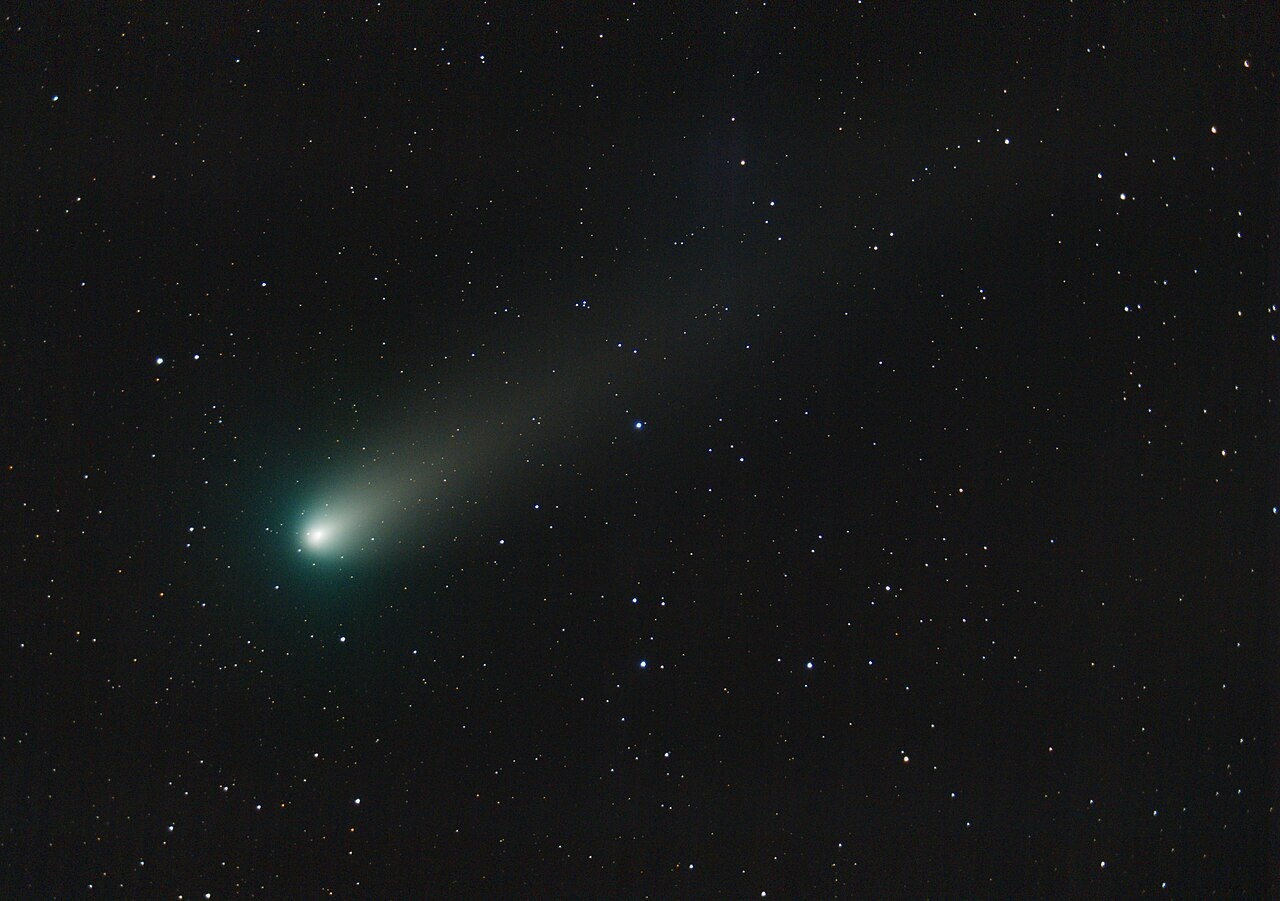
Comet Giacobini-Zinner. Wikipedia photo. By Alexander Vasenin – Own work, CC BY-SA 4.0,
We previously reported about how the phenomenon of meteor scatter was discovered in 1944, through the distant reception of short bursts of signal from FM broadcast stations on the 42-49 MHz band. And 80 years ago tonight, hams got their first taste of what meteors were capable of.
The night of October 9, 1946, saw a spectacular astronomical show. While much of the Eastern Seaboard had cloudy conditions, areas with clear skies witnessed a meteor shower from the passage of the comet Giacobini-Zinner. For example, the Nogales (AZ) International for October 11 reported, “many Nogalians saw a spectacular display Wednesday night when hundreds of falling meteorites from the comet Giacobini-Zinner flashed across the sky. The display was said by astronomers to have been one of the greatest ever witnessed.”
Prompted by the 1944 discovery of the phenomenon, hams were ready to see what it had in store for them. And for those who tuned the six meter band that evening, they were not disappointed.
Ed Tilton, W1HDQ, wrote about that night in the World Above 50 MC in the December 1946 issue of QST:
https://www.worldradiohistory.com/Archive-DX/QST/40s/QST-1946-12.pdf
We thought we’d seen everything! We’ve lived with temperature inversions and sporadic-E skip for years, aurora effect, with its fuzzy c.w. and unintelligible ‘phone is becoming widely recognized; the possibility of long-distance work via F2 skip is well known, and countless v.h.f. workers are on the lookout for it – but then along comes old Giacobini-Zinner and we have “ionization by cosmic dust” as a new means of v.h.f. propagation.
The display of meteors, forecast for October 9th, had been well publicized, and v.h.f. enthusiasts were on the lookout for unusual propagation conditions throughout the evening. By about
8:30 P.M. a peculiar rumble was noticeable on all 50-Mc. signals coming from beyond the horizon. Signals from points in a range from 200 to 1200 miles began to fill the 6–meter band, causing a degree of QRM never before experienced in this normally wide-open space.
