Author Archives: clem.law@usa.net

SNAP Challenge 2015: Day 1

The SNAP Challenge got to an uneventful start today. For breakfast this morning, I had two of the pancakes.  Because of the failure with the syrup last night, I put peanut butter on them.  On the way to church, I put an extra pancake and a couple of cookies in my pocket, which I had as a snack on the way home.

20150118_140044For a fast lunch, I made some tuna salad, consisting of pastaicon, one can of tuna, and some mayonnaiseicon.  I had about half of it for lunch and saved the rest for later.  I also had two biscuits and a couple of cookies for dessert.  I didn’t resort to drinking windshield washer fluid.  The blue liquid was actually Kool-Aid, since it turns out that the first batch was that color, undoubtedly with all-natural coloring.  I also had coffee.  For some reason, many SNAP Challenge participants add to the suffering by erroneously concluding that coffee is out of their budget.  I have plenty for a week, and it cost only about $2.  I am conserving somewhat, however.  Normally, I would go through the 10.5 ounce can in a little less than a week.  Therefore, I’m making it one cup at a time, and I should have plenty for the week.


For supper, I made experimental pizza.  Since one focus during my SNAP Challenge is the use of food appropriate for emergency storage, I decided to work with cheese.  Storing dairy products can be a challenge for some, but there are many options.  One of them is canned cheese, such as shown here.  At WalMart, it cost about $2.50 for a 15-ounce can.  It’s available in many supermarkets in the Mexican aisle.  This one is called “condensed,” and for use in things like nachos, the instructions call for water to be added.  We normally buy the uncondensed version, which sells for about $2 for the same size.  It was out of stock when I made my shopping trip.

I used this cheese in pizzas, which are shown here.  SNAPpizzaAs you can see, they wound up looking a bit unusual, since the cheese didn’t completely melt.  Chances are a more skilled chef would be able to make the pizza look a bit more presentable, but it tasted good.  The crusts are flour tortillas which I first coated with a bit of vegetable oil.  On top of that was some of the spaghetti sauce.  For toppings, I used about 1/4 of the can of cheese and two Vienna sausages.

Despite it’s odd looks, this year’s pizza tasted much better than my first attempt last year.  Last year, I used plain tomato sauce, and I didn’t have many seasonings to work with.  As a result, it was rather bland. In fact, the pizza represented the one time that I threw away leftovers last year.  In addition, the canned cheese I used this year actually worked a lot better than the cheap cheese I used last year.  And ounce for ounce, the price was about the same.  I’ll be using the canned cheese in other recipes over the next few days.  Even though the can of cheese represented my single largest expenditure this year, I think it was a good choice.

The can of cheese had an expiration date of May 2016, meaning that it has a shelf life of over a year.  It does look like a good option for emergency storage.  Calorie for calorie, it’s more expensive than other options (about $2.50 for 700 calories), but it’s still a good choice for adding a bit of variety.

I washed down supper with another glass of blue Kool-Aid and, of course, coffee.

Click Here For Today’s Ripley’s Believe It Or Not Cartoon


1940 Emerson Radios

EmersonAd011940

Seventy-five years ago, Gimbels Department Store in Milwaukee ran this ad for Emerson radios in the January 19, 1940 edition of the Milwaukee Journal.

For $9.95, you could get the standard broadcast receiver with a “miracle tone chamber” and built-in loop antenna. It came with a “safety power cord,” which apparently meant that it didn’t have a “curtain burner” cord with built-in dropping resistor for the filaments. This appears to be the Emerson Model 330 in a bakelite case.  You can see the radio in operation at this YouTube video.  Another nice example, along with the schematic, can be found at RadioMuseum.org or at N9DD’s site.

$19.95 would get you a six-tube set that tuned police calls as well as the 49-meter shortwave band. It appears to have two bands, meaning that the police calls were probably at the top end of the standard broadcast band.

And for $29.95, you could get the seven-tube set which also covered the broadcast and shortwave bands for “complete foreign and American Broadcasts” with “EXCELLENT tone.” This one appears to be similar to the Emerson Model 356, but with a slightly different cabinet. A nice video of a restored model in operation can be found at YouTube.

Click Here For Today’s Ripley’s Believe It Or Not Cartoon


SNAP Challenge 2015 Day 0: Cooking

I plan to start the seven-day SNAP challenge tomorrow.  I did the shopping yesterday.  I spent a total of $26.99 on groceries that should last me the week.  Most people who take the SNAP challenge seem to go hungry since they don’t think about their basic caloric needs, which for most people is in the ballpark of 2000 calories per day.

Most of my caloric needs are taken care of with $4.94 of my purchase money, in the form of the following, which make up a total of 17,510 calories, more than enough for seven days:  Five pounds of flouricon , four pounds of sugaricon, and 16 ounces of  cooking oilicon.  Those items are not, by themselves, particularly edible.  Therefore, my mission for today was to change some of those ingredients, along with a few others, into actual food.  Since this process takes about the same amount of time regardless of the quantity, I made enough for the next few days and put them in the freezer.

20150117_200705I started by making the pancakes shown here.  They are now in the freezer and can quickly be warmed up in the toaster or microwave for a fast breakfast or snack.  I used the same recipe as last year, except I used cooking oil instead of margarine, in keeping with my theme this year of using ingredients that can be stored for emergency use.

And since my use of storage food items precludes the luxury of 20150117_203434-1having bread, I’ll be relying more on the pancakes and biscuits.  I also made my first batch of biscuits, which are shown here.  I again used the same recipe as last year, but used cooking oil in place of the sausage grease or margarine that I used previously.

I also made a batch of peanut butter cookies.  The downfall of many SNAP challenge participants seems to be the lack of snack items.  The 18 cookies I baked should tide me over between meals for the next couple of days.  I used the same recipe as last year, but since I had more peanut butter to work with this year, I was slightly more generous.  I went ahead and used the margarine for these cookies, although I think the cooking oil would have worked just as well.

I also prepared two other items, or at least tried to do so.  Envelopes of Kool-Aidicon cost 20 cents, considerably less than the pre-sweetened variety.   It’s easier to prepare it by the glass, so I made my own pre-sweetened Kool-Aid by adding one envelope to a cup of sugar.  My first failure so far was with pancake syrup.  I mixed two parts sugar and one part water (equal parts of white and brown sugar work better, but I don’t have brown sugar) and left them to simmer on the stove.  I was reminded of this when the smoke detector went off, since I neglected to keep an eye on it.  Perhaps I’ll try again tonight, but I’ll probably just clean up the mess and leave my syrup making for another day.  In any event, I lost one cup of sugar, which was burnt to a crisp rather than delivering any food value.  But last year, I had more than a pound of sugar left at the end of the SNAP challenge, so I won’t go hungry as a result of my carelessness.


Click Here For Today’s Ripley’s Believe It Or Not Cartoon


SNAP Challenge 2015: Testing Storage Food

20150116_215600


As I did in 2013, I will once again be taking the SNAP Challenge, starting in the next couple of days.  I explained it in more detail when I originally took it, but the general idea is to subsist for seven days on $31.50 in food, which represents the average amount received by recipients of the SNAP program, formerly known as Food Stamps.

There seem to be two categories of people who take the challenge.  The first group is made up of those who view the challenge as being extraordinarily trivial.  Occasionally, one of them will announce that he or she is participating and go out and buy $31.50 worth of food.  They often put little thought into what they buy, and they usually aren’t heard of after a few days.  This is probably due to the fact that they failed.

The other group of people usually make it through the full seven days, but only after enduring a great deal of suffering.  Like the other group, they usually make poor buying decisions by buying apparently “healthy” but expensive food.  They usually suffer through the seven days, but are hungry most of the time.

I’m in the middle group.  Last year, I discovered that the challenge was not trivial.  But I also discovered that with a little bit of planning, I could eat quite well over the course of the seven days.  This year, I’m doing it again, but with a new twist.  One of the focuses of this blog is emergency preparedness, and I learned last year that the challenge also taught lessons for disaster planning.

On my website, I have a number of pages discussing emergency food storage.  Since I don’t own any camouflage clothing, I’m not much of a “survivalist.”  But even for those who are not contemplating a complete apocalypse, I believe that it is important to make preparations to be reasonably self-sufficient in emergencies.  And having a reasonable amount of food in the house is one important preparation.  In most cases, this “emergency food” is just part of the groceries we would normally buy.  Therefore, the SNAP challenge is a good way to test these emergency supplies.  Last year, my SNAP purchases included quite a few refrigerated items, such as hot dogs and ground beef. These would not be a good choice for emergency storage.  This year, I made a point to store items that are similar to the kinds of things that can be stored for an emergency.

This is not a perfect test, because I also needed to stay under the $31.50 budget.  Some of the storage food I would normally buy comes in larger quantities.  Therefore, I have made a few substitutions:

I did buy six fresh eggs, which should stay in the refrigerator (although it’s relatively safe to store eggs at room temperature for a few days).  For emergency storage, I would recommend Honeyville powdered eggs. Despite any bad reputation that powdered eggs might have, the Honeyville eggs are actually excellent, and indistinguishable from fresh eggs in cooking or baking. They can even be used for scrambled eggs, which taste almost as good as normal eggs. In a real emergency, I would use the Honeyville eggs. But for purposes of this test, they would be out of my budget. A large can costs almost $20. While they are economical, the can is much more than I need for one week. Therefore, I’m substituting fresh eggs, which cost me $1 for a half dozen.

I also purchased a pound of margarine.  Margarine will keep outside of the refrigerator, but not for long-term use.  In an actual emergency, there are other options.  One option is canned butter (ghee), which is fairly expensive. Another more economical option is Honeyville Powdered Butter, which I have not actually tried, but seems to have excellent reviews.  Another surprisingly good option is Butter Flavor Crisco, which can be stored.  Last year, I didn’t purchase any cooking oil. This time, to help allay any concerns that I’m “cheating”, I did purchase vegetable oil, which I’ll use for most cooking. Therefore, my use of the margarine should be farily minimal.

My shopping list for the challenge does include a couple of items that have fairly long shelf lives, but not what one might consider “long term.” I have one package of tortillas, and one bag of tortilla chips. Both of these have an expiration date a few months out, so it’s not unreasonable to believe that they would be in a normal cupboard in time of emergency.

Finally, as I did last year, the main staple of my diet will be my five-pound bag of self-rising flouricon. The bag I just purchased has an expiration date of December 2015, meaning that it can be stored for almost a year. For actual emergency storage, I would recommend normal flour, since the “self-rising” flour is nothing more than normal flour with baking powder already added. But for the SNAP challenge, the self-rising flour is easier on the budget. The smallest can of baking powder, which would last months, was over a dollar. For emergency use, it would be better to purchase regular flour along with a can or two of baking powder.

My focus on shelf-stable food means two big changes from last year’s challenge. First of all, I used two pounds of bread last year, and I don’t have the same luxury this year. But I had flour left over last year, so I’ll need to use the flour to make a substitute. Last year, I did have meat, in the form of hamburger, hot dogs, and sausages. This year, I’ll need to get by on canned meats. That will make things more challenging.

Finally, I should say a word about milk. I’ll be using shelf-stable milkicon. It’s always available at the dollar store for a dollar a quart, it has a shelf life of about a year, and it tastes just like any other milk. It’s a good choice for emergency storage, although since most of my uses are for cooking, powdered milk would be adequate. More information is available on my milk page.

As I did last year, I’ll spend a few hours the day before the challenge begins preparing some food.  I’ll eat well during my week, but it does require advance preparation.  And it’s more efficient to do most of the preparation all at once.

Today, I purchased the food shown above.  My total expenditure was $26.99.  I bought all of the food at either Walmart or Dollar Tree.  The complete shopping list is shown below, along with the prices I paid.  You can click on the links to see the exact items I purchased.  (In a few cases, I couldn’t find the same brand online, in which case the link goes to an identical product of a different brand or size.)


Click Here For Today’s Ripley’s Believe It Or Not Cartoon


Taking the Girls for a Spin on the Radio-Equipped Ice Yacht

IceYacht

Ninety years ago, DeWolf Barton discovered the secret of attracting the girls: Just offer them the chance to go out for a spin on the ice of Lake Placid aboard his ice yacht. Barton, shown to the left piloting the craft, is joined by Virginia Markel of Cambridge, Mass., Dorothy Knoepke of South Orange, N.J., Patricia Schmidt of New York City, and Eloise Thompson of New Haven.

The radio is said to be a superhetrodyne fed by a “concealed loop” for an antenna.  Mr. Barton was apparently a particularly skilled navigator of the craft, since there’s no mention of the boom of the sail knocking over the precariously placed speaker.  This photo appeared in the January 17, 1925, issue of Radio World.

VirginiaMarkelMiss Markel was apparently no stranger to winter sports. She is shown here skiing at Lake Placid, from the December 27, 1928, issue of the Niagara Falls Gazette.

Click Here For Today’s Ripley’s Believe It Or Not Cartoon


W9XJL: Duluth-Superior Shortwave Broadcast Station

W9XJL QSL card,

W9XJL 1938 QSL card, All Wave Radio, Feb. 1938.  A color image of the card can be found at this link.,

You probably didn’t know that Superior, Wisconsin, was once the home of a shortwave broadcast station. Station W9XJL was an experimental station licensed to Head of Lakes Broadcasting Company.  It originally operated with 80 watts on 26.10 MHz, and later increased its power to 250 watts. The January 1940 issue of Radio & Television magazine carries the following report:

W9XJL, 26.10 mc, Superior, Wis., is now using a full 250 watts from 9 a.m. to 5 p.m. daily. Much can be said for the fine quality and consistency this station has shown in the last three years and for its excellent verification policy. Our observers in Massachusetts, Connecticut, New Jersey, Florida, Arizona, California and Washington all report an R9 signal whenever the band opens.

w9xjl

WEBC-W9XJL advertisement, 1939 Broadcasting Yearbook.

W9XJL  simulcasted  Duluth-Superior station WEBC on the Apex band, which existed from 1934 to 1940. The 11 meter band (25-27 MHz) was allocated internationally for broadcasting, but largely unused outside of the U.S. Apex stations. In Minnesota, both WCCO and WTCN had licenses to broadcast on the Apex band, as W9XHW and W9XTC respectively.  (A portion of the band, 25.6-26.1 MHz, is still allocated for international broadcasting, but rarely used.)  Some sources incorrectly describe W9XJL as an FM station, but it actually used amplitude modulation, although the Apex stations generally used a wider bandwidth than on the standard broadcast band, thus allowing for a more “high fidelity” audio signal.

W9XJL transmitted from 40th and Tower Avenue in Superior.  The program was generally the same as WEBC, with an announcer at the transmitter location breaking in to give the station identification.  One interesting use of the station was reported in 1937 as the relay of personal messages to and from persons wintering on Isle Royale. Station WSHC was licensed to Isle Royale.

W9XJL did receive reception reports from around the world.  As noted above, it had a good reputation for QSL’ing.

References


Click Here For Today’s Ripley’s Believe It Or Not Cartoon


Civil War Veteran and the Radio

OldSoldierRadioThis photo from the October 14, 1922 issue of Radio World shows a veteran of the Civil War listening to the radio. According to the caption: “The Grand Army veteran . . . wanted to listen in and the owner of a set obliged him. Before he had satisfied his longing, the old soldier was able to tune in himself…. The old fighter said that becoming acquainted with this new wonder gave him a new lease on life.”

While there might be a few younger, most Civil War veterans at that time would have been at least 75 years old. (A man born in 1847 would have been 18 years old at the time of the war.) He was probably born in the Polk administration, fought in the Civil War, and his sons or even his grandsons could have fought in the Spanish-American War or the First World War. The telegraph was barely in existence when he was born, and he lived to see electrification, motor cars, phonographs, the telephone, and even radio.

The world became a very different place during this one lifetime.


Click Here For Today’s Ripley’s Believe It Or Not Cartoon


How To Tune a Regenerative Receiver

1925RadioNews

Ninety years ago, this young woman demonstrates the proper method for tuning a regenerative receiver. She is shown in the January 1925 issue of Radio News.  The caption explains that the control on the left is tuning, and the one on the right controls regeneration.

Click Here For Today’s Ripley’s Believe It Or Not Cartoon


1947 One Tube Regenerative Receiver from Popular Mechanics

PMJan47RadioFido is shown here assisting with the construction of this simple one-tube radio from the January 1947 issue of Popular Mechanics. The radio is a very simple regenerative receiver described as a “student set.” The tuning range is 550-1200 kHz, meaning that the top part of the AM broadcast band is cut off. The article notes that this limited tuning range was used “for simplicity and to enable the builder to find the component parts in current radio catalogs.” In particular, instead of having the builder wind the coil, the plans call for a standard oscillator coil intended for a superheterodyne receiver.

PMJan47Radio2The receiver uses a single 117N7 tube, which combines a pentode and rectifier in the same tube. Therefore, both the filaments and the B+ can be obtained from an AC line cord. The chassis is simply a wooden base supported by cabinet knobs. Most of the wiring is under the chassis, although the high voltages are easily accessible to anyone who picks up the radio when it’s plugged in, which probably wouldn’t fly today. The radio puts out enough audio to drive a 5″ speaker, which is simply mounted facing down.

As with many Popular Mechanics electronic projects, the set was also available in kit form from Allied Radio.  It could be found in the 1948 catalog for $10.50.

Most of the parts should be readily obtainable. The most difficult would be the coil, but it is available from Antique Electronic Supply.  It could also be scavenged from an old five-tube AM radio. The tube is available from TubeDepot.com.  For more ideas on where to find parts, you can visit my Crystal Set Parts page or Jameco Electronics.


Fallout Shelter Occupancy Experiment, 1964

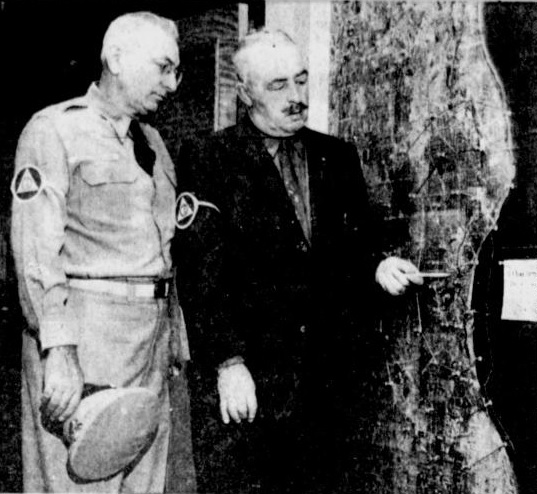
ChicagoFalloutShelterTestFifty years ago today, January 12, 1964, 26 Chicago-area volunteers, most of them in their 50’s and 60’s, were locked in the basement of the Lombard Village Hall as part of a fallout shelter test. Under the scenario, a nuclear bomb had detonated in Keokuk, Iowa, and the prevailing winds were delivering the fallout over the Chicago area. The test was covered by that day’s Chicago Tribune, from which this photo was taken.

After settling into a routine and singing the National Anthem while facing a 48-star flag found in the basement, the group played a game to get acquainted. A Catholic priest served as a medic, and treated a man found to have entered the shelter with an overdose of radioactivity. The group eagerly lined up for their first meal of survival crackers, but after tasting them, the enthusiasm for the second meal was clearly dampened. One prudent woman brought with her a thermos of coffee, undoubtedly to the great envy of other participants.

The group elected an advisory council, and various jobs were assigned. In charge of handing out the rations was a 54 year old man who had previously served as an air raid warden during World War 2 in Mannheim, Germany. The veteran of Allied air raids opined that he knew how important it was to be prepared.

The only contact that the group had with the outside world was in the form of simulated radio broadcasts, in which they were informed that retaliatory strikes had been carried out.

The Priest/Medic was to say Mass on Sunday morning, and shortly thereafter, the experiment was to come to an end.  The next day’s paper reported on the volunteers’ emergence from the shelter.  It also reported that the latecomer’s condition proved fatal.  Interestingly, while the priest was serving a medical officer, a chiropractor was serving as religious officer.  The priest summoned the chiropractor to administer last rites to the unfortunate gentleman.

For another fallout shelter occupancy experiment, see my earlier post.

Click Here For Today’s Ripley’s Believe It Or Not Cartoon