Author Archives: clem.law@usa.net

1940 Wireless Telegraph

1940DecPStelegraph

1940DecPStelegraphDiagramThe gentleman shown above is demonstrating a simple wireless telegraph, the plans for which appeared 75 years ago this month in the December 1940 issue of Popular Science. As you can see from the diagram here, the concept was nothing new, and is quite simple.  The transmitter sends an AF signal of about 75 volts at the buzzer’s frequency into two ground rods.  The receiver is also hooked up to two ground rods, and consists of an audio amplifier to detect the weak audio signal being sent into the ground.  This set was said to have a range of about 200 feet.

The concept is similar to the WW1-era field buzzer which appeared here previously.  With even a very weak audio signal, it’s easy to pick out the dots and dashes of Morse code, even though the signal is far too weak to make out speech.

Click Here For Today’s Ripley’s Believe It Or Not Cartoon


13th Amendment Ratified, 1865

13thAm

Today marks the 150th anniversary of the Thirteenth Amendment to the U.S. Constitution, forever ending slavery in the United States.  On December 6, the reconstruction Georgia legislature ratified the amendment, marking the 27th, meaning that two thirds of the states had done so.  On December 18, 1865, Secretary of State William H. Seward proclaimed that the amendment had been adopted.

Click Here For Today’s Ripley’s Believe It Or Not Cartoon


GE AM-FM Console, 1940

1940DecRadioTodaySeventy-five years ago, this pleased listener was tuning in a static-free program on her General Electric model JFM165.  The AM-FM set sported a 12 inch speaker for faithful reproduction of those high-fidelity FM programs.  This picture appeared in the December 1940 issue of Radio Today.

The set featured sixteen tubes and in addition to the standard broadcast band, covered the prewar 42-50 MHz FM band, rendering its FM capability obsolete after the war.  The set also covered, however, two shortwave bands, so it would pull in lots of interesting signals both during and after the war.

A nice example of the set can be found at this link.  As you can see, the FM tuner seems to be added in as a bit of an afterthought.  The FM dial is located in the top compartment the young lady is fiddling with.  The main tuning dial, covering standard broadcast and short wave, is at the front of the set.  The same tuner, the JFM90, was also available as a separate unit, and you can view a nice example at this link.

Click Here For Today’s Ripley’s Believe It Or Not Cartoon


A Factory Set for Christmas 1925

1925DecRadioHome

Ninety years ago, Christmas 1925 was a Radio Christmas for this family, shown on the cover of that month’s issue of Radio in the Home enjoying their new set.

Radio was coming of age, and it was no longer the sole province of home do-it-yourself tinkerers. The magazine asked the question: “Will our next radio set be home-made or factory-assembled?” While it didn’t provide a definitive answer, the handwriting was on the wall, and most homes with radio would be getting a factory built set. It noted though, that “some of us prefer a home-made set, just as we prefer mother’s home-made cake; whereas the rest of us are going to the store and buy the best set which our pocketbook can afford, just as the apartment dweller buys bakery goods because the kitchenette is too small to permit manufacture of a full-size cake.”

By 1925, almost three times as much money was spent on sets as was spent on parts, what the magazine. But back in 1922, ten times as much was spent on parts as compared with manufactured sets. So in just three years, there had been a radical shift toward the factory sets.

Click Here For Today’s Ripley’s Believe It Or Not Cartoon


1941 ASCAP Boycott

1940AscapBoycottAd

Seventy-five years ago, American broadcasters were gearing up for some big changes in 1941. The engineers were busy ordering crystals and getting ready to retune their transmitters on March 29, 1941, to the new frequencies mandated by NARBA.

But the program director had even bigger things to worry about, because of the ASCAP Boycott, which was to start on January 1, 1941, and would last until October 29, 1941.

The American Society of Composers, Authors and Publishers (ASCAP) was formed in 1914 to enforce the 1897 copyright law. In the days of live performances, this had been easy, since the royalties were just based on a percentage of the box office sales. But the phonograph, and later radio, complicated things considerably. But after almost a decade of haggling, a tenuous truce was in place between ASCAP and the broadcasters. The stations grudgingly agreed to pay 5% of advertising revenue in exchange for a blanket license to perform all ASCAP music. But the truce didn’t last long, and in 1940, worried that radio performances were cutting in to phonograph sales, ASCAP announced that it was going to triple the broadcast fee. The broadcasters decided that enough was enough, and at the National Association of Broadcasters (NAB) convention, the broadcasters decided that they would boycott ASCAP. Therefore, as of January 1, 1941, most of the stations’ existing music libraries could not be used. This included both recorded music and the sheet music used in the still common live performances by orchestras and studio pianists and organists.

Virtually every part of a station’s programming was affected. Even most program theme songs were controlled by ASCAP and had to be changed. Jack Benny had to stop playing his signature “Love in Bloom” on the violin, and Burns and Allen had to stop using their theme “Love Nest,” written by ASCAP co-founder George M. Cohan.

JeanieWithTheLightBrownHair1854.png

Jeanie in 1854, before her hair turned gray. Wikipedia image.

The stations had two alternatives, and had to act fast. First, they could make use of public domain material. This is why the Lone Ranger rode to the tune of the public domain William Tell Overture, and the Green Hornet flew to the music of The Flight of the Bumblebee. One notable beneficiary on stations’ play list was “Jeanie with the Light Brown Hair,” penned by Stephen Foster in 1854. Time magazine quipped that the song had received so much airplay that Jeanie’s hair turned gray.

Stations also turned to foreign music such as “Perfidia.” And since ASCAP had generally believed that “hillbilly” and African-American music were beneath their dignity, these genres quickly found a home on the American airwaves.

In order to get radio airtime, performers had to make the same choices. It’s no coincidence that Glenn Miller’s orchestra made 1941 hits with “American Patrol” and “Song of the Volga Boatmen,” both in the public domain.

For new music, broadcasters turned to the fledgling Broadcast Music International (BMI), a rival licensing agency founded by the broadcast industry in 1939. BMI recruited composers whose ASCAP contracts were about to expire as well as new composers, and made these available to broadcasters on more favorable terms.

A substantial portion of the December 15, 1940, issue of Broadcasting magazine was devoted to helping broadcasters gear up for the boycott.  For example, the ad at the top of this page Standard Radio touted, during the “music emergency,” its music library of 2046 non-ASCAP taxfree selections including performances by artists such as Duke Ellington and Ray Herbeck, with the promise of 100 new releases per month.

An editorial in the same issued called it a war, not unlike the war raging in Europe:  “Zero hour approaches in the war over music.  War is hell in any language, and there are hellish days ahead for the adversaries in the conflict precipitated by a hitherto arrogant, brass-knuckled ASCAP that now must know it overplayed its hand.  The rank and file broadcaster is not thinking about an ASCAP deal.  Like the Italians, ASCAP attacked with untenable demands.  And like the Greeks, the broadcasters are on the march.”

And in this war, the broadcasters knew that ASCAP would be ruthless.  Every broadcaster knew that the ASCAP lawyers would retaliate heavily for even the most innocent minor violation.  The broadcasters had to ensure that not one note of an ASCAP-licensed competition could go out over the airwaves.

The magazine carried the advice sent out by CBS to its affiliates about the steps that needed to be taken to avoid even an accidental infringement of any ASCAP music. It stressed that the program producer or director had to personally inspect “all music on the conductor’s stand against his certified music sheet. No other music may be broadcast.” It stressed that it was particularly important to be careful with remote broadcasts. And for protection in case of later accusations, it was especially critical to keep a meticulous log of all music broadcast.

And dead air was better than an ASCAP lawsuit, so “the program producer must have the right to pull the plug on the slightest deviation from a certified music schedule.”

Ad libs and improvisations were not to be allowed. “If it isn’t on paper and certified, it is not be be broadcast.” And stations couldn’t forget that last-minute substitutions of talent might be required. “All staff artists, organists, and pianists, who might be required to fill in, must clear a sufficient number of work sheets to meet such needs.” Organists on dramatic shows would need to immediately submit a folio of cue music sufficient for their needs and be reminded that no other music could be played unless it had been cleared.

Even at non-musical remotes, the stations would have to be careful. If a station knew that music might be played in the background at a baseball game or political rally, it was not to be picked up. Since most band music was controlled by ASCAP, “the chances are we will have to forego those portions of a special event during which the band is playing, unless you can build and work from a soundproof booth.”

All recordings would have to be checked, and the ASCAP material be put away for the duration of the emergency. If a record had an ASCAP song on one side and a non-ASCAP song on the other, then tape would need be placed over the infringing side to keep it from being accidentally played. Even the emergency records kept at the transmitter site would need to be checked. A failure of the studio to transmitter link could not be allowed to serve as a reason for the ASCAP lawyers to swoop in.

1940MarksThe magazine also contained some good news.  There were already 3400 records licensed by BMI would could be safely played.  The magazine also announced the signing of a contract between BMI and the Edward B. Marks Music Corp., shown here, transferring that publisher’s catalog of over 15,000 songs to BMI.  This freed up such compositions as “Hot Time in the Old Town Tonight” and “Ta Ra Ra Boom Der Ay” for broadcast.  Benny Goodman’s theme song, “Let’s Dance” was among those included in the Marks deal.

References

Read More at Amazon

The following songs in this post are available at Amazon where you can listen to a free sample or download the MP3:


Click Here For Today’s Ripley’s Believe It Or Not Cartoon


Vivienne Segal, 1935

1935VivienneSegal

80 years ago, the cover of this day’s issue of Radio Guide, December 14, 1935, featured actress, singer, and radio personality Vivienne Segal.  The magazine noted that she had until that week been featured on the “American Album of Familiar Music” and “Waltz Time” programs, and that she expected to begin a new series of broadcasts shortly.

The magazine noted that she had been awarded an honorary professorship of music at the New York School of Music, in recognition of her encouragement of talented young singers, including endowing scholarships and awarding trophies in amateur competitions.

Ms. Segal was born in Philadelphia in 1897 and is best known for introducing the song “Bewitched, Bothered and Bewildered” in the 1940 production of Rodgers and Hart’s Pal Joey.  She died in California in 1992 at the age of 95.

The 1940 production of Pal Joey was never recorded, but she made the following recording of her most famous performance in 1951.

Click Here For Today’s Ripley’s Believe It Or Not Cartoon


Annette Hanshaw, 1920’s-30’s Radio and Recording Star

1935RadioGuideAnnetteHanshaw2
1935RadioGuideAnnetteHanshawFeatured here on the cover ofhe March 11, 1933 issue of Radio Guide is Annette Hanshaw, who was also featured in the magazine’s June 16, 1934, issue, from which the photograph above is taken.

Throughout her carreer, she gave her birthdate as 1910, although it was revealed after her death that she had actually been born in 1901. The 1934 article notes that she first sang professionally at the age of sixteen, but she would have been about 25 at the time. Her father owned an inn at Mt. Kisco, New York, and she started a music shop in the same town. One day, Waldemar Rose, a Pathé record executive, visited the store, heard her voice, and advised her to audition. She was immediately offered a job, and between 1926 and 1934, she sold over four million records.

One of her most ardent fans was Edward VIII, the then Pricne of Wales, who had a standing order for all of her records. She recorded under a number of names, including her own. Her other names included Gay Ellis, Dot Dare, and Patsy Young, Ethel Bingham, Marion Lee, Janet Shaw, and Lelia Sandford. Her first records were released under the Pathé and Perfect labels, as well as other labels. Her radio career included a starring role in the NBC radio program Maxwell House Show Boat, and she had one film appearance, in a 1933 Paramount short “Captain Henry’s Radio Show”, a “picturization” of the radio program, which you can view here:

In 1934, readers of Radio Stars magazine voted her the best female popular singer, the same year that Bing Crosby was named the best male popular singer.

She retired from show business in the late 1930’s. She later revealed that she disliked the business intensely, and admitted “I loathed it, and I’m ashamed to say I just did it for the money.”

She died in New York in 1985, and her New York Times obituary gave her age as 74. She was actually, however, 83, as her actual birth date was not revealed until after her death.

Scores of her recordings are available online. Here is her 1930 recording of “Happy Days are Here Again”:

Click Here For Today’s Ripley’s Believe It Or Not Cartoon


Funeral Gigs for 1940 Sound Men

1940DecRadioCraft

The electronic entrepreneur 75 years ago always had his eye open for a business opportunity, and

Ray W. Winter of Jenk’s Electric in La Habra, California, was no exception. In the December 1940 issue of Radio Craft magazine, he offers a case study of how he sold sound to local funeral directors and ministers.

A prominent physician had been killed in an auto accident, and an overflow crowd was expected for his funeral. The evening before the funeral, the minister and funeral director contacted Winter to set up a public address system covering the lawn and sidewalk outside the church. The diagram above shows the setup that was used.

A single microphone was used, about 5 feet from the pulpit and 8 feet from the choir and singers. This was close enough to ensure good pickup, but far enough away to avoid loud blasts if someone spoke too loudly too close to the microphone. The amp was set up a moderate distance from the speakers where the operator could monitor the levels. At the end of each solo or talk, he momentarily lowered the volume to avoid a loud blast, and then readjusted it for the next portion of the program.

The amp put out about 4 watts to each of the speakers. The amp had ten tubes, and could accomodate two mike inputs. In addition, for other work, the owner had a turntable and tuner available. He charged $6-12 for a funeral, and he reported that the total cost of all of his equipment was about $340. He always carried a few extra tubes as a safety factor.

Winters hoped that his idea would prove useful for other sound men. He noted the importance of making contacts with the local funeral directors.

Click Here For Today’s Ripley’s Believe It Or Not Cartoon


Neutral Ship Wireless in the European War Zone

The Seguranca in Havana Harbor

The Seguranca in Havana Harbor

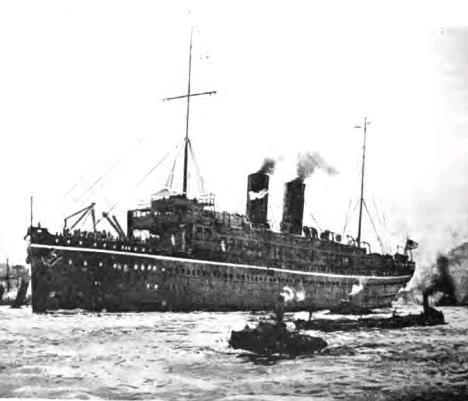
A hundred years ago this month, the December 1915 issue of Wireless Age carried an interesting account of J.K. Noble, the wireless operator aboard the steamer Seguranca, recounting the ship’s voyage from Pensacola to London with a cargo of naval stores and lumber. The ship left New York en route to Pensacola on May 30, and the most remarkable incident on that leg of the voyage was a hawk which perched itself on the ship’s mast looking for a meal. It set its eyes on the ship’s mascot, a kitten named Booze, and finally swooped down on the cat. The cat fought back and managed to break free. The ship’s crew attempted to shoot the hawk, but the bullet went wild and the bird flew away.

The trip across the Atlantic was initially uneventful. Noble points out that the wireless gave the latest news every night from Cape Cod and Poldhu, England. He was able to copy the French war news from FL, the Eiffel Tower station, up to 1600 miles from Paris. The French time signals were also used to check the accuracy of the ship’s chronometer.

As the ship neared England, the traffic picked up, the call signs were unfamiliar, and almost all messages were coded. The call signs he heard included ZAAW, ABMV, CX, A27, 51M, XXJ, and YCF.

On July 7, Noble copied a message sent by the Poldhu station to the Saxonia, then serving as a troop ship, with a warning of a possible bomb placed on board by a fanatic who had attacked J.P. Morgan (apparently Erich Muenter).

As the ship entered the war zone, the Seguranca kept her neutral American flag illuminated at night, as well as the letters “U.S.A.” which had been painted on both sides of the ship. The lifeboats were slung out. Two submarines were sighted, but they kept a considerable distance.

The Seguranca's lifeboats at the ready as she enters the war zone.

The Seguranca’s lifeboats at the ready as she enters the war zone.

The ship entered the English Channel through the Strait of Dover, passing through two light ships. The British ordered the Seguranca to take down her aerial at this point. At Deal, the ship was stopped by a British patrol boat and its officers examined the Seguranca’s papers. After a few hours’ delay, a pilot boarded and the ship headed to London under torpedo boat escort.

Taking down the aerial off Dover.

Taking down the aerial off Dover.

The big guns in France could be heard, the sound ceasing only as the ship started up the Thames. To guard against air raids, the ship’s lights had to be covered at night, and the generator had been ordered shut off at 10:00 PM.

Because of a wartime shortage of stevedores, the ship remained in London for five and a half weeks while being unloaded. While in London, Noble was stopped more than one time by British officers trying to persuade him to enlist in the British forces.

The return trip gave Noble the opportunity to hear more radio traffic. After passing Dover, the aerial was reinstalled, and Noble was back on the air. On August 19, he first copied the Baron Erskine (MHF) reporting that it was being chased by a sub. One of the patrol boats reported that it was coming to her assistance. At 2:45, he copied an SOS, stating that it had been struck by two enemy subs. This ship gave a location, but didn’t sign a call sign. Noble concluded that this SOS had come from either the Arabic or the Nicosion. Since the reported location was 200 miles away, the Saguranca did not go to the aid of the distressed vessel.

Soon thereafter, at 5:30, he copied an SOS from the steamer Bovic, call sign GDO, reporting that she was being chased by a sub. A patrol boat said that she was coming to the Bovic‘s aid, but at 7:30, the Bovic reported that she was sinking. The patrol boat reported that she would be there by 9:00.

Two days later, the steamer Georgia (call sign GDT) was requesting a doctor, since her chief engineer had seriously wounded himself with a rifle. The Minnehaha, MMA, had a doctor aboard, but had some doubts as to the veracity of the message, fearing that it might have been faked by the Germans. After some confirmation, a rendezvous was arranged, and an hour or two later, the Minnehaha reported that the wounded man was on board.

The remainder of the voyage back to New York was uneventful, and the “Seguranca steamed past the lights of Coney Island and headed up the bay while on the lips of those on board was framed a word full of meaning–home.”

According to the Nautical Gazette, the Seguranca was launched in 1890 and served until 1920.

Click Here For Today’s Ripley’s Believe It Or Not Cartoon


Loretta Brophy, WABD, 1945

1945WABDCamel

Seventy years ago today, life was good. The War was over, television was becoming a reality, and you could buy a pack of Camels whenever you wanted. Shown here in the December 10, 1945, issue of Life Magazine is Loretta A. Brophy, getting ready to enjoy a Camel during a break from her busy job as program director at the New York DuMont television station, WABD.

The ad also showed Miss Brophy rehearsing with a song-and-dance team, but pointed out that the next day, it might be a quiz program or grand opera. Miss Brophy called her job “fast, exciting, fun!”

And when she called “cut,” that meant the show was over, but Camels were still in order. She reported that during the wartime cigarette shortage, “when I couldn’t get Camels, I smoked anything I could get, more different brands than I can remember. That’s when I learned really to appreciate Camels–there’s nothing like a Camel.”

Other than this advertisement, I wasn’t able to find any other references to Miss Brophy, although she was obviously one of the pioneers of television. She wasn’t alone, as women held a number of important positions.

1945WootenWhile not mentioning Miss Brophy, the Spring 1945 issue of Televiser carried a feature entitled “Women in Television.” At WABD, when the wartime manpower crisis put a damper on hiring, “women in slacks blossomed forth as ‘cable engineers’ (studioese for people who haul co-axial cables out of the way of the cameramen). One of WABD’s early staffers was Dotty Wooten, shown here. She was hired as a stenographer in 1943, but was one day called in to fill an emergency slot as announcer. The magazine reported that she had filled the announcing post ever since.

In our previous post about WABD, we noted that the station really had no full-time staff when it first came on the air.  The station was on the air three evenings a week, and was largely staffed by workers at DuMont’s New Jersey war plant.  With men off to war, it wasn’t surprising that women were called on to staff the station.

The same issue of Televiser  gave some insight into the challenges faced by Miss Brophy in her job.  Directing a television program was challenging, as it involved careful choreography of the cameras.  Each of the large cameras was fed with a thick coaxial cable from behind.  Therefore (except perhaps with the assistance of one those cable engineers), it was impossible for one camera to cross behind another.  Therefore, one camera had to be already in place for the next shot before the second camera “dollied in” for a closeup.  Interestingly, the byline for the sidebar explaining this choreography was that of a woman, one Patricia Murray, also on the staff of WABD.

Click Here For Today’s Ripley’s Believe It Or Not Cartoon