Author Archives: clem.law@usa.net

Potter Rug Aerial, 1930

1930PotterRugAerial

Frankly, I’m a little surprised that this idea from 1930 didn’t get more traction. It probably worked about as well as any other indoor antenna, and it was conveniently out of the way and swept under the rug. The sole reference I’ve ever seen to the “Potter Rug Aerial” was this ad from the December 1930 issue of Radio Retailing.

The antenna was manufactured by the Potter Co. of 1946 Sheridan Road, North Chicago, Illinois. In addition to the antenna, they manufactured replacement condensers. They had common ones in stock, and promised to duplicate special units within 48 hours.

One reason that the rug aerial might not have caught on was the utter simplicity of the idea. Any piece of wire about the same length slipped under the rug would probably pull in the stations just about as well.

Click Here For Today’s Ripley’s Believe It Or Not Cartoon


1936 Silvertone Model 1954

19351227

80 years ago today, you could get this 6 tube all wave set for $24.95 at Sears, as advertised in the December 27, 1935, edition of the Milwaukee Journal.  The model number isn’t given, but it appears similar to a Silvertone model 1954.  You can see a restored one in action at this video:

Click Here For Today’s Ripley’s Believe It Or Not Cartoon


Train Engineer Ejection Seat, 1915

1915DecPM

A hundred years ago, Popular Mechanics, December 1915, carried a description of this invention to save the lives of the engineer and fireman of a locomotive that finds itself about to be involved in a head-on collision.  Heretofore, the only options had been to either stay with the train or attempt to jump clear, and hope for the best.  Even though the magazine admitted that there might be some practical problems, it was enough to give the men a fighting chance.

With a few seconds warning, the men could pull a lever on their seat.  This would drop them, seat and all, into this thick cylinder, which would close itself and throw it free of the train.  It was strong enough that it would hold even if the locomotive landed on top.  And if it landed in the water, it would float.

Simultaneously, the lever would pull back the throttle, dump the fire, apply the brakes, and put sand on the tracks, so the departing engineer would be doing all he could for his passengers as well.

Click Here For Today’s Ripley’s Believe It Or Not Cartoon


Merry Christmas!

Lighting the Los Angeles Christmas tree, 1940.

Lighting the Los Angeles Christmas tree, 1940.

Merry Christmas from OneTubeRadio.com!

We look back to 1940, as America celebrated its last prewar Christmas. The December 23 issue of Life Magazine proclaimed that “forgetting war and stringing holly, U.S. spends to make Christmas jolly.” The magazine reported that despite the clouds of war, American preparations for Christmas “reflected no hint of anything but peace, prosperity and goodwill.”

1940 electrified Santa on the world's second largest sign.

1940 electrified Santa on the world’s second largest sign.

But the magazine also noticed a mood that contrasted significantly with Christmases of other years. Gone were the Yules filled with the fragrance of evergreens, candles, carols, still snows, and silent skies. Instead, it was filled with streamlined, mass-produced mechanical Santas of identical image grinning and nodding in department store windows. Decorators did tricks with electricity and plastics. Comic strip characters and bathing beauties intruded on a show previously dominated by the Magi and the Virgin Mary.

It said that the new mood wasn’t hard to explain, as the nation had lived with the threat of war for fifteen months. “Only in excitement, in spending, could America forget Coventry, Birmingham, and Alolf Hitler.” And there was a lot of money to spend. With war industries gearing up, Americans were flush with cash.

Click Here For Today’s Ripley’s Believe It Or Not Cartoon


1955 Photocell Alarm

1955DecRadioElec

Sixty years ago, this kid’s electronic expertise was no match for Santa. The cover of the December 1955 issue of Radio Electronics.  The youngster had constructed the transistorized photocell alarm (using a CK722 transistor) from the plans contained in the issue.  But he failed to outwit Santa, as shown in this photo.

Click Here For Today’s Ripley’s Believe It Or Not Cartoon


NORAD Santa Tracking Begins, 1955

1955NoradSantaAs you are probably aware, each Christmas, the North American Aerospace Defense Command (NORAD) tracks Santa Claus as he travels around the world. Obviously, there’s a practical reason for this. If his supersonic travels were mistaken for something else, then the results of the error could be quite dramatic, to say the least.

NORAD first began sharing this information with children 60 years ago, in 1955. Initially, this was the result of another mixup, albeit a less dramatic one. A Sears store in Colorado published the ad shown at the top of the page, purportedly showing Santa’s previously unlisted telephone number. Unfortunately, the ad carried the wrong number. Instead of Santa’s number, the store had listed the number of the Continental Air Defense Command, NORAD’s predecessor. Initially baffled, the officer answering the phone ultimately figured out what was going on, and had his men check the radar. He then gave reports of Santa’s current location.

NORAD now uses the Internet to disseminate this information, which is available at NoradSanta.org.

Click Here For Today’s Ripley’s Believe It Or Not Cartoon


Santa Claus Goes to War!

19-0339a

This World War 2 poster serves as a stern reminder of why you want to keep your name off the naughty list. Hitler and Tojo hadn’t been very nice, and the Jolly Old Elf was going to see to it that they got more than a lump of coal.

Click Here For Today’s Ripley’s Believe It Or Not Cartoon


Buying a Transistor Radio, 1960

1960DecemberEI

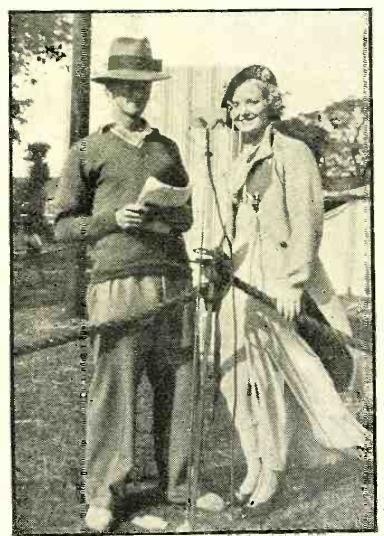
Fifty-five years ago, Santa was getting ready to place a lot of transistor radios under trees, and radio engineer Richard Stollmack is shown above giving advice to one of Santa’s helpers on how to avoid getting taken by an unscrupulous retailer. Here, he took the back off a few high quality sets to show the consumer what one should look like: They were part packed, and obviously complex designs.

Stollmack first advised shopping at a store with a good reputation, where the dealer won’t misrepresent merchandise and will honor the warranty. He warned not to buy a radio with fewer than six transistors if you wanted worthwhile performance. Also, he stressed that you should look for a superheterodyne circuit, which would require a bare minimum of five transistors. Any doubt could be resolved by looking at the tuning condenser to see if it was a dual-gang unit.  Any set with less than five transistors should be considered a toy or novelty, Stollmack warned. He advised that you should insist on having the salesman open up the back of the set and let you see the inner construction and compare it to a higher priced set. Shoddy construction or a paucity of parts would be a major warning.

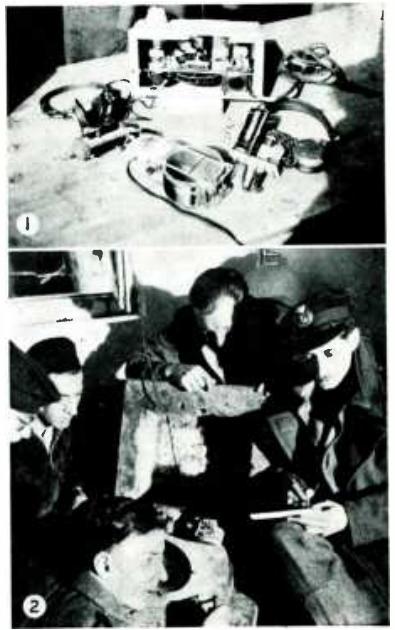
1960DecemberEI2He also stressed the need to handle the radio and take it outside or close to a window. In this photo, he is showing a trick sometimes used by unscrupulous dealers to pass off cheap novelty sets as having better reception than they really offered. The set performs well when located near an induction coil, cleverly concealed under the counter, hooked to a longwire antenna. But when brought home, the set would be unlikely to get more than a couple of stations with loudspeaker volume.

Stollmack shared these tips in the December 1960 issue of Electronics Illustrated.

Click Here For Today’s Ripley’s Believe It Or Not Cartoon


Medium Wave Police DX’ing in 1965

A sampling of the author's MF police QSLs.

A sampling of the author’s MF police QSLs.

I was surprised to learn that as recently as 1965, there were still some police departments using the MF frequencies just above the standard AM broadcast band.  Many receivers in the 1930’s and 1940’s included the police band, either by including a separate band, or by simply extending the tuning range of the broadcast band.  Surprisingly, a few of these police stations were still around in 1965, and the December 1965 issue of Radio TV Experimenter included a complete listing.

At the end of 1947, there were 700 police base stations operating between 1600 and 2500 kHz, but by 1965, the number was down to less than a hundred “hearty stations clinging to these channels”.

The author of the article, Tom Kneitel, K3FLL/WB2AAI (later K2AES and KBG4303, later still W4XAA) called these stations a “vanishing breed,” and that they would probably be gone in just a few more years.

Kneitel noted that the easiest way to log these stations was to park the receiver on a given channel and listen for an hour or two. He had listened to a dead frequency for 15 minutes only for it to come alive with several stations at the same time. One of his favorites was the New Hampshire State Police, KCA999 on 1682 kHz. Their signal had been regularly logged in Europe.

As shwon above, most of these stations would QSL. Kneitel’s advice was to include date, time, frequency, signal strength, equipment, and some specific detail about the transmission. Although a few of them had QSL’s printed up, most didn’t. Therefore, he recommended preparing a prepaid reply card for them to fill in, sign, and return.

Kneitel pointed out that within a few years, all of these stations would be gone, “little more than memories to be discussed around the table with other old time DX’ers, which made them seem even more interesting.

Tom Kneitel, 1971.

Tom Kneitel, 1971.

If the name Tom Kneitel sounds familiar, that’s probably because he wrote for numerous publications over the years, including Popular Communications, S9, and Popular Electronics, and a number of books.  I remember him mostly for his regular column in Electronics Illustrated,  dubbed “Uncle Tom’s Corner,” in which he provided usually useful, and occasionally snarky, answers to reader letters. A example of the latter is this one from the November 1971 issue:

I’m only beginning in Amateur Radio and I’d like you to explain what is the Voice of America.

-Stephen Baier
LaCrosse, Wisc.

Spiro Agnew.

Kneitel died in 2008 at the age of 75.

Click Here For Today’s Ripley’s Believe It Or Not Cartoon