Author Archives: clem.law@usa.net

1970 One Tube Superhet

1970OneTubeThe plans for this one-tube receiver appeared in the Fall-Winter 1970 issue of Electronic Hobbyist, a special issue put out by the publishers of Elementary Electronics.  Even though it’s a one-tube set, it’s really the functional equivalent of the “All American Five” five-tube receiver, whose reign was just ending about that time.  The one tube employed was a 6M11, a triple tube consisting of two triodes and a pentode.  The three sections of the tube acted as local oscillator, IF amp, and AF amp.  The detector was a 1N34 diode, and the rectifier was a solid-state bridge rectifier.  So as one-tube broadcast radios go, this is about as sophisticated as they get.

As revealed by the picture, the author concedes, “we didn’t attempt to make the front panel an artistic masterpiece. You may want to make yours more attractive by restyling the dial plate and /or the speaker grille.”

“New old stock” examples of the tube are available at a reasonable price.  The parts that might prove to be unobtanium are the loopstick antenna, oscillator coil, and IF transformer.  If you have an old AA5 that’s beyond repair, the best course of action might be to scavenge them from it.

1970OneTubeSchematic


Click Here For Today’s Ripley’s Believe It Or Not Cartoon


1945 Stromberg Carlson Radio

1945StrombergCarlson

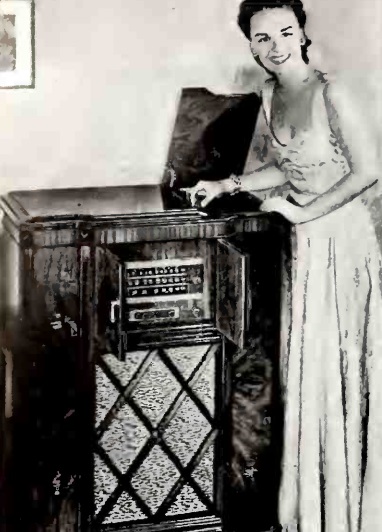
Seventy years ago, the War was over, and American radio manufacturers were getting ready to deliver on the pent-up demand for radios, which had been out of production since early 1942. Stromberg-Carlson was no exception, as shown by this ad in Life Magazine, November 12, 1945, promising that the sets shown here would soon be available.

Interestingly, the FM sets covered two bands.  Since some prewar stations were still on the air on the old band, the sets covered 42-49 MHz.  But since that band would soon be depopulated and the stations moved to the new band, they also covered the modern 88-108 MHz FM band.

Click Here For Today’s Ripley’s Believe It Or Not Cartoon



Armistice Day Blizzard 75th Anniversary

Armistice Day Blizzard, Excelsior Blvd., West of Minneapolis. Minn. Historical Society photo, NOAA.

Today marks the 75th anniversary of the Armistice Day Blizzard, a deadly storm that hit Minnesota and surrounding states on the eleventh day of the eleventh month of 1940.  The strom came up suddenly and without warning, and resulted in 145 deaths, including 49 in Minnnesota.  The death toll was so high because the day started out unseasonably warm, but quickly and unexpectely turned into a severe blizzard to which many were totally unprepared.

I wrote about it previously, and focused on how amateur radio operators became involved.  A couple of names that later became familiar were involved.  Stan Burghardt, W9BJV, later W0IT, kept Watertown, South Dakota, in touch with the outside world, and Sherm Booen, W9HRT, who later became known for the World of Aviation program on WCCO-TV, was a key link from Albert Lea.

Broadcast radio also played an important role that day.  Booen was also employed by KATE radio in Albert Lea.  Even though personal messages were not normally allowed on broadcast stations, an emergency exception was made and some personal messages were broadcast.  Also, to establish contact with Mankato, the station broadcast a message and requested that KYSM in Mankato reply on its frequency.  A two-way link was established on the broadcast band, and some emergency messages were broadcast.  Local phone service was working in Albert Lea, and long-distance service was available in Mankato.  Therefore, the on-air link established a lifeline to the outside world.

In Willmar, Minnesota, station KWLM had gone on the air only a month earlier.  The station’s application had initially been rejected by the FCC on the grounds that Willmar was too small a community to warrant a station.  The blizzard proved this argument wrong, since the station provided an important link for that community as well.

The storm covered much of the Midwest, and in Chicago, it was notable as a severe wind storm. The area was hit with 65 MPH winds, the strongest since 1898. Among the victims was this 357 foot tower of a station then located in Gary, Indiana. The call letters of the station, and the cause of the tower collapse, are revealed on the transmitter building: WIND.

And now, as another Chicago broadcaster would say, you know the rest of the story.1940WIND

This image is from the November 15, 1940 issue of Broadcasting.

Read More at Amazon

Click Here For Today’s Ripley’s Believe It Or Not Cartoon


Execution of Henry Wirz, 1865

150 years ago today, November 10, 1865, Confederate Army Captain Henry Wirz was executed by hanging.  He had served as commander of the Andersonville Prison Camp, where 13,000 of the 45,000 prisoners died.

It appears that Wirz was well aware of the appalling conditions in his camp, sought supplies from the Confederate government, and even released prisoners to carry a message to the Union seeking a prisoner exchange.  Nonetheless, he was convicted of murder and executed.

Click Here For Today’s Ripley’s Believe It Or Not Cartoon


1965 Northeast Blackout

Today marks the 50th anniversary of the Northeast Blackout of November 9, 1965.  During the afternoon rush hour, the power went out in most of New York City, as well as parts of the states of New York and New Jersey, New England, and Ontario.

Interestingly, the blackout was documented in part by an aircheck tape from WABC

in New York.  In the minutes before the blackout, the lights began to dim, but the frequency dropped from the normal 60 cycles per second to close to 50 cycles.  Since the station’s turntables used synchronous motors, the music slowed down noticeably.  The DJ even quipped that one recording sounded like it was in the key of R.  When the power went out, most FM and TV stations went off the air until the power was restored.  Most of the City was back on line around midnight, with power fully restored by six the next morning.

The New York Times managed to put out a ten-page edition, using the presses of the Newark Evening News.  Most telephone exchanges remained in service, thanks to battery backups and emergency generators.  Nonetheless, Amateur Radio operators reported for duty, and were on the scene a civil defense headquarters and hospitals, as well as their own homes and vehicles.  The activities of hams throughout the region were reported in QST in February 1966.  Nets on 2 meters and 10 meters were in operation in the New York metropolitan area as well as other areas.  HF traffic nets remained in operation continuously, but there was little additional traffic due to most phones remaining operational.

Massachusetts Governor John Volpe was reported a saying, “I understand that the performance of the radio amateurs on Cape Cod and the Islands during the recent blackout indicate you men lived up to the finest in the tradition of the radio amateurs.”

Click Here For Today’s Ripley’s Believe It Or Not Cartoon


1915 Toy Electric Range


1915ToyRange

Kenner came out with the Easy-Bake Oven in 1963, and millions have been sold over the years.  Even if it was powered by a humble light bulb (not included), it was capable of baking (and, of course, melting crayons).  And I think most boys would agree with me that of all the girl toys produced, it was probably the most interesting.

But it wasn’t a new idea, as shown by this toy electric range from a hundred years ago, as shown in the November 1915 issue of Electrical Experimenter.  As with many things, it looks like the original was even better than the watered-down later version.  This one doesn’t appear to have used a light bulb.  Instead, it appears to contain an honest-to-goodness heating element, probably capable of inflicting actual burns.

This toy range, measuring 15 inches in height, contains not only an oven (at 4-1/2 by 5 inches, slightly larger than the Easy-Bake), but also a stove top.

“On top of the range a kettle can be placed, or food can be cooked in tiny utensils that come with the range.” The range included a long cord that could go into any handy socket, and the cord even contained a switch for regulating the amount of heat.

“Little girls fortunate enough to get a toy electric range for Christmas will find ‘playing house’ a more fascinating pastime than they have ever before enjoyed.” And as with the Easy-Bake half a century later, I bet their brothers were jealous.

Click Here For Today’s Ripley’s Believe It Or Not Cartoon


1955 One Tube Reflex Radio

1955reflex

Sixty years ago, the November 1955 issue of Popular Electronics carried the plans for this little one-tube reflex receiver for the broadcast band.  With a very short antenna (just a few inches), the set was capable of loudspeaker volume thanks to the single tube being “reflexed.”  The single 6AU6 simultaneously amplified the RF and also served as a one-stage audio amplifier to drive the speaker.  The set used a 1N34 germanium diode as the detector, and a selenium rectifier, meaning that in the early days of radio, this would have been a three-tube set.

1955reflexSchematicThe author reported that the set picked up the Chicago stations from a hundred miles away.  The set was small enough to build into a wall or a piece of furniture, and instructions were provided to add a phono input or headphone output jack.

Click Here For Today’s Ripley’s Believe It Or Not Cartoon


Celebrating Perversion of America’s First Freedom (or so I’m told)

logo-wide-mediumI’m in Des Moines this weekend at the  Freedom 2015 religious liberties conference.

I suspect that the vast majority of attendees are more conservative than I am. (My liberal friends will probably find it hard to believe that there’s anyone more conservative than I.) But despite that, I found everyone there to be respectful, and it’s been an interesting experience. According to a report at WHO-TV,  there’s another religious liberties conference taking place this weekend. And according to an organizer of the other event, the one I am at “embraces a perversion of America’s first freedom and encourages bias and prejudice, religious liberty is not and should never be discriminatory.”

I’m completely at a loss as to where this notion came from. I did not hear a single person encourage bias or prejudice, and I certainly didn’t hear anyone encourage anything discriminatory. Another speaker at the competing conference opined, “we don’t believe that religious liberty should be used as a weapon, against anyone.”

I didn’t agree with everything I heard today. But I honestly don’t understand the broad brush criticism.

I wasn’t able to arrive in time for the opening session. But the first speaker I heard, Michigan attorney and pastor Robert Whims, made the unremarkable plea that Christians have a duty to serve in Government.  He encouraged those in attendance to seek out opportunities to serve the civil government in appointed an elected capacities.

Mr. Whims is of the Reformed tradition, and pointed to the Westminster Confession to show that Christians have a duty not only to pray for an honor the civil magistrate, but to serve as such:

I. God, the supreme Lord and King of all the world, has ordained civil magistrates, to be, under Him, over the people, for His own glory, and the public good: and, to this end, has armed them with the power of the sword, for the defence and encouragement of them that are good, and for the punishment of evil doers.

II. It is lawful for Christians to accept and execute the office of a magistrate, when called thereunto: in the managing whereof, as they ought especially to maintain piety, justice, and peace, according to the wholesome laws of each commonwealth; so, for that end, they may lawfully, now under the New Testament, wage war, upon just and necessary occasion.

III. Civil magistrates may not assume to themselves the administration of the Word and sacraments; or the power of the keys of the kingdom of heaven; yet he has authority, and it is his duty, to take order that unity and peace be preserved in the Church, that the truth of God be kept pure and entire, that all blasphemies and heresies be suppressed, all corruptions and abuses in worship and discipline prevented or reformed, and all the ordainances of God duly settled, administrated, and observed. For the better effecting whereof, he has power to call synods, to be present at them and to provide that whatsoever is transacted in them be according to the mind of God.

IV. It is the duty of people to pray for magistrates, to honor their persons, to pay them tribute or other dues, to obey their lawful commands, and to be subject to their authority, for conscience’ sake. Infidelity, or difference in religion, does not make void the magistrates’ just and legal authority, nor free the people from their due obedience to them: from which ecclesiastical persons are not exempted, much less has the Pope any power and jurisdiction over them in their dominions, or over any of their people; and, least of all, to deprive them of their dominions, or lives, if he shall judge them to be heretics, or upon any other pretence whatsoever.

In short, this was hardly the stuff of “perversion” that “encourages bias and prejudice.”

Rafael Cruz

Rafael Cruz

The star of today’s events was Rafael Cruz, the father of presidential candidate Ted Cruz, who also appeared earlier in the day. The elder Cruz reminded us that the Bible tells us whom to vote for, a statement that would undoubtedly cause further consternation by the competing group. But sure enough, the Holy Writ says exactly what Cruz said it did. It tells us exactly who to vote for:

Select capable men from all the people–men [and women, Cruz added] who fear God, trustworthy men who hate dishonest gain–and appoint them as officials over thousands, hundreds, fifties and tens. Have them serve as judges for the people at all times, but have them bring every difficult case to you; the simple cases they can decide themselves. That will make your load lighter, because they will share it with you.

Exodus 18:21-22.

He pointed out that we’re given four qualifications for the people we should vote for:

  1. Capable
  2. Fear God
  3. Trustworthy
  4. Hate Dishonest Gain

(Mr. Cruz quoted from a different translation, which used the word “covetous” in connection with the fourth point, but one gets the idea.) He also pointed out that the second verse quoted above sounds a lot like federalism. I suppose this represents “bias and prejudice” only if one thinks that we should elect incapable people who are not trustworthy and who are in favor of dishonest gain. If that makes me biased, so be it.

Ted Cruz

Ted Cruz

According to Salon, Rafael Cruz “is even more frightening than Ted Cruz.” I guess if you’re an incapable untrustworthy covetous leader who doesn’t fear God, then you’re probably right.  But that doesn’t describe most of us, and I’m leaning toward voting for his son.

For more (and probably less biased) coverage of the conference, you can listen to Jan Mickelson’s live broadcast this morning on WHO Radio. (The broadcast includes a good interview regarding Samaritan Ministries, a topic about which I’ve written previously.)

If you’re interested in my own offerings on related topics, feel free to listen to my Continuing Legal Education programs:

Feel free to listen to these programs at no charge. If you are an attorney and would like to take either of these programs for CLE credit, please visit the course description page.

Click Here For Today’s Ripley’s Believe It Or Not Cartoon


Tacoma Narrows Bridge, 1940

For four months in 1940, the Tacoma Narrows Bridge was the third longest suspension bridge in the world. That distinction came to an end 75 years ago today, November 7, 1940, when the bridge, between Tacoma and the Kitsap Peninsula, Washington, came spectacularly crashing down into Puget Sound. As soon as the deck had been built in 1938, construction workers dubbed the bridge “Galloping Gertie,” due to its propensity to move vertically during windy conditions.

On the morning of November 7, the 40 MPH winds proved too much for the structure. No human life was lost in the collapse of the bridge. The last person to drive on the bridge was Leonard Coatsworth, who was forced to flee the bridge on foot. Unfortunately, his terrified cocker spaniel, was afraid to leave the vehicle, and was left behind. An engineering professor and news photographer attempted to rescue the dog during a lull, but the dog refused to leave the vehicle and bit one of the rescuers. When the bridge finally collapsed at 11:00 AM, Tubby disappeared into Puget Sound, and his body has never been recovered.

Since the bridge took some time to collapse, there was plenty of time for newsreel photographers to arrive on the scene to document the disaster.  The film is often shown to engineering students.

I first saw this film when my seventh grade drafting teacher showed it in class, apparently in an attempt to impress upon us that if you build something, you ought to build it right.  Of course, the main thing we wondered is why the guy was walking on the bridge.  Of course, he was returning from his vain attempt to rescue Tubby.

Click Here For Today’s Ripley’s Believe It Or Not Cartoon


Last Surrender of the Civil War: CSS Shenandoah

CSS Shenandoah. Wikipedia photo.

The last surrender of the Civil War took place 150 years ago today, November 6, 1865, when the CSS Shenandoah surrendered in Liverpool England.

The Shenandoah was a commerce raider whose mission was to interfere with Union shipping. The Scottish-built ship was originally called the Sea King, and was secretly purchased in England in September 1864. In October, off the coast of Spain, she was converted into a warship, with Captain James Iredell Waddell in command. When General Lee surrendered to Union forces in April 1865, the ship was in the South Pacific, and had already captured thirteen Union merchant ships. The ship headed toward the Bering Sea, crossing the Arctic Circle on June 19. She then headed south along the Alaska coast, where she encountered Union whaling ships and destroyed most of them. The last two shots of the Civil War took place on June 22, when the Shenandoah fired upon a fleeing whaler, the Sophia Thornton.

On June 27, the captain of one of the captured ships produced a San Francisco newspaper, and it was then that Capt. Waddell first learned of Lee’s surrender. But since the newspaper also carried President Jefferson Davis’s proclamation that the “war would be carried on with renewed vigor,” Waddell continued to capture Union whaling ships, taking ten more. The Shenandoah set sail for San Francisco, where Waddell had intended to carry out a raid.

But on August 2, the Shenandoah encountered an English ship, and Waddell learned of the Confederacy’s total collapse. Waddell then repainted the ship, converted it to a merchant ship by stowing the cannon below deck, and set about figuring out the best way to surrender. He assumed (probably correctly) that he would face hostility if he tried to do so in an American port. After all, he had captured numerous innocent ships after the cessation of hostilities. There was a real risk of being tried for piracy and having himself and the crew hanged.

Staying well off shore, the Shenandoah headed south and around Cape Horn and thence to Liverpool, where he surrendered to an officer of the British Royal Navy. After an investigation by the British Admiralty Court, the crew were released.

In her year at sea, the Shenandoah logged over 58,000 miles and has the distinction of being the only Confederate vessel to have circumnavigated the world.


Click Here For Today’s Ripley’s Believe It Or Not Cartoon