Author Archives: clem.law@usa.net

1917 Stewart Phonograph

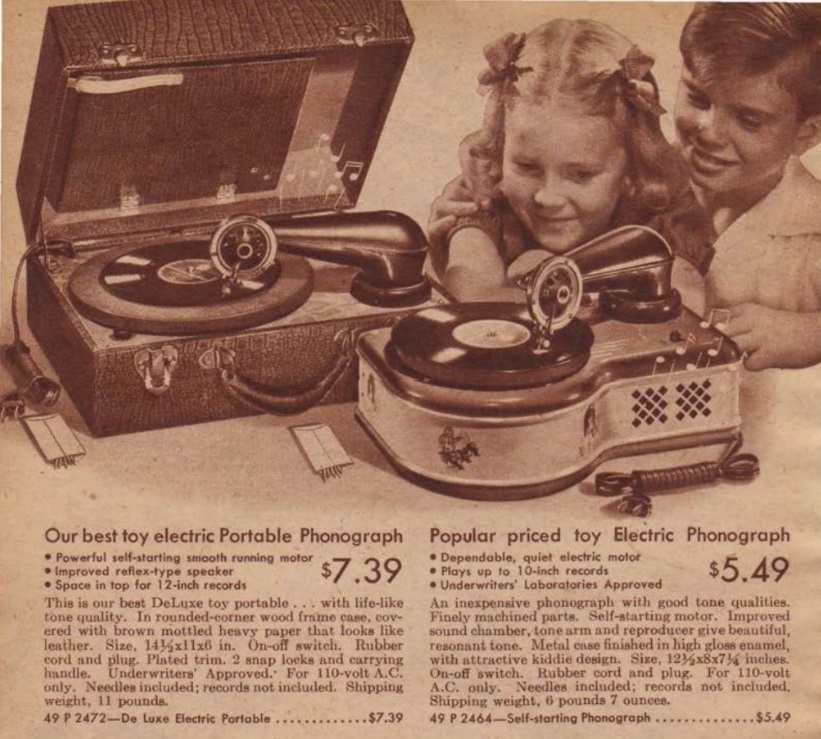
1917DecTalkingMachineThis ad directed at dealers appeared a hundred years ago this month in the December 1917 issue of Talking Machine magazine.  It’s for a relatively inexpensive compact phonograph from the Stewart Phonograph Corp. of 327 Wells Street, Chicago.

According to the ad, thousands of them would “be sent to the boys in the Army and Navy.  It is most suitable as a gift for Uncle Sam’s fighting men.  It is easy to see that large numbers will be sold.”  Of course, those fighting men would need the optional carrying case, turning it into the “Military Special” for a total price of $11.

It turns out that the Steward Phonograph Corporation ceased business in the United States in about 1920, but most of the assets were sold to a Canadian subsidiary, which continued production of an identical unit.  It also turns out that the proprietor of the company was John Stewart, who later became one of the principals of Stewart-Warner radio.

References


Treasure Trove of Ten One-Tube Radios: 1942

1942DecemberRadioCraft0Seventy-five years ago this month, Hugo Gernsback and the other editors of Radio Craft magazine undoubtedly anticipate the popularity of OneTubeRadio.com, since the December 1942 issue was packed with no less than ten different one tube radios!

1942DecemberRadioCraft1The first is the simple set being operated by the young man shown above.   This set, the “easy one-tuber” was a broadcast set billed as being for any beginner: “Any schoolboy can build this unique one-tube set at a trifling cost. It is an easy little set to make and will bring in plenty of stations on the headphones.”

"Easy One Tuber" schematic.

“Easy One Tuber” schematic.

This set, which used a type 30 triode, was built in the venerable cigar box, and procurement of this chassis could be done at no cost: “Any cigar store will have an empty one to give you–or perhaps your father will hurry up and finish his latest box of cigars, if you tell him that you are about to build something really useful for once!”

The tuning coil was tapped for variable selectivity. The article noted that the lower the clip was placed on the coil, the sharper the tuning would be. But if carried too far, volume would be reduced.

Regernation was adjusted by means of a variable tickler coil mounted inside the tuning coil. It could be rotated to place the set just on the verge of oscillation for maximum sensitivity.

The article recommended an indoor aerial wire of about 40 feet, but noted that stronger signals would be picked up with a longer outdoor aerial.

One-tube shortwave set.

One-tube shortwave set.

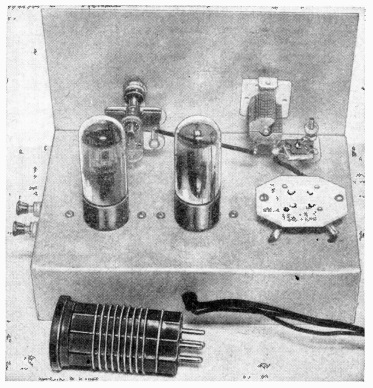
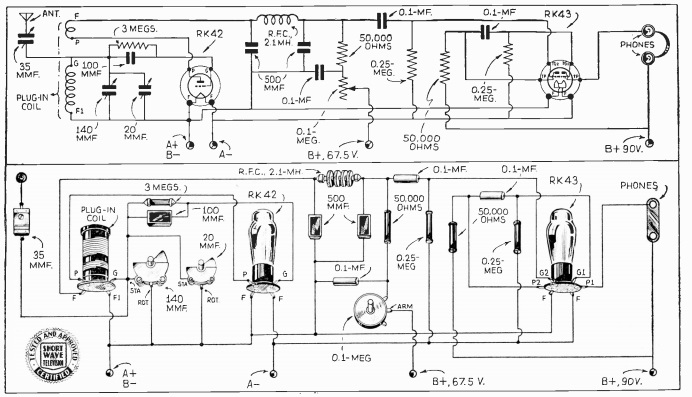
For the slightly more advanced student, the magazine next carried the “beginner’s one-tube short-wave set” shown at the top of this page and at the left, designed by Francis R. Harris, who noted that “broadcast wavelengths and the programs they carry are very interesting, but the real thrill of radio lies in the short wavelengths–the higher frequencies–on which it is possible to pick up programs of all kinds from the very ends of the earth!”

The set was “the simplest and the best breadboard style that we have yet constructed. It is designed for the absolute beginner who is neither radio man nor mechanic, and yet it will equal or better the performance of many more elaborate lay-outs.”

The use of plug-in coils allowed the set to tune 545 to 16 meters (550 kHz to 18 MHz). The only tools required were screwdrivers, diagonal cutters, long-nose pliers, wood tools, and a soldering iron.

The set used a type 33 pentode. While that tube was designed for AF applications, it apparently functioned well as a detector up to the promised 18 MHz.

1942DecemberRadioCraft3

The article recommended a 50 foot outdoor antenna, fed into the house with a porcelain standoff. “Don’t under any circumstances, use one of those flat contraptions that is supposed to go under the window.”

MorganReceiverThis set probably looks vaguely familiar to many readers.  While the circuit is not identical, the general layout and construction philosophy is very similar to Alfred Powell Morgan‘s one-tube receiver from the Boy’s First Book of Radio and Electronics.  Many radio hobbyists got their start after discovering this book in the elementary school library.  Morgan’s set is shown at the left, and has an uncanny resemblance to the 1942 model.

If that wasn’t enough for one tube radio fans, the magazine went further and included eight more “famous 1-tube circuits” shown below.

1942DecemberRadioCraft5

The seven shown on the page above are first the “Ultra-Audion,” “undoubtedly the most publicized circuit in radio,” the genesis of the regenerative circuit, which would tune all way down to 30,000 meters with appropriate coils and one tuning condenser.

The “Ambassador” was “without question the receiver that longest held the spotlight of popular interest.”

The “Interflex” was a design of Hugo Gernsback’s creation, using a crystal detector with one stage of audio amplification, with no need for transformer.

The “Megadyne” was said to be “of special interest to technicians,” and also combined a crystal detector with one stage of audio amplification.

The “Harkness Reflex” put the single tube to work twice, first as detector, and also as audio amplifier.

The “Solodyne” had been imported from Egnland, and was originally billed as “batteryless.” However, it simply combined the A and B batteries.

1942DecemberRadioCraft6Finally, shown here on the continuation page is the “Oscillodyne,” a super-regenerative circuit.

In addition to all of these one-tube sets, the issue also contains some two-tube receivers, as well as a few one-tube phono oscillators.


1942 Coffee Rationing

1942Nov30Life75 years ago, the war had hit the home front, as shown by this article in this day’s issue of Life Magazine, November 30, 1942. It wasn’t tires or gasoline or even sugar. This time, it was serious. German U-Boats were sinking freighters coming from Brazil, and as a result, the United States was about to adopt coffee rationing. Coffee addicts would be limited to one pound of coffee every five weeks, and Life magazine showed them how to cope.

In the illustration above, the magazine notes that boiling is the most efficient method of producing coffee, followed by percolating, followed finally by drip methods. The magazine discussed methods of conservation, the simplest being not filling the cup all the way. It noted that adding a small amount of chicory would stretch the yield about 30% without affecting the taste very much. And while not advised by experts, the magazine even touched on the possibility of “double dipping.”

To prevent hoarding, some retailers were breaking the seal on vacuum packed cans of coffee, insuring that the contents be consumed promptly.


1957 Boys’ Life Telephone Circuit

1957NovBL1Sixty years ago, Maurice Peacock, Jr., of Radnor, PA, got $5 for sending these simple circuits to the “Hobby Hows” editor of Boys’ Life, where they were printed in the November 1957 issue.

The circuit shows how to rig up a telephone system to a friend’s house nearby, using an old radio headphone. One earpiece is used at each end, with batteries wired in series. Peacock explains that the wire needs to be insulated, and suggests that old thread spools can be used as insulators. The basic circuit is shown in figure 1. To save on the cost of wire, a good ground can be used as the return, as shown in figure 2.

I suspect the Boy Scouts of 1957 eventually figured it out, but the diagrams shown here wouldn’t work. A minor change needs to be made.

I suspect that, just like the Boy Scouts of 1957, our readers will quickly spot the problem. When you’ve found it, please comment on our Facebook page.


1967 Blast Furnace For Young Soviets

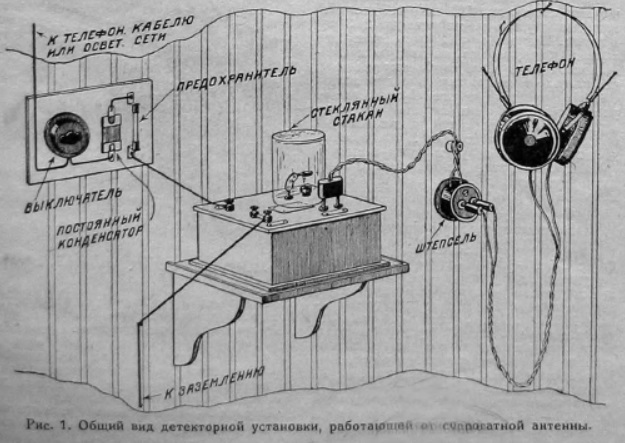
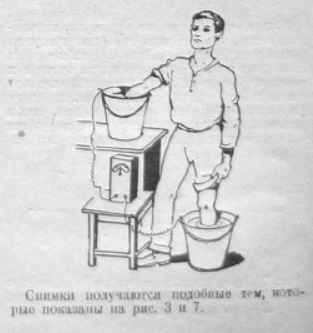
1967NovSovietI’m not able to make out the text, but this Soviet magazine from November 1967 appears to be right up our alley. It appears to be giving young comrades instructions for building a home blast furnace!

I am able to make out the caption for the item between the vacuum cleaner and the wall outlet, and it’s marked “rheostat.” Presumably, it’s set to blow air into the combustion chamber, and the young Soviet mad scientist can adjust the intensity of the furnace with the rheostat.

The illustration appeared in the November 1957 issue of Юный техник magazine.  A treasure trove of similar magazines, many on the subject of radio, can be found at Журналы СССР.

Contrary to first impression, the logo at the top of the page is Ют, the abbreviation for the name of the magazine. But if it looked like HOT at first glance, we don’t blame you. This contraption will indeed get hot!

We put this item in the “science fair ideas” category. However, we do recommend that before duplicating this project, young scientists should have the article translated to see if it contains any safety warnings. I suspect some might be called for.


1942 Army Signal Corps Recruiting

1942NovPMThis recruiting ad for the U.S. Army Signal Corps appeared in Popular Mechanics 75 years ago this month, November 1942. It noted that this was a radio war, and that the nerve center of the army needed skilled hands.  It suggested a number of opportunities to serve.

Physically fit men ages 18 to 45 were eligible for direct enlistment in the Signal Corps Enlisted Reserve.  Those with experience as a licensed radio operator, a trained repairman, or active telephone or telegraph worker would qualify for active duty at once with pay of up to $138 per month, plus board, shelter, and uniforms.

Those without direct experience but “skilled with tools” would qualify for training and ordered to active duty after completing the course.

Degreed electrical engineers, as well as junior and seniors in EE programs, would be eligible for commission.

Young men over 16 having an ability with tools would be eligible for immediate training, with pay of not less than $1020 per year.  Even those with a minor physical handicap could find a place to serve.


Nipper Goes to War: 1917

1917Nov26PGHWith the nation at war, the Victor Talking Machine Company was doing its patriotic duty by cranking out phonographs and records.  This ad appeared in the Pittsburgh Press a hundred years ago today, November 26, 1917.


Billy Hallicrafters to the Rescue Again

1957NovBLA few months ago, we reported how young Billy Hallicrafters used his Hallicrafters shortwave receiver to save the lives of some men aboard a sinking ship.

Here, we see young Billy at it again, saving the life of a pilot in distress, as reported in the November 1957 issue of Boys’ Life.

Billy was apparently late for school that day, but I’m sure his tardiness was excused.  We enter the story as Billy’s mother reminds him that it’s time to get ready for school.  He prepares to shut down his receiver and get to school, but at the last minute, he hears something truly ominous.

He hears a pilot, apparently in communication with air traffic control, since the pilot is acknowledging a message. But the pilot interrupts the acknowledgment to declare a mayday, which apparently only Billy hears. The pilot had “flamed out 10 miles south of Westport” and was bailing out.

Billy interrupts his school preparations and frantically calls the Civil Air Patrol to report the emergency. Within minutes, a CAP helicopter is dispatched, and spots the parachute. One of the crew comments that it’s a good thing that boy was tuned in, since nobody else heard the Mayday.

The crew quickly gets the unconscious pilot out of the tree where he’s dangling and to the hospital. In the next scene, Billy is visiting the hospital where the downed pilot thanks Billy for saving his life.


Hammarlund Super Pro Console, 1937

1937NovRadioWorld

The Hammarlund Super-Pro series of receivers represent one of the best performing prewar communications receivers. The line was first introduced in 1936, and when war came, they took the BC-779 nameplate for the military version.

Thousands of the models making up the series rolled off the Hammarlund assembly line over the years, but one of the rarest variations is shown here, and it appears that only about 70 were made.  Inspired, no doubt, by high-end home consoles such as the McMurdo Silver, Hammarlund decided to move the set from the ham shack to the living room.  So they put it in the cabinet shown here, as seen in the August 1937 issue of Radio World.

But it wasn’t just any cabinet that they slapped it into.  As the accompanying article explains, the cabinet was carefully designed for its audio qualities, particularly the bass response.  There’s no doubt that the set was a top performer, and I’m sure it sounded good.  Since it was destined for the living room, a few modifications were made.  For example, even though the set had a BFO for listening to code, the BFO pitch was not adjustable from the front panel.

But it was a flop as far as sales.  As the Radio Boulevard site explains, “it just wouldn’t do for hams – it had no BFO on the front and it was too big. It didn’t have the Scott or McMurdo chrome chassis – how could you impress your friends?”  The site does have a picture of a nicely restored specimen, owned by AA6S.  From the color picture, it does look like a communications receiver thinly disguised as a console.  The front panel is faux walnut, and just looks out of place.  It’s not quite a communications receiver, and it’s not quite a console.

I’d love to have one in my living room.  And as a loyal reader, you would love to have one.  But let’s face it, nobody else would want one!