Author Archives: clem.law@usa.net

Homemade Photovoltaic Cell

1943FebRadioCraftSeventy-five years ago this month, the February 1943 issue of Radio Craft showed how to make this rudimentary photovoltaic cell.

With some modification, it scould be easily duplicated today, and could be the basis for an interesting science fair project.

It consists of a strip of lead, as well as a copper plate covered with cuporus oxide.  To achieve the coating, the copper plate is heated in a flame until it is covered by a black flaky substance, which is cupric oxide.  Then, it is washed in a weak solution of ammonia, which reveals the light-sensitive cuprous oxide.

A sheet of lead should be available at a craft store, or can be ordered from Amazon.  Similarly, a small piece of copper is readily available at a hardware store or Amazon.

The electrolyte is a somewhat more difficult proposition.  The lead nitrate is somewhat hazardous, but should be safe if handled carefully.  The main problem is that it is expensive.  It is available on Amazon, both as a solution and as crystals,  However, the prices might be outside the young mad scientist’s budget.

Fortunately, this site seems to suggest that ordinary salt water will function adequately as the electrolyte.  Therefore, one suitable science fair project might be to determine what other electrolyte solutions might work best.  All that would be required would be a voltmeter to see which configuration puts out the most electricity.  The advanced student could skip buying the voltmeter and instead make this simple galvanometer.

Another fun project would be to demonstrate communication over a light beam, with a setup similar the one on this site.  Your homemade photocell is hooked to the input of a small audio amplifier, and you hook an LED to the headphone jack of a radio or other audio source.


See Us at Ozarkcon!

hillbilly1

This year, we will have a table at OzarkCon, at
4State_logo_BLUE_300dpi
which hams gather for two days of QRP (low power) related activities.  Activities include a kit-building session, at which we will construct a 30 meter (10 MHz) transceiver, various seminars, a QRP flea market, music sessions, and more.   Ozarkcon is sponsored by the Four State QRP Group (4SQRP).  Even though this is my first Ozarkcon, it will be a bit of a homecoming, since I was present at the very first 4SQRP meeting in Seneca, MO, in 2002.

Private sale: save 10% The Stone Castle Hotel & Conference Center BransonOzarkcon is held the first weekend of April (this year, April 6-7, 2018) at The Stone Castle Hotel & Conference Centerin Branson, Missouri.

1943FebRadioCraftKeyOne of the trademark events at Ozarkcon is the Wacky Key Contest, an event designed to encourage non-traditional Morse code keys made out of things such as toasters.  For inspiration, we offer this design from Joe Binko, who sent it in to Radio Craft magazine in February 1943.

We’re not sure if it’s wacky enough for first place, but we’re sure Binko’s design would have been in the running had OzarkCon been in existence in 1943.  He converted a phone jack (presumably, a quarter-inch model) into a key by carefully cutting it apart, mounting it to a base, and extending one of the contacts.  You should get the general idea from the diagram.

Among the big names attending is legendary sound engineer Bob Heil, K9EID, of Heil Sound, the only manufacturer to have an exhibit at the Rock n Roll Hall of Fame.

For more information about OzarkCon, visit their website or Facebook group.


Save 35% Branson Surrey Inn Branson
Update (Feb. 18):  When we checked today, all single rooms at the Stone Castle were fully booked.  (After I posted this, someone else posted that some rooms were still available.  So it’s probably worth a phone call.  See the OzarkCon hotel page for information.)   We will be staying at the nearby
Branson Surrey Inn
.  When we booked, rooms were only $42 per night, and it is located within walking distance of Ozarkcon.


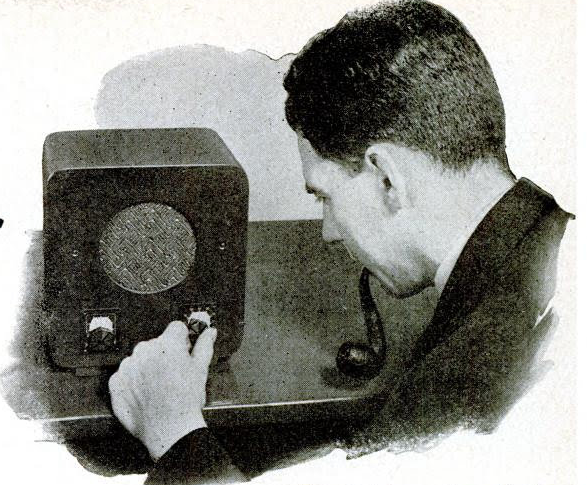
1943 One-Tube Combination Code Oscillator/Regenerative Receiver

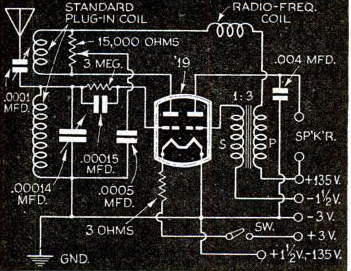
1943FebPSSeventy-five years ago this month, the February 1943 issue of Popular Science carried the plans for this one-tube combination receiver and code practice oscillator. The construction article, by Arthur C. Miller, noted that thousands of young men and women were learning code for civil defense purposes or prior to enlistment in the Signal Corps. A code oscillator was then impossible to buy.

A single switch changed the set from receiver to code oscillator. As a radio, the set ran on 45 volts, but the code oscillator required only 4.5 volts.

1943FebPSschematic


1938 Two-Tube Shortwave Regen

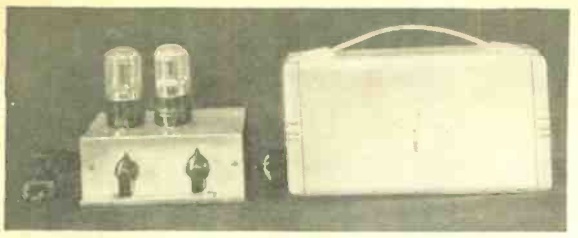
1938FebPS11938FebPS2The February 1938 issue of Popular Science carried the plans for this two-tube regenerative shortwave receiver.  While absent from the schematic diagram, the globe on the top was critical, since it allowed the shortwave fan to quickly spot the location of every new station logged, and easily spot the location where the message originated.

The circuit inside the box employed two type 30 tubes, one serving as regenerative detector, with the other serving as AF amplifier. Since regeneration operated more smoothly at a reduced voltage, the set employed two B batteries. A 22.5 volt battery powered the detector, with a 45 volt battery allowing for extra volume from the amplifier stage.

The cover of the set was hinged, to allow for changing the plug-in coils.

1938FebPS3


1958 Boys’ Life Shortwave Receiver: Part 2

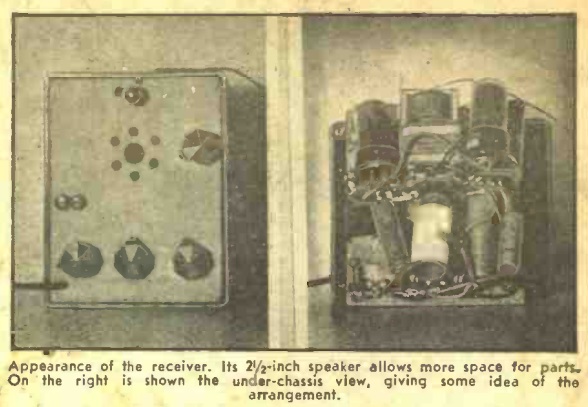
WB3HLHradioWe recently wrote about this three-transistor regenerative receiver from the January 1958 issue of Boys’ Life magazine.

I just received this picture of the completed receiver, constructed by Tom, WB3HLH, of Rockville, Maryland.

As a Cub Scout, he saw the receiver in the magazine and was very interested. This is understandable, since the magazine also carried a feature extoling the virtues of SWL’ing, as well as a listing of the prizes in the annual radio contest.

About 50 years later, he located the magazine and took it upon himself to make one. The article noted that the set was not for beginners, and his experience agrees with this assessment. He notes that the audio stage was simple, but it was very tricky to get the detector oscillating.  As you can see, he very carefully duplicated the layout of the original project.

In addition to the coils described in the article (wound on plug-in coil forms), he wound a coil for the broadcast band. He reports that the set performs well on shortwave, both for broadcast and SSB signals. On the broadcast band, it pulls in all of the major East Coast stations, and signals as far west as KMOX in St. Louis.

The article calls for the use of four penlight batteries, but he reports using a 9 volt battery. The only other circuit modification is the addition of a 3.3 k resistor in parallel with a .01 uF capacitor on the emitter of the detector transistor.


Solar Fire Starter

1980SolarLighterWhen I worked for Radio Shack in an earlier lifetime, one of the more interesting products we sold was the solar cigarette lighter. It was something of a novelty item, but it was also fully functional. It was nothing more than a parabolic mirror, with a little holder at the focal point.  It’s shown above in the 1980 Radio Shack catalog. The idea was to place a cigarette in the holder, point it at the sun, and after several seconds, the cigarette would start smoldering. No, it didn’t work at night or on cloudy days, but on a sunny day, it worked flawlessly.

The same simple device is now available at Amazon.  Taking inflation into consideration, it’s not much more expensive than it was back in the day, and would serve as one method of starting a fire in an emergency. Yes, you’re better off if you have matches or a traditional lighter with you, but redundancy can be a good thing, and it’s kind of fun to amaze your friends by lighting a fire using solar power.

If you don’t smoke (this is one rare case where a cigarette could save your life), then you could use other similar tinder, such as tissue paper, dry grass, or leaves. This device won’t cause anything to burst into flame, so you’ll need more tinder at the ready. As soon as whatever you lit starts to smolder, you’ll need to transfer it to a larger pile of tinder, and then blow on it until it bursts into flame.  You then keep adding larger fuel until you have a fire of the desired size.  You don’t want the fire to go out after it gets dark, because obviously you won’t be able to light another one until morning.

(Some links on this page are affiliate links, meaning that we get a small advertising fee if you purchase from Amazon after clicking on the links.)


Sinking of the Tuscania, 1918

SS Tuscania (1914)

SS Tuscania. Wikipedia Image.

Today marks the 100th anniversary of the sinking of the SS Tuscania, February 5, 1918. The ship was a luxury liner of the Cunard Line, and was serving as a troop transport, carrying American troops to Europe. The ship left Hoboken with 384 crew and 2013 army personnel aboard. On the morning of February 5, a German submarine sighted the convoy and stalked it until darkness. At 6:40 p.m., it fired two torpedoes, one of which sent the ship to the bottom of the Irish Sea. 210 men were killed in the attack.

Color picture; An elderly man holding a glass and wearing a hat stands in front of a wooden lodge.

Harry Truman. Wikipedia image.

One of the notable survivors was 20-year-old soldier Harry R. Truman (not to be confused with the President), notable for becoming a victim of Mt. St. Helens in 1980.free-vector-poppy-remembrance-day-clip-art_106032_Poppy_Remembrance_Day_clip_art_small


1968 QRP Rigs

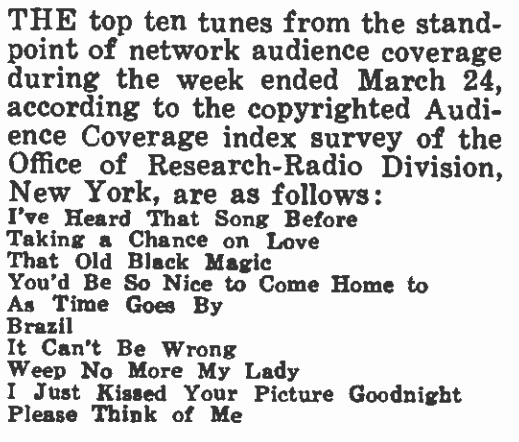
1968JanRadTvExpFifty years ago this month, the January-February 1968 issue of Radio TV Experimenter devoted a considerable number of its pages to Amateur Radio QRP (low power) operation.

At the time, “QRP” generally referred to power levels of under 100 watts, but the introductory article by Robert M. Brown, K2ZSQ, revealed that many in what was known in ham circles as “that crazy QRP crowd” were seeing what could be done with flea-power setups, often consisting of a single transistor, IC, or tube.  He included these diagrams of minimalist one-transistor QRP transmitters:

1968JanRadTvExpSchematics

The cover feature was the “Mini-Mite,” a QRP transmitter designed by Howard Pyle, W7OE. This was a 4-band transmitter for 80, 40, 20, and 15 meters. The author reported that the set ran an input power of 1.2 watts with a 6 volt power supply, or up to 1.8 watts with a 9 volt supply. His best DX was 1100 miles on 15 meters, 600 miles on 20, 300 miles on 40, and a respectable 200 miles on 80.

1968JanRadTvExpIntlXtalThe transmitter actually consisted of four transmitters, since it used four of the ubiquitous International Crystal oscillator module kits, and ad for which is shown here from the same magazine. The oscillator cost $2.35, and an additional $3.75 for the necessary crystal. Essentially the oscillators, even though designed for test circuits, were functioning as transmitters, with just a bit of external matching network before the antenna. To switch bands, one transmitter was switched out of the circuit, and one for another band switched in.

It should be noted that it’s likely that none of these 1968 circuits would meet modern spectral purity requirements. Chances are, a bit more external filtering would be required. But the concept shown here is recognizable in many minimalist QRP rigs that are once again in style by “that crazy QRP crowd.”


The Immortal Chaplains: 1943

Stained glass window, Pentagon. Wikipedia image.

  Stained glass window, Pentagon. Wikipedia image.

Today marks the 75th anniversary of the sinking of the troop carrier SS Dorchester, February 3, 1943.

The ship, constructed in 1926, originally carried cargo and passengers between Miami and Boston. She was put into wartime service in 1942 and was converted to a troop carrier. In January 1943, she left New York in convoy bound for Narsarsuak, Greenland. She was torpedoed in the early morning hours of February 3 by a German submarine, which caused severe damage, and the ship sank in about 20 minutes.  672 died, many of hypothermia.

Sinking of the Dorchester. Wikipedia image.

Sinking of the Dorchester. Wikipedia image.

Four relatively new Army chaplains were aboard, First Liuetenants Reverend George L. Fox (Methodist), Reform Rabbi Alexander D. Goode, Roman Catholic priest Father John P. Washington, and Reformed Church in America minister the Reverend Clark V. Poling.  Collectively, they came to be known as the Immortal Chaplains.

As the ship was going down, they helped other soldiers board lifeboats. When the supply of life jackets ran out, they gave up their own. They joined arms, said prayers, and sang hymns as they went down with the ship.220px-Four_Chaplains_stamp1


Happy Groundhog Day!

GroundhogWe always take a break from our scheduled programming for the major holidays, and Groundhog Day is certainly one of the major holidays.

The groundhog shown here appeared a hundred years ago in the May 1918 issue of National Geographic magazine.  As you can see, the groundhog’s shadow is visible, meaning that winter 1918 lasted another six weeks (despite the visible flowers).

The article explains the phenomenon:

The prominence of the groundhog as a popular figure in the country lore of the Eastern States is shown by his having been given a place with the Saints on the calendar, February 2 being widely known as “Groundhog Day.” It is claimed that on this date the groundhog wakes from his long winter sleep and appears at the mouth of his burrow to look about and survey the weather. If the sun shines so that he can see his shadow, bad weather is indicated and he retires to resume his sleep for another six weeks. Otherwise, the winter is broken and mild weather is predicted. Even on the outskirts of Washington some of the countrymen still appraise the character of the coming spring by the weather on “Groundhog Day.”

To help you celebrate with an appropriate holiday dinner, here’s a link to some ground hog recipes.