Author Archives: clem.law@usa.net

Science Fair Ideas: Earth’s Magnetic Field

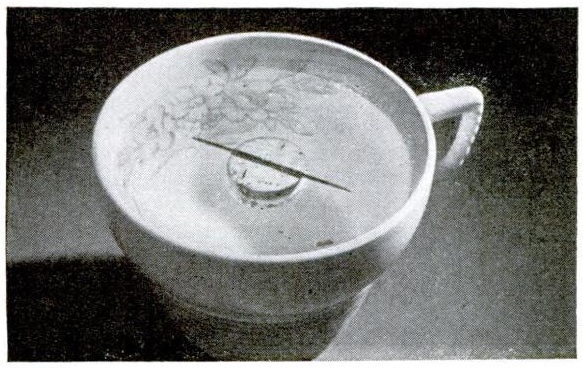
1944AugPScompassSeventy-five years ago this month, the August 1944 issue of Popular Science showed a number of simple science experiments relating to the Earth’s magnetic field. For students looking for a simple science fair experiment, these will prove most adequate. The two shown on this page answer the question, “does the Earth have a magnetic field?” It turns out that yes, yes it does.
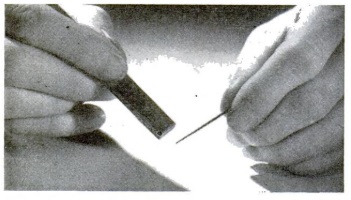
Magnetizing the needle.

Magnetizing the needle.

The first experiment produces the compass shown above that is, as the magazine puts it, as good as the best that was known for centuries. All you need is a sewing needle, a magnet, a cork, and a cup or glass (non-metallic) of water. You magnetize the needle by stroking it over the south pole of the magnet, starting at the eye and ending at the point.

If you get that mixed up, it doesn’t really matter, as one end will point north, although it might not be the pointy end. Either way, you’ve proven that the Earth has a magnetic field.
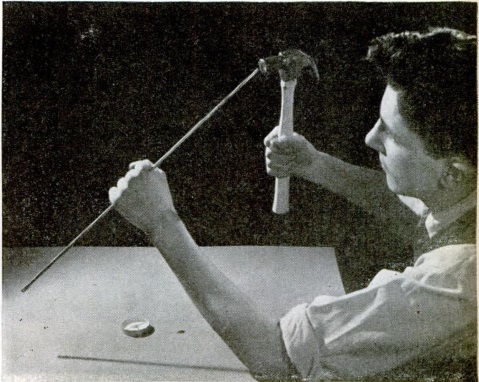
1944AugPSironrodThe other experiment, shown at left, uses the Earth’s magnetic field to magnetize an iron rod. You hold it so that it’s pointing north, and to maximize the magnetic field, you angle it down toward the ground. Tap the upper end with a hammer, and the atoms will align with the magnetic field. You can test this by bringing an end near a compass, either the one you made yourself, or one you bought.

You probably have most of the supplies you need for these experiments around the house, or they are available locally.  The links above are to Amazon.  The links are affiliate links, meaning that this site receives a small commission if you order after clicking on them.


Villa on the Lake Ontario, 1944

1944Aug21LifeShown above, in the August 21, 1944, issue of Life Magazine, is Mrs. Eva Bass, a Paris nightclub singer who had lived in Milan before the war. Because she was a Swiss Jew, she was placed in a concentration camp, and later in “free confinement” in Potenza.

When the Allies arrived in Italy, she carried her children 60 kilometers through the lines, many days without food. They were placed in an Allied relief camp in Italy. She was one of a smaller group, chosen because they were virtually desitute without any means of support, to go to America. “They will remain at Fort Ontario, Oswego, N.Y., for the duration of the war as wards of the U.S. Sine they entered the U.S. outside the immigration quotas, they will have to leave when the war is over.”

After they were registered and their meager possessions cleared customs, they were assigned 1944Aug21Life3to army barracks where they would live for the duration of the war.

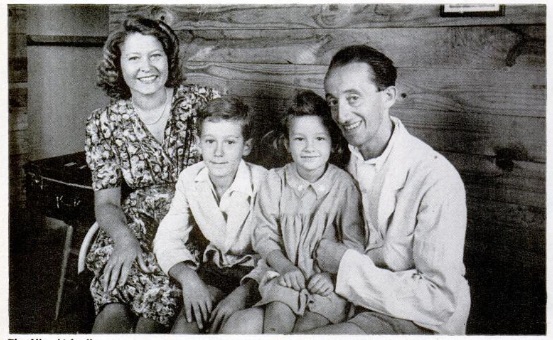
The family shown below is identified as the Albrecht family. The father was Jewish and the mother Catholic. The children are identified as Peter, 10, and Renata, 5. According to the magazine, he operated a theater in Vienna but fled to Italy in 1939, followed later by his wife and children.

As the photos and article make clear, the conditions were very austere, but one of the refugees “threw her arms around a government representative, saying, ‘this is more beautiful than anything in Europe.  Now I have a villa on the Lake Ontario.”

All of the residents remained interned until 1946.  According to Wikipedia, ” President Roosevelt made himself very clear that immigration laws were not going to be ignored. The refugees would merely be in the United States, not citizens of the United States. They would have no visa status. President Roosevelt also assured Congress that the Army would not permit any refugee escapes.”  In 1946, under President Truman, the decision was made to allow the refugees to become U.S. Citizens.

1944Aug21Life2


Boy Meets Girl on Train: 1939

1939Aug21LifeCover

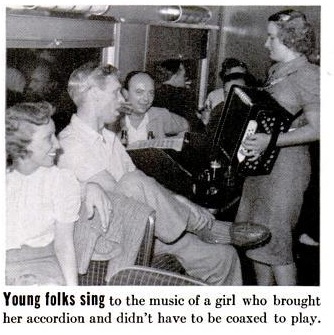
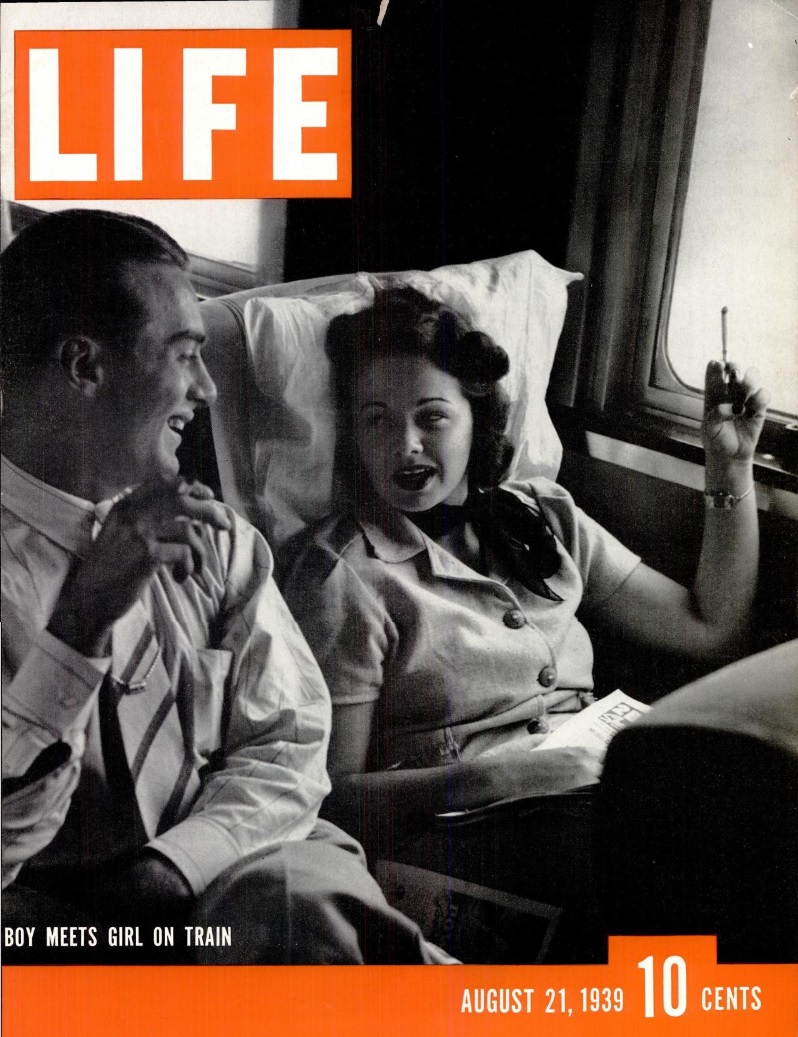
Eighty years ago today, the August 21, 1939, issue of Life Magazine carried this photo on its cover, with the caption “boy meets girl on train.” But it wasn’t just any train on which they met, it was the  El Capitan, the modern train of the Atchison, Topeka and Santa Fe from Chicago to Los Angeles. The train’s running time was 39-3/4 hours. While not exactly a luxury train, it was marketed toward passengers who could afford only day-coach fares, but “disliked the long-drawn-ourt tedium and discomfort of an old-fashioned transcontinental coach train.”

The train did not have any Pullman cars. Instead, the coaches were designed to be soft and comfortable by day, but also made a reasonably restful sleep at night.

The article noted that rail traffic had been declining. In 1920, passenger revenue for U.S. railroads was $1.2 billion, but this had declined to a mere $400 million in 1938. The blame was placed on the highways, both private vehicles and buses. By upgrading the coach experience, it was hoped that the trains could compete with buses. New York to Los Angeles by train was 57 hours, whereas by bus, the same trip would take 90 hours.

1939Aug21Life2The magazine noted that, unlike most trains where passengers kept grimly to themselves, most passengers were young, friendly, and gregarious. It wasn’t uncommon to invite strangers to the bar for a beer. “Women put on slacks for comfort and men take off their ties.”

The train was powered by two quiet modern 1800 HP diesel electric locomotives, but when the train reached a 2.2% grade, a steam locomotive was brought in to assist, given the passengers a sound they hadn’t heard since Chicago.

The coaches included lounges in which passengers could change their clothing, and the dining car offered reasonably priced meals.  The train remained in service until 1973.

The couple pictured on the cover were Richard C. Bergen, a lawyer, and Rosabelle Borushik, who worked for Republic Pictures.  Richard was returning to California after a vacation in the East, and Rosabelle was going to California for vacation.  “Though they became good friends en route, Richard unhappily forgot to get Rosabelle’s Los Angeles phone number before they left the train.”  Bergen appears to be the same Richard C. Bergen who was later attorney and friend to Bing Crosby.


Cheerioats: 1944

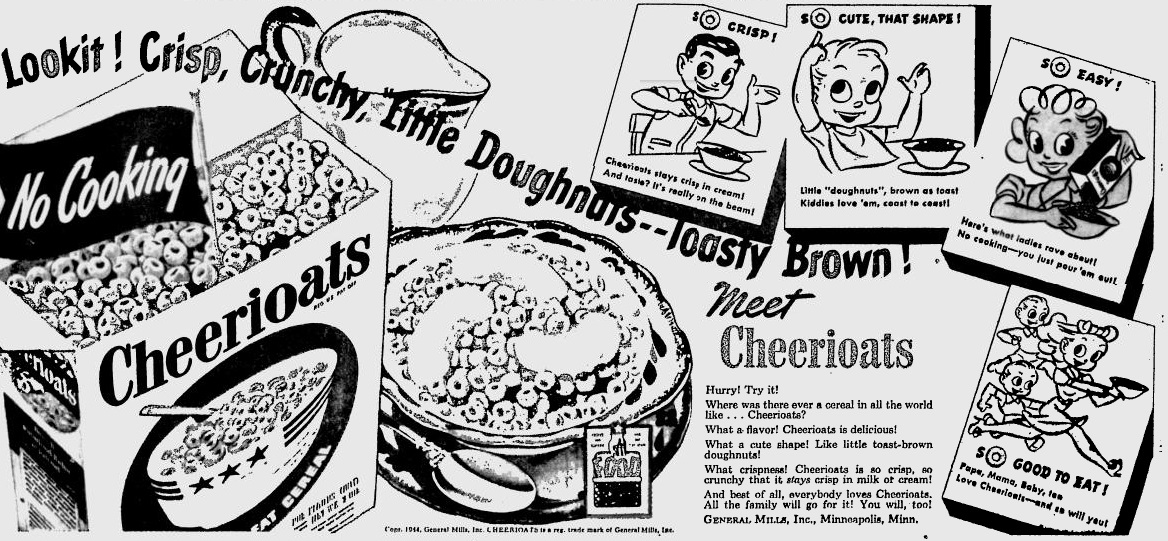
1944Aug20MilJorSeventy-five years ago today, the Sunday funnies of the Milwaukee Journal, Aug. 20, 1944, carried this ad for a familiar product with a slightly unfamiliar name.

Just to make sure everyone knew, Cheerios (then known as Cheerioats) didn’t require cooking, and they had a cute donut shape with a brown toast color that kids loved.  They stayed crispy even in cream.  The product had been introduced by General Mills in 1941, and the name was changed to Cheerios in 1945.


Apollo 11 Communications

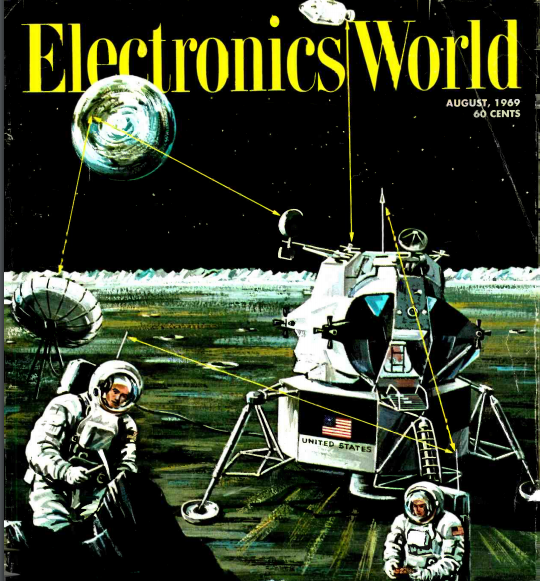
1969AugElecWorldFifty years ago this month, the August 1969 issue of Electronics World contained a good description of the communications system used by the Apollo space program. Even though the issue is dated August, it went to press prior to the Apollo 11 mission, so it was written in the future tense.

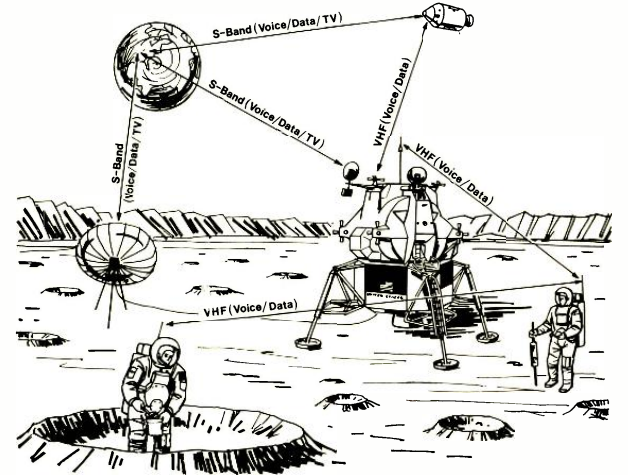
1969AugElecWorld2Each backpack contained an extra-vehicular communications system (EVCA) built by RCA. That consisted of a transceiver measuring 14 x 6 x 1.25 inches and weighing (on Earth, presumably) 6.5 pounds. Both backpack units contained two AM transmitters and two FM receivers, plus telemetry instruments. In another respect, the suits were not identical. One EVCA contained an FM transmitter, and the other contained an FM receiver. This allowed the astronaut equipped with the receiver to serve as a relay for voice and data from the other astronaut to the Lunar Module (LM).

The FM signal was transmitted on 279 MHz, and the AM signal was on either 259.7 or 296.8 MHz. From the LM, the signals were retransmitted to Earth on an S-band transmitter on 2282.5 MHz. The main antenna for this link was a 26 inch steerable dish on the LM, with about 20 dB gain. As a backup, an erectable antenna that opened like an umbrella was set up on a tripod. This antenna had 32 dB gain, measured 10 feet in diameter, and weighed 14 pounds.

Live TV from the moon came from a 7 pound camera manufactured by Westinghouse. Compared to US broadcast television, which used 525 lines and 30 frames per second, the camera transmitted 320 lines at 10 frames per second. The reduced video quality was to conserve both power and bandwidth. The signal from the lunar camera could operate on 500 kHz bandwidth, compared to 4.5 MHz for commerical TV. The conversion to make the signal available to broadcast networks was taken care of on Earth. The signal went back to earth on the S-band transmitter.

Navigation signals from Earth were on 2101.8 MHz, with data from both the LM and Command Module (CM) being transmitted on 2282.5 MHz.

Other contractors involved in supplying the gear were Collins Radio, which provided the S-band signal processor, Motorola for the S-band transceivers, Raytheon for the S-band power amp, and Dalmo-Victor for the S-band antenna. All gear was solid state, with the exception of an amplitron tube in the S-band amplifier.

Louisville Courier-Journal, via ARRL.

Baysinger pulling in the lunar signals.  Louisville Courier-Journal, via ARRL.

With the frequencies and details published, one might wonder whether earthbound listeners other than NASA tuned in to the astronauts’ signals from the moon.  Almost certainly the Soviets were listening, but it turns out that one American ham was listening in, as detailed by this story at the ARRL website.  Larry Baysinger, W4EJA, of Louisville, KY, was able to pull off the feat, thanks to an 8×12 foot corner horn antenna.  He picked up the VHF signals (presumably the AM ones), and did not attempt to receive the S-band signals bound for Earth.  He recorded 35 minutes, including the message from President Nixon.


Skid Row Radio: 1960

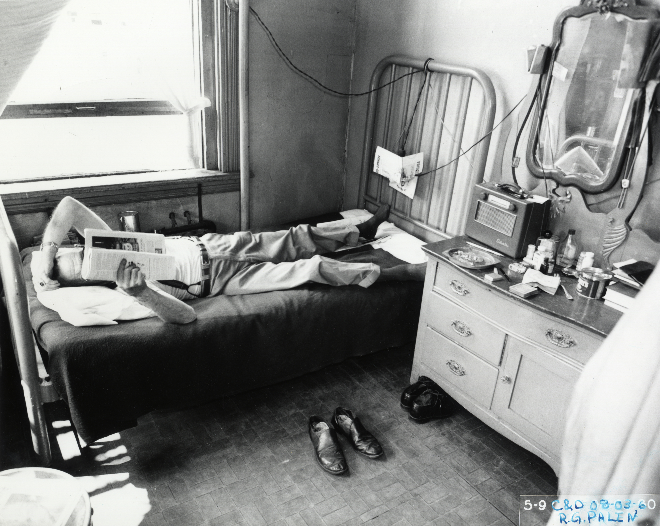
SkidRowRadioIn the early 1960s, the City of Minneapolis decided to engage in some urban renewal, which consisted of razing most of the Gateway district, also known as Skid Row.  The area contained many hotels and boarding houses occupied largely by middle aged and older men who were or had been laborers.

One of the accommodations was the Pioneer Hotel, a “cage hotel,” meaning that the individual rooms were made of plywood, with chicken wire serving as the ceiling.  Before the area was torn down, the City of Minneapolis decided to document conditions by taking photographs.  In the process, the Pioneer Hotel became one of the most photographed flophouses in History.

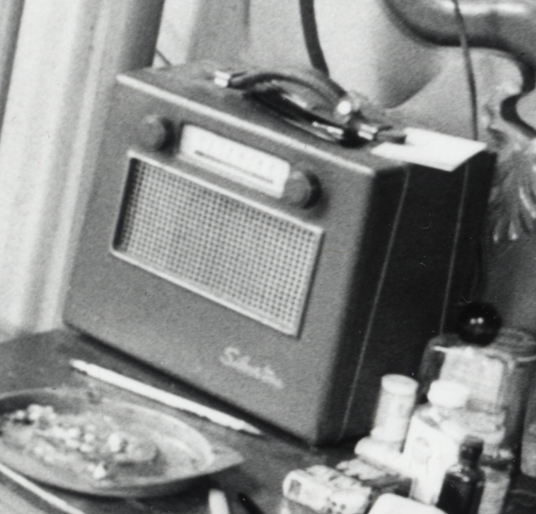
SkidRowRadioZoomThe city photos include the one shown above, taken in 1960, from the collections of the Minnesota Historical Society.   The room was small, but it was this gentleman’s home until the city tore it down.  On the dresser is what appears to be the most valuable possession shown in the room, a radio.  It’s shown zoomed in at the left.  It is a Silvertone model 9280, manufactured for Sears in about 1949 or 1950.

The 5 tube portable (Two 1U4s, a 1R5, and a 3V4, plus selenium rectifier) ran on either AC or batteries. It appears to be plugged in to the single lamp socket near the window, and it’s unlikely that the owner spent much of his money on B batteries.

The ten year old set was probably a pretty good performer, as it contained one RF stage in addition to the normal superhet lineup.  You can see the same model radio playing at the following video:

https://www.youtube.com/watch?v=QbYF5FH3LsQ


How to Make a Hectograph: 1949

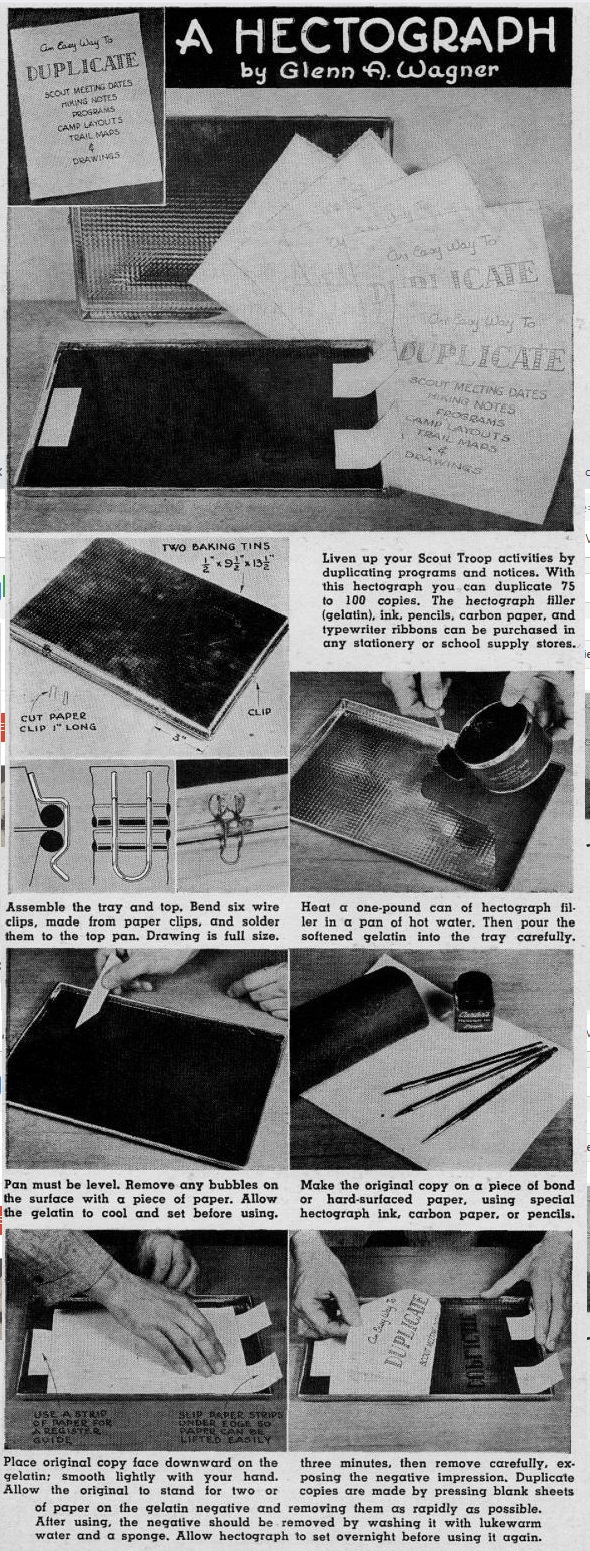
1949AugBLSeventy years ago, an aspiring young publisher could make up to 100 copies of important announcements, newsletters, or other documents, by way of the hectograph. The process is described here in the August 1949 issue of Boys’ Life magazine.

Back in the day, acquiring all of the needed parts was simple, as they were available at any office or school supply store.  Unfortunately, they are not available in prepackaged form any longer, but at our website, we have have instructions for making yours at home, and the process is quite simple.

For those not familiar with the process, the hectograph was the simpler version of the mimeograph.  The image is drawn or typed on paper using special hectograph ink.  The ink can come from a special sheet of carbon paper or from markers, and both are still readily available.  This image is then transferred to a gelatin surface, and from there it’s transferred to the sheet you want to print.  The prefix “hecto” means 100, but in practice, you’ll probably get a bit fewer copies.


Science Project: Conductivity of an Electrolyte

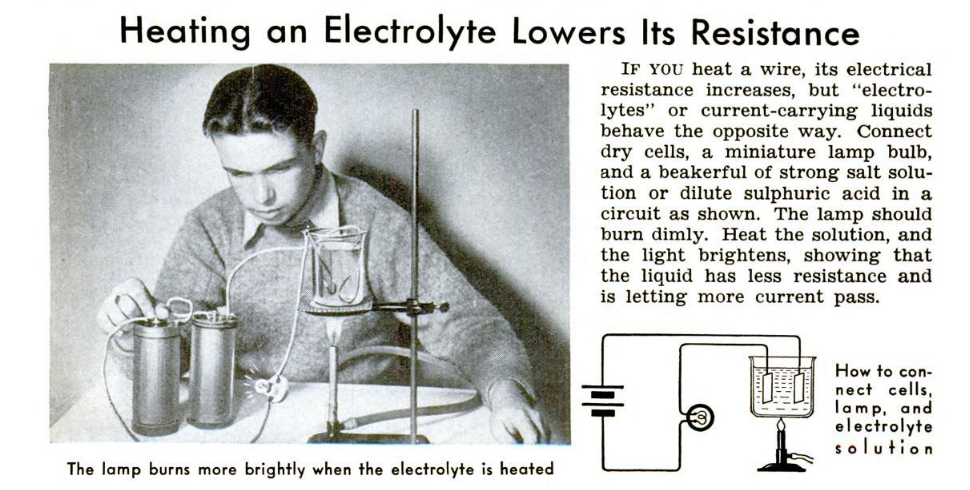
1939AugPSIf you’re looking for an interesting science fair project, this one from the August 1939 issue of Popular Science is interesting, looks like you put a lot of work into it, but is really quite simple. It answers the scientific question, “does the temperature of an electrolyte solution affect the conductivity?” It turns out, as this experiment will show, that the answer is yes. As the temperature increases, so does the conductivity.  (Or to put it another way, as the temperature goes up, the resistance goes down.)

The experiment, as shown above, is relatively simple.  You should be able to find all of the required supplies locally (if you don’t already have them at home).  If you want to order online, the links below are to Amazon.

The 1939 version of the experiment shows old fashioned dry cell batteries, but modern alkaline D cell batteries will work just fine.  You can figure out some other way to attach the wires to the batteries, but life is a lot easier if you use a battery holder.

Any flashlight bulb will work, as long as it’s from a flashlight that normally uses 2 batteries.  This one is suitable.  Again, you can figure out some other way to connect the wires, but having a socket will make things easier.  Finally, for the electric hookups, you will need some kind of wire, although almost any will work just fine.

The two electrodes going into the solution can be almost anything metallic.  I would recommend using some large nails.

You’ll need a beaker and some lab hardware to support it while heating, although if you should be able to borrow that from your science teacher.  If you’re doing the experiment in the school lab, you can use a bunsen burner.  If you’re doing it elsewhere, you’ll need a heat source such as an alcohol burner.

The experiment calls for either salt water or sulfuric acid.  You surely have salt at home.  If you prefer to go with sulfuric acid, you can order that online, or ask for it in the hardware store, where it’s available as a drain cleaner.


1939 Code Practice Oscillator

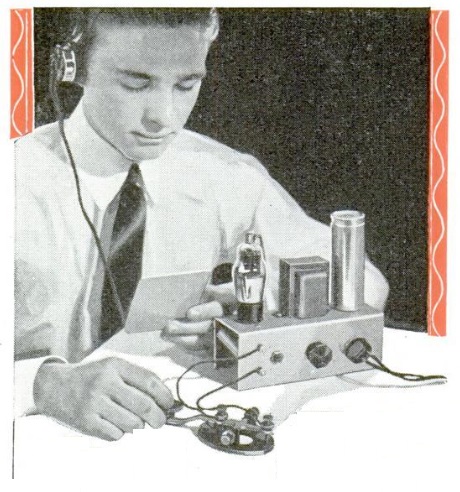
1939AugPMCPO1The young man shown here is brushing up on the International Morse Code thanks to the simple code practice oscillator described in the  August 1939 issue of Popular Science.

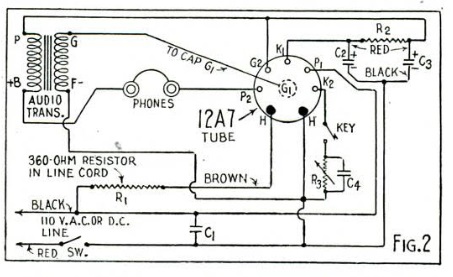
The one-tube unit, containing a 12A7, ran directly off the line cord, with a 300 ohm line cord resistor dropping the filament voltage.  A power switch and pitch control on the front panel meant that he could start practicing at any time.

1939AugPMCPOschematic


Dixie-Fixit Radio Hospital, Lima, Ohio, 1944

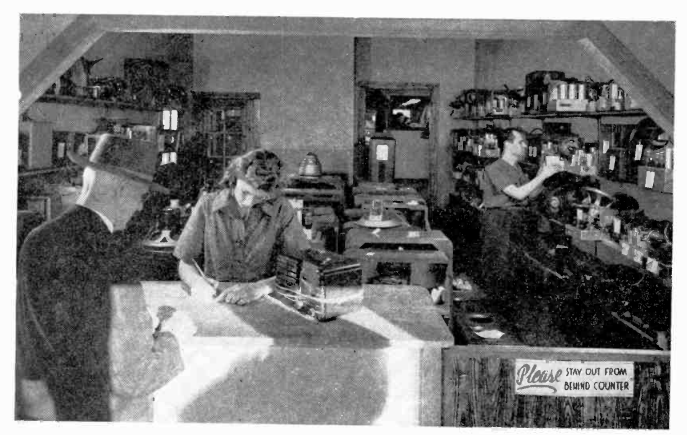
1944AugNatRadioNewsShown here, in the August-September 1944 issue of National Radio News are Richard and Amy Feil of Dixie-Fixit Radio Hospital, Lima, Ohio. The shop was strictly service, and handled the radio maintenance for sixteen dealers, including department stores and auto dealers. The shop efficiently handled a large volume thanks to its systematic procedure. When sets came in, they weree given a ticket, and went onto a shelf in the order received. Next, the chassis was removed from the cabinet, and each was moved to the next shelf. When finished, they moved to a third shelf.

The sets were serviced strictly in the order received, and if the shelves were full, the shop was closed to new sets. Service was promised within 1-2 weeks.

The shop also had a three bay garage where auto sets were serviced.