Author Archives: clem.law@usa.net

1939 One Tube Shortwave Regen

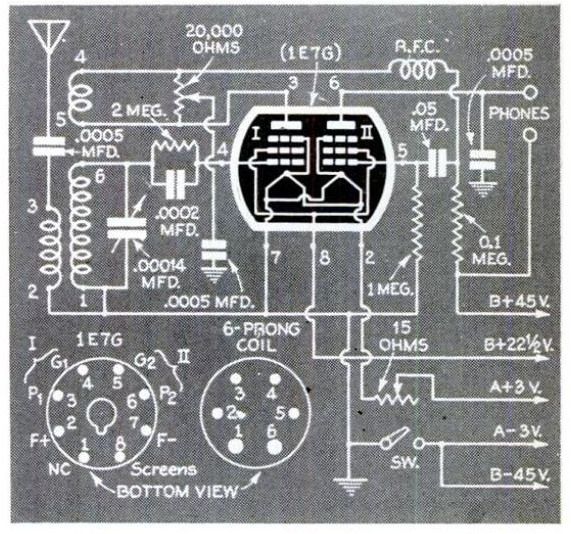
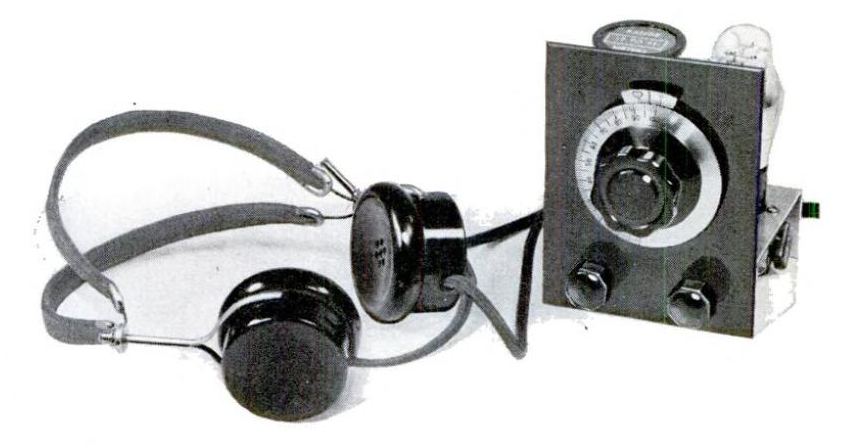
1939AugPSsw1939AugPS5If you had put together this minimalist little shortwave set when it was published in Popular Science in August 1939, you would have been able to use it to pull in the news of the beginning of World War II the next month.

The little set is simplicity itself. It uses a single 1E7G tube, a dual pentode.  Half is used as regenerative detector, with the other half serving as audio amplifier.  There are only three controls on the front panel:  The tuning dial, regeneration control (with on-off switch built in) and another potentiometer for adjusting filament voltage.  The voltage was a compromise, since the RF section needed slightly less voltage than the audio amplifier, but there was still plenty of volume left to drive the headphones and pull in the war news.

1939AugPSswschematic


1944 Canadian Scouting Reminiscences

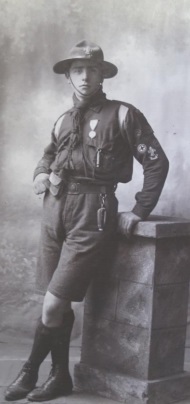
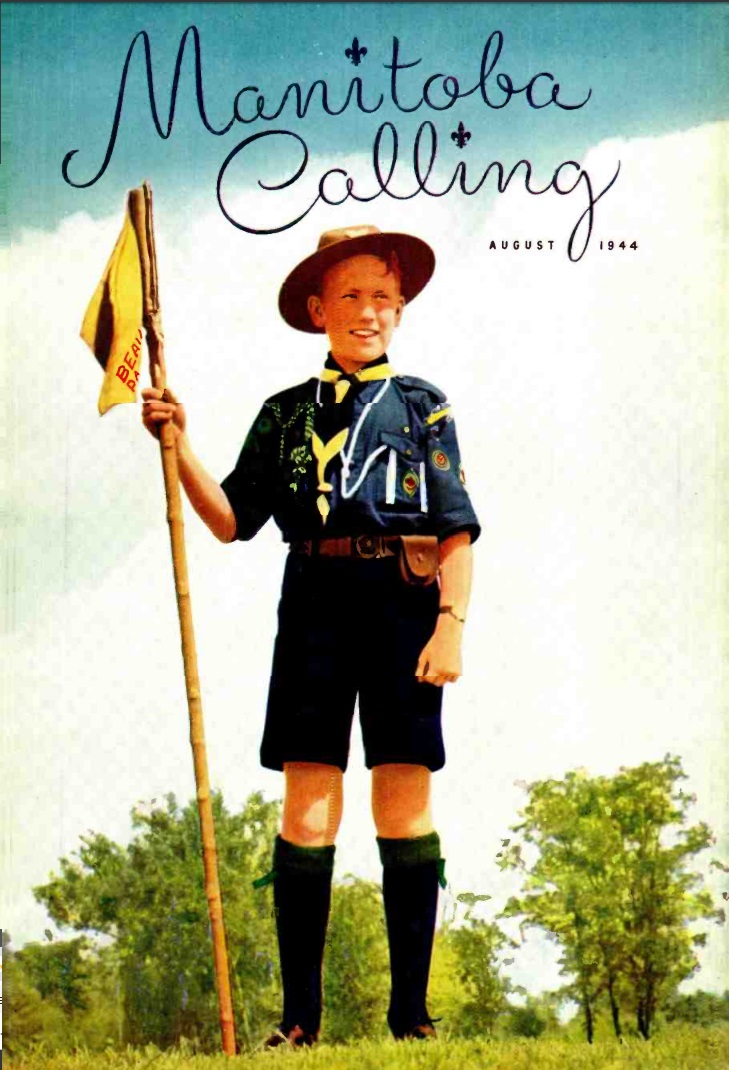
1944AugManitobaCallingShown here is Canadian Boy Scout Frank Lay, of the 67th Winnipeg (St. Aidan’s) Troop. He is featured on the cover of the August 1944 issue of Manitoba Calling, the monthly program guide of CKY Winnipeg, and sister station CKX in Brandon, Manitoba.

The entire issue of the magazine paid tribute to the value of Scout training for Citizenship. It noted that while scouting was designed as peace training, the organization had a fine record in its services to the war effort. At least 100,000 members of the Armed Forces had been Scouts. Indeed, of the 63 Victoria Crosses awarded to date, eight were won by former Scouts.

The magazine includes the reminiscences of W.F. “Bill” Seller, the manager of station CKX. The magazine calls him probably the veteran of all old Scouts in Canada, as he was a member of one of the earliest troops, in fact the first official troop formed in London. It noted that when Lord and Lady Baden-Powell visited Winnipeg in 1935, they met with Seller and exchanged reminiscenses of the early days of Scouting in England.

Here is the full text of Seller’s article:

Early Days in the Boy Scouts
By W. F. SELLER (Manager CKX)
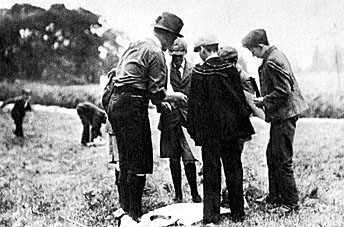
Robert Baden-Powell at the first Scout encampment on Brownsea Island held in August 1907. Wikipedia image.

In August, 1907, two men, an orderly and 20 boys pitched tents and hoisted a Union Jack on Brownsea Island, near my home at Poole, Dorset, England. The leader of the party, General Baden-Powell with a friend (Major MacLaren), was making his first experiment in teaching English lads the scouting games he had learned himself as a boy and had used to such good advantage in South Africa, to test his idea of an organization for boys.

The twenty boys were gathered from several sources, from Eton and Harrow and from elementary schools; from the homes of the aristocracy and from the fisherman’s cottage. The troop was divided into four Patrols–each with a leader, Curlews – Ravens -Wolves -and Bulls. From morning till night they were busy learning to live in the open, to cook their own meals, to develop their powers of observation and above all to cultivate comradeship.
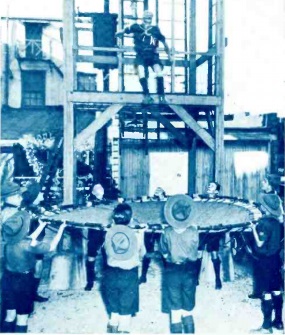
Canadian Scouts training for the Fireman's badge, 1944.

Canadian Scouts training for the Fireman’s badge, 1944.

Baden-Powell taught them how to follow trails, how to find a few grains of Indian corn in an acre of heather and how to hide and find messages in trees. Then, too, there were organized games and bathing and all the time these twenty boys were unconsciously acquiring habits of self control, fair play and manliness; in other words, the underlying principles of the Boy Scout Movement. The evenings were topped off with the group gathering round the campfire listening to thrilling stories, bird calls, lessons on stalking and singing, all led by “The Chief “.

By the end of two weeks Baden-Powell had proved that his scheme was sound to the core and he settled down to launch it upon the world. Its value was soon realized, the movement grew and Baden-Powell not only became a hero to but beloved by boys throughout the world.

It was not my good fortune to be in on the experimental camp but a cousin of mine was and his glowing accounts of Baden-Powell and his ideas fired a small group of us with enthusiasm, so in 1908 after purchasing one of the first issues of “Scouting for Boys“, we decided to become Boy Scouts. There was no local organization, we just got together, ten of us, using a shack at the bottom of the garden for our “club house “. We met Thursday nights and Saturday afternoons. There were no uniforms at first and then we were able to buy Scout supplies and started to become real Scouts. This, too, was tough, it was all so new.

1909ScoutUniform

1909 uniform, scouts.org.uk image.

For the first few weeks after getting our shorts, shirts, hats and shoes, etc., we used to carry the stuff up to the woods, change under the rhododendron bushes, practise our scouting and then in native’s dressing rooms change back again and amble off home.

After a while we decided that this would not do: if we were going to be Scouts we should be proud of the fact, and so we went one step farther and we changed into uniform in the shack and all marched in patrol formation to our scouting practises. For a time we had to take the public taunts of other boys whose ideas of sport were not always satisfied with wordy insults, but were backed up with sticks, stones and sometimes eggs!

Paying Their Way

1909 Crystal Palace Scout Rally. Wikipedia photo.

Soon, however, we had two patrols of ten each and we looked for a scoutmaster and rented accommodation in one of the schools. To pay the rent, we each donated a few coppers each week to the club funds. If one could afford six -pence o.k., if only a penny, again o.k. But often when rent day came around funds were inadequate, so instead of “scouting” on the Saturday afternoon, we would all go out and hunt up odd jobs, running errands, digging gardens, cutting lawns, etc. Everyone brought in whatever he had earned to the common funds and it worked. Came the day when we had three patrols and could officially qualify as a “troop “. We applied for a Charter and Troop Flag, which was presented to us at a special ceremony at Canford Manor by Lady Wimborne and so we became the first troop of Boy Scouts in the world, registered as the 1st Parkstone Troop, afterward Lady Baden Powell’s own. We attended the first scout rally which was held at the Crystal Palace, London.  15,000 I believe were present, and we were impressed by the size of the old Crystal Palace, when due to rain the march past was held entirely under glass. The following year we attended the rally at Windsor Castle and later one at Birmingham. This last, numbering close to 200,000, was made most interesting for us by the presence in our troop of a prince of the royal house of Ethiopia, dressed in his native costume, one of the sons of Haille Selassi. The lad, about 13, had stowed away on a liner leaving his country for Great Britain and had to remain in England until dignataries from Ethiopia could arrive and return with him in befitting splendour. He was sent to our home town and in despair the gentleman responsible for his care asked our troop to share the responsibility and many were the interesting episodes provided by this young man.
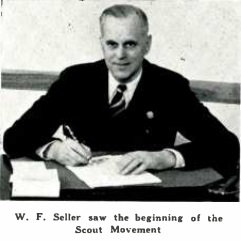
1944AugManitobaCallingSellerI believe the troop justified its membership in the great brotherhood of scoutdom. Our ambulance patrol was on duty at most public functions and a sports gathering including the first flying meet ever held. This was at Bournemouth, and during this meet the pioneer A. V. Rowe was killed in a vol-planing competition. [Louis] Bleriot, the first man to fly the English Channel, was there and we also saw [Hubert] Latham flying one of the first monoplanes, a crazy looking contraption with the appearance of an over -developed kite. We had the first King’s Scouts and the first Silver Wolf; won many district and national trophies, and had a good time doing it, with clean keen competition and the joy of contest rather than conquest being strongly stressed.

I could ramble on like all pioneers, to tell you of the time when camping, the troop saved a group of cottages from destruction by forest fire, the time a boat -load of us were nearly drowned but for the timely rescue of the Coast Guards, the course of home nursing undertaken by some of the boys, the concerts we ran, the bazaars we organized to rase our own funds.

“B.P.’s” Marriage

I could tell how we got news of Baden-Powell’s wedding at St. Peter’s Church, Parkstone, and were able to turn out in time to salute him and his bride.

We were very fortunate that Baden – Powell had selected our district for his experiment and that he chose a lady from our home town for his bride, for as a result, we enjoyed many informal visits and interesting evenings at our club rooms with the Chief himself. Many members of that first troop of Scouts are living in Canada and most of that same troop served in the first World War. We all carry pleasant memories of the wonderful experiences we had as Scouts and one of my prized possessions is the old Scout shirt resplendent with badges, all-round cords and service stars, together with the scarf and many pictures that are now historical but unfortunately not good enough for reproduction.

1919 Mobile Radiotelephone

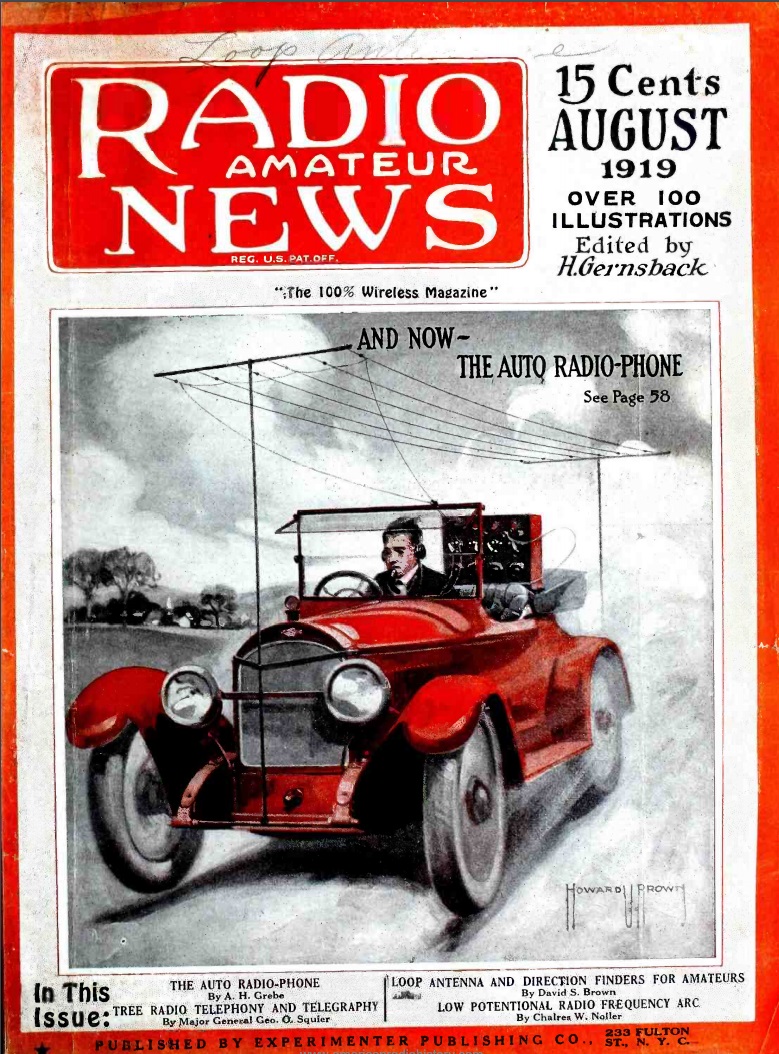
1919AugRadioAmateurNewsShown here a hundred years ago this month, on the cover of the August 1919 issue of Radio Amateur News, is Alfred H. Grebe.  The magazine contains an article by the radio pioneer about his experiments with mobile radio.  He found that the radiotelephone set mounted in the car worked well, and that 150 meters gave the best results.  The transmitter was of the latest design, and the receiver was a regenerative set with a variometer.  While it was still at the experimental stage and no definitive measurements were made, he did note that both ship and land stations within a few hundred miles were heard.  Even with shielding, the spark plugs of his car limited the range, and the interference from other cars could be heard for quite some distance.

Grebe was involved in the beginnings of WCBS radio, and when he died in 1935 at the age of 40, his obituary appeared in the New York Times.


Simple Modification to Receive CW: Zenith 6B16BT

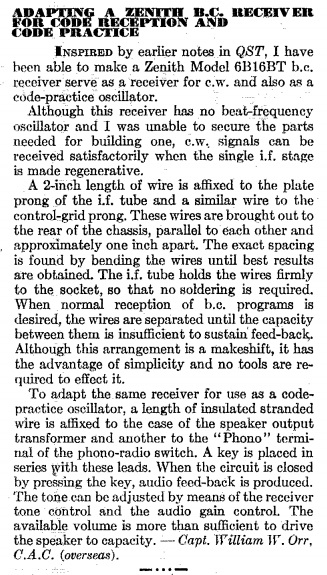
Finished-11944AugQSTSeventy five years ago, Capt. William W. Orr, stationed somewhere overseas with the U.S. Army Coast Artillery Corps,  had a Zenith Model 6B16BT receiver similar or identical to the one shown above, but no way to listen to Morse Code transmissions with it.  The set covered the standard broadcast band and 2.3 – 22 MHz shortwave, but the set was intended for listening to broadcast programs, and didn’t contain a Beat Frequency Oscillator (BFO) for listening to Morse Code.  If there hadn’t been a war going on, adding a BFO would have been a relatively straightforward proposition of building a one-tube oscillator running near the set’s IF frequency of 455 kHz.  But as Capt. Orr points out, he was “unable to secure the parts needed for building one.”

Instead, he came up with a solution elegant in its simplicity.  It is shown here from Hints & Kinks in the August 1944 issue of QST.  He turned the IF into a regenerative stage by adding a “gimmick” capacitor to provide feedback.  This consisted of nothing more than two short pieces of wire, sticking out the back of the set.  It wasn’t even necessary to solder the wires.  One was stuck into the socket for the plate pin, and the other one to the grid pin.  To copy CW, the wires were moved close to one another.  For listen to voice programs, the wires were moved apart.

Interestingly, the Knight Star Roamer receiver later used a similar method for copying CW.  To copy CW, feedback was switched in to the IF stage to make it go into oscillation.

He used a similar trick to turn the set into a code practice oscillator.  The key was hooked between the speaker transformer and the phono input.  When the key was pressed, the resulting feedback could be used to generate the code.

I would like to thank Dave McClellan for providing the image of the beautifully restored Zenith receiver shown above.   You can read about his restoration and see more pictures at this link.


1944 Radio Rentals

1944AugRadioServiceDealerShown here in the August 1944 issue of Radio Service Dealer magazine is the proprietor of Acme Radio Service Co., 880 Third Avenue, New York, NY.

Before the war, he got half of his business from repairs and the balance from sales and rentals. But there were no new sets to be sold, and labor shortages made service problematic. So he focused on rentals to the point where they represented 75% of his business. He acquired used sets, refurbished them, and put them into circulation.

He did this by canvassing all of the hotels within ten square blocks. He managed to place ads in rooms and elevators, but his real success came from the fact that he paid a flat $1 commission to the clerk or bellboy who made the sale. For the bellboy especially it was a lucrative proposition, since when he delivered the set and plugged it in, he was probably going to get an additional tip. Hotels were packed, and it became a very lucrative part of his business.

Good record keeping was key, and the magazine offered some suggestions. The article suggested that a set could be rented out for an average of 100 days per year at an average rental of $1 per day. The magazine noted that the resulting $100 was “many, many times over the original cost of the average midget or table model radio that would be used for rental.”


1939 Portables

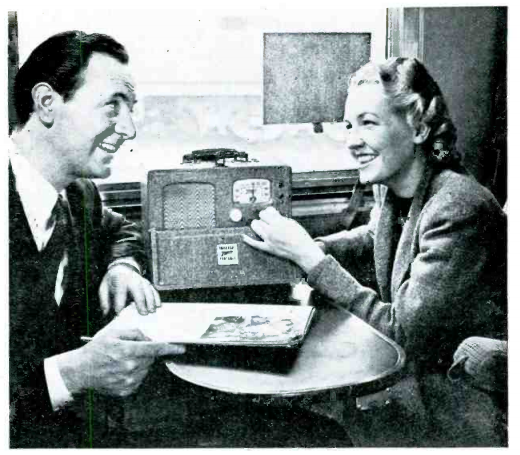
1939AugRadioRetailing2Eighty years ago, portable radio receivers were all the rage, as shown by the pages of the August 1939 issue of Radio Retailing.

Above, for example, these listeners are happily pulling in a program as they travel in luxury aboard an all-metal Pullman car, thanks to the Zenith portable with detachable antenna.  The magazine notes that many consumers are amazed by the sensitivity of portables, even though just a few years earlier, portables were lacking in pickup.  The set shown here appears to be a 5G500, which included a detachable “wave magnet” antenna to pull in stations in difficult situations such as an all-metal car.

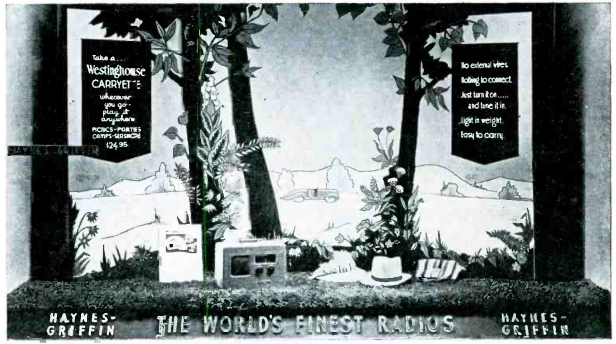
And below, New York dealer Haynes-Griffin put together this window display featuring a Westinghouse portable.  The magazine noted that the simple backdrop, artificial grass, two summer hats, and a bag gave the scene a human interest.

1939AugRadioRetailing3


Solar Eclipse of August 7, 1869

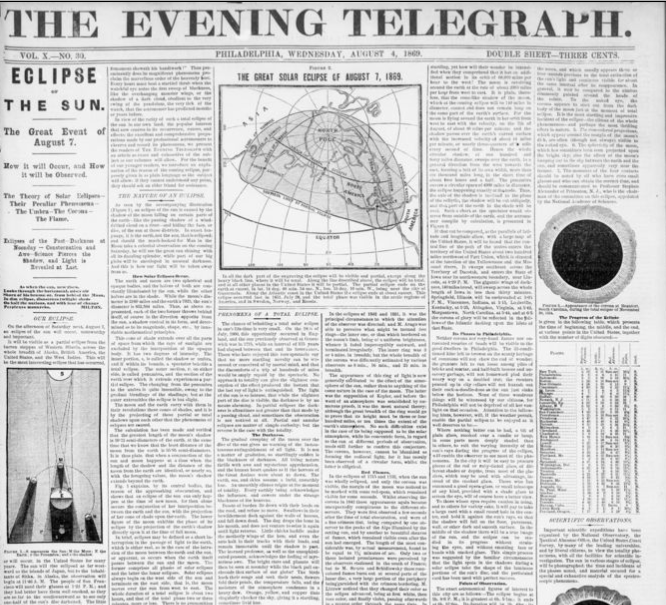
1869EclipseSpectrumToday marks the 150th anniversary of the total solar eclipse of August 7, 1869.  The path of totality started in Asiatic Russia, and covered a tiny swath of China and much of Siberia before crossing the Bering Strait into Alaska and Yukon, and then through parts of the present day provinces and states of British Columbia, Alberta, Saskatchewan, Montana, the Dakotas, Minnesota, Iowa, Nebraska, Missouri, Illinois, Kentucky, Tennessee, Virginia, West Virginia, and the Carolinas.

The eclipse wasn’t the first to be photographed.  Those honors go to the eclipse of July 28, 1851, which, according to Wikipedia, produced the first scientifically usable photograph.  It does have the distinction of being the first to provide detailed spectroscopic images of the corona, which revealed an element believe for many years to be “coronium“.  It took 70 years to realize that the spectrographic line was not a new element, but instead iron at over a million degrees Kelvin.  The image shown above left was prepared by Prof. Charles Augustus Young of Dartmouth College, who was part of a team at Burlington, Iowa.  The same team produced the photo shown below:

1869EclipseBurlingtonPhoto

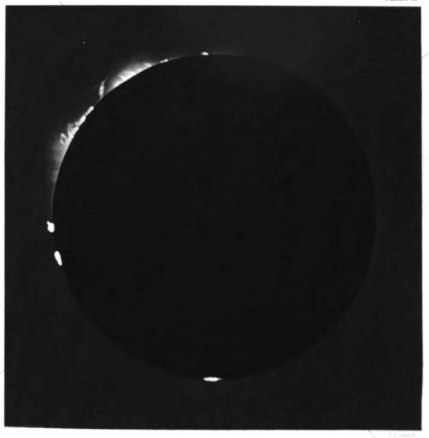
1869EclipseOttumwaPhotoAnother team left Burlington for Ottumwa, Iowa, but was beset by problems.  They had forgotten their chronometer in Burlington, and the telescope clockwork was damaged in transit.  Notwithstanding these difficulties, they managed 34 photographs, including four of totality, one of which is shown at left.

Another team was headed by Prof. William Harkness of the U.S. Naval Observatory. This team constructed a temporary observatory at the northwest corner of Second and Short Streets in Des Moines. Harkness reported that this vacant property on the west bank of the Des Moines River had a horizon almost devoid of obstructions.  “Short Street”  no longer exists, but according to the 1869 Des Moines city directory, it ran from the Des Moines River to Third Street (only a little more than a block, hence the name).  From the description of the observatory being on the west bank, it would appear that the building was near the current site of Wells Fargo Arena.1869EclipseDSMobservatory

A local contractor, one F.T. Nelson was retained to build the structure, shown at right.  This team also obtained multiple photographs and spectrograms.   The sketch below is the eclipse as seen through their four inch telescope.

Carptenter F.T. Nelson's listing in the 1869 city directory.

Carptenter F.T. Nelson’s listing in the 1869 city directory.

1869EclipseDSMsketch

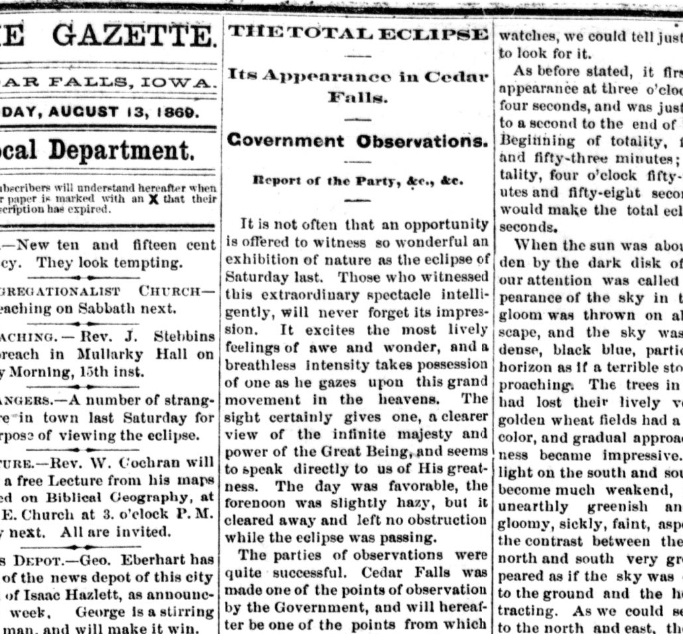
The August 13, 1869, issue of the Cedar Falls (IA) Gazette carried this account of the eclipse. Those of us who witnessed the 2017 eclipse concur in the accuracy of this report. Indeed, from our viewing point in Hastings, Nebraska, we also had the added tension that “the forenoon was slightly hazy, but it cleared away and left no obstruction while the eclipse was passing.”

THE TOTAL ECLIPSE

Its Appearance in Cedar Falls

Government Observations.

Report of the Party, &c., &c.

It is not often that an opportunity is offered to witness so wonderful an exhibition of nature as the eclipse of Saturday last. Those who witnessed this extraordinary spectacle intelligently, will never forget its impression. It excites the most lively feelings of awe and wonder, and a breathless intensity takes possession of one as he gazes upon this grand movement in the heavens. The sight certainly gives one, a clearer view of the infinite majesty and power of the Great Being, and seems to speak directly to us of His greatness. The day was favorable, the forenoon was slightly hazy, but it cleared away and left no obstruction while the eclipse was passing.

The parties of observations were quite successful. Cedar Falls was made one of the points of observation by the Government, and will hereafter be one of the points from wliich calculations will be made. The party sent out by the Government to take observations iu this city were Ed. W. Horr, son of Dr. Horr of the Smithsonian Institute, and Wm. I. Anderson and W. W. Wormood, of Dubuque.

1869CedarFallsGazette

References


Blink Health Rx Review

PharmacyReceipt

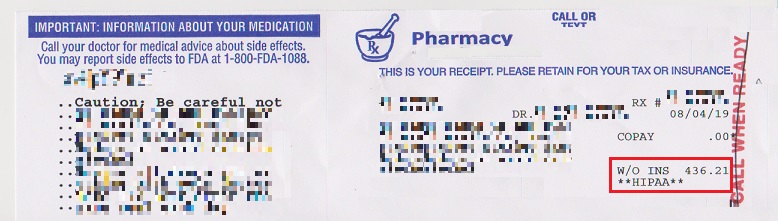
Today, I paid $15 to have a prescription filled.  But if I hadn’t been careful, I could have paid $436.

I’ve previously written about the importance of price shopping when having a prescription filled or refilled. This is not like shopping around to save a couple of dollars when buying a gallon of milk. Prescription prices can vary by a huge amount. A pharmacy might have a reasonable price on one prescription, but another pharmacy will charge hundreds of dollars for the exact same prescription. They get away with this because the doctor conveniently offers to call in the prescription to your favorite pharmacy. If you take your doctor up on the offer, you might pay hundreds of dollars more than you need to. You need to get a paper prescription, shop around for price, and then have the prescription filled.

GoodRxLogoI’ve previously explained that the website GoodRx.com makes this process easy. You enter the name of the medication, and the site shows you the prices at various pharmacies. In most cases, you need to print a coupon or display it on your smartphone.

BlinkLogoSince I wrote that, another site sometimes provides a better price.  That site is Blink Health.  It often has the lowest price, so it’s worth checking.  Also, by following the links on this page, you will save $15 off your first order.

To check the price, you enter the prescription name on their website.  When the list of possible medications comes up, select the proper dosage and number of doses.

In most cases, you will see three options for price. The first is for home delivery, and this price is usually quite reasonable. The second is the “Blink Everyday Low Price.” The “Blink Everyday Low Price” is for major pharmacy chains such as Walmart and Safeway. If you need to buy from one of these pharmacies, GoodRX.com probably has a better price.

The third price is for the “Blink Smart Deal,” and this is usually the lowest price. It will display the name of an independent pharmacy in your area, but this pharmacy might not be convenient. You can click on the “change pharmacy” link, and you will see a list of most independent pharmacies in your area. Select that pharmacy, and that’s where you will pick up your prescription.

The Blink website is easy to use, and you place your order as you would with any other website. But there is one additional step. The Blink site is only to pay for the prescription. You also need to call or visit the pharmacy to place your order with the pharmacy. This represents a slight inconvenience, but you are more than compensated by the price savings. When the prescription is ready, you pick it up and give the pharmacy the receipt you printed from the Blink website.

The two-step process is slightly inconvenient, but in some cases, the price savings will be substantial. Often, GoodRx will have a better price or one that is about the same. But sometimes, the difference will be significant, so you want to try both.

At the top of this page is my receipt for a prescription I picked up today. My cost was $15.30. As you can see on the receipt, the copay is listed as zero.  This is because I paid in full online.  But the most shocking thing about this receipt is the “W/O INS 436.21“.  This means that if I had walked in off the street with my prescription, or had the doctor call it in, I would have paid $436.21.

In many cases, GoodRx would have given me a price that was almost as good.   In fact, in this case, one pharmacy listed on GoodRx has a cash price of $13.67, with no coupon required. Also, one membership pharmacy would charge $6, plus an annual membership fee. One other local pharmacy shows a price of $316, but $18.46 with coupon.

These prices are crazy, and this whole system makes no sense. Frankly, it’s obscene that my pharmacy would charge an unwitting customer $436, but charged me only $15 because I was willing to jump through some online hoops.  And it’s obscene that one pharmacy’s cash price is $14, but another one is $436 for the exact same product.  There’s no rhyme or reason, but you have to jump through the hoops every single time.  The last time I filled this prescription 90 days ago, Blink was the lowest price.  I stayed with them because the price was only slightly higher.  The next time, perhaps it will be a lot higher.  When that time comes, I’ll switch again.

If you purchase from Blink after using the links on this page, you will receive a $15 discount on your first order.  If the total price is less than $15, then the prescription will be free.  This site will also receive a credit.

This is one of a series of posts about our experiences with Samaritan Ministries, a health sharing ministry.   You can read my other posts about Samaritan at this link.  If you decide to join Samaritan Ministries, please mention my name, Richard Clem, as the person who referred you, as I will receive a credit for referring you.


1944 Radio Hospital

1944AugRadioRetailing

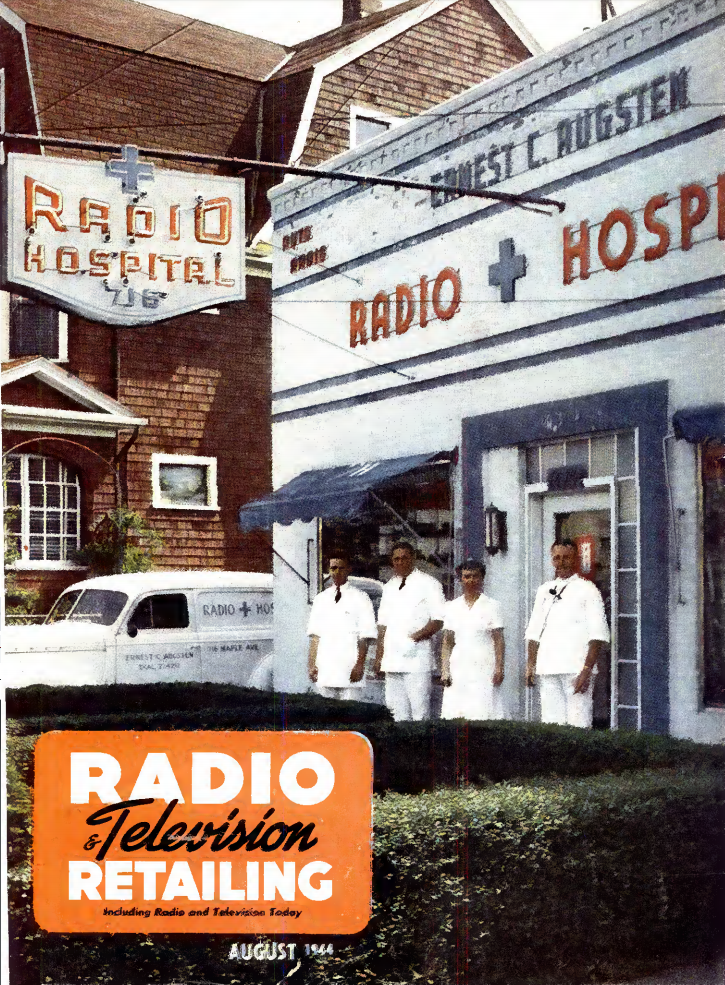
When “Dr.” Ernest C. Augsten entered the radio business in Hartford, CT, in about 1938, he realized that there were so many others in the field that he had to make himself stand out. So he decided to try a different angle, and make his shop at 714 Maple Avenue a Radio Hospital.

The dealership was featured in the August 1944 issue of Radio Retailing, which revealed that he employed one Nurse, his wife, who received the patients and maintained their records. His two interns assisted in operations.

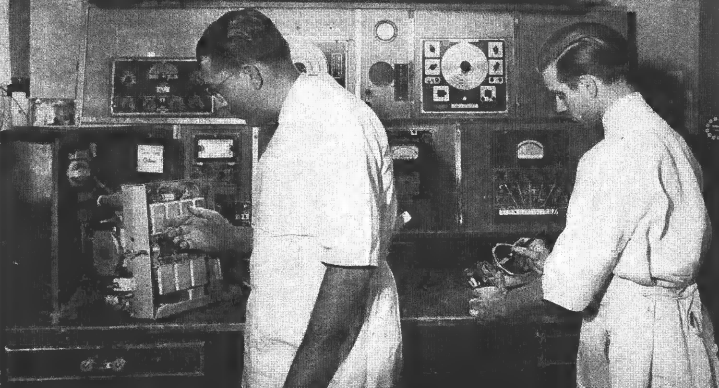
Dr. Augsten wore a stethoscope, which he used on occasion in diagnosing a set. The article also explained how a hypodermic needle (filled with carbon tetrachloride) was used for cleaning a dirty part, and a scalpel was used for jobs such as loudspeaker repair. The ambulance was largely grounded for the duration, due to wartime gas and tire rationing. But before the war, when the ambulance was sent out to pick up a set, it was typically carried out in a stretcher.

This usually caused a crowd to gather, and invariably a member of that crowd had a set at home in need of repair.

Dr. Augsten had been licensed as a ham as early as 1924, as shown by this callbook listing, with callsign 1BFU.

Interns Cliff Islieb and Russ Johnston working on patients with a hypodermic syringe and scalpel.

Interns Cliff Islieb and Russ Johnston working on patients with a hypodermic syringe and scalpel.


1959 Cubicles

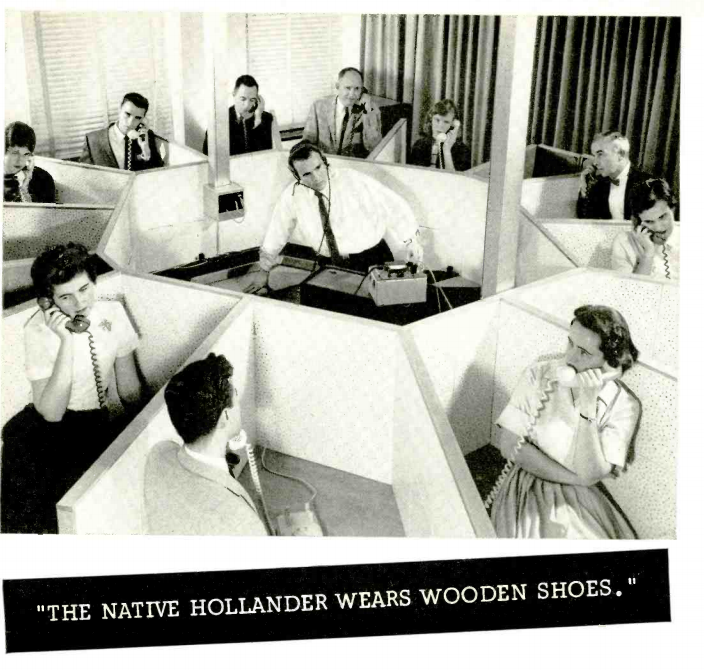
1959AugRadioElecWhat are these people doing, and what does it have to do with Dutch footwear? And how does the guy in the center get in or out of his cubicle?

These people, from a Bell Labs ad in the August 1959 issue of Radio Electronics, are helping The Phone Company rate the effects of various kinds of noise and interference. The ad notes that noise is a major distraction to modern living, and “an enemy of the Bell System.” They did all they could to fight it, and that’s what these people were doing.

The gentleman in the center would play a tape with common phrases, such as “the native Hollander wears wooden shoes.” In carefully controlled tests, he would then introduce noise to the line, as well as playing background noise through a loudspeaker. These volunteers would then rate the quality of the call.

As to the last question, how the guy in the center got in and out, I’m not sure, because the ad doesn’t say. I assume it involved crawling underneath, because none of the cubicles appears to have a door. Interestingly, the office cubicle didn’t hit the market until 1967, so this was another case where Bell Labs was ahead of the times.