Author Archives: clem.law@usa.net

Pandemic Shopping Time

image of Coronavirus Disease 2019 (COVID-19)The photograph above was taken on February 26, 2020, at a supermarket in Bergamo, Italy. As you can see, the shelves are almost bare. As of this writing (March 5), according to news reports, Italy has confirmed 3800 coronavirus infections, and 148 persons have died. Institutions such as schools have been closed.

Where the sanitizing wipes were supposed to be today.

Where the sanitizing wipes were supposed to be today.

It’s quite possible that the epidemic will affect commerce in North America just as it has in Italy. Since more and more cases are being reported in the U.S., it seems quite possible that store shelves will have similar shortages within a few days. This afternoon, I visited a local Walmart. There was no “panic buying,” but many items were out of stock. At this point, the missing items were mostly preparations specific to a pandemic. There was no hand sanitizer, or sanitizing wipes. There was no isopropyl alcohol. There was still bleach available, but the shelves were starting to become empty.

BleachAisleThe only “prep” item I bought today was a gallon of bleach. The CDC has instructions
for using household bleach for cleaning and sanitizing, and even if other cleaning products are not available, a gallon of bleach should be enough for thousands of uses. If your big box store is out of it, I bought mine at Dollar Tree. People are buying it, but if you look around, plenty should be available.

As of today, there weren’t any shortages comparable to those in Italy.  However, I did notice that many grocery items seemed to have minimal stocks.  In the soda aisle, for example, some brands and flavors were missing.  The bottled water aisle seemed to have the most obvious shortages.  Personally, I don’t see much need to buy water, since there’s no reason WaterAisleto believe that the tap water will stop working.  But I guess if you normally drink bottled water, you might go on the assumption that it will be unavailable, at least temporarily, within a few days.

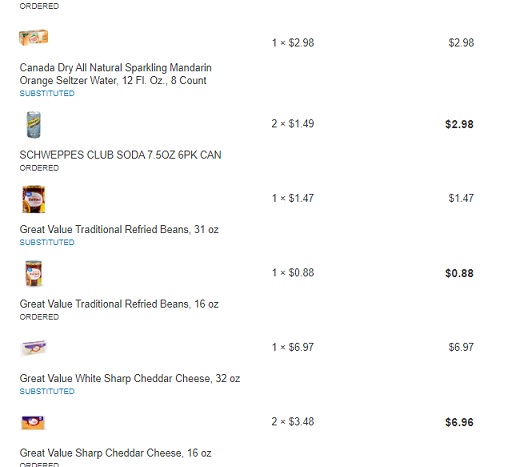
I think the moral of the story is that the time is now to stock up your normal groceries, and to do it as soon as possible.  We published the following list previously as a recommended shopping list for hurricanes.  For a pandemic, you have much more flexibility, since your normal refrigerator and stove will continue to function normally.  These are, of course, just suggestions.  The following links are to Walmart.com.  If you want to save time, you can order online, and then pick up your order at the store.


1920 Boys’ Life DeForest Radio Ad

1920MarBLOne hundred years ago this month, the March 1920 issue of Boys’ Life carried this ad from the Deforest Radio Telephone and Telegraph Company, 1397 Sedgwick Avenue, Bronx, New York.

Interestingly, I’ve noticed that some ads from this era, like this one, don’t make a distinction between a licensed amateur radio operator, who could transmit, and someone who was just operating a radio receiver as an amateur.  The ad invites boys to write in for a catalog of radio equipment to get the news from everywhere by wireless.  It told them that they could “be an Amateur Radio Operator with your own Receiving Station.”  The ad made clear that the company didn’t sell toys, but instead “practical, scientific Radio Apparatus like that used by Government and Commercial Stations.”  One could start out inexpensively and then build up the station.


Product Review: Walmart Equate Plus Nutritional Shake

Update:  This page was written pre-COVID, and in the intervening years, only the chocolate, vanilla, and strawberry flavors are available.

As I’ve previously recounted, I was quite sick just over a year ago and was hospitalized.  In the process, I lost a lot of weight, and needed something to provide easy nutrition.  As a result, I became something of a connoisseur of nutritional drinks, the most familiar brand names being Ensure and Boost.  These products are designed to partially replace part of one’s normal diet.  They generally contain a warning that you shouldn’t use them as your sole source of nutrition without consulting your physician, but they are a good supplement to ensure you’re getting adequate calories and nutrition.  Most, for example, provide about 350 calories.

As I discovered, some tasted better than others.  My health has recovered, and I guess there’s really no medical need for the added nutrition.  But I like them, and they make an extremely convenient breakfast if I’m in a hurry.  The 350 calories keep me going even if I don’t have a chance to eat anything else.  They’re now part of my routine.

The major brand names tasted OK, but I also sampled some of the store brands.  Initially, the Walgreen’s store brand was my preferred choice.  Unfortunately, however, at some point they changed the formula.  The old version’s label stated that it provided 25 vitamins.  The new label proudly proclaimed that it now had 26 vitamins.  Unfortunately, the changed formula didn’t taste as good.  So I had to do more shopping, and tried the Walmart store brand.

Initially, I was a bit disappointed.  I bought the chocolate, and it wasn’t quite as good as the Walgreen’s brand.  It’s hard to articulate, but something about the chocolate flavor seemed a bit artificial, and the overall experience wasn’t as “smooth” a taste as I wanted.  Fortunately, however, I decided to try some of the other flavors.

My favorite was the mocha flavor.  If you like coffee, you’ll like this flavor.  The addition of the coffee flavor brings back the “smoothness” that was missing in the plain chocolate.  In fact, if you ordered an iced mocha at Starbucks and they served you one of these, you would be quite satisfied.

I also enjoy the strawberry and banana flavors.  It’s also available in vanilla, but I haven’t had a chance to try that flavor yet.  While they can be consumed at room temperature, they are best served chilled.  Refrigeration of the unopened bottle is not necessary, so they’re handy to keep a few on hand.

If you’re looking for a product with fewer calories, the Walmart brand, as well as most of the other brands, offer an “Original” version.  The “Plus” version is 350 calories, but the “Original” version is 220.  Look for the words “Plus” or “Original” on the label, or glance at the Nutrition Facts label to make sure you’re getting the 350 calorie version.

I much prefer the Walmart store brand to the name brands.  As an added bonus, as you might have guessed, the store brand is also cheaper.  Tastes may vary, but if you or a loved one have been prescribed a nutritional drink, you’ll want to consider trying this less expensive store brand.  In addition to saving a little money, you very well could prefer it.  And if you’re a busy person and might occasionally miss a meal, it’s not a bad idea to keep one in the back of the fridge, or even in your desk at work, to quickly give you the nutrition to keep going.

And while one of these products is too expensive to buy in bulk for emergency food storage, it might fill a niche, and keeping some on hand for emergency preparedness purposes might be prudent.

Some links on this page are affiliate links, meaning that this site earns a small commission if you make a purchase after clicking on the link.



Answer to Yesterday’s Quiz

1945MarPSYesterday, we featured this brain teaser from the  March 1945 issue of Popular Science.

At first glance, it looks like it will work.  If you trace the path with button a pushed, bell A should ring.  But what you might not have noticed is that with neither button pushed, both bells are hooked up to the transformer in series.  So they will ring continually, albeit probably at reduced volume.

So wartime shortages or not, Jones will have to scrounge up some additional wire.


1945 Electrical Quiz

1945MarPSWartime shortages were undoubtedly the reason that Jones tried to save wire when hooking up his two doorbells. But can you figure out what went wrong? We’ll have the answer tomorrow.

This item appeared 75 years ago this month in the March 1945 issue of Popular Science.


Oral Rehydration Solutions for Emergency Preparedness

image of Coronavirus Disease 2019 (COVID-19)Click here for homemade electrolyte solution information.

As the coronavirus continues to make the news, we’ll be offering some posts with advice for preparing. As with any potential emergency, there are common-sense preparations that one can make, such as making sure that your family has an adequate supply of food and other items, in case supplies are interrupted or you are unable to leave your home.

Note: Please keep in mind that I’m not a doctor. I’m a lawyer. Just as you wouldn’t take legal advice from a doctor, you probably shouldn’t take medical advice from a lawyer. So please do your due diligence, and take medicine only upon medical advice.   But you can’t take medicine if it’s not available. My main focus is giving advice to make sure you have medicine available in the first place.

Basic Preparations:  Food and Medicine

For pandemic preparedness, the Department of Homeland Security’s ready.gov website recommends that you store a two week supply of water and food. (You can find food storage pointers at many earlier posts, many of which are linked here.)  The site also stresses that you should make sure you have a continuous supply of any prescription drugs you are taking. This seems especially critical in the case of the corona virus. According to news reports, about 90% of the active ingredients used by U.S. drug manufacturers originate in China. It seems quite possible that supply chains will be disrupted. If you take any prescription medications, it’s best to get refills as soon as possible, so that you always have a supply on hand. If the pharmacy can’t fill your prescription, it won’t be an emergency if you have a month’s supply at home. But if the pharmacy can’t get your medicine, and you just took the last pill, this could turn into a serious emergency.

Unfortunately, some insurers won’t pay for the refill until you’ve almost run out. If that’s the case, you might consider simply paying cash for an extra refill. But whatever you do, don’t just walk into the pharmacy and say that you’ll be paying cash. That could be a mistake that costs you hundreds of dollars. In this post and this post, I have suggestions that will dramatically reduce the cost of your prescription. You’ll save so much that you’ll be angry that the pharmacy was willing to charge so much in the first place.  In fact, in some cases, you might wind up paying a cash price that is less than your insurance co-pay.

Ready.gov also recommends making sure you have adequate supplies of nonprescription drugs and other health supplies, “including pain relievers, stomach remedies, cough and cold medicines, fluids with electrolytes, and vitamins.”

Oral Rehydration Solutions

By “fluids with electrolytes,” they mean oral rehydration solutions, the most familiar brand name of which being Pedialyte. If you are dehydrated by a condition such as diarrhea, this could be a lifesaving item to have on hand.

Unfortunately, this could be expensive to stock up in advance. However, with some foresight, you can do this economically. The simplest way to plan for possible dehydration is to stock up is to buy some Pedialyte or generic equivalent. It’s probably less expensive to buy it in powdered form. One replacement, albeit probably not as good medically, is a sport drink such as Gatorade. It is available ready to drink, or as a powder. (I have noticed that Dollar Tree sells small containers of a generic equivalent of Pedialyte, and at $1, these are quite economical for stocking up.)

Preparing to Make Homemade Rehydration Solution

As a last resort, you can make an oral rehydration solution at home. There are a number of recipes available, including from reputable sources such as the World Health Organization.

In most cases, you can make an acceptable oral rehydration solution with items that you normally have at home, such as sugar, table salt, and sodium bicarbonate (baking soda). If this is all you have, then this is certainly better than nothing. Many recipes, however, also call for potassium chloride. For example,  this recipe from physician Dr. Kara Fitzgerald, adapted from the WHO formula. includes potassium chloride. This is probably something you don’t have in your kitchen. However, the good news is that it’s readily obtainable prior to the disaster, and you can get enough to last a lifetime for just a few dollars. You can buy it at the grocery store in the form of “Morton Lite Salt.” This product is half regular salt (sodium chloride) and half potassium chloride. Since sodium chloride is also part of the recipe, this can be used. Dr. Fitzgerald, gives the following recipe, to be added to four cups of water: 1/4 tsp. table salt, 3/4 tsp. baking soda, and 1/4 tsp. Morton Lite salt.  For flavoring, you can add some Crystal Light or Sugar Free Kool-Aid.

Another alternative is Morton Salt Substitute, which is 100% potassium chloride. If your recipe calls for 1/2 teaspoon of salt and 1/2 teaspoon of potassium chloride, then you would use a full teaspoon of Morton Light Salt. On the other hand, you could also use a half teaspoon of regular salt and a half teaspoon of Morton Salt Substitute. The only difference is that the Morton Salt Substitute appears to be slightly more expensive.

Since the Lite Salt is so cheap (it’s probably about $2 at your supermarket), it seems to me that it’s cheap insurance. Since the only reason we would ever use it is for an emergency rehydration solution, I wrote the recipe and taped it to the container. We always have the other ingredients on hand, and it’s good to know that we have a method to produce a lifesaving medicine, if the need ever arises.

Some links on this page are affiliate links, meaning that this site earns a small commission if you make a purchase after following the link.


1960 Aerial Platform

1960FebEISixty years ago this month, the February 1960 issue of Electronics Illustrated the “radio powered sky station” shown here.  It was an artist’s conception of the Raytheon Airborne Microwave Platform.  It could be used for either civilian or military purposes, but would establish a platform 65,000 feet in the air.  From there, it could relay radio or television signals, or serve as part of the nation’s missile defense system.

The craft would be stationary above its power source, which consisted of a beam of microwave energy.  This was picked up by an antenna on the bottom.  It was rectified, and the resulting energy was used to power the propeller as well as the electronic payload.

I’ve never heard of this system being deployed, probably because the bugs never got worked out.  This once classified 1965 military report (authored by Raytheon) speaks in glowing terms of the feasibility of the project (which presumably needed just a few more million dollars).  However, as of 1965, successful experiments consisted of the successful use for ten continuous hours at 50 feet, a far cry from the 65,000 feet planned.  And to keep the craft over the microwave beam, a tether was employed, which would probably be impractical at 65,000 feet.

It seems like an ambitious project for 1960, but it’s probably quite possible today.  It seems to me that battery and solar technology will soon be at a point (if they’re not there already) where it’s possible to have a craft that will stay aloft indefinitely.  And unlike the 1960 vision, it wouldn’t need to stay above a fixed point.  If a craft can stay aloft indefinitely, this means that it can fly anywhere in the world.

It also seems to me that an autonomous military vehicle could derive its power from the enemy’s power grid.  When it needed a charge, it could roost on a convenient power line.  In fact, it could probably get its power inductively from an AC power line merely by flying close.


Mediterranean-Dead Sea Hydroelectric Project

1920FebElecExpA hundred years ago this month, the February 1920 issue of Electrical Experimenter detailed this plan which surfaces from time to time: To get hydroelectric power by piping water from the Mediterranean Sea to the Dead Sea, which lies 1400 feet below sea level.

The necessary tunnel would be 37 miles long, and would pass about 2500 feet under Jerusalem. According to the magazine, the plan would bring electric lights and electric trolleys to the Holy Land.

More information about the various proposals for this project over the years can be found at Wikipedia.


From The People Who Brought You the Flame Thrower…

1920FebTalkMachWorldThis young woman, even if she weren’t armed with a giant magnifying glass, could easily change records without soiling her finger nails, thanks to the Vacuum Record Lifter, from Vacuum Record Lifter Ltd., 701 Seventh Avenue, New York.

The device appears to be a suction cup which is placed on the record. It had a vent hole at the top, which was covered by one finger. When the record is safely lifted, the vent can be opened, and the record falls gently into the other hand.

The device was invented by Joseph Menchen, whom the article calls the inventor of “the first liquid fire appliances used by the Allied armies.” Sure enough, Wikipedia lists Menchen as the inventor of a flame thrower, as well as “self-made businessman, film producer, screenwriter, and literary agent.”

The ad appeared a hundred years ago this month in the February 1920 issue of Talking Machine World.