We’ve previously featured products designed to store drinking water in your bathtub. These are an excellent choice if something like a hurricane is approaching your area and you believe that normal utilities might be cut off. These products are a large plastic bag that goes into the tub to keep the water sanitary.
The disadvantage is that these are relatively expensive, and can only be used one time. There’s really no way to empty them completely, so when the disaster is over, there’s really nothing to do other than drain the bag and throw it away.
I’ve recently learned of a product that would work almost as well, at a fraction of the cost. These are bathtub liners that are apparently targeted toward people who are squeamish about taking baths in unfamiliar bathtubs. You place the plastic liner in the tub, fill it with water, and take your bath with the assurance that your body isn’t touching someone else’s germs.
Very few of our readers are squeamish, but there’s no reason why this product can’t also be used to store drinking water. It serves the same purpose as the products designed for that purpose, at a fraction of the cost. The disadvantages are minor.
The first disadvantage is that this liner is not sealed at the top. It’s designed to be placed at the bottom of an open tub. However, it appears to be large enough that it can be draped over the top. It could probably be closed with clothespins or binder clips. (The picture shown above isn’t particularly good, since it shows the liner in a non-standard tub. But the liner measures 90 by 47 inches, so should fit any standard tub.)
The other disadvantage is that it doesn’t come with a pump. However, there’s really no need for a pump, since you can simply bail out the water with a pan or even a cup. If you really want a pump, you can purchase one separately for just a few dollars.
The products designed for water storage look like they would work well, but there’s really no way to test them. These liners are inexpensive enough that you could try one out and then throw it away when you’re satisfied that it works. Depending on the brand, the package contains either ten or twelve liners, so that even after testing, you should be all set for another several disasters, at a very reasonable cost, which is shown here:
Links on this page are affiliate links, meaning this page earns a small commission if you make a purchase after clicking on the link.
As the coronavirus continues to spread, we will occasionally be posting hints to help your family prepare. We recommend that you continue to follow official advice, such as that provided by the CDC. Click here to keep yourself informed.
Click here to read our previous posts on the subject of emergency preparedness.
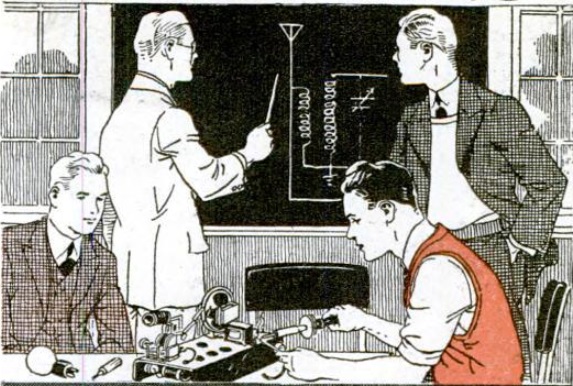
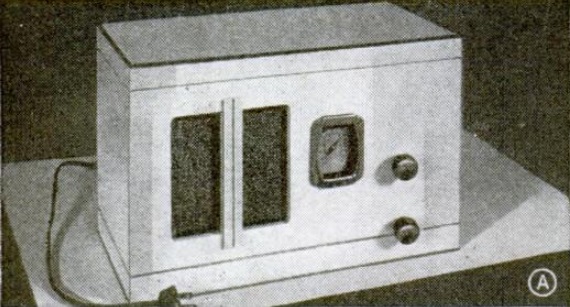
Every year, Popular Mechanics featured plans for a receiver dubbed the “Little Giant,” and these gentlemen are putting together the version described in the magazine’s March 1945 issue.
Despite a war going on, this set was somewhat more elaborate than most. It featured push-pull audio, with two 6G6-G tubes driving the speaker. To drop the voltage for the filament string, a 40 watt light bulb was used. It could be mounted on the chassis, or a lamp could be plugged in to the radio. The set used a TRF circuit, and the magazine recommended a 75 foot antenna to pull in distant stations.
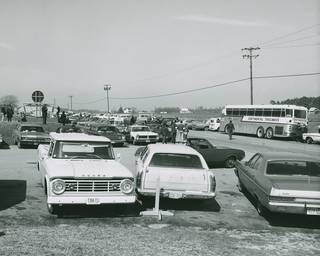
Crowds descending on Virginia to view 1970 eclipse. NASA photo.
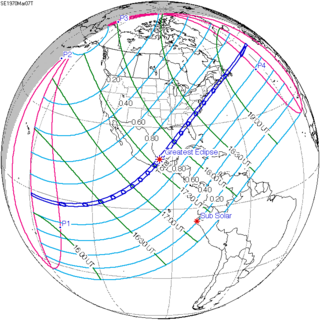
Today marks the 50th anniversary of the total solar eclipse of Saturday, March 7, 1970. As I previously recounted, this was the first eclipse I witnessed. That eclipse began in the Pacific and had a path of totality that crossed southern Mexico before entering the Gulf of Mexico.
Then, the shadow hit the United States , first in Florida, then Georgia, then the Carolinas and Virginia, then grazing Maryland before heading back out to sea, saying goodbye to the United States at Nantucket.
For those with Learjets, it then crossed Nova Scotia, Newfoundland, and the French island of Miquelon, before heading out to sea again into the North Atlantic.
Where I was in Minnesota, it only covered 47% of the sun at high noon. If nobody had told me about it, I probably wouldn’t have noticed. It didn’t get dark outside, and no animals were confused by sudden darkness. But that day, it was the biggest deal in the world. The moon contained fresh footprints of Americans who had walked on its surface less than a year earlier. Now that same moon was casting its shadow over me.
To me and my fellow third graders, it was presented as a big deal. And it was a big deal. If there had ever been any doubt about it, yes, the moon went around the earth, the earth went around the sun, and sometimes they got in the way of each other. Any third grader could see tangible proof.
In school, we had learned all about umbras and penumbras, and by the time the big day came, I was an expert on all things eclipse. With a shoebox, some foil, and a note card, I constructed myself a pinhole viewer. I figured that if a pinhole was good, then a giant hole would be even better. Fortunately, my mom corrected my error and got the viewer in good working order.
I pointed the box at the sun coming in the window, and sure enough, there was a little crescent shape of sunlight coming in through the round hole, plainly visible on the note card.
Perhaps I was a little disappointed at the tiny size of the image, but it didn’t matter. Right there in my shoebox was proof positive that the moon orbits the earth. I didn’t have to take anyone else’s word for it. The proof was right before my eyes.
The home movie here shows some of my contemporaries in North Carolina who had the fortune of being in the path of totality:
From our location, we had to turn on the TV to see the full effect, and we witnessed the darkened skies and the amazed reactions of those who went outside to see it. I don’t remember too many details about the TV coverage. Mostly, I remember some poor confused rooster in Georgia crowing in the middle of the day.
I believe it was the CBS coverage that I watched on TV fifty years ago today, and that broadcast is available on YouTube. (You can hear the rooster at 22:23.)
Here is another reminiscence of another kid who was older than I was and who lived closer to the path of totality. As he recounts, he was able to talk his dad into driving him the 200 miles to totality where he was able to set up his telescope and take some photos.
When my friends and I got back to school the next Monday, the eclipse was the topic of conversation. We knew how the universe worked, because we had seen it with our own eyes. It was a big deal, and the kids remembered it.
In 1970, we were over a thousand miles away from the path of totality, and going to see it wasn’t really an option. But I envied those people and roosters on TV who got to see it in person.
The next total solar eclipse in North America will take place on Monday, April 8, 2024, just over four years from now. The path of totality will be a narrow strip passing through Mexico and Canada, and the states of Texas, Oklahoma, Arkansas, Missouri, Illinois, Kentucky, Indiana, Michigan, Ohio, Pennsylvania, New York, Vermont, New Hampshire, and Maine. The path of totality includes a number of large cities, including, San Antonio, Austin, Fort Worth, Dallas, Little Rock, Indianapolis, Cleveland, Buffalo, and Rochester. That path through Canada will include Windsor, ON, and Montreal.
My family went to see the 2017 eclipse, and the 2024 eclipse will be within a days’ drive of most of the population of the United States. It’s an unforgettable experience, and you should plan on seeing it, just over four years from now. It will be a school day, and if 2017 is any guide, most schools will fail to do anything meaningful. I rarely encourage truancy, but kids should skip school that day, and instead travel to the zone of totality. When I’m substitute teaching, I tell kids to ask their science teacher on the first day of the 2023-24 school year if there will be a field trip to see the eclipse. If the teacher balks, then I tell them they should plan on skipping school. From where I live in Minnesota, it’s a day’s drive to Illinois or Indiana to view it. Kids who are currently sixth grade and older will probably have their driver’s licenses by then. And all of the kids probably have parents who can take them.
You should also pencil in the 2024 eclipse on your calendar. Keep following OneTubeRadio.com, and we’ll certainly remind you. My experience from 2016 is that if you make your travel plans about one year in advance, there will be plenty of inexpensive accommodations available. If you are a student or parent, then you should plan on bugging the science teacher in September 2023 about organizing a trip. Just as I tell the kids here, if he or she doesn’t seem enthused, then you should take matters into your own hands.
When I’m teaching a class, there are often one or two kids in the class whose parents took them to see the 2017 eclipse. I ask them if it was the coolest thing they had ever seen, and they invariably say that it was. If you had asked me fifty years ago, I would have said that it was pretty cool, even though I was stuck mostly watching it on TV. It took 47 years to actually go see a total eclipse in person, and I can vouch for the fact that it was indeed the coolest thing ever.
The photograph above was taken on February 26, 2020, at a supermarket in Bergamo, Italy. As you can see, the shelves are almost bare. As of this writing (March 5), according to news reports, Italy has confirmed 3800 coronavirus infections, and 148 persons have died. Institutions such as schools have been closed.
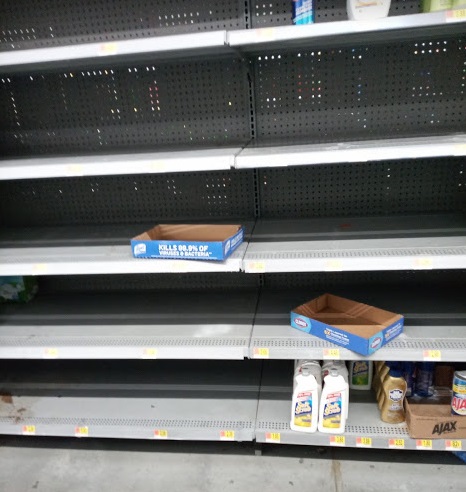
Where the sanitizing wipes were supposed to be today.
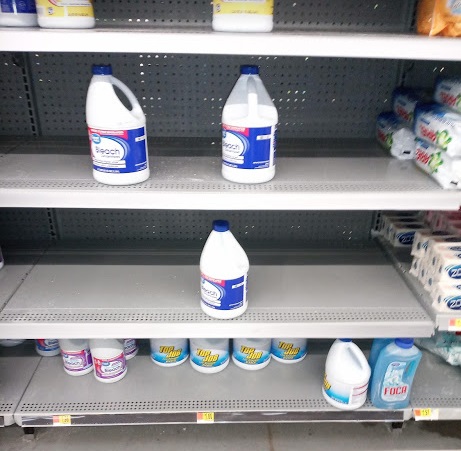
It’s quite possible that the epidemic will affect commerce in North America just as it has in Italy. Since more and more cases are being reported in the U.S., it seems quite possible that store shelves will have similar shortages within a few days. This afternoon, I visited a local Walmart. There was no “panic buying,” but many items were out of stock. At this point, the missing items were mostly preparations specific to a pandemic. There was no hand sanitizer, or sanitizing wipes. There was no isopropyl alcohol. There was still bleach available, but the shelves were starting to become empty.
The only “prep” item I bought today was a gallon of bleach. The CDC has instructions
for using household bleach for cleaning and sanitizing, and even if other cleaning products are not available, a gallon of bleach should be enough for thousands of uses. If your big box store is out of it, I bought mine at Dollar Tree. People are buying it, but if you look around, plenty should be available.
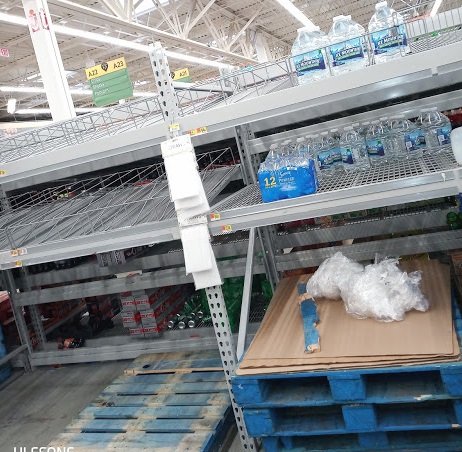
As of today, there weren’t any shortages comparable to those in Italy. However, I did notice that many grocery items seemed to have minimal stocks. In the soda aisle, for example, some brands and flavors were missing. The bottled water aisle seemed to have the most obvious shortages. Personally, I don’t see much need to buy water, since there’s no reason to believe that the tap water will stop working. But I guess if you normally drink bottled water, you might go on the assumption that it will be unavailable, at least temporarily, within a few days.
I think the moral of the story is that the time is now to stock up your normal groceries, and to do it as soon as possible. We published the following list previously as a recommended shopping list for hurricanes. For a pandemic, you have much more flexibility, since your normal refrigerator and stove will continue to function normally. These are, of course, just suggestions. The following links are to Walmart.com. If you want to save time, you can order online, and then pick up your order at the store.
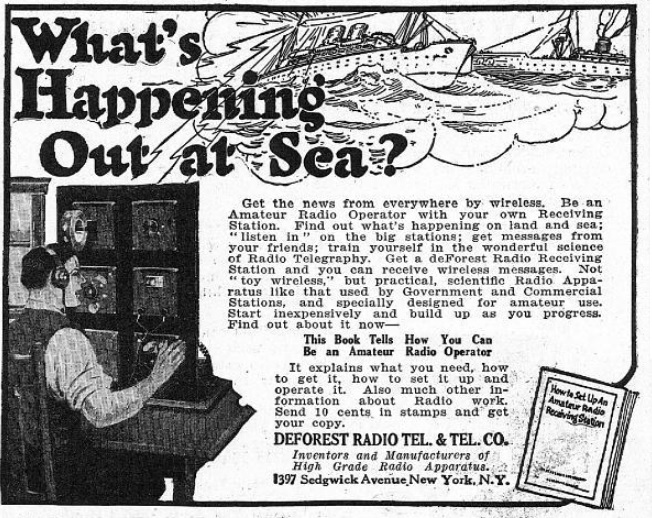
One hundred years ago this month, the March 1920 issue of Boys’ Life carried this ad from the Deforest Radio Telephone and Telegraph Company, 1397 Sedgwick Avenue, Bronx, New York.
Interestingly, I’ve noticed that some ads from this era, like this one, don’t make a distinction between a licensed amateur radio operator, who could transmit, and someone who was just operating a radio receiver as an amateur. The ad invites boys to write in for a catalog of radio equipment to get the news from everywhere by wireless. It told them that they could “be an Amateur Radio Operator with your own Receiving Station.” The ad made clear that the company didn’t sell toys, but instead “practical, scientific Radio Apparatus like that used by Government and Commercial Stations.” One could start out inexpensively and then build up the station.
Update: This page was written pre-COVID, and in the intervening years, only the chocolate, vanilla, and strawberry flavors are available.
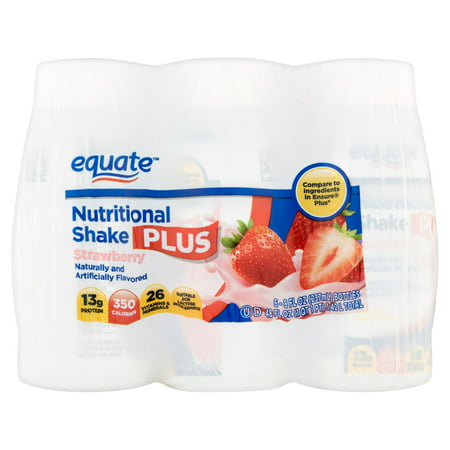
As I’ve previously recounted, I was quite sick just over a year ago and was hospitalized. In the process, I lost a lot of weight, and needed something to provide easy nutrition. As a result, I became something of a connoisseur of nutritional drinks, the most familiar brand names being Ensure and Boost. These products are designed to partially replace part of one’s normal diet. They generally contain a warning that you shouldn’t use them as your sole source of nutrition without consulting your physician, but they are a good supplement to ensure you’re getting adequate calories and nutrition. Most, for example, provide about 350 calories.
As I discovered, some tasted better than others. My health has recovered, and I guess there’s really no medical need for the added nutrition. But I like them, and they make an extremely convenient breakfast if I’m in a hurry. The 350 calories keep me going even if I don’t have a chance to eat anything else. They’re now part of my routine.
The major brand names tasted OK, but I also sampled some of the store brands. Initially, the Walgreen’s store brand was my preferred choice. Unfortunately, however, at some point they changed the formula. The old version’s label stated that it provided 25 vitamins. The new label proudly proclaimed that it now had 26 vitamins. Unfortunately, the changed formula didn’t taste as good. So I had to do more shopping, and tried the Walmart store brand.
Initially, I was a bit disappointed. I bought the chocolate, and it wasn’t quite as good as the Walgreen’s brand. It’s hard to articulate, but something about the chocolate flavor seemed a bit artificial, and the overall experience wasn’t as “smooth” a taste as I wanted. Fortunately, however, I decided to try some of the other flavors.
My favorite was the mocha flavor. If you like coffee, you’ll like this flavor. The addition of the coffee flavor brings back the “smoothness” that was missing in the plain chocolate. In fact, if you ordered an iced mocha at Starbucks and they served you one of these, you would be quite satisfied.
I also enjoy the strawberry and banana flavors. It’s also available in vanilla, but I haven’t had a chance to try that flavor yet. While they can be consumed at room temperature, they are best served chilled. Refrigeration of the unopened bottle is not necessary, so they’re handy to keep a few on hand.
If you’re looking for a product with fewer calories, the Walmart brand, as well as most of the other brands, offer an “Original” version. The “Plus” version is 350 calories, but the “Original” version is 220. Look for the words “Plus” or “Original” on the label, or glance at the Nutrition Facts label to make sure you’re getting the 350 calorie version.
I much prefer the Walmart store brand to the name brands. As an added bonus, as you might have guessed, the store brand is also cheaper. Tastes may vary, but if you or a loved one have been prescribed a nutritional drink, you’ll want to consider trying this less expensive store brand. In addition to saving a little money, you very well could prefer it. And if you’re a busy person and might occasionally miss a meal, it’s not a bad idea to keep one in the back of the fridge, or even in your desk at work, to quickly give you the nutrition to keep going.
And while one of these products is too expensive to buy in bulk for emergency food storage, it might fill a niche, and keeping some on hand for emergency preparedness purposes might be prudent.
Some links on this page are affiliate links, meaning that this site earns a small commission if you make a purchase after clicking on the link.
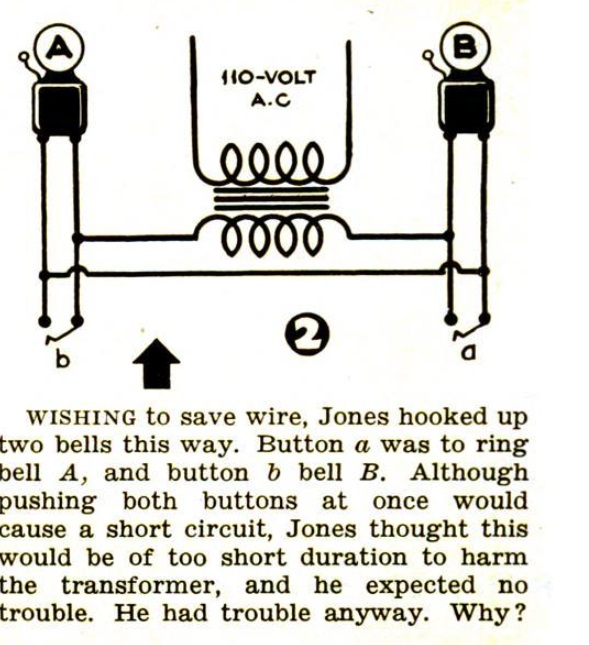
Yesterday, we featured this brain teaser from the March 1945 issue of Popular Science.
At first glance, it looks like it will work. If you trace the path with button a pushed, bell A should ring. But what you might not have noticed is that with neither button pushed, both bells are hooked up to the transformer in series. So they will ring continually, albeit probably at reduced volume.
So wartime shortages or not, Jones will have to scrounge up some additional wire.
Wartime shortages were undoubtedly the reason that Jones tried to save wire when hooking up his two doorbells. But can you figure out what went wrong? We’ll have the answer tomorrow.
This item appeared 75 years ago this month in the March 1945 issue of Popular Science.
Click here for homemade electrolyte solution information.
As the coronavirus continues to make the news, we’ll be offering some posts with advice for preparing. As with any potential emergency, there are common-sense preparations that one can make, such as making sure that your family has an adequate supply of food and other items, in case supplies are interrupted or you are unable to leave your home.
Note: Please keep in mind that I’m not a doctor. I’m a lawyer. Just as you wouldn’t take legal advice from a doctor, you probably shouldn’t take medical advice from a lawyer. So please do your due diligence, and take medicine only upon medical advice. But you can’t take medicine if it’s not available. My main focus is giving advice to make sure you have medicine available in the first place.
Basic Preparations: Food and Medicine
For pandemic preparedness, the Department of Homeland Security’s ready.gov website recommends that you store a two week supply of water and food. (You can find food storage pointers at many earlier posts, many of which are linked here.) The site also stresses that you should make sure you have a continuous supply of any prescription drugs you are taking. This seems especially critical in the case of the corona virus. According to news reports, about 90% of the active ingredients used by U.S. drug manufacturers originate in China. It seems quite possible that supply chains will be disrupted. If you take any prescription medications, it’s best to get refills as soon as possible, so that you always have a supply on hand. If the pharmacy can’t fill your prescription, it won’t be an emergency if you have a month’s supply at home. But if the pharmacy can’t get your medicine, and you just took the last pill, this could turn into a serious emergency.
Unfortunately, some insurers won’t pay for the refill until you’ve almost run out. If that’s the case, you might consider simply paying cash for an extra refill. But whatever you do, don’t just walk into the pharmacy and say that you’ll be paying cash. That could be a mistake that costs you hundreds of dollars. In this post and this post, I have suggestions that will dramatically reduce the cost of your prescription. You’ll save so much that you’ll be angry that the pharmacy was willing to charge so much in the first place. In fact, in some cases, you might wind up paying a cash price that is less than your insurance co-pay.
Ready.gov also recommends making sure you have adequate supplies of nonprescription drugs and other health supplies, “including pain relievers, stomach remedies, cough and cold medicines, fluids with electrolytes, and vitamins.”
Oral Rehydration Solutions
By “fluids with electrolytes,” they mean oral rehydration solutions, the most familiar brand name of which being Pedialyte. If you are dehydrated by a condition such as diarrhea, this could be a lifesaving item to have on hand.
Unfortunately, this could be expensive to stock up in advance. However, with some foresight, you can do this economically. The simplest way to plan for possible dehydration is to stock up is to buy some Pedialyte or generic equivalent. It’s probably less expensive to buy it in powdered form. One replacement, albeit probably not as good medically, is a sport drink such as Gatorade. It is available ready to drink, or as a powder. (I have noticed that Dollar Tree sells small containers of a generic equivalent of Pedialyte, and at $1, these are quite economical for stocking up.) Preparing to Make Homemade Rehydration Solution
As a last resort, you can make an oral rehydration solution at home. There are a number of recipes available, including from reputable sources such as the World Health Organization.
In most cases, you can make an acceptable oral rehydration solution with items that you normally have at home, such as sugar, table salt, and sodium bicarbonate (baking soda). If this is all you have, then this is certainly better than nothing. Many recipes, however, also call for potassium chloride. For example, this recipe from physician Dr. Kara Fitzgerald, adapted from the WHO formula. includes potassium chloride. This is probably something you don’t have in your kitchen. However, the good news is that it’s readily obtainable prior to the disaster, and you can get enough to last a lifetime for just a few dollars. You can buy it at the grocery store in the form of “Morton Lite Salt.” This product is half regular salt (sodium chloride) and half potassium chloride. Since sodium chloride is also part of the recipe, this can be used. Dr. Fitzgerald, gives the following recipe, to be added to four cups of water: 1/4 tsp. table salt, 3/4 tsp. baking soda, and 1/4 tsp. Morton Lite salt. For flavoring, you can add some Crystal Light or Sugar Free Kool-Aid.
Another alternative is Morton Salt Substitute, which is 100% potassium chloride. If your recipe calls for 1/2 teaspoon of salt and 1/2 teaspoon of potassium chloride, then you would use a full teaspoon of Morton Light Salt. On the other hand, you could also use a half teaspoon of regular salt and a half teaspoon of Morton Salt Substitute. The only difference is that the Morton Salt Substitute appears to be slightly more expensive.
Since the Lite Salt is so cheap (it’s probably about $2 at your supermarket), it seems to me that it’s cheap insurance. Since the only reason we would ever use it is for an emergency rehydration solution, I wrote the recipe and taped it to the container. We always have the other ingredients on hand, and it’s good to know that we have a method to produce a lifesaving medicine, if the need ever arises.
Some links on this page are affiliate links, meaning that this site earns a small commission if you make a purchase after following the link.









 Y
Y


 By “fluids with electrolytes,” they mean oral rehydration solutions, the most familiar brand name of which being


 Since the Lite Salt is so cheap (it’s probably about $2 at your supermarket), it seems to me that it’s cheap insurance. Since the only reason we would ever use it is for an emergency rehydration solution, I wrote the recipe and taped it to the container. We always have the other ingredients on hand, and it’s good to know that we have a method to produce a lifesaving medicine, if the need ever arises.