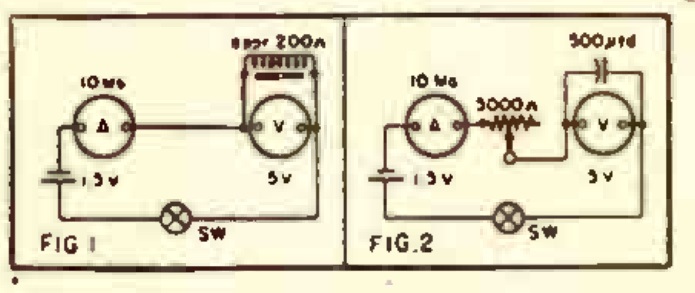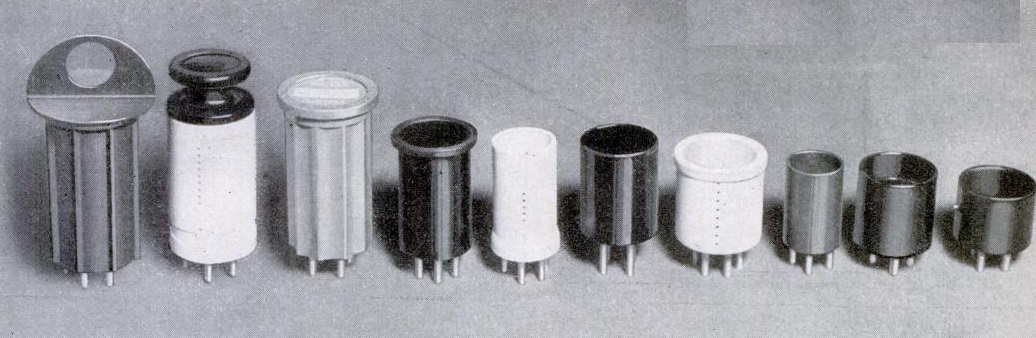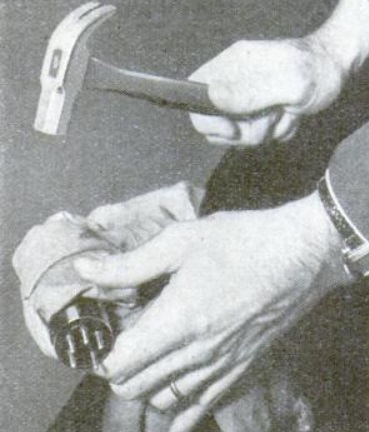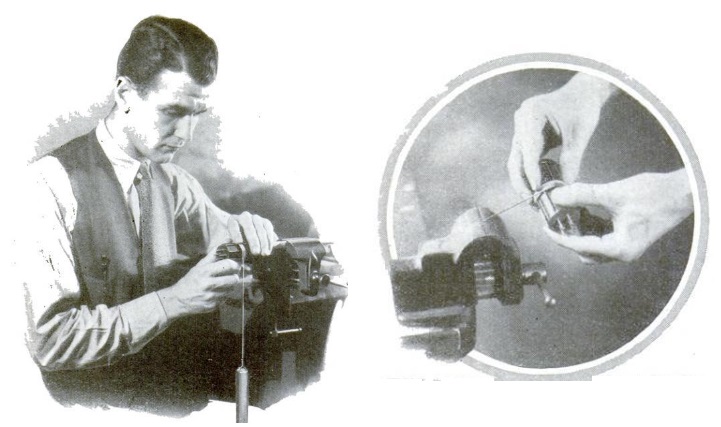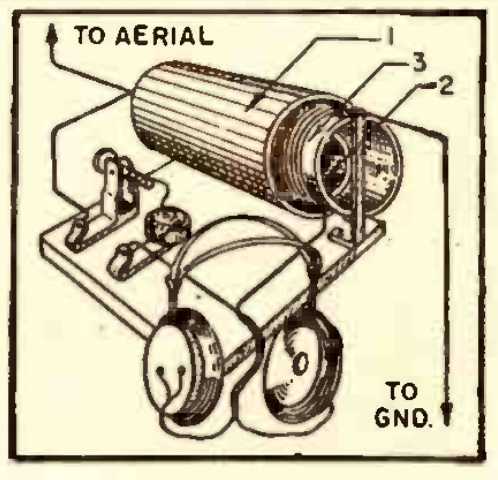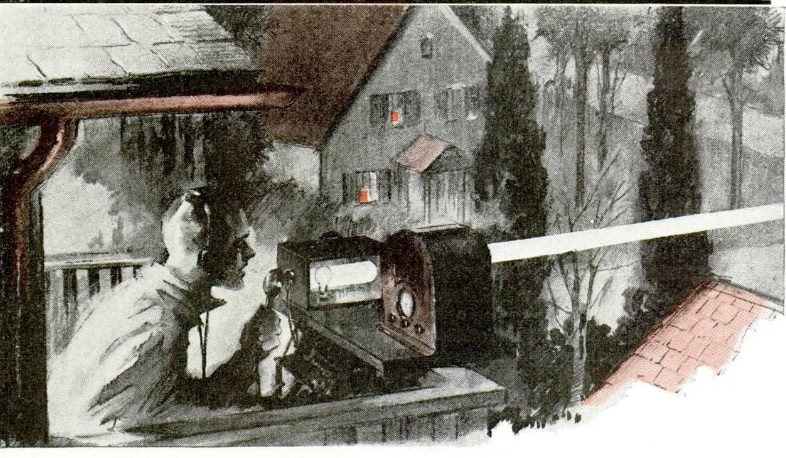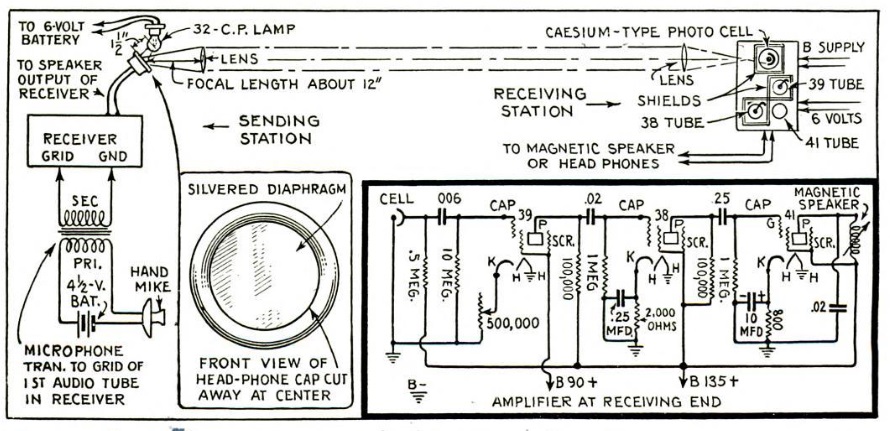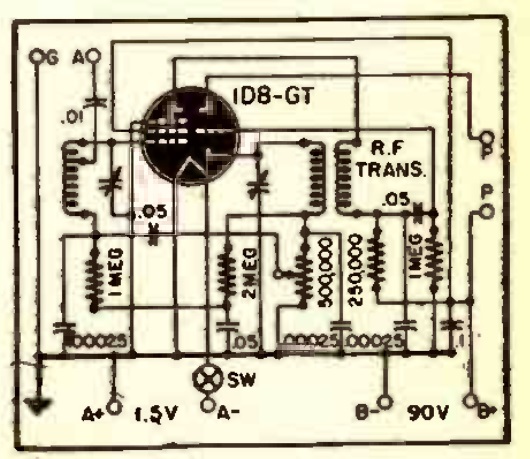
Sixty years ago this month, the March 1960 issue of Electronics Illustrated showed this nuclear blast detector to be used in critical installations. The magazine noted that such installations were well protected, as long as they were away from ground zero. But they still had to button down at the last second by closing blast doors and closing valves on ventilation equipment.
The sensors here would detect the flash of the nuclear explosion and the gamma ray burst. This would sound an alarm that would automatically seal up the base prior to the arrival of the blast wave seconds or minutes later.
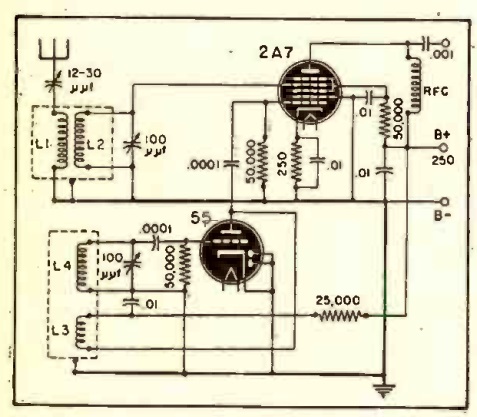
This handsome but utilitarian wartime cigar-box set was put together by G.L. Keirstad of Toronto, and described in the March 1945 issue of Radio Craft magazine. According to the author, the set pulled in all four of the local Toronto stations, as well as WGR and WBEN in Buffalo. At night, it would also get the New York stations with loudspeaker volume quite adequate for a personal radio.
For the aspiring scientist who is interested in earthquakes, today we show you how to build your own seismometer. If you started by searching for “science fair seismograph,” you were possibly disappointed at the initial search results. You undoubtedly found sites showing how to make a toy seismosgraph out of materials such as cardboard boxes. I’m sure these were fine projects for less advanced students, but they weren’t real seismographs. Instead, they were models that showed how a seismograph worked. You build the toy instrument, and then jump up and down in close proximity, simulating an earthquake.
We are glad that you kept searching, because we will show you how to build a real seismometer or seismograph, one capable of detecting distant earthquakes. If there are no earthquakes before the science fair, you can test the unit with nearby trucks and trains as they pass by. The unit shown here, for example, picked up trains a mile away. In addition, a very similar unit was used, in Texas, to detect underground nuclear tests in Nevada. So it’s not a toy–it’s a real seismometer.
The overall concept is clear from the diagrams shown above. A magnet is suspended from a wire or line attached to a sturdy beam of your building. In the final version, this pendulum is placed inside a pipe, to prevent air currents from disturbing it. The magnet is placed above a coil, and the slightest motion of the pendulum, caused perhaps by an underground nuclear test hundreds of miles away, induces a tiny electrical current in the coil. This is amplified by two op amps, and registers with an LED and/or a piezo buzzer.
As shown in the diagram, the instrument is a seismometer, since it detects seismic activity. To turn it into a seismograph, you will need to add some method of recording the readings continuously. However, that is a very easy matter, thanks to a data acquisition module, similar to the one shown at left. This is a very inexpensive device that hooks to the USB connection of your computer. It has several inputs that you can hook to a circuit, and it continually feeds the measured voltage to the computer. You can then use the computer to record the data numerically or in a graph.
All of the other parts are readily obtainable. From Amazon, you can order the telephone pickup coil, the 741 op amp chips, and all of the other electronic components. (For ideas on how to buy parts, see my crystal set parts page.) All of the mechanical components should be available in any hardware store.
The diagram above is from a book by Forest Mims III, Engineer’s Mini-Notebook: Science Projects, one of a series sold at Radio Shack. This particular volume was published in 1990. It’s available free online. The same author has another version of the seismograph at this site. You can also visit his website, forestmims.org.
Incidentally, as you can see above, the book contains the phrase, “when he was in high school in Texas, Eric Ryan Mims used a similar arrangement to detect underground nuclear tests in Nevada.” There is a multimedia CD by this long title by Canadian musician Matt Rogalsky. Inspired by that phrase, Rogalsky processed the output into ambient sound. While it is out of print, used copies are available on Amazon.
In March 1945, the war was still on, and that meant that there was no production of civilian radio receivers. But the manufacturers knew that there would be a big sales boom as soon as the war was won, and they were getting their name before the public.
This ad from Stromberg-Carlson appeared in Life Magazine 75 years ago today, March 12, 1945. And the company was betting on the miracle of FM being the wave of the future. These young people are listening to some postwar program daydreaming. The girl dreams of marrying the man of her dreams, and her tenderfoot little brother dreams of being the patrol leader of the best patrol in town.
On the first warm weekend eighty years ago, this couple were taking their portable radio for a spin around the lake. It was pulling in the stations thanks to their foresight in bringing it in to the dealer for a free check of the battery and tubes, and a reasonably priced tune-up.
This promotional poster appeared in the March 1940 issue of Radio Retailing. Presumably, the dealer cut the page out of the magazine and put it in his window or bulletin board. He then sat back and waited for the portables to start flooding into the store.
Due to the coronavirus, some items are unavailable in stores. If there are sick people in your house, it might become important to clean and sanitize more than usual. One convenient method is a product such as Clorox Wipes or Lysol Wipes. However, availability is currently very limited.
One excellent alternative for sanitizing is normal household bleach. The CDC offers guidance on their website. All of the stores I’ve been to in the last few days have had bleach, although there were gaps in the shelf. You probably already have a gallon of bleach on hand for normal laundry needs. If you don’t (or the bottle is getting low), I would recommend adding this to your shopping list.
The first caution is never to mix bleach with ammonia or other cleaners, as deadly fumes can result.
To sanitize surfaces, the CDC recommends one cup of bleach for 5 gallons of water. For smaller jobs, the recipe can be scaled down. For example, for a gallon of water, you would add 1/5 cup bleach. For a quart, you would use 1/20 cup, which is 2-1/2 teaspoons.
The agency recommends cleaning the surface with soap and water, rinsing, and then sanitizing with the bleach solution. Allow the surface to air dry. Try not to breathe in fumes, and keep windows and doors open.
While it’s unlikely that it will be necessary due to the coronavirus, for other emergencies, it’s good to remember that bleach can also be used to disinfect drinking water. The EPA provides instructions on their website. Generally, very small amounts of bleach are used, approximately 8 drops per gallon. The Clorox website also has instructions for sanitizing drinking water with bleach.
We’ve previously featured products designed to store drinking water in your bathtub. These are an excellent choice if something like a hurricane is approaching your area and you believe that normal utilities might be cut off. These products are a large plastic bag that goes into the tub to keep the water sanitary.
The disadvantage is that these are relatively expensive, and can only be used one time. There’s really no way to empty them completely, so when the disaster is over, there’s really nothing to do other than drain the bag and throw it away.
I’ve recently learned of a product that would work almost as well, at a fraction of the cost. These are bathtub liners that are apparently targeted toward people who are squeamish about taking baths in unfamiliar bathtubs. You place the plastic liner in the tub, fill it with water, and take your bath with the assurance that your body isn’t touching someone else’s germs.
Very few of our readers are squeamish, but there’s no reason why this product can’t also be used to store drinking water. It serves the same purpose as the products designed for that purpose, at a fraction of the cost. The disadvantages are minor.
The first disadvantage is that this liner is not sealed at the top. It’s designed to be placed at the bottom of an open tub. However, it appears to be large enough that it can be draped over the top. It could probably be closed with clothespins or binder clips. (The picture shown above isn’t particularly good, since it shows the liner in a non-standard tub. But the liner measures 90 by 47 inches, so should fit any standard tub.)
The other disadvantage is that it doesn’t come with a pump. However, there’s really no need for a pump, since you can simply bail out the water with a pan or even a cup. If you really want a pump, you can purchase one separately for just a few dollars.
The products designed for water storage look like they would work well, but there’s really no way to test them. These liners are inexpensive enough that you could try one out and then throw it away when you’re satisfied that it works. Depending on the brand, the package contains either ten or twelve liners, so that even after testing, you should be all set for another several disasters, at a very reasonable cost, which is shown here:
Links on this page are affiliate links, meaning this page earns a small commission if you make a purchase after clicking on the link.
As the coronavirus continues to spread, we will occasionally be posting hints to help your family prepare. We recommend that you continue to follow official advice, such as that provided by the CDC. Click here to keep yourself informed.
Click here to read our previous posts on the subject of emergency preparedness.
Every year, Popular Mechanics featured plans for a receiver dubbed the “Little Giant,” and these gentlemen are putting together the version described in the magazine’s March 1945 issue.
Despite a war going on, this set was somewhat more elaborate than most. It featured push-pull audio, with two 6G6-G tubes driving the speaker. To drop the voltage for the filament string, a 40 watt light bulb was used. It could be mounted on the chassis, or a lamp could be plugged in to the radio. The set used a TRF circuit, and the magazine recommended a 75 foot antenna to pull in distant stations.
Crowds descending on Virginia to view 1970 eclipse. NASA photo.
Today marks the 50th anniversary of the total solar eclipse of Saturday, March 7, 1970. As I previously recounted, this was the first eclipse I witnessed. That eclipse began in the Pacific and had a path of totality that crossed southern Mexico before entering the Gulf of Mexico.
Then, the shadow hit the United States , first in Florida, then Georgia, then the Carolinas and Virginia, then grazing Maryland before heading back out to sea, saying goodbye to the United States at Nantucket.
For those with Learjets, it then crossed Nova Scotia, Newfoundland, and the French island of Miquelon, before heading out to sea again into the North Atlantic.
Where I was in Minnesota, it only covered 47% of the sun at high noon. If nobody had told me about it, I probably wouldn’t have noticed. It didn’t get dark outside, and no animals were confused by sudden darkness. But that day, it was the biggest deal in the world. The moon contained fresh footprints of Americans who had walked on its surface less than a year earlier. Now that same moon was casting its shadow over me.
To me and my fellow third graders, it was presented as a big deal. And it was a big deal. If there had ever been any doubt about it, yes, the moon went around the earth, the earth went around the sun, and sometimes they got in the way of each other. Any third grader could see tangible proof.
In school, we had learned all about umbras and penumbras, and by the time the big day came, I was an expert on all things eclipse. With a shoebox, some foil, and a note card, I constructed myself a pinhole viewer. I figured that if a pinhole was good, then a giant hole would be even better. Fortunately, my mom corrected my error and got the viewer in good working order.
I pointed the box at the sun coming in the window, and sure enough, there was a little crescent shape of sunlight coming in through the round hole, plainly visible on the note card.
Perhaps I was a little disappointed at the tiny size of the image, but it didn’t matter. Right there in my shoebox was proof positive that the moon orbits the earth. I didn’t have to take anyone else’s word for it. The proof was right before my eyes.
The home movie here shows some of my contemporaries in North Carolina who had the fortune of being in the path of totality:
From our location, we had to turn on the TV to see the full effect, and we witnessed the darkened skies and the amazed reactions of those who went outside to see it. I don’t remember too many details about the TV coverage. Mostly, I remember some poor confused rooster in Georgia crowing in the middle of the day.
I believe it was the CBS coverage that I watched on TV fifty years ago today, and that broadcast is available on YouTube. (You can hear the rooster at 22:23.)
Here is another reminiscence of another kid who was older than I was and who lived closer to the path of totality. As he recounts, he was able to talk his dad into driving him the 200 miles to totality where he was able to set up his telescope and take some photos.
When my friends and I got back to school the next Monday, the eclipse was the topic of conversation. We knew how the universe worked, because we had seen it with our own eyes. It was a big deal, and the kids remembered it.
In 1970, we were over a thousand miles away from the path of totality, and going to see it wasn’t really an option. But I envied those people and roosters on TV who got to see it in person.
The next total solar eclipse in North America will take place on Monday, April 8, 2024, just over four years from now. The path of totality will be a narrow strip passing through Mexico and Canada, and the states of Texas, Oklahoma, Arkansas, Missouri, Illinois, Kentucky, Indiana, Michigan, Ohio, Pennsylvania, New York, Vermont, New Hampshire, and Maine. The path of totality includes a number of large cities, including, San Antonio, Austin, Fort Worth, Dallas, Little Rock, Indianapolis, Cleveland, Buffalo, and Rochester. That path through Canada will include Windsor, ON, and Montreal.
My family went to see the 2017 eclipse, and the 2024 eclipse will be within a days’ drive of most of the population of the United States. It’s an unforgettable experience, and you should plan on seeing it, just over four years from now. It will be a school day, and if 2017 is any guide, most schools will fail to do anything meaningful. I rarely encourage truancy, but kids should skip school that day, and instead travel to the zone of totality. When I’m substitute teaching, I tell kids to ask their science teacher on the first day of the 2023-24 school year if there will be a field trip to see the eclipse. If the teacher balks, then I tell them they should plan on skipping school. From where I live in Minnesota, it’s a day’s drive to Illinois or Indiana to view it. Kids who are currently sixth grade and older will probably have their driver’s licenses by then. And all of the kids probably have parents who can take them.
You should also pencil in the 2024 eclipse on your calendar. Keep following OneTubeRadio.com, and we’ll certainly remind you. My experience from 2016 is that if you make your travel plans about one year in advance, there will be plenty of inexpensive accommodations available. If you are a student or parent, then you should plan on bugging the science teacher in September 2023 about organizing a trip. Just as I tell the kids here, if he or she doesn’t seem enthused, then you should take matters into your own hands.
When I’m teaching a class, there are often one or two kids in the class whose parents took them to see the 2017 eclipse. I ask them if it was the coolest thing they had ever seen, and they invariably say that it was. If you had asked me fifty years ago, I would have said that it was pretty cool, even though I was stuck mostly watching it on TV. It took 47 years to actually go see a total eclipse in person, and I can vouch for the fact that it was indeed the coolest thing ever.