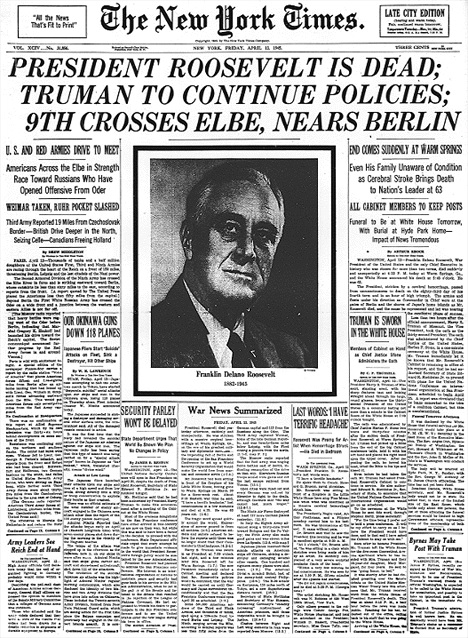
On this day 75 years ago, April 12, 1945, President Franklin Delano Roosevelt died, and President Harry S Truman was sworn in.
You can hear some of the radio coverage at this video:
https://www.youtube.com/watch?v=djcuHhg6PRQ

On this day 75 years ago, April 12, 1945, President Franklin Delano Roosevelt died, and President Harry S Truman was sworn in.
You can hear some of the radio coverage at this video:
https://www.youtube.com/watch?v=djcuHhg6PRQ
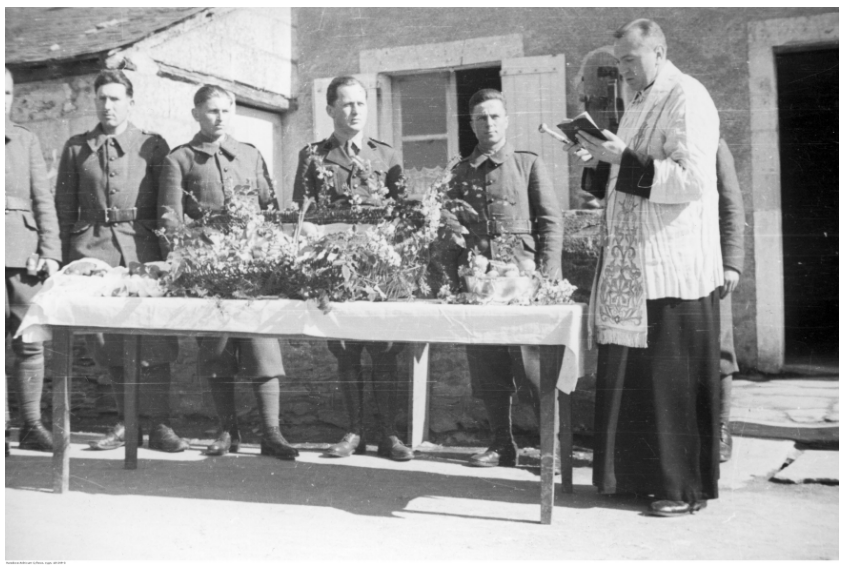 For many around the world, Easter 2020 will be one of deprivation. It might be one of separation from loved ones. It might be one of sorrow.
But we pray that it is also one of resurrection, as we remember that future Easter’s will be brighter.
The men shown here are Polish soldiers, celebrating Easter 80 years ago, stationed in France. The priest is blessing the food that they will share. It’s quite possible that this was their last Easter. It was an Easter of deprivation, of separation from loved ones, of sorrow. But it was also an Easter of resurrection. On the battlefields of France they proclaimed, as we can proclaim again today: He is Risen! Alleluia!
The photo is courtesy of the Polish National Digital Archives.
 There’s a good reason why this young man dressed up to go ride his bike. That’s because its basket contained a four-tube radio capable of providing loudspeaker volume on local broadcast stations.
Because of its nondirectional characteristics, a four-foot rod antenna was used. Grounding was necessary, but an attachment to the bicycle frame provided an excellent counterpoise.
The set featured a DPDT key-lock switch to keep curious onlookers from running down the batteries. The magazine also advised locking the set to the basket or bicycle frame. The set used three 1N5GT tubes as RF amplifier, detector, and the first stage of AF amplification. A 1T5GT served as final AF amplifier to drive the speaker.
The set appeared 80 years ago this month in the April 1940 issue of Popular Science.
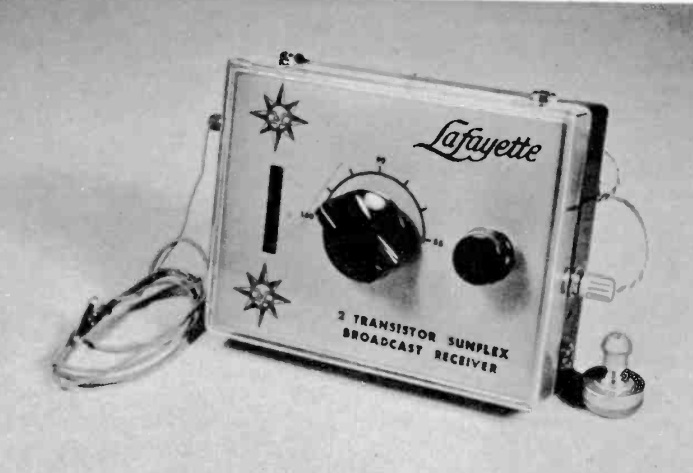
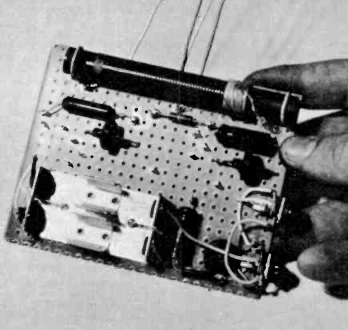 Sixty years ago this month, the April 1960 issue of Electronics Illustrated carried a review of the Lafayette Sunflex radio kit (model KT-132). It derived its name from the fact that the two transistors did the work of three, thanks to reflexing, and that the set could be powered by the sun, using an optional solar battery. The set was said to be very sensitive, and also ran off two penlite batteries. Power switching was done by plugging the earphone into the appropriate jack–one for the internal battery, and the other for the solar battery.
The kit retailed for $11.95, with the solar battery selling for $7.75. According to the magazine, the kit took about six hours to put together.
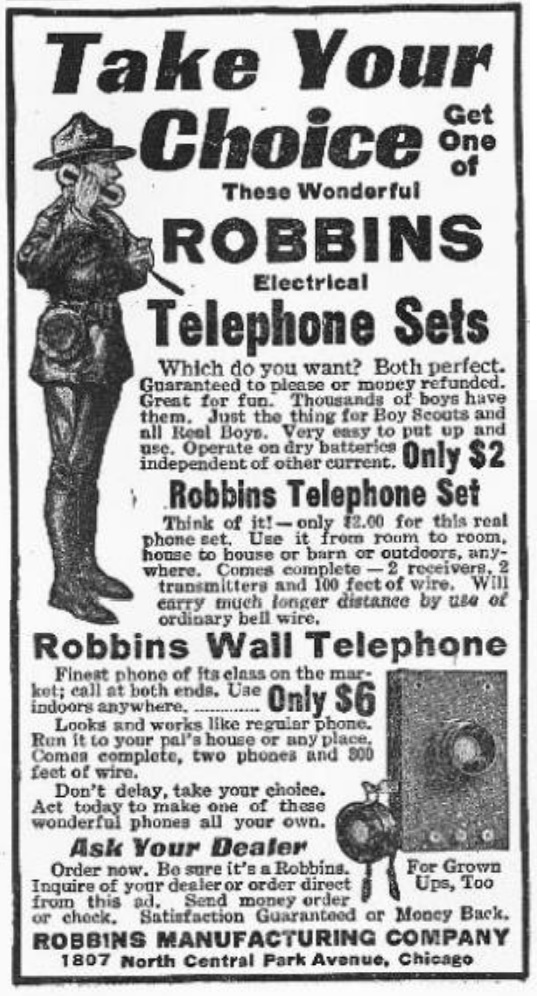 A hundred years ago, the Scout or “any Real Boy” desiring to set up his own private telephone exchange couldn’t go wrong with these telephone sets from the Robbins Manufacturing Company, 1807 North Central Park Avenue, Chicago. For $2, the company would supply two transmitters, two receivers, and a hundred feet of wire. The sets would work over a much longer distance with ordinary bell wire.
For Real Boys desiring a deluxe setup, two wall phones (suitable for grown ups, too) and 300 feet of wire were available for only $6.
The ad ran a hundred years ago this month in the April 1920 issue of Boys’ Life.
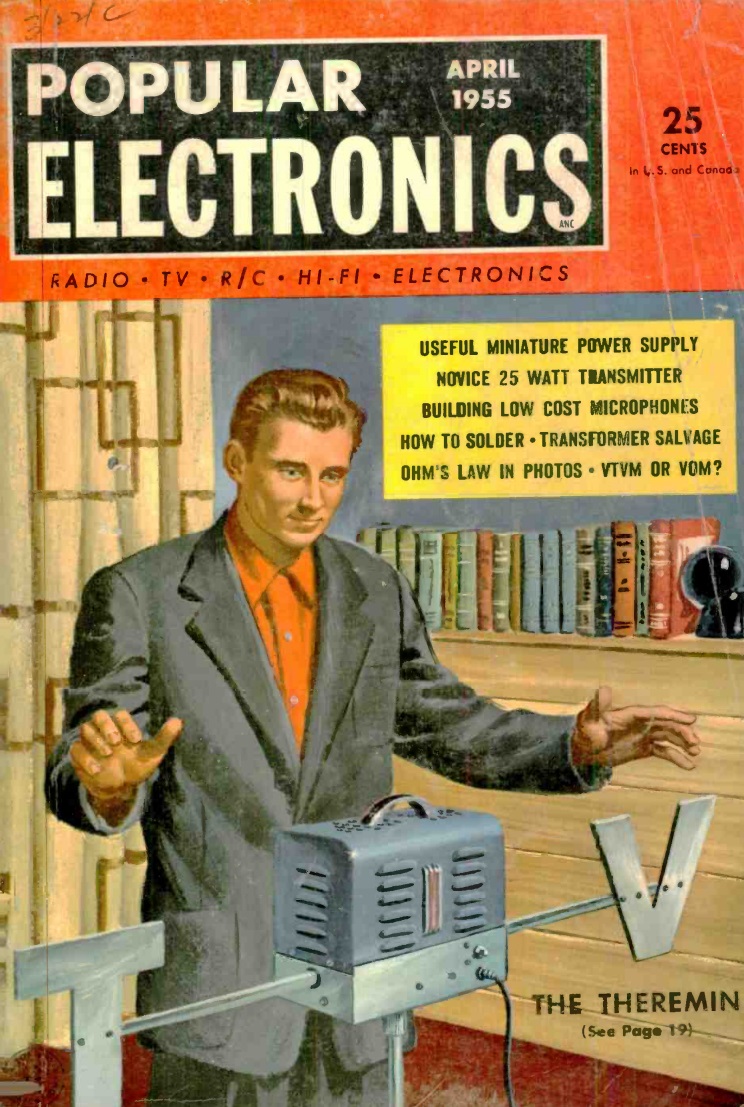
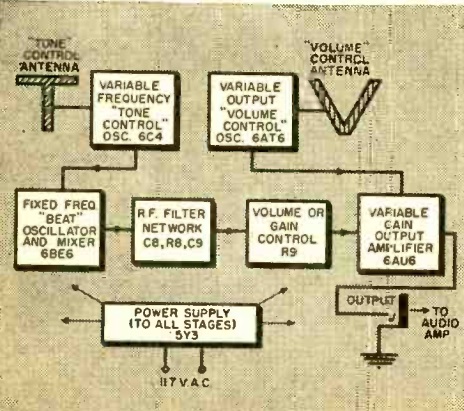 This musician-electronic hobbyist, shown on the cover of the April 1955 issue of Popular Electronics is playing the Theremin that he built according to the magazine’s plans. The magazine stressed that the project was not for beginners, but for those with some electronic experience, it was fairly easy to assemble.
Once built, the owner could use the instrument to play music, or to provide background sound effects for amateur theatricals. “A complete show can be produced by combining its abilities to emit both music and sound effects.”
The instrument depended on hand capacitance on the two antennas. The one marked “T” was the tone. The variable capacitance changed the frequency of an RF signal generated by an oscillator. This was mixed with another oscillator to produce a heterodyne which was amplified. The “V” antenna controlled the volume.
Several column inches were devoted to instructions on how to play the instrument, the final one being: “Practice! Practice! Practice! Practice!” To give an idea of what the instrument sounds like for someone who did practice, here’s what a 1929 Theremin sounds like:
Building the Theremin today with modern solid-state components would probably be simpler, and definitely much cheaper than 65 years ago. You can buy a Theremin already assembled. If you just want to experiment with the concept, you can start with this inexpensive kit.
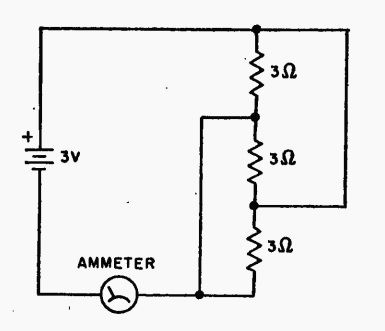 Yesterday, we showed this diagram from the April-May 1970 issue of Science & Electronics magazine and asked what current is shown on the ammeter.
The puzzle is easier than it appears, once you see the trick. The answer is 3 amps. Despite the confusing diagram, the three resistors are wired in parallel, so the total resistance is 1 ohm. You can do the math in your head using the “reciprocal of the reciprocals” method. 1/3 + 1/3 + 1/3 = 1, and 1/1 = 1. To get the current, it’s 3 volts divided by 1 ohm, which equals 3 amps.
Today’s quiz appeared 50 years ago this month in the April-May 1970 issue of Science & Electronics magazine. What is the current shown on the ammeter?
This was sent in to the magazine by a reader who was given the question during a job interview for a position as an electronic technician. We’re guessing he didn’t get the job, since he wrote to the magazine to explain it. If you’re also stumped, we’ll have the answer tomorrow.
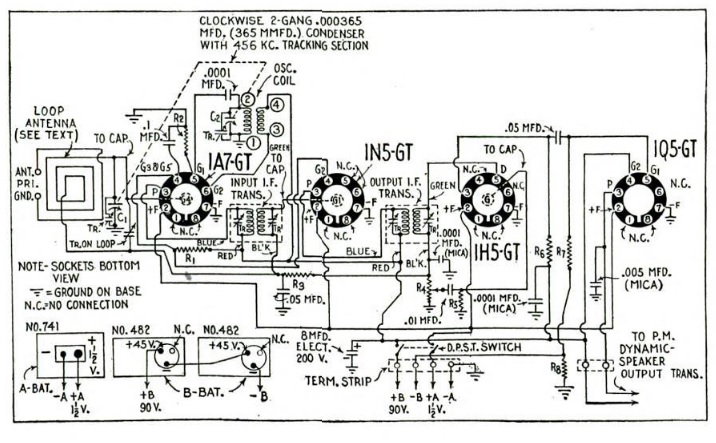
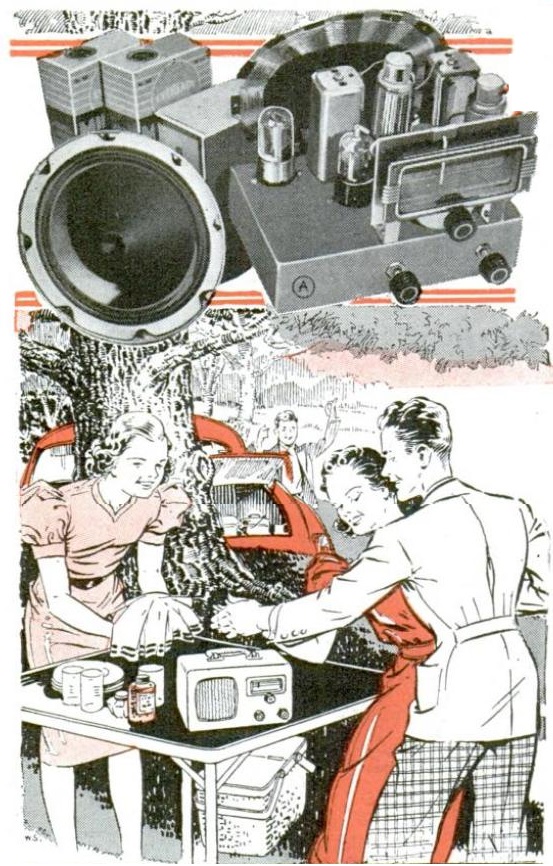 The plans for this handsome four-tube superhet portable appeared 80 years ago this month in the April, 1940, issue of Popular Mechanics. The set was said to be suitable for anyone with even a little radio construction and wiring experience. It used 1.4 volt tubes and was a highly flexible and portable receiver.
For those without metalworking tools, the chassis was available pre-punched and drilled. A loop antenna meant that no external antenna was necessary for local stations.
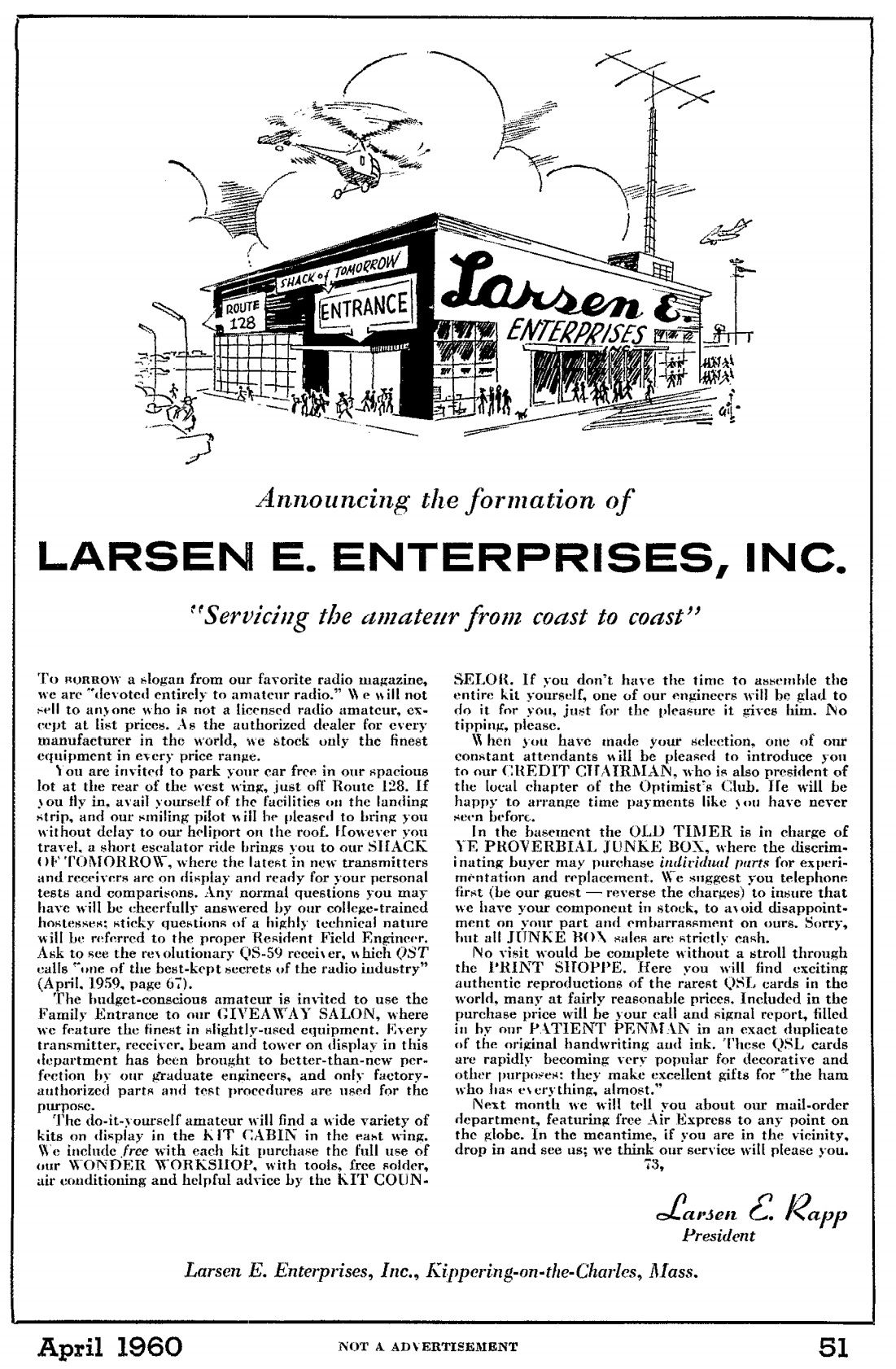 I’ve never had the opportunity to visit yet, but my bucket list certainly includes a trip to the headquarters of Larsen E. Industries. The company was founded by technical genius Larsen E. Rapp, WIOU, sixty years ago this month. This announcement of the momentous event appeared in the April 1960 issue of QST.
From most browsers, clicking twice on the image will show you an enlarged version.