Author Archives: clem.law@usa.net

Radio A Hundred Years Ago

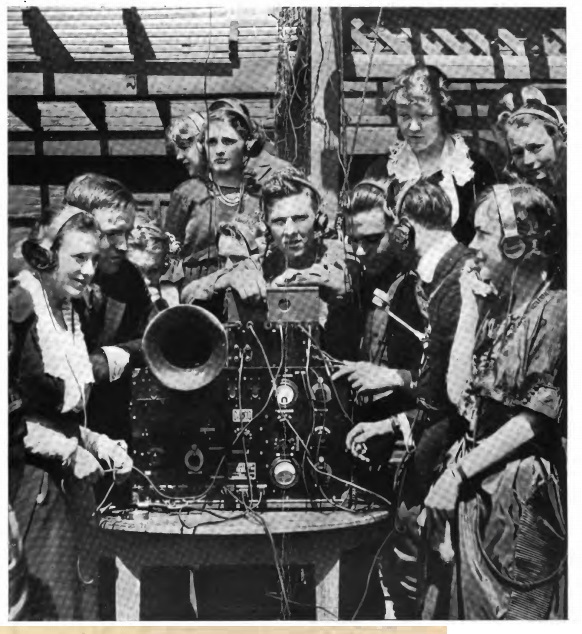
1920JuneWirelessAgeI don’t know much about the provenance of this photograph, other than that it was taken in Atlanta about a hundred years ago. What is clear from their expressions, however, is that the two girls in the foreground obviously understand the magic of radio. Chances are, they had never heard a radio before, but when they heard music coming out of the headphones, they realized that the world had changed. I’m guessing their families were among the first on their block to get their own radio set.

Not everyone gets the magic, though. Many of the others seem a bit skeptical about this new contraption. All I know about this picture is that it appeared a hundred years ago this month on the cover of the June 1920 issue of Wireless Age, and that the caption reads, “members of an Atlanta club who danced to music received by wireless ‘phone.”


R.F. Field, R.F. Engineer

1945JuneNatlRadioExp

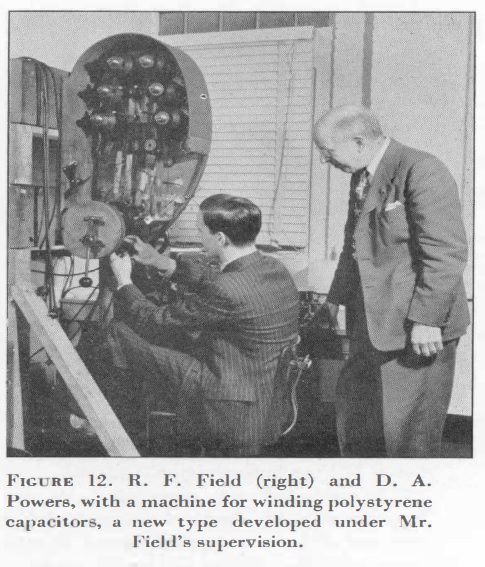
Shown here (at right) is the appropriately named Mr. R.F. Field, a radio engineer with General Radio Company. The photo appeared 75 years ago this month in the June 1945 issue of General Radio Experimenter, a monthly publication put out by the company.


Sending Sourdough Yeast by U.S. Mail

BreadSeveral weeks ago, I wrote about my experiences using sourdough started with commercial yeast. While it’s starting to show up again in supermarkets and it’s apparently now available again on Amazon, yeast is not always available. In a long-term food emergency, that could pose a problem. Flour is inexpensive and plentiful, but in order to turn it into bread, you really need yeast. Fortunately, as I wrote previously, you can grow your own at home. You just need one package of commercial yeast, and you can turn it into an infinite supply.

You can also share your sourdough starter with neighbors. But I wondered whether it was possible to share with people who live further away. I asked for volunteers, and got two. I’ve now heard back from one of them, and it turns out that yes, you can share your yeast with anyone, courtesy of the U.S. Mail.

I spread a thin layer of the sourdough starter, about three inches by three inches, on a piece of parchment paper, and then left it to dry. In a couple of days, I removed it and broke it into two pieces, one for each recipient. I could have just as easily used wax paper, plastic wrap, or even just a plate.  After drying, I placed them in plastic sandwich bags, and placed those inside envelopes which I mailed.

My suggestion when they received them was to put it in a glass of sugar water to bring the yeast back to life. Then, use that water in place of some of the water and yeast in a bread recipe.

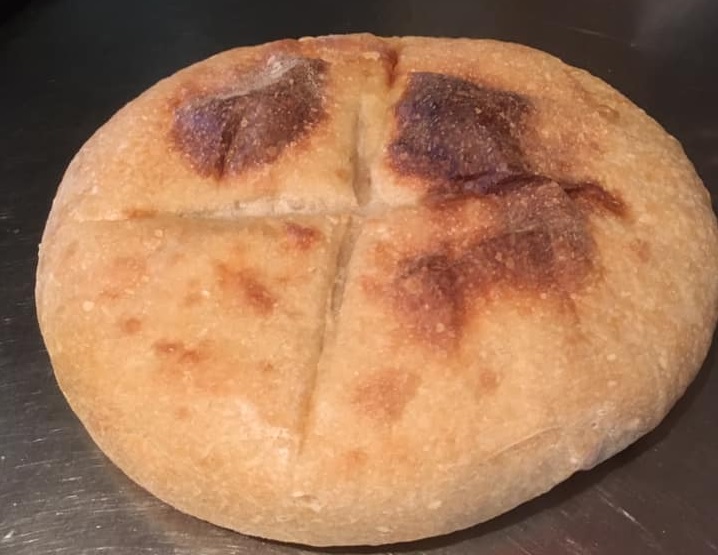
The loaf of bread shown above was baked by my cousin in Oregon, after she received it in the mail from Minnesota. She did report that the bread didn’t rise as much as expected. But it did rise some, even though it was denser than usual.

This is my experience as well. The yeast that are growing today, the descendants of the ones I started with, aren’t quite as active. It does take longer for bread to rise. But she reported that the bread tasted good.

The other package went to a friend in Alabama.  He reported that the yeast survived the trip and came to life when he added sugar water, although I don’t think he’s made any bread with it yet.  If he does, I’ll also post the results here as well.



The Class of ’20

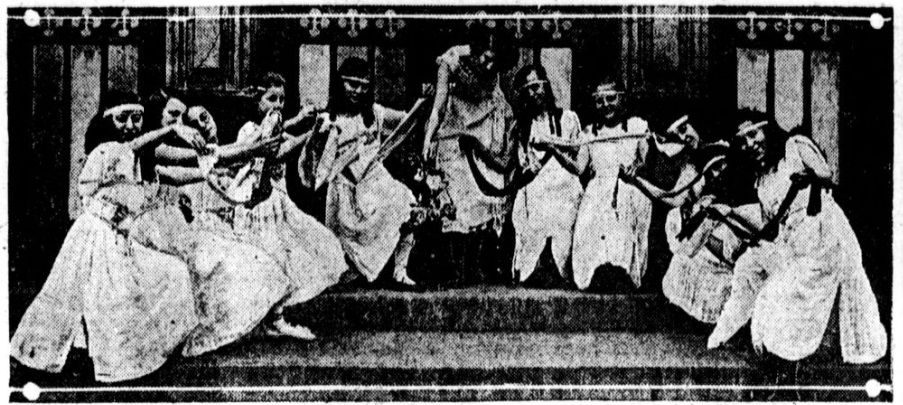
23June1920Shown here is the Class of ’20 (1920, that is) who graduated from the Furness School of Philadelphia on this day a hundred years ago, June 22, 1920. These girls are performing the “Welcome to Summer” dance as part of the commencement exercises, and this picture appeared in the next day’s issue of the Philadelphia Evening Public Ledger.

Since the school was a junior high at the time, these were probably eighth graders, probably born in about 1906. Their older brothers very well might have gone to war, and we hope that most of them came back to attend the graduation.

A few years after this picture was taken, their families probably got their first radio. They were 23 years old when the stock market crashed, and they lived through the depression as young adults. Then, another war came. They were a little too old to go to war, and most of their children were too young. All of them, boys and girls, undoubtedly fought on the Homefront.

When they were in their 40s, they saw their first television, and probably bought one soon thereafter. They worked hard and retired with more wealth than their parents. A handful of them bought a computer and sent e-mails to their grandchildren. A few of them lived to see 9/11 on their television screen.

Welcome to Summer, Class of ’20.

A few weeks ago, I recorded this message to the Class of 2020:


1960 British 4 Tube Superhet Portable

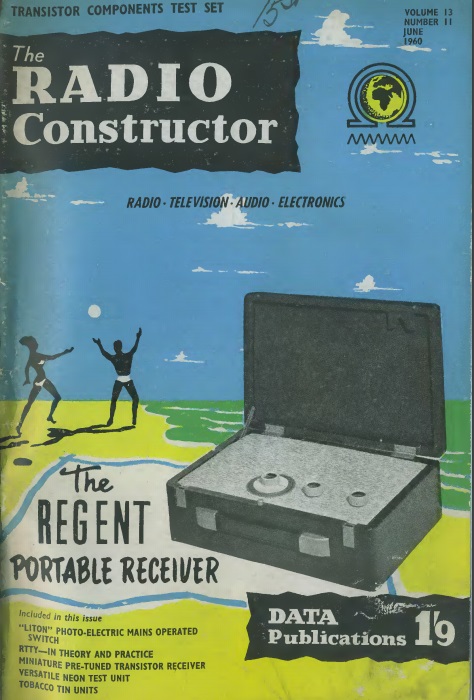
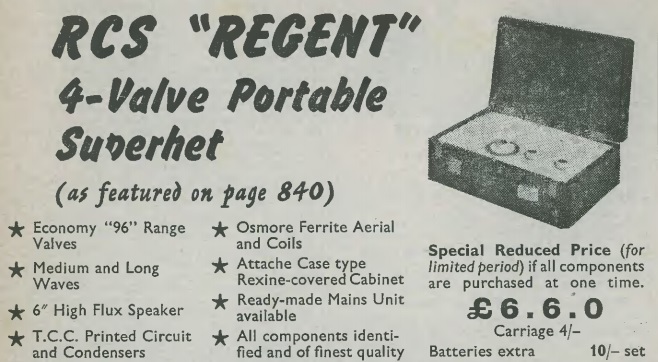
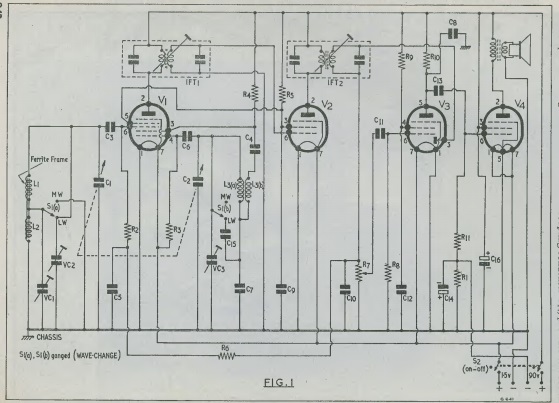
1960JuneRadioConstructor11960JuneRadioConstructor2Sixty years ago this month, the June 1960 issue of the British magazine Radio Constructor carried the plans for this four-tube superhet portable, dubbed by the magazine “The Regent.” The set tuned both the longwave and mediumwave broadcast bands, and was said to be sensitive. The set was easy to construct, thanks to the use of a printed circuit board.

For those who needed help tracking down all of the parts, one of the magazine’s advertisers, Radio Component Specialists, 337 Whitehorse Road, West Croydon, had them advertised, and they could be purchased as a complete kit, or separately.

1960JuneRadioConstructor3


Vera Lynn, 1917-2020

We are sad to report that Vera Lynn has died at the age of 103.  She was known in Britain as the “Forces’ Sweetheart” for her songs that helped raise morale during World War 2.  Her most famous recording was “We’ll Meet Again,” which was recently echoed by Queen Elizabeth II in her address to her subjects about the coronavirus.


1950 Four Tube Portable

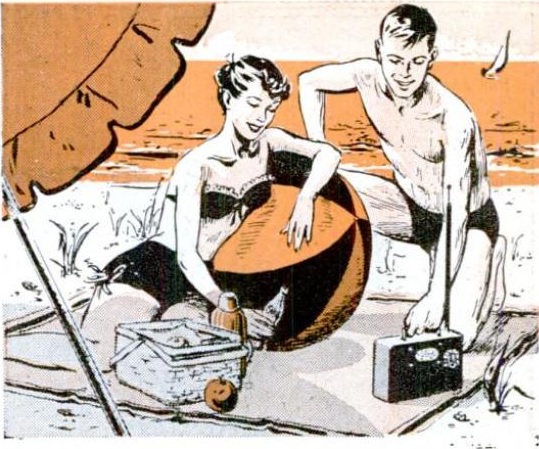
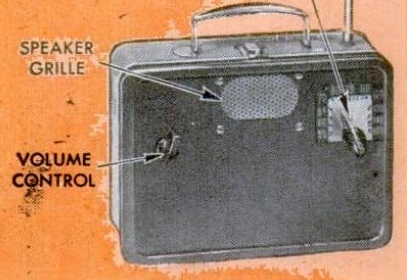
1950JunePM1I don’t know if they’re on the beach at Benton Harbor, but seventy years ago this month, this couple were listening to some entertaining program on a radio built into a metal lunch box, as described in the June 1950 issue of Popular Mechanics.

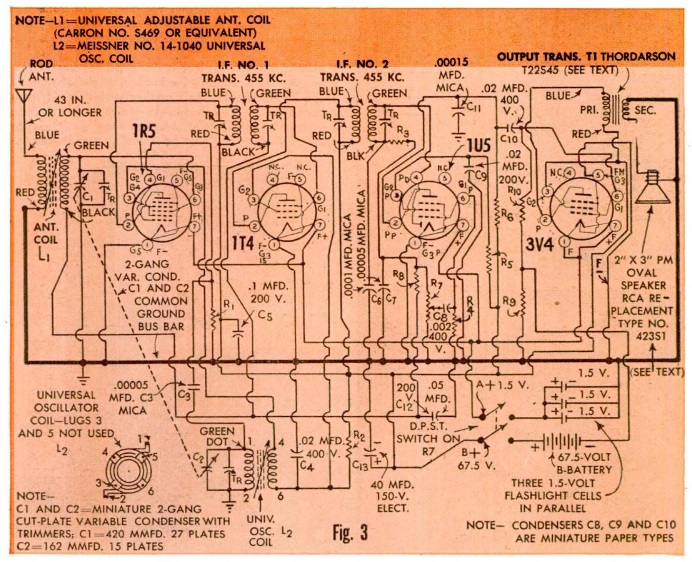
1950JunePM2The set was a four-tube superheterodyne, with a 67.5 volt battery supplying the B+ and 3 flashlight batteries in parallel lighting up the filaments. Perhaps the set served as inspiration for the famous Gilligan’s Island radio, as it featured a telescoping whip antenna attached to one side of the internal antenna coil. The built-in antenna was said to pull in local stations, and with an outdoor antenna, even distant stations would supply loudspeaker volume.

The finished set had a professional look thanks, in part, to a dial scale printed in the magazine. For the finishing touch to the set, the dial could be cut out of the magazine and cemented to the case.

1950JunePM3


Camping With the Phonograph: 1920

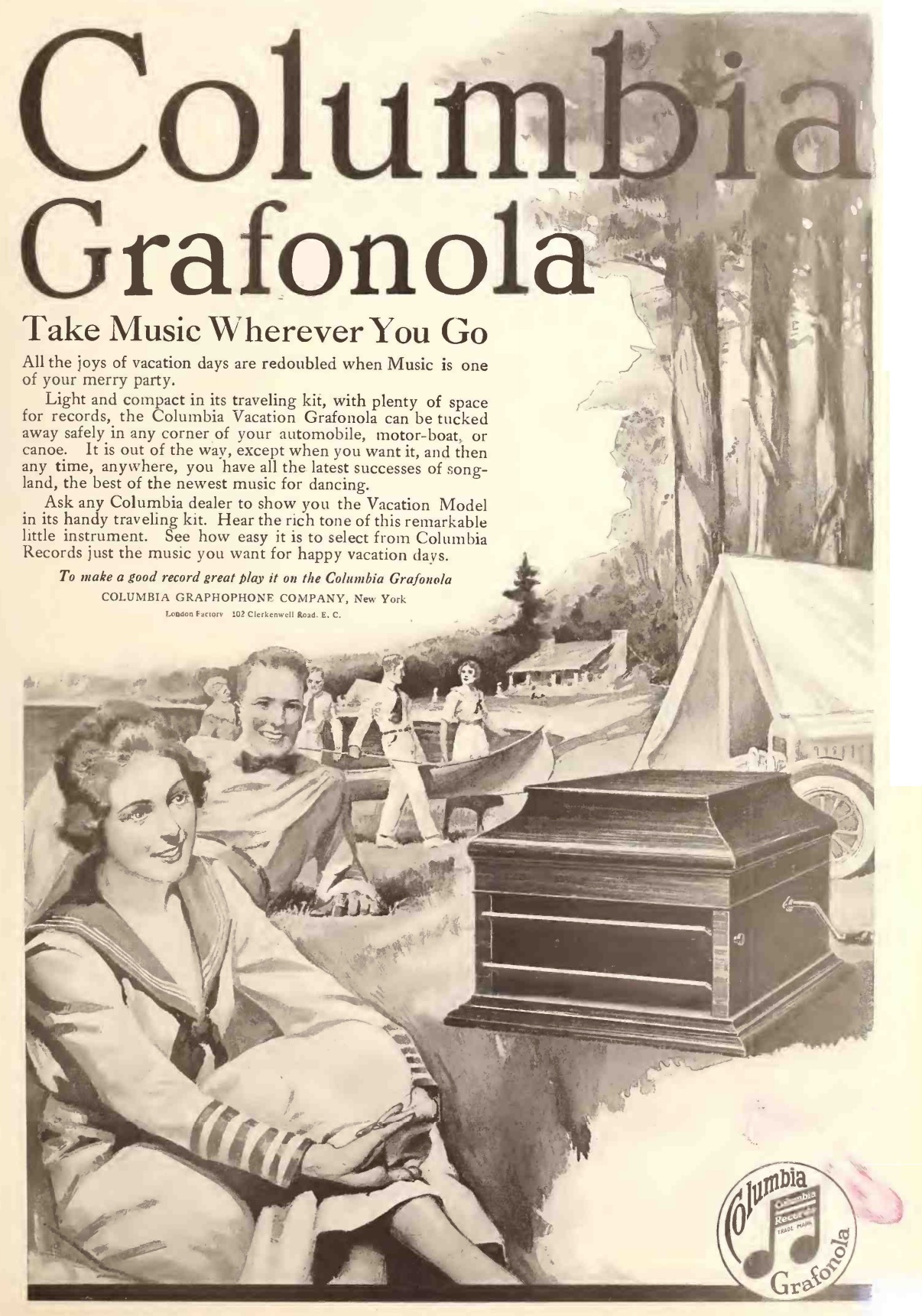
1920JuneTalkingMachineWorldA hundred years ago this month, the June 1920 issue of Talking Machine World carried this ad for the Columbia Grafonola phonograph, and reminded readers that the joys of vacation are redoubled when music is brought along.

The compact instrument in its traveling kit could be tucked away safely in any corner of an automobile, motor boat, or even canoe. It stayed out of the way until needed for the latest music for dancing.


Electrostatic Generator

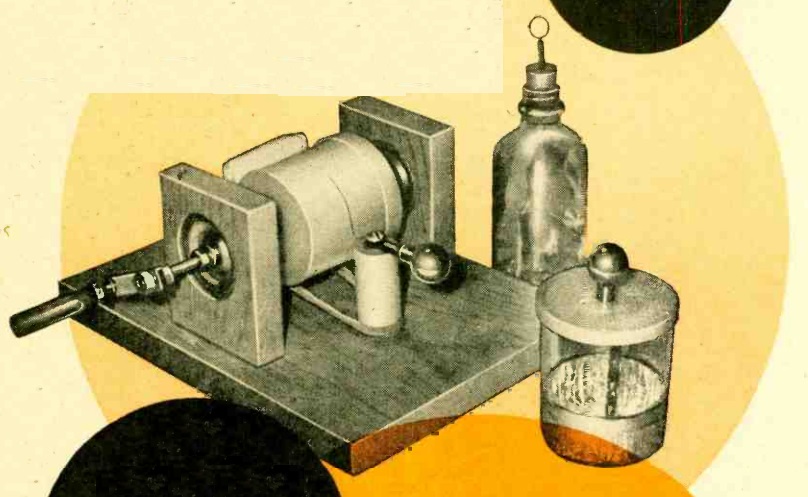
1970JunSciElecFifty years ago this month, the June-July 1970 issue of Science and Electronics showed how to put together this electrostatic generator, as well as the accompanying Leyden jar and electroscope.

It consisted of a plastic jar which was turned by the crank to rub against a piece of wool. A pickup wire collected the charges and conducted them to the metal ball. This could be used to charge the Leyden jar. For bearings, the device used roller skate wheels.

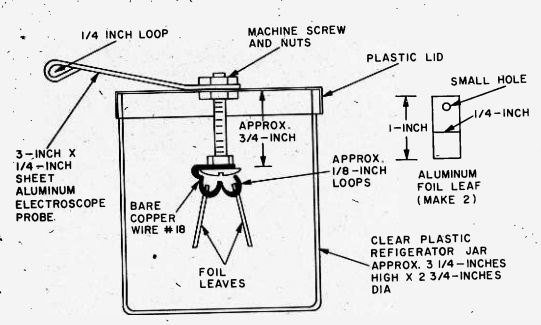
1970JunSciElec2Emergency preparedness buffs will notice that the electroscope, at left, looks very similar to the venerable Kearney Fallout Meter (KFM) used for detecting nuclear radiation. Indeed, they do rely on the same principle. In the presence of ionizing radiation, the charge will slowly dissipate, allowing the leaves to get closer together. This electroscope is not calibrated. Therefore, it would not be able to provide an accurate radiation dose reading. However, this generator would be useful to charge the KFM.

For young scientists without any ionizing radiation at their disposal, the magazine describes a number of interesting experiments, any one of which would be sure to bring home the blue ribbon at the next science fair.  To guarantee the top prize, one interesting experiment would be to purchase a small uranium sample.  Charge up the electroscope and see how long it takes to discharge.  Then, repeat the experiment with the uranium inside the electroscope and see how much faster it discharges.