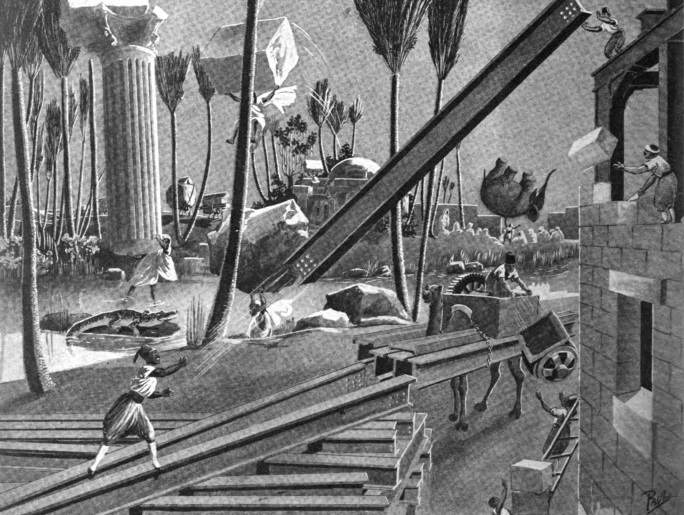
This hypothetical view of a construction project is from near the equator of an alternate Earth whose period of rotation is 1.41 hours, rather than the customary 24. A lot of work can get done during that shorter day, since the effects of gravity are cancelled out by the increased centrifugal force. Here, a worker is shown tossing a steel beam to his colleague.
The caption notes one disadvantage, namely, that the guy on top needs to be a good catch, since if he misses, the beam will simply keep flying, never to return.
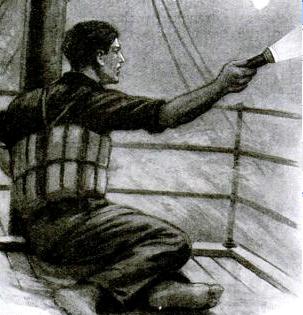
A hundred years ago this month, the February 1915 issue of Popular Mechanics reported the story of Loren A. Lovejoy, the wireless operator of the steamer Hanalei, shown here in this artist’s rendition.
The Hanalei suffered a shipwreck on November 23, 1914. While the incident is almost forgotten today, more than twenty of the 63 aboard the ship perished off Point Bolinas, 14 miles north of the Golden Gate. Even though the ship was within 500 feet of land and it was daylight when it hit the rocks, the rescue proved difficult. The ship initially made an incorrect report of its position. By the time rescuers realized the correct location, fog was setting in, and it was late at night before any rescue could be attempted. By then, the ship’s radio had been destroyed. Trucks transporting the rescuers had to travel 60 miles on poor roads in heavy fog.
To communicate with the rescuers, Lovejoy was able to signal using Morse code with a flashlight. Those ashore were able to send “words of cheer” with automobile headlights. With a mortar, the rescuers would shoot a lifeline to the ship. Lovejoy then sent messages back such as “windward and too low. Send her higher.”
The Secretary of Commerce later sent a personal letter commending Lovejoy for “his courage and ingenuity, measuring up to the high standards of the wireless service.”
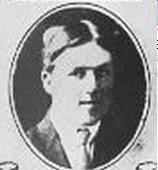
Lovejoy was born in Hillsdale, Kansas, on June 27, 1891, and graduated from high school in Seattle. He entered service with the Marconi Company in 1912. He died in 1977.
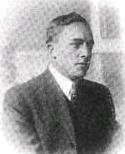
The Seattle Star reported in the next day’s paper that Lovejoy was killed in the shipwreck. In fact, it was the Star’s reporter who communicated that sad news to Lovejoy’s father. The newspaper account, however, was greatly exagerated, and Lovejoy lived another six decades, Lovejoy survived the wreck. He is pictured in the 1960’s in White’s book linked below. His First Grade operator’s license was listed as being renewed in December, 1916.
According to the Social Security Death Index, Lovejoy died in 1977 at the age of 86 in the Seattle area. He is buried at Acacia Memorial Park in King County, Washington.
The Hanalei was originally constructed for the Hawaiian sugar trade, but was in service at the time of its wreck hauling lumber and passengers between Northern California and San Francisco.
The Hanalei’s assistant wireless operator, Adolph J. Svenson, who sent out the first SOS, was among those killed in the wreck. He drowned when the ship broke up. Lovejoy later recounted of his colleague, “throughout our terrible experience he remained cool and resourceful, upholding in an exemplary manner the traditions of the Marconi service.” Svenson’s name is among those inscribed in the Wireless Operators Memorial in Battery Park, New York, which was dedicated on May 12, 1915.
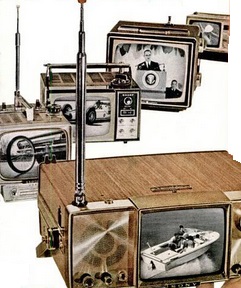
Here’s something I lusted after as a youngster: A battery operated TV! Fifty years ago, the February 1965 issue of Popular Science reviewed the available options, and proclaimed that all of the eight models tested performed so well that they can’t help but be popular. It noted that most of the portables with telescoping antennas outperformed home sets with outside antennas. They all had good picture and sound quality. They ranged in size from “the size of a desk dictionary” up to “as big as a bowling ball bag.” The article noted that models using rechargable batteries, which were good for about 50 charges, would work out to about 6 cents per viewing hour. Normal dry cell batteries would work out to about 40 cents an hour.
Screen sizes ranges from four inches up to nine. The article noted that the four-inch models were useful only for one person viewing, but the nine-inch models would accomodate a group. All of the sets could also be powered with household AC current, and many came with the plug to watch in the car on 12 volts.
But alas, for an impecunious youngster, the prices were all well out of reach, ranging from $149.95 up to $199.95.
Note: If you’re looking for a modern battery operated or 12 volt TV, please visit the guide on my website.
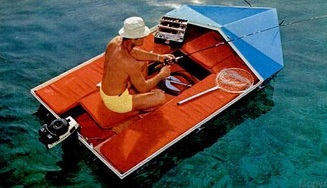
Here’s an idea from 45 years ago that somehow never caught on. It’s the Travelpod, from the February 1970 issue of Popular Mechanics.
It’s a camper, it’s a boat, and it’s a car top luggage carrier, all in one. The author must have built two of them, since the yellow one is shown on top of the station wagon, and the blue one is shown in the water. Complete plans were available from the publisher, and you could even get custom decals for an additional 50 cents.
According to the author, the Travelpod could be built with about $125 in materials. After an 8500-mile camping trip with the family, he reported that it was the most versatile and most functional camper on the road.
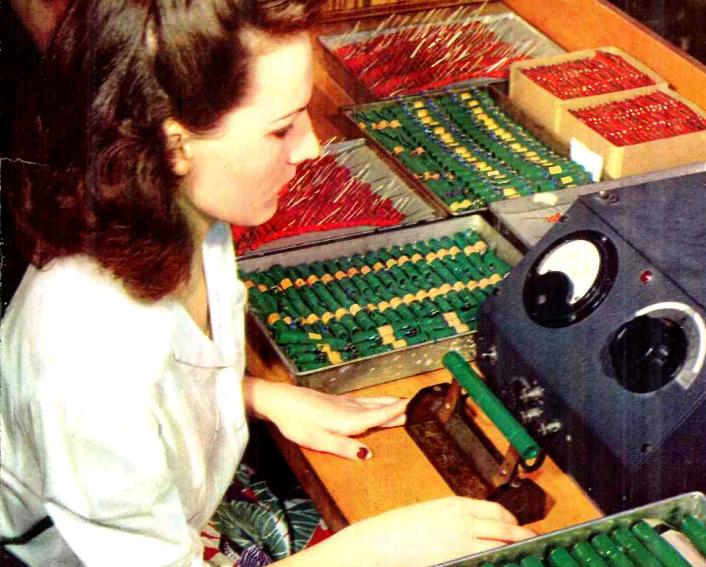
Seventy years ago, American war production was going strong, as demonstrated by this worker at the Ohmite Manufacturing Company plant in Chicago. This worker, shown here on the cover of the February, 1945, issue of Radio News, is testing transmitter RF chokes for their “Q” factor.
Like virtually all American industry, the company was engaged entirely in war production. The company had been founded in 1925 and, as suggested by its name, primarily engaged in the manufacture of resistors. It’s currently headquartered in the Chicago area, with its production and distribution facilities moved to Matamoros, Mexico and Brownsville, Texas, one of many maquiladoras along the U.S.-Mexico border.
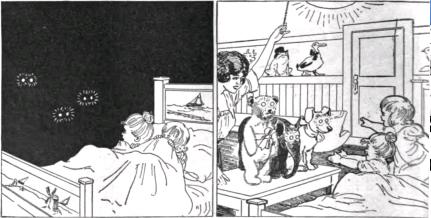
Even those of us curmudgeons who aren’t easily swayed by the winds of political correctness might have to concede that this is a bad idea. This illustration is from the August 1920 edition of Science and Invention.
It shows a new toy, the invention of one Miss Florence Garrigue of Danvers, Mass. The idea is either to cure children of their “natural aversion for darkness,” or perhaps simply scare the crap out of them; the accompanying article is somewhat unclear. But in any event, the idea is to place these animals with glow-in-the-dark eyes next to the sleeping child, who awakens to see several pair of luminous green eyes staring at them in the darkness. “But their fears are quickly turned to joy when Nursie, in response to the cries of alarm, winks on the electric lights” to reveal that the eyes belong to the seemingly harmless toys. Miss Garrigue was awarded US Patent 1337354 for the toy.
The article reveals that the eyes are luminescent due to the use of radium. The patent stresses that the eyes should be made of “preferably a radium composition which will retain its luminescent property for a long time.”
For the politically incorrect, it should be noted that radium is not particularly dangerous, unless ingested, such as by the Radium Girls, who were instructed to routinely lick their brushes while applying radium paint. But still, this particular toy probably isn’t the best of ideas.
It appears that the toy’s inventor went on to be the founder of Meditation Mount in Ojai, California, a center, according to its website, devoted to the building of an enlightened and compassionate world through meditation and universal spiritual principles. It stresses “loving understanding that treats all beings with respect and dignity.”
I’ve always been aware that civilian radio sets were not manufactured during World War 2, but I never knew the details. Those details are reported on page 22 of Broadcasting, March 16, 1942.
On March 7, 1942, the War Production Board, which had itself been created by executive order on January 16, 1942, issued its order regarding radio equipment. Under that order, all manufacture of civilian receiving sets was to cease on April 22 in preparation for the conversion of the 55 manufacturers to war production. Sets in production as of that date were allowed to be finished, but only if not more than $500 in materials (not including wooden cabinets) were used.
30,000 were employed by these firms, and they had collectively produced more than 13 million sets prior to the order. They had done $240,000,000 in business during 1941, and all of their resources were now to be turned to war production.
War orders for all of the companies were already in place, and they were to begin gearing up for war production as soon as the manufacture of civilian sets ended.
The War Production Board estimated that the firms would turn out about three million more sets before the deadline, which would increase the total number of civilian sets to about 60 million.
Those sets would need to be kept in good shape, since the Board doubted that even replacement parts would be manufactured for the duration of the war. The Board even hinted that rationing and registration might be required, noting that some homes had more than one good set, and extras could be used in homes having none. But the Board’s chairman believed that the current supply of sets, along with those in production and on retailer’s shelves, would be sufficient for the nation’s needs.
The next month, Hugo Gernsback, editor of Radio Craft magazine, opined in an editorial as to the possibilities this situation presented for America’s youth: “Young men between the ages of 12 and 17 who are not subject to the draft have time on their hands, which they now can turn into cash by building sets not only for their friends and relatives–yes, but even sell them to radio stores. It is certain that if a number of boys gang together and manufacture a few sets every week in their spare time, and providing the sets are made right, they can be sold to the trade.”
Gernsback noted that millions of obsolete sets cluttering up storerooms would be a source of parts, as would automobile junk yards and junk shops, since they were loaded with a goldmine of parts. He pointed out that readers could “perform a patriotic service to conserve whatever substitute materials we have and turn such materials into radio sets.”
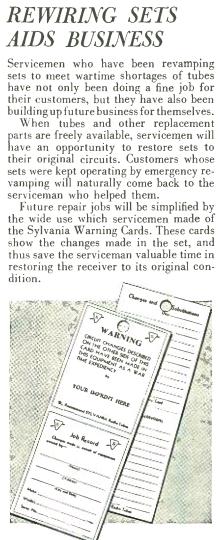
Early in the war, manufactured parts were hard to come by. By the end of the war, some common parts were becoming available for civilians, but most were in limited supply, and most could be sold only to those attesting that they would be used to make repairs to existing sets. But throughout the war, radio service men had to be creative due to the absence of needed parts. The February 1945 issue of Radio News reported that, barring a miracle, civilian production would not resume until victory over Japan. That issue also contained an ad by Sylvania, a portion of which is shown here. When a service man had to make an emergency repair by re-wiring the set to make use of available parts, he could document the change on the card in order to facilitate restoring the set to its original condition when parts became available after the war.
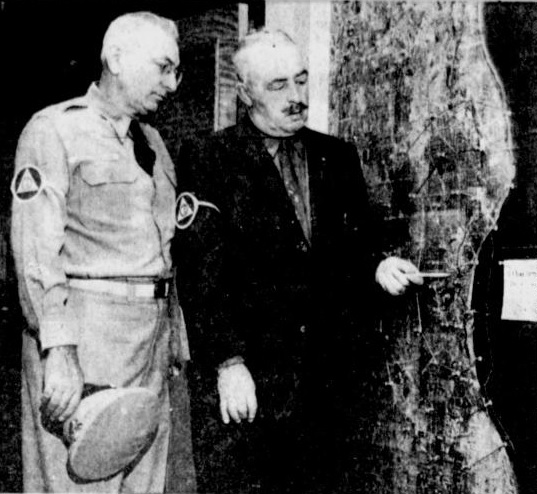
Milwaukee Civil Defense Director Don E. Carleton and Col. Anthony F. Levno assess damage after simulated attack on Milwaukee. Milwaukee Journal, Jul. 20, 1956.
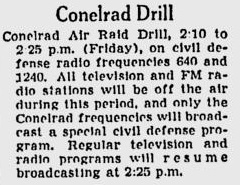
At 3:10 PM Eastern Standard Time on July 20, 1956, CONELRAD conducted its first (and as far as I can tell, only) nationwide test. At that time, all radio and television stations left the air for 15 minutes, and the only broadcast signals coming from the United States were those of the CONELRAD system on 640 and 1240 kHz.
CONELRAD was obsolete almost as soon as it was put into effect, but the idea was that during an enemy attack, attacking bombers must be deprived of the ability to use American broadcast stations for direction finding and navigation. Aviation routinely made use of AM stations for navigation, and the locations of broadcast stations and their frequencies are still printed on aviation charts. It was a reasonable concern, but it became much less critical when the bomber was replaced by the ICBM as the main component of both Soviet and American strategic war planning.
CONELRAD was created by President Truman in 1951, and hung on until 1963, when it was replaced by the Emergency Broadcast Sytem, in which participating stations continued to broadcast on their normal frequency.
Under CONELRAD, all stations in the U.S. would operate on the same two frequencies. The navigator of an enemy bomber tuning to either of those frequencies would be confronted with hundreds of stations on the same frequency, rendering them useless for navigation. And each station would transmit for only a few seconds or minutes. In smaller markets with only one station, the station would quickly give instructions, and then sign off for a few minutes. In larger cities, the stations would be linked together by telephone lines. A continuous program could be sent, but it would switch quickly from one transmitter to another, hopelessly confusing enemy bombers.
But for those 12 years, CONELRAD was the method by which Americans would be warned of war, and in 1956, it was put to a test. At 3:10 PM Eastern Time, each participating station was to transmit the program which had been delivered by record. The introduction to this broadcast can be heard at the following YouTube video:
In many cities, such as Chicago, the CONELRAD test was conducted in conjunction with other civil defense exercises. The Chicago Tribune for July 20, 1956, details some of the preparations being made there. The next day’s paper reports 325,000 simulated deaths in the Land of Lincoln.
There was surprisingly little reporting on how well the test went: Namely, whether the public was actually able to hear the broadcasts. One of the few actual tests was carried out by Radio News magazine, and reported in the October 1956 issue.
The magazine arranged receiving sites at four locations around the New York area. They were in a steel building in Brooklyn, a steel building in Manhattan, a home about 25 miles from the city, and a home about 50 miles from the city. At each location, writers for the magazine had multiple receivers ready for the test. They then rated the percentage of the broadcast they were able to receive intelligibly.
An outdoor antenna proved to be the greatest asset. At the home 25 miles from the city, the editor reported a 100% satisfactory signal using a Hallicrafters S-40 hooked to an outside TV antenna, and also with a Heathkit crystal set with a 100 foot outdoor antenna. At the same location, a Westinghouse battery portable without external antenna gave only 75% satisfactory reception.
In Brooklyn, the best performer turned out to be the Regency TR-1 transistor portable,
which gave a 100% reliable signal, but with continual retuning as the signal shifted from one transmitter to another. At the same location, the Knight tube portable was only 75% satisfactory, with the remaining signal too weak without reorienting and retuning the radio.
In Manhattan, the transistor portable, a Zenith Royal 500, outperformed the tube portable, with 85% satisfactory reception compared to 65%.
50 miles from the city, a Grundig tube portable gave 85% satisfactory reception, outdoing the Zenith portable, which had only 60% reliability. At this more distant location, the main problem came from interference from stations in other cities’ CONELRAD networks.
It is somewhat surprising that so much “retuning” was necessary. Presumably, the stations all had a crystal for their assigned frequency (the article didn’t state whether New York was using 640 or 1240), so it’s unlikely that the individual transmitters were drifting. More likely, some of the individual transmitters were slightly off frequency, resulting in the need to retune when the signal switched from one to another.
The article did stress the importance of having nondirectional antennas, something that was lacking in most AM portables. Most of the receivers, other than those using outdoor antennas, had to be reoriented when the signal switched transmitter locations. The article noted that extreme sensitivity wasn’t necessarily a good thing, because of the danger of interference from adjacent networks. These two factors explain why the crystal set had such good results in the test.
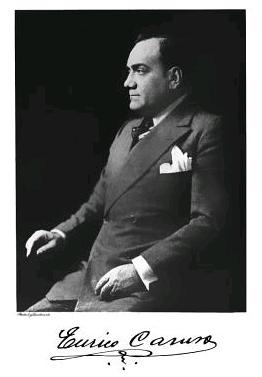
A hundred years ago today was perhaps the first example of a pirate broadcasting music over the airwaves. The New York Tribune, January 31, 1915, reported a mysterious broadcast of a phonograph record of Enrico Caruso. The previous year, Caruso had taken part in a broadcast from the roof of the Wanamaker Department Store, as previously reported here.
But this was apparently an unauthorized broadcast, and the source of the January 1915 signal was a mystery. The paper reported that amateur wireless operators were surprised by the broadcast on the afternoon of January 30, which came from somewhere New York, and on a wave legth a few hundred meters below that used by the government. In what was perhaps the first recorded pirate radio broadcast, someone played, without further comment, a phonograph recording of Enrico Caruso singing an aria.
The article went on to point out predictions that within the year, there would be wireless telephone messages “flying through the air instead of code messages.”
During the centennial of World War 1, this page periodically remembers American servicemen who gave their lives in that war.
Private Carl Alfred Oefstedahl of Spring Grove, Minnesota, was born in 1893. He appears to have been born in North Dakota, the son of Peter and Inger Oefstedahl, and is recorded as being a resident of North Dakota in the 1900 Census. He served in Company L, 138th Infantry.
In the casualty list of July 23, 1918, he was reported as being killed in action, one of 24 men so listed that day. He is buried at Spring Grove Lutheran Old Cemetery, Spring Grove, Minnesota.


 )
)