1915 Receiver

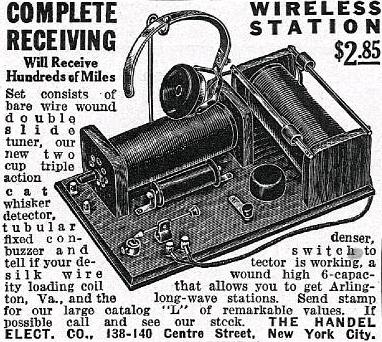
1915AugustBLOne hundred years ago, a Boy Scout interested in wireless could get this complete receiving station for only $2.85, as advertised in the August 1915 issue of Boys’ Life.  It’s unclear whether the headphone was included for that price. While a headphone is shown in the picture, it’s not mentioned in the description, which leads me to suspect that a few Scouts might have learned the disappointing phrase “sold separately” after placing the order.

In any event, the set was probably capable of picking up the time and weather signals of NAA, at least for those within a few hundred miles of Arlington, Virginia. The set is described as consisting of “bare wire wound double slide tuner, our new two cup triple action cat whisker detector, tubular fixed condenser, buzzer and switch to tell if your detector is working, a silk wire wound high 6-capacity loading coil that allows you to get Arlington, Va., and the long wave stations.”

In addition to the possibly missing headphones, the owner of the set would need to come up with some wire for an antenna and ground connection. But the set appears to be capable of picking up NAA and other stations. As the ad mentions, the test buzzer would be helpful in making sure the cat whisker was set to a “sweet spot” on the crystal. A battery would also be necessary to operate the test buzzer.

The set was offered by the Handel Electric Company of 138-140 Centre Street, New York.

Click Here For Today’s Ripley’s Believe It Or Not Cartoon


1915 Car Powered Ferry

1915CarFerry

The prototype car barge shown here was reportedly built for less than $100 and in use by a motorist in Aberdeen, Washington, to cross a bay 20 miles wide. It is shown on the cover of Popular Mechanics a hundred years ago this month, August 1915.

Each paddle wheel is connected to a hardwood wheel, which is strapped with leather straps to the spokes of the car’s wheels. The rear of the car is jacked up off the floor, and the craft is ready to cross the bay. It reportedly took about eight minutes to load the car aboard and make it seaworthy.

Click Here For Today’s Ripley’s Believe It Or Not Cartoon


TV Comes to Marathon, Ontario, 1953

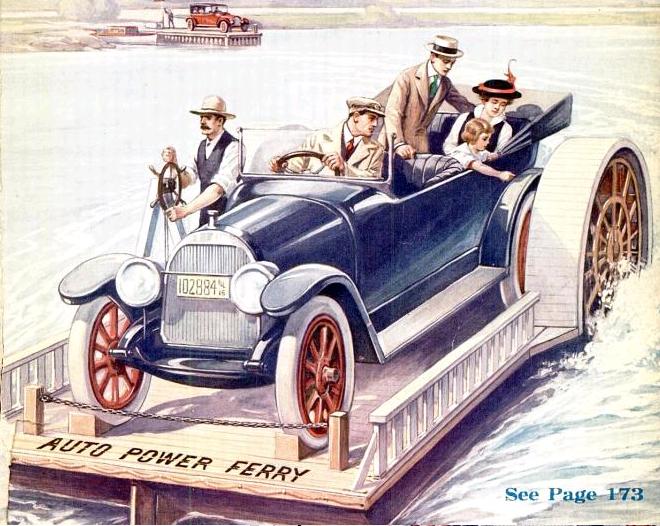
GreenBayMarathonIn 1953, Marathon, Ontario, was a full 300 miles away from the nearest TV station, WBAY channel 2, in Green Bay, Wisconsin. That distance didn’t stop Grant Ross from deciding that the town needed television, and he set out to deliver. He discovered that from a hill 300 feet above the shore of Lake Superior, the signal was perceptible, and he set out to get reliable reception. Half of the path between Green Bay and Marathon was over the waters of Lake Superior. However, Green Bay was on the shores of Lake Michigan, and the signal had to cross 152 miles of Wisconsin  and Upper Michigan countryside before reaching the unobstructed waters of Lake Superior. But it did so, and Ross was intent on providing a signal to the town. He wound up constructing a rhombic array on 45 poles mounted atop the hill. This signal was fed down to the town on an 1800 foot transmission line. A 1955 report showed that he received “excellent” signals at least 40% of the time. Reception was “poor or useless” only 20% of the time.

Ross signed up over 400 homes for his pioneer Community Antenna Television (CATV) systam, collecting a $50 installation fee from each. In addition, the monthly subscription for the service was $2.50.

A few years later, channel 2 came on the air in Port Arthur, Ontario (now Thunder Bay), and he switched the service to that. The rhombic was rebuilt to receive the new signal from WLUC in Marquette, Michigan, which was a relatively easy catch, being 166 miles away, but with a path entirely over the waters of Lake Superior.


Click Here For Today’s Ripley’s Believe It Or Not Cartoon


1935 Two-Tube Shortwave Portable

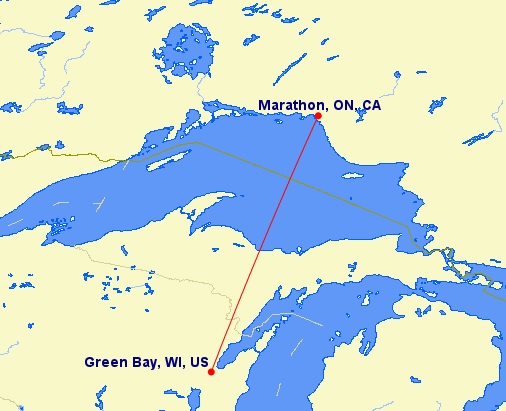
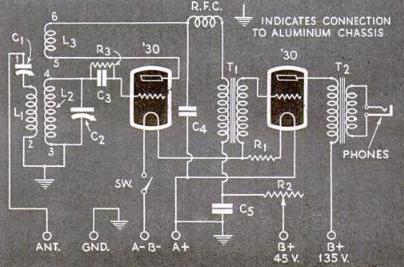
1935AugPSSW1This little two-tube portable receiver appeared in Popular Science
80 years ago this month, August 1935. It featured two type 30 triodes, one serving as the regenerative detector, with the other one providing one stage of audio amplification. With four plug-in coils, the set would tune 17 to 270 meters.

One novel feature was the inclusion of the antenna trimmer condenser inside the plug-in coil. This would allow the antenna to be separately tuned to each band, without having to fiddle with that adjustment when plugging in a different coil. The coils were changed through an opening in the top of the cabinet, with a removable cover to keep dust out.

1935AugPSSW2

Click Here For Today’s Ripley’s Believe It Or Not Cartoon


1925 Four Tube Loudspeaker Set

1925AugPM

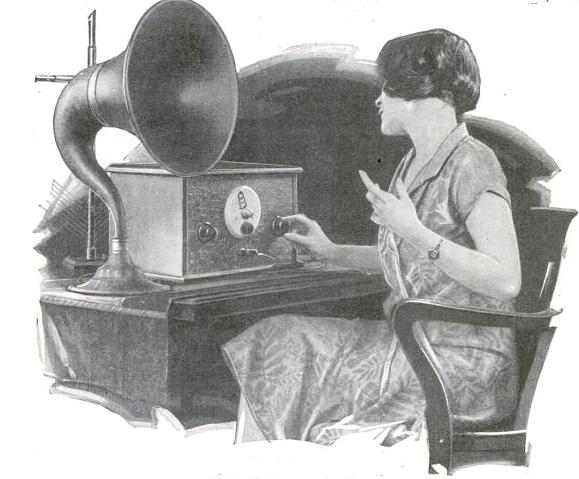
Ninety years ago this month, Popular Mechanics, August 1925, carried the plans for this four-tube receiver. The set contained four type 201 tubes, and featured a tapped loop antenna. The set had very good selectivity by virtue of having the tapped loop. By changing the taps, the set tuned different portions of the broadcast band. On one tap, it tuned 370-550 meters (545 through 810 kHz). On another tap, it tuned
224-400 meters (750 through 1340 kHz). By breaking up the tuning in this fashion, a smaller range of frequencies was tuned by the single tuning condenser, resulting in greater separation between the stations.

The article noted that during testing in Chicago, even with the Chicago stations transmitting full blast, it was possible to receive more distant stations with the speaker.

Click Here For Today’s Ripley’s Believe It Or Not Cartoon


K2BSA in 1975

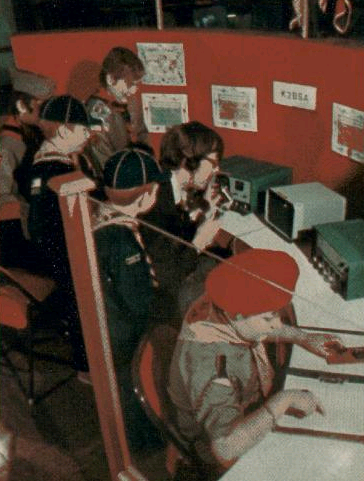
K2BSA1975Shown here is the flagship Amateur Radio station of the Boy Scouts of America, K2BSA, as it appeared 40 years ago this month, in the August 1975 issue of Boys’ Life.

As reported in the magazine, the station was then located at the Johnston Historical Museum, on the grounds of the BSA’s then national headquarters in North Brunswick, New Jersey. K2BSA is still active, although it no longer has a fixed location from which it operates. It is on the air on multiple bands and modes at BSA Jamborees. At the most recent one in 2013, I was on staff, and thousands of contacts were made around the world. In addition, the station call sign and even portable equipment are available for loan by licensed hams who are scouts and scouters for use at scouting events. In this way, the call sign is frequently heard during Camporees and other events at which scouts get a chance to experience amateur radio.

The article notes that in 1975, the station was put on the air on weekends on a monthly basis to allow visitors to speak to other Scouts around the country.

A larger reincarnation of the museum is open to the public at the National Scouting Museum near the organization’s present headquarters in Irving, Texas.

(Scouts who are working on the Scouting Heritage or Radio merit badges will find helpful information for both at my website.)

Click Here For Today’s Ripley’s Believe It Or Not Cartoon


Order to Liquidate Allied Prisoners: 22 Aug. 1945


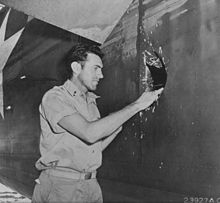
Louis Zamperini in 1943. Wikipedia photo.

Louis Zamperini in 1943. Wikipedia photo.

Today marks the 70th anniversary of an event that thankfully never happened.

In 1944, the Japanese War Ministry issued orders to prison camp commandants for the “final disposition” of Allied prisoners of war. Under those orders, all POW’s were to be killed at such time as Allied forces landed in the territory in which they were being held. The rationale behind the order was to prevent the POW’s from being repatriated and becoming a part of the liberating force.

For example, on December 14, 1944, about 150 prisoners of war at Palawan in the Philipine Islands, were ordered to the air raid shelters, at first in apparent response to an actual air raid. But after the raid, because of a mistaken belief that an invasion of the island was underway, they were ordered to remain, at which time the wooden structure was doused with gasoline and set afire.

According to the book Unbroken by Laura Hillenbrand, the date set for at least one camp on the home islands was 70 years ago today, August 22, 1945.

That book is the story of Louis Zamperini, a record-breaking track star of the 1930’s. Among his claims to fame was a personal meeting with Hitler at the 1936 Olympics. In 1943, his plane crashed in the Pacific and he drifted in a small raft for 47 days until his “rescue” by the Japanese. He remained a prisoner until the end of the war, enduring much torture. After the war, haunted by nighmares of his experience, he drifted into alcoholism until attending a Billy Graham crusade in California.

Because of the Japanese decision to surrender, motivated at least in part by the bombings of Hiroshima and Nagasaki, the orders to execute Zamperini and other prisoners in Japan were never carried out.

References

Read More At Amazon

Click Here For Today’s Ripley’s Believe It Or Not Cartoon


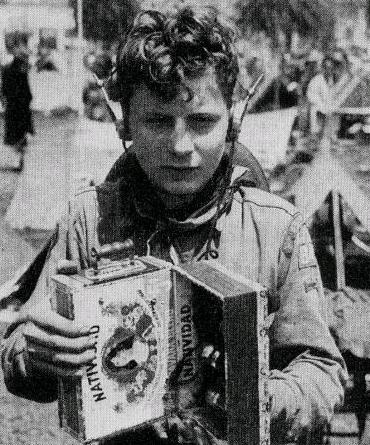
1940 Boy Scout’s Radio

1940AugBLSeventy-five years ago, this unnamed California Boy Scout decided to bring his radio to camp. The set was one he built himself in a cigar box. The caption in this picture from the August 1940 issue of Boys’ Life reveals that the picture was taken at the Camporee of the BSA’s Oakland Area Council.

Click Here For Today’s Ripley’s Believe It Or Not Cartoon


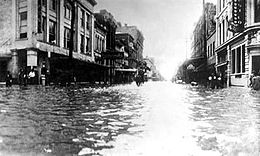
1915 Galveston Hurricane

Flooding in Galveston after 1915 hurricane.  Wikipedia photo.

Flooding in Galveston after 1915 hurricane. Wikipedia photo.

A hundred years ago, a major hurricane hit the United States, leaving between 275-400 dead and $50 million in property damage. Adjusted for inflation, this made the storm the fourth costliest in U.S. history. The storm brought winds and heavy rains to the Leeward Islands, Puerto Rico, Hispaniola, and Cuba. Like the deadly hurricane of 1900, it made landfall in Galveston, Texas. The 1900 hurricane had caused thousands of deaths, and some lessons had been learned. In particular, in the wake of the 1900 hurricane, Galveston saw construction of a seawall. The structure was only partially effective in 1915, but still limited the destruction and saved many lives. It did cause flooding, and the beach was eroded to the point where it became an offshore sandbar.

This was one of the first natural disasters in which radio played a role in relief efforts, as reported in the September 1915 issue of Wireless Age.  The magazine, published by the Marconi Company, reports that “in a tornado [sic] which blew continuously for eighteen hours in southeastern Texas, leaving death and destruction in its path, Marconi wireless telegraphy and Marconi men showed their worth by keeping the residents of Galveston in touch with the rest of the world when all other means of communication had failed.”

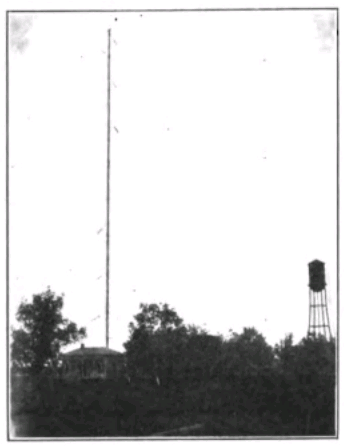
Port Arthur Marconi station, 1915.

Port Arthur Marconi station, 1915.

The aerial mast of the Galveston Marconi station was destroyed, and some of the ground plates and mast anchors were swept away. But even though flood waters reached the station house, the equipment was undamaged. A Marconi superintendant in New Orleans came to Galveston to investigate, and arrived on August 19, three days after the winds had started their fury. By that time, an army transport had already established radio contact with Forst Sam Houston, 250 miles away, but with only limited success. A Marconi-equipped steamship, the Concho, was in port, and the Galveston Marconi operators reported for duty aboard that ship. On August 20, they established contact with the Marconi station at Port Arthur, Texas. This was the only reliable communications link between Galveston and the outside world, and many messages were handled for the steamship companies, the military, and the general public.

At some point, the mast at the Port Arthur station gave way, at which time messages were sent and received from another Marconi-equipped steamer, the Wild Duck.

After unleashing its fury on Texas, the storm turned toward the Ohio Valley, finally fading out on August 23.


Click Here For Today’s Ripley’s Believe It Or Not Cartoon


UHF TV in Bridgeport, CT, 1950

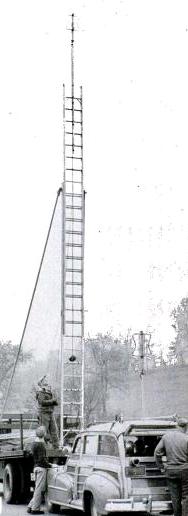
1950AugPSThe contraption shown here was part of a 1950 RCA test of the capabilities of UHF television. The truck, carrying an extension ladder, cruised the streets of Bridgeport, Connecticut, to test the signal being put out by its experimental UHF television station, KC2XAK.

Inside the station wagon was a TV receiver evaluating the quality of the picture being received from the antenna atop the ladder.

The article from which this picture is taken, the August 1950 issue of Popular Science, points out that cities such as Bridgeport faced challenges getting television. With only twelve VHF channels allocated, the stations in New York had already filled the quota. Bridgeport was too far away for good over-the-air reception, but too close to use the same channels in use in New York or the adjacent ones. The solution was seen in setting up a “slave” UHF station. KC2XAK was rebroadcasting the signal of WNBT in New York, to about 100 homes in Bridgeport that had been equipped with UHF converters. The video was received by the relay station from a microwave feed from the Empire State Building. The audio was simply received over the air for retransmission.

The article noted that reception by the test households was good, and that UHF offered a promising way to deliver television to smaller cities.

Click Here For Today’s Ripley’s Believe It Or Not Cartoon