Stratovision: Airborne TV Broadcasting

stratovision1945

Seventy years ago this month, Radio Craft magazine, October 1945, introduced the concept of Stratovision, and the illustration above showed how it could work.

The war was over, and the American public was hungry for television.  A handful of markets already had stations using the same format that would remain in use for seventy years.  For example, the predecessor of WNBT-TV came on the air in New York in 1939.  And the predecessor of WABD signed on in 1944.  And starting in 1942, Los Angeles had the station that would become KTLA.  But most of the nation was dark as far as television signals.  To get signals to a significant proportion of the populations would require hundreds of stations.  And getting network programs to those stations would require either hundreds of microwave relay stations, are a coaxial network estimated to cost a hundred million dollars.

Stratovision provided an alternative.  The plan was proposed in 1945 by Westinghouse, and was the brainchild of engineer C.E. Nobles.  Under the plan, fourteen aircraft would fly at the predetermined locations shown on the diagram at an altitude of 30,000 feet where they would continually orbit their designated location.  They would transmit VHF and UHF television signals, as well as FM broadcasts.  Because of the antenna height, each plane would provide a good broadcast signal to an area 422 miles in diameter.  And because there would be no terrain that would need to be overcome, the transmitters could operate with much less power than ground-based stations.

The system also solved the problem of delivering network programming.  Only eight planes would be required to link New York with Los Angeles.  The planes would establish a reliable network whenever they were in flight, and the fourteen planes would provide broadcast television to 78% of the country’s population.  The plan called for each plane to broadcast four television and five FM signals.

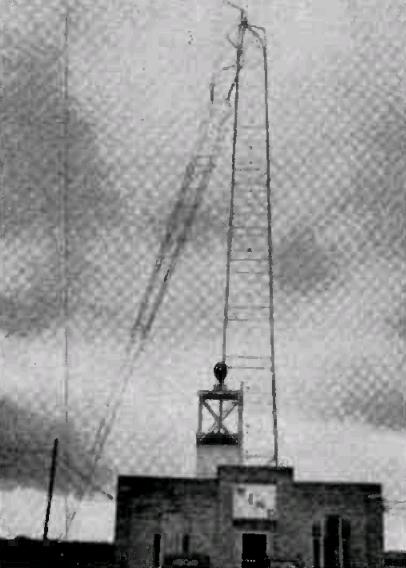
The plan may appear far fetched to some, but it is sound, and would result in a workable national network.  The system was tested by Westinghouse in 1948 and 1949, as seen in this photo.   In one 1949 test, the aircraft shown here, a B-29, relayed the signal of WMAR-TV in Baltimore on channel 6, using a 5 kW video and 1 kw aural transmitter. In June 1948, the same aircraft was used to rebroadcast the Republican National Convention in Philadelphia for one hour. As part of the test, a receiver was set up in Zanesville, Ohio, where it was used to demonstrate to the gathered newspaper reporters that the system was capable of reaching small town and farm homes.

Reception reports were solicited, and many were received.  From the reports, Westinghouse confirmed that eight planes would provide the transcontinental relay.

There’s nothing technically unfeasible about Stratovision.  The reason why it never took off (pardon the pun) was probably the mere fact that broadcast stations did spring up nationwide.  They were initially provided with programs by kinescope recordings, but microwave and coaxial transmission quickly came into place.  For example, by 1950, the Minneapolis/St. Paul market was getting the national networks live, by means of a coaxial cable from Des Moines, which was in turn linked to Chicago by microwave relay.  Once the network signal was in place, there was no need for Stratovision’s relay services.  And by this time, most major cities had multiple stations, and smaller markets had at least one.  And for those far in the hinterlands, there were herculean efforts to get the distant terrestrial signals, such as those use in the tiny communities of Ellensburg, Washington and Marathon, Ontario.

But despite the fact that Stratovision was never adopted for its intended purpose, it did live on, and continues to do so, in some specialized niches.  For example, between 1961 and 1968, educational programs were broadcast from two DC-6AB aircraft based at Purdue University by the Midwest Program on Airborne Television Instruction (MPATI).  The MPATI aircraft would fly in a figure-8 pattern for six to eight hours at a time at 23,000 feet above a point just north of Muncie, Indiana.  Prerecorded educational programs were broadcast on UHF channels 72 and 76, with call letters KS2XGA and KS2XGD.  The transmission diameter was 200 miles, and covered both the Chicago and Detroit metropolitan areas.

Between 1966 and 1972, the U.S. Navy used Stratovision to broadcast two channels in the area surrounding Saigon, South Vietnam.  One channel was intended for the Vietnamese audience, with the other providing information and entertainment programs to U.S. servicemen.  Armed forces programs were carried on channel 11, with call letters NWB-TV, with the Vietnamese program on channel 9 with call letters THVN-TV.  The aircraft also broadcast on 1000 kHz AM and 99.9 MHz FM.  The Vietnamese program typically ran 1-1/2 hours per day, with the armed forces channel running three hours per day.  American programs included Bonanza, Perry Mason, Ed Sullivan, and the Tonight Show.

Click photo for screen-resolution image

Pennsylvania Air National Guard Commando Solo aircraft preparing to depart for emergency broadcasts to Haiti in 2010. Department of Defense photo.

The U.S. military continues to use EC-130 Commando Solo aircraft to provide PSYOPS broadcasts during war.  Most recently, only radio programming has been used.  But the aircraft is capable of television transmissions.  For example, in 1999 in the former Yugoslavia, some television programming, using Yugoslavian broadcast format, was transmitted from aircraft.  Typically, Commando Solo transmits an FM program, along with broadcasts on the standard AM band and short wave.  For AM and short wave, the airborne transmitter has no particular advantage, other than providing a secure location to house the station.  But on FM, the signal, like the original Stratovision concept, takes advantage of the aircraft’s altitude, and can provide a strong broadcast signal over a large area with a relatively low powered transmitter.  The photo here shows a Pennsylvania Air National Guard Commando Solo aircraft preparing to depart for Haiti to make emergency broadcasts in the wake of the 2010 earthquake.

During the 2011 attack on Libya, Commando Solo aircraft broadcast information.  Transcripts of the broadcasts are available at PsyWar.org.  Since the Libyan broadcasts were carried on short wave as well as FM, they were heard by short wave listeners worldwide, including myself.  A recording of the transmissions can be found at this video:


Click Here For Today’s Ripley’s Believe It Or Not Cartoon


See Us at Freedom2015, Nov. 6-7, Des Moines

When we’re not busy posting pictures of old radios, one of our more serious concerns is the state of religious liberty in America.  Therefore, we will be attending Freedom2015, a religious liberty conference in Des Moines, Iowa, Friday November 6 and Saturday November 7.  The conference has a number of nationally recognized speakers scheduled, including presidential candidate Ted Cruz.  If you’re attending, please look for me.  I’ll probably be wearing my bright yellow OneTubeRadio.com shirt.

One of the conference sponsors is Samaritan Ministries, about which I’ve written in other posts.  If you plan on attending, please let me know so that I can say hello!

WNBT-TV New York, 1945


1945WNBTSeventy years ago today, NBC took out a two-page ad in Life Magazine, October 15, 1945, promoting itself as America’s No. 1 Network.

In addition to promoting its radio programs, it offers a reminder that “‘The Tomorrow’ people talked of only a short time ago, is here today.” It points out that thousands in New York were already enjoying visual entertainment, news, sports, fashion shows, dramas and other programming from WNBT. The ad points out that five large advertisers were already on board, and as more sets became available, larger TV audiences would be able to find visual pleasure in the words, “This is the National Broadcasting Company.”

The production shown here is apparently one of those fashion shows going out over the station which had first signed on in 1939.  The station already had competition from two other stations, including Dumont station WABD.

Click Here For Today’s Ripley’s Believe It Or Not Cartoon


Introducing MathDoctor.net

It’s off to a modest start, but I’ve just started a new website, MathDoctor.net.  Obviously, I still have a lot of work to do, but I hope this new site meets a need.

Undoubtedly, other parents have encountered Common Core standards.  Of course, if you listen to the conspiracy buffs, Common Core is to blame for everything that’s wrong with education.  I don’t go quite that far, but I think I have identified a serious problem with Common Core.  There is a certain amount of material that every student is expected to master.  There’s absolutely nothing wrong with that principle, and I agree with it completely.

The problem with the concept is that every teacher at a given grade level is expected to teach those concepts, whether or not those concepts are within that particular teacher’s area of expertise.  The teacher is in an unenviable position:  He or she is presented with a certain set of material and is expected to teach it in a particular way, even if teaching slightly different material in a slightly different way would have a better outcome.  It’s another case of social problems being “solved” by taking discretion away from the very people who are best able to solve the problem.  In short, the teacher isn’t really allowed to use his or her expertise to teach.  Instead, he or she is asked to carry out directives handed down from politicians and bureaucrats.

So it’s not really the teacher’s fault, but the end result is that the teacher delivers poor instruction.  My son is facing this as he is expected to master the material that bureaucrats have mandated as being required for sixth graders.  And he’s expected to learn it in the manner dictated by those bureaucrats.  The net result is that he’s not learning the material unless I step in and teach it to him.

Some students undoubtedly thrive with the mandated instructional methods.  But not all of them do.  My son, even though he has a firm understanding of mathematical concepts that are far above his grade level, was not understanding instruction about elementary concepts, even though he had mastered the actual material years earlier.  He needed an approach different from the one mandated by Common Core, and I stepped in to provide it.

Since my son didn’t understand the material until I explained it, I assume that there are others in the same situation.  And since I need to explain it anyway, little additional effort is required to put my explanations on video and make them available to others, and that’s exactly what I decided to do.  The videos themselves are hosted on YouTube, and they’re all available at my new site, MathDoctor.net.  For now, there’s just one video, but as the school year progresses, I plan to create a comprehensive resource that will be useful for parents and students.

Not every student will thrive with my approach.  Some of them will prefer the mandated format, and if they do, they should continue to follow it.  Common Core works for them, and that’s a good thing for them.

But for those for whom Common Core is not working, I encourage you to seek out other approaches.  Perhaps MathDoctor.net will be the approach that works for your student.  Or perhaps it will be something very different.  But one size does not fit all, and it is my hope that I’ll provide instruction of a size that will be suitable for at least some.

This introductory video for parents explains more:


Click Here For Today’s Ripley’s Believe It Or Not Cartoon


Zeppelin Raid on London, 13 October 1915

Zeppelin L 15 in the Thames, 1916.

A hundred years ago tonight, the night of October 13/14, 1915, was the deadliest German air raid on Britain of the First World War. In what became known as the “Theatreland Raid,” five German Navy Zeppelins arrived over the Norfolk coast at about 6:30 PM. Unbeknownst to the Germans, new ground defenses had been put in place, but the British guns proved ineffective. One of the guns, near Broxbourne, was put out of action by bombs dropped from Zeppein L 15. The airship continued to London and began bombing over Charing Cross. The first bombs struck the Lyceum Theatre, killing 17. Additional bombs were dropped on Holborn. As it approached Moorgate, it encountered a new 75 millimeter gun. Recognizing the threat, the airship quickly jettisoned ballast and dropped only three more bombs before fleeing.

In total, the five German airships killed 71 and injured 128 that night.  Among those killed were three brothers, ages 10, 14, and 15. Roy, Brien, and Gorden Currie were sleeping when a bomb fell on their building.

When the fire brigade reached the boys’ room, Brien, the youngest, was already dead. Roy, the middle boy, was dead on arrival at the hospital. Gorden, the eldest, was severely wounded with wounds to the back, chest, hip, and thigh. A piece of shrapnel was in his body. He died of his wounds two days later.

At the coroner’s inquest, the Currie family’s housekeeper gave this account of the deadly attack:

I was fast asleep when I heard an awful explosion which awoke me. I seemed to spring from the top of the bed to the bottom. Then I groped my way to the door which I found was on the floor. I stayed there because the side wall had fallen in on the stairs and landing. I called out to the father asking if he was all right. He replied, “I’m all right, but I can’t move.” Then next I called for the boys, only the elder one answered. He said, “do get help.” I shouted to the lady next door. The wall was out and I could see into her house. I said, “our staircase is cut off, will you get help?”

The commander of Zeppelin L 15, which was probably the ship responsible for killing the boys, later described the mission in very different terms from his perspective at 9000 feet:

We then steered over Hyde Park, in the direction of the City. The picture we saw was indescribably beautiful–shrapnel bursting all around, our own bombs bursting and the flashes from the anti-aircraft batteries below. We flew over the City at between 9,000 and 9,800 feet and dropped twenty 110-pound bombs, and all the incendiary bombs. We could see large explosions between Charing Cross Station and the Bank of England.

The next year, this craft met its demise when it was taken down in the Thames estuary on April 1, 1916, shown in the picture above. One crewman was killed and the other 17 taken prisoner.

The German Zeppelin raids probably didn’t have the intended effect of terrorizing the populace into surrender.  German Chancellor Theobald von Bethmann-Hollweig warned General Paul von Hindenburg that the anger of the English public over the raids had reached such a pitch that a negotiated peace between the two countries would be impossible.  This assessment was probably correct.  The Times of London opined after one raid, “if it were possible for the enemy to increase the utter and almost universal detestation in which he is held by the people of this country, he did it yesterday.”

In fact, one British army recruitment poster took advantage of the outrage by showing the image of a Zeppelin over a British city with the admonition, “it is far better to face the bullets than to be killed at home by a bomb. Join the army at once and help to stop an air raid.”

This BBC video contains the recollections of a survivor of a different attack, which took place in 1917.  That attack took the lives of eighteen five-year-old students.  This survivor was six years old and sitting at his desk at the time of the attack.

Read More at Amazon


References


Click Here For Today’s Ripley’s Believe It Or Not Cartoon


1927 Personalized Radio Retailing

1927RadioRetailing

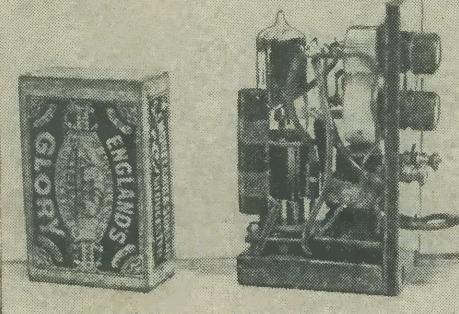
Here’s an interesting marketing idea from 1927. G.I. Morgan, the proprietor of Independent Radio Sales, Inc., 214 South Main Avenue, Sioux Falls, South Dakota, was looking for a way to increase radio sales. So he set about clipping photographs from the local newspaper or programs. He then pasted the photo to a sales letter and mailed it to the person depicted.

The newlywed bride at the right, for example, is Mrs. Guy Fairweather of 49 Lincoln Street in Sioux Falls. To her, he writes:

This charming bride should have a radio set. Now-a-days the little nest is not considered properly “feathered” unless this “music box of magic” occupies its rightful place therein.

Now is the time to buy, Mrs. Fairweather. Right at the start of life’s greatest adventure. Give yourself every minute you can get to enjoy this modern blessing. Our phone number is James-258.

The labor-intensive nature of this kind of advertising only allowed Morgan to send out six or seven such letters per week, “but, believe me, it’s time well spent.” Morgan reported that over half of the prospects so contacted called him back, and the proportion of resulting sales was large. These letters and the accompanying article appear in the February 1927 issue of Radio Retailing, which notes that other dealers might find the idea helpful.

Click Here For Today’s Ripley’s Believe It Or Not Cartoon


1955 Motorola Clock Radio

1955MotorolaClockRadio

Sixty years ago, this week’s issue of Life Magazine carried this ad for Motorola’s latest clock radio.  For $39.95, this handsome set told the time and date, and would sing you asleep at night and sing you awake in the morning.  As an added bonus, it would have your coffee waiting.

The last item was accomplished by having a switched AC outlet on the back of the radio, which came on when the radio did.  All you would need to do would be to plug your electric percolator into the radio.  Since the radio was presumably in the bedroom, you would need to make the coffee there as well, unless you had a heavy-duty extension cord.

Click Here For Today’s Ripley’s Believe It Or Not Cartoon



1945 Los Angeles Radio and TV

101045RadioHightlights

Here is what was on the radio 70 years ago today, October 10, 1945, in Los Angeles.  This listing is taken from that week’s issue of Radio Life, which contains, in addition to these highlights, the complete program listings.

You’ll see that there are three television programs, on station W6XYZ, the predecessor of KTLA.  The station was owned by Paramount, received its construction permit in 1939, and came on the air for the first time in 1942, on channel 4.   The station received its commercial license and the KTLA call letters in 1947, the first commercial television station west of the Mississippi.

On this day, starting at 8:00 PM, the station signed on with a test pattern that ran for a half hour, followed by “Scanning the Globe” at 8:30, “Fashion Guide” at 8:45, and “Variety” at 9:00.

Click Here For Today’s Ripley’s Believe It Or Not Cartoon


Science Fair Ideas: Homemade Batteries from 1965

HomemadeBattery3

When the aspiring young mad scientist is looking for ideas for the science fair, someone invariably suggests making a homemade battery. Making a battery is a fairly simple proposition. All you need are two dissimilar metals and an electrolyte. A common choice for electrolyte is a mild acid such as lemon juice, and copper and zinc make good dissimilar metals. No matter how badly you construct the thing, a little bit of electrical current is bound to flow, and you can probably coax a little bit of light out of a light-emitting diode (LED) or even power a small electronic device such as a digital clock.

A good choice for the kids who aren’t as smart as you are.

In fact, for students with limited scientific abilities, you can just go out and buy yourself a Potato Clock kit. You simply open the box and jab the electrodes into a potato, and the potato juice serves as the electrolyte. It’s completely safe, since I can hardly think of any chemical more benign than potato juice. If you drop the potato on the floor, you don’t need to bother calling the haz mat team. And unless you screw up horribly, the clock will instantly come to life. There’s nothing wrong with the humble potato clock, but if you’re reading this looking for ideas, you probably want to come up with something a bit more spectacular. And while you’re at it, you probably want to use chemicals slightly more dangerous than potato juice.

So you might want to go back in history a bit when adults weren’t quite so concerned with hazardous chemicals, and use something slightly more powerful in making your battery. You can go back in time fifty years, when adults let their responsible children play around with slightly more dangerous chemicals such as household bleach, often referred to by its most popular brand name, Clorox. Not only will you have more fun, but you’ll wind up with a much more powerful battery, suitable for powering much bigger electronic devices.

For details on how to put the battery together, you can go to page 98 the Fall 1965 issue of Elementary Electronics.  That article describes two batteries that you can make at home, both of which are hundreds of times more powerful than the one running that other kid’s potato clock.

Warning:  Bleach really is a dangerous chemical.  You need to be careful with it, and keep it out of the reach of children who are not as smart as you are.  If you get any on your clothes, your mom will be mad.  If you get any in your eyes, you’re facing a major medical emergency.  Your mom is probably right when she tells you, “you can put an eye out with that.”  Ask your parents and/or teacher for permission.  If they balk at the idea, ask them to read the article about how to make the battery.  To show how responsible you are, show them that you read the Material Safety Data Sheet (MSDS).

Homemade battery using drops of bleach.

Battery using drops of bleach.

The article shows how to make two batteries.  The first one, while much more powerful than the potato, is “more of a novelty than a practical device.”  It is shown here, and consists of fifteen sets of aluminum strips and copper wires. The metallic pieces are arranged in a circle around a piece of Plexiglas. The copper and aluminum are close together, but not touching.  When ready for use, a drop of bleach is placed on each one.  When the last drop of bleach is added, the connected radio or other device springs to life.  If measured with a voltmeter, the complete battery will put out about 15 volts.  However, this drops when there’s an actual load, and 15 cells is about right to power a radio that normally calls for 9 volts.

Unlike the potato battery, this one will run a radio for several minutes.  But the article concedes that it’s more of a novelty.  Therefore, the article goes on to describe another more powerful battery.  The bigger one is even suitable for use around the house in case of a power outage.  If the power is out and you’ve used up the last battery, there’s probably still a bottle of bleach down in the laundry room, good for hundreds of homemade batteries.

HomemadeBattery2

Homemade battery using ice cube tray.

The larger battery is constructed in a plastic ice cube tray.  You use six of the individual compartments, so you can cut the ice cube tray in half and make two batteries.  Each compartment of the tray contains one piece of aluminum and one piece of copper.  You simply fill each compartment with bleach, and you have enough power to run a radio for several hours.  When the battery finally goes dead, you pour out the old bleach and replace it.  You can re-use the battery hundreds of times before the aluminum finally gets worn away completely.

Voltaic pile similar to the 1799 version. Wikipedia photo.

With either battery, you have essentially recreated the work of Allesandro Volta, who invented the Voltaic pile in 1799.  He was eventually able to build a battery large enough to administer an uncomfortable electric shock.  Until the electric generator came along in the 1870’s, anything that required electricity (such as the telegraph or telephone) was powered by batteries similar to those created by Volta.

Armed with this fifty year old article, a bottle of bleach, and a few pieces of scrap metal, you can now make your own Voltaic pile.  You’ll get to use dangerous chemicals.  You can generate significant amounts of electrical power.  Perhaps you can even administer uncomfortable electric shocks to your friends, teachers, and parents.

You’ll have the most interesting project at the science fair.  And the kid who goes home with a participation ribbon for his potato clock is going to be pissed.

Check out my other science fair ideas, some of which are slightly dangerous.

Click Here For Today’s Ripley’s Believe It Or Not Cartoon


1940 3-tube Loudspeaker Set

1940PS3tube2

This little three-tube broadcast set could be put together for $4.04, according to the project description in the October 1940 issue of Popular Science.  The article described the AC-DC broadcast set as “simplicity itself,” with three tubes, a 43, a 6C6, and a 25Z5. With a short antenna, it had enought “pep” to drive the 93 cent speaker, and the chasis consisted of an aluminum cake pan. The cabinet was made of pieces of scrap wood.

1940PS3tubeOne interesting feature was the use of honeycomb style coils for the regenerative detector. They were wound on two cardboard disks, the tickler coil 3-1/4″ diameter, with the antenna coil 2-3/4″ diameter. The two coils were mounted above the chassis on brass screws and spacers, 3/4″ apart.

While the set was designed to cover the broadcast band, the author noted that the range could be adjusted up or down a bit by adding or removing turns from the antenna coil.

Click Here For Today’s Ripley’s Believe It Or Not Cartoon