World War II Begins: 1 Sept. 1939

1939Sep1MilJourToday marks the 80th anniversary of the start of World War II. The late edition of the Milwaukee Journal for that day, shown above, carries this AP report:

German troops and warplanes invaded Poland Friday after Nazi annexation of Danzig was proclaimed.

Poland immediately called for aid from Great Britain and France.

Prime Minister Chamberlain announced that Britain and France would fulfill their obligations to Poland unless Germany withdraws immediately.

King George VI signed an order in council for complete British army, navy, and air force mobilization.

The attack was reported to have begun at 9:00 AM local time in Poland, 2:00 AM U.S. central time.  Accordingly, the final edition of the paper shown above was preceded by the Extra edition shown below, which probably hit the streets in the early afternoon.

Click for full size image.

For more headlines, view our post from the 75th anniversary.


1939 Homemade Tractor

1939AugPMA few weeks ago, we featured a young man in 1944 driving around his California back yard in a tractor built by his father.  And it’s not inconceivable that the father was inspired by this picture, which appeared in the August 1939 issue of Popular Mechanics.

The constructor of the 1939 version is described only as a “Maine radio man.”  The tractor was put together for entertainment, as well as practical use in the garden.  It measured five feet long and three feet high, and was powered by a two cycle 3/4 HP washing machine motor, with a three speed motorcycle transmission.  Thus, the young man shown here was undoubtedly adept at using the clutch.


Polio Quarantine: 1944

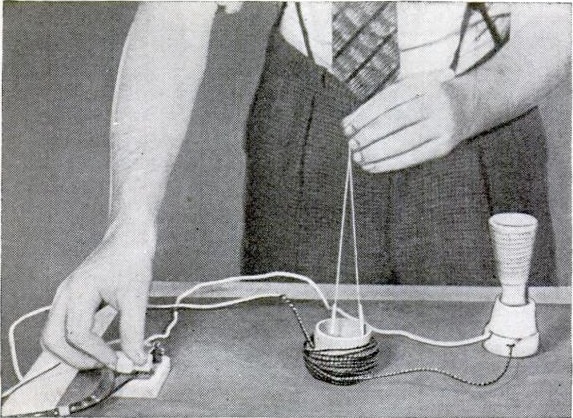
1944Aug30MilJour1944Aug30MilJour2On this day 75 years ago, the United States was at war, but the City of Milwaukee was at war against Polio. Because of an outbreak, all children under 12 years old were confined to their homes.

That didn’t stop these girls from socializing with their friends two doors down. Shown here are Rosemary O’Brien, 12, Peggy O’Brien, 9, and Florence Ann O’Brien, 12, of 5321 N. Diversey Blvd., Milwaukee. They have rigged up a pulley system to send notes to their friends at 5335 Diversey, Betty Ann Dundon, 12, Sherman Dundon, 9, and Monica Dundon, 11.

Meanwhile, Schuster’s Department Store offers to help with these toys, books, and records for kids who are quarantined.

Both images appeared in the Milwaukee Journal, August 30, 1944.


Hurricane Preparedness Links

With Hurricane Dorian bearing down on Florida, here are links to earlier posts on hurricane preparedness.


1939 3 Tube Portable

1939AugPS21939AugPS3This trio are enjoying a radio program out on the terrace thanks to a miniature portable receiver described in the August 1939 issue of Popular Science. The three-tube set drove a loudspeaker thanks to three miniature 1.5 volt British tubes, the XW for the two RF tubes, and the XY serving as audio amplifier. Even though the tubes were made in England, the magazine noted that they were available from the major U.S. suppliers.

The construction was quite compact, and the magazine cautioned that, as with most sets, success depending on the quality of the workmanship. An antenna of 25-40 feet was recommended, with a ground connection optional.

1939AugPSschematic


1939: No Car Too Old for Radio

1939AugRadioRetailingEighty years ago this month, the August 1939 issue of Radio Retailing offered this suggestion for marketing car radios. By this time, it was natural to have a new radio in a new car. But the creative dealer could create a market by selling new radios to put in old cars.

The demonstration shown here was put together by dealer Crest, Incorporated, in St. Louis. To show that no car is too old for a radio, they installed the latest 1940 pushbutton model in this 1909 Ford. “And out into both commercial and residential districts went the car, attracting crowds by the very contrast between its own ancient appearance and the ultra-modern styling and performance of its accessory.”

The car cost the dealer ten dollars per day, which included the driver, gas, and oil. The canvas sign cost another ten dollars.


Liberation of Paris

LiberationOfParis

Gen. de Gaulle and entourage set off from the Arc de Triomphe to Notre Dame. Wikipedia photo.

Today marks the 75th anniversary of the Liberation of Paris, August 25, 1944.

Wikipedia image. By Bureau of Printing and Engraving — U.S. Post Office – Arago: people, postage & the post online, National Postal Museum, Public Domain.


How To Cut A Cross With A Single Slice of the Scissors

1944AugPS

I’m sure that even an armchair theologian can come up with a suitable explanation, but if you’re looking for an interesting craft for your Sunday school class or children’s sermon, the one should fit the bill. This explanation of how to cut a cross with a single slice of the scissors appeared in Popular Science 75 years ago this month, August 1944. It works best if the paper you start with is about twice as long as it is wide.


Science Fair Ideas: Earth’s Magnetic Field

1944AugPScompassSeventy-five years ago this month, the August 1944 issue of Popular Science showed a number of simple science experiments relating to the Earth’s magnetic field. For students looking for a simple science fair experiment, these will prove most adequate. The two shown on this page answer the question, “does the Earth have a magnetic field?” It turns out that yes, yes it does.

Magnetizing the needle.

Magnetizing the needle.

The first experiment produces the compass shown above that is, as the magazine puts it, as good as the best that was known for centuries. All you need is a sewing needle, a magnet, a cork, and a cup or glass (non-metallic) of water. You magnetize the needle by stroking it over the south pole of the magnet, starting at the eye and ending at the point.

If you get that mixed up, it doesn’t really matter, as one end will point north, although it might not be the pointy end. Either way, you’ve proven that the Earth has a magnetic field.

1944AugPSironrodThe other experiment, shown at left, uses the Earth’s magnetic field to magnetize an iron rod. You hold it so that it’s pointing north, and to maximize the magnetic field, you angle it down toward the ground. Tap the upper end with a hammer, and the atoms will align with the magnetic field. You can test this by bringing an end near a compass, either the one you made yourself, or one you bought.

You probably have most of the supplies you need for these experiments around the house, or they are available locally.  The links above are to Amazon.  The links are affiliate links, meaning that this site receives a small commission if you order after clicking on them.


Villa on the Lake Ontario, 1944

1944Aug21LifeShown above, in the August 21, 1944, issue of Life Magazine, is Mrs. Eva Bass, a Paris nightclub singer who had lived in Milan before the war. Because she was a Swiss Jew, she was placed in a concentration camp, and later in “free confinement” in Potenza.

When the Allies arrived in Italy, she carried her children 60 kilometers through the lines, many days without food. They were placed in an Allied relief camp in Italy. She was one of a smaller group, chosen because they were virtually desitute without any means of support, to go to America. “They will remain at Fort Ontario, Oswego, N.Y., for the duration of the war as wards of the U.S. Sine they entered the U.S. outside the immigration quotas, they will have to leave when the war is over.”

After they were registered and their meager possessions cleared customs, they were assigned 1944Aug21Life3to army barracks where they would live for the duration of the war.

The family shown below is identified as the Albrecht family. The father was Jewish and the mother Catholic. The children are identified as Peter, 10, and Renata, 5. According to the magazine, he operated a theater in Vienna but fled to Italy in 1939, followed later by his wife and children.

As the photos and article make clear, the conditions were very austere, but one of the refugees “threw her arms around a government representative, saying, ‘this is more beautiful than anything in Europe.  Now I have a villa on the Lake Ontario.”

All of the residents remained interned until 1946.  According to Wikipedia, ” President Roosevelt made himself very clear that immigration laws were not going to be ignored. The refugees would merely be in the United States, not citizens of the United States. They would have no visa status. President Roosevelt also assured Congress that the Army would not permit any refugee escapes.”  In 1946, under President Truman, the decision was made to allow the refugees to become U.S. Citizens.

1944Aug21Life2