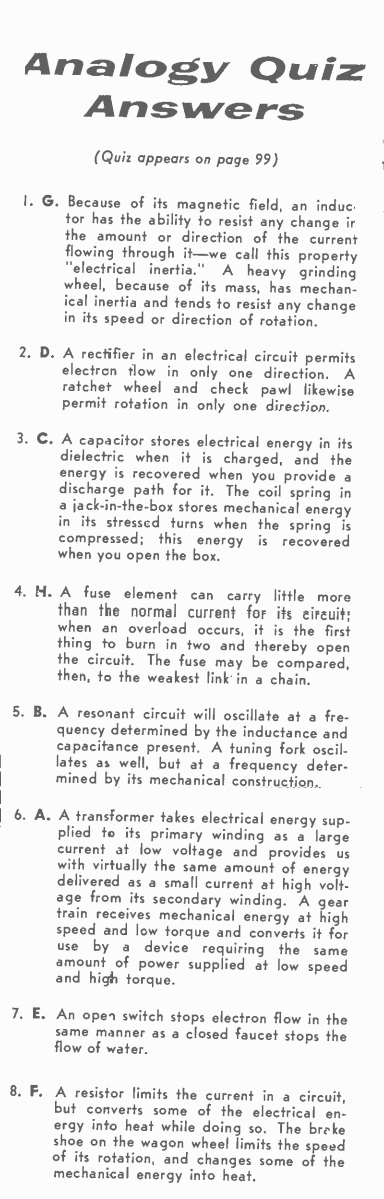
 As promised, here are the answers to yesterday’s quiz, from the August 1960 issue of Popular Electronics.

As promised, here are the answers to yesterday’s quiz, from the August 1960 issue of Popular Electronics.
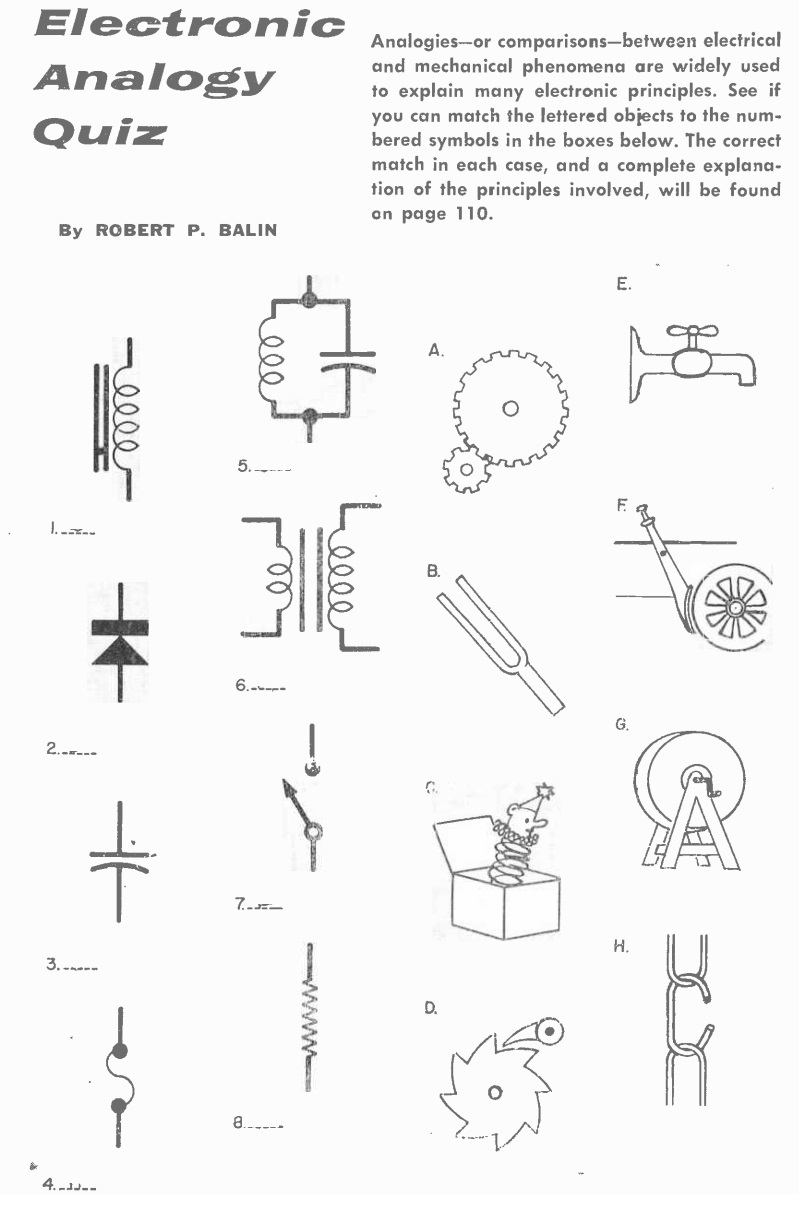 Today’s quiz first appeared sixty years ago this month in the August 1960 issue of Popular Electronics. We’ll post the answer tomorrow.
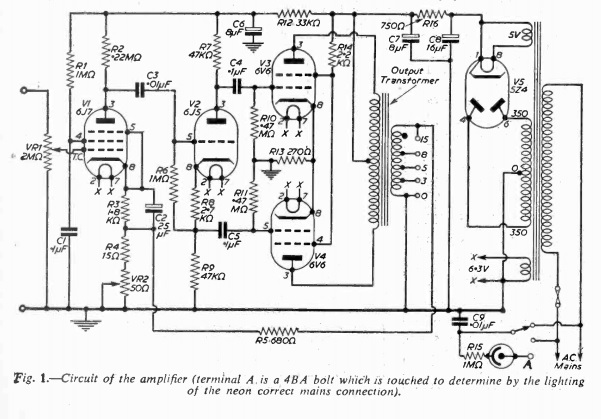
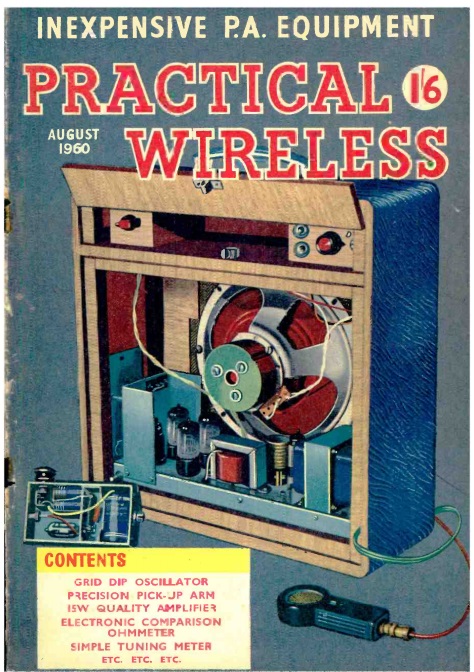 Sixty years ago this month, the August 1960 issue of the British Practical Wireless magazine carried the plans for this handsome five-tube public address amplifier. The guiding principles behind the design were reliability, portability, and economy. It put out 10-12 watts at modest cost and weight. The built-in speaker was said to provide for dance music in a medium size hall, and in the open air, with reliable speakers, speech would be intelligible about 500 yards.
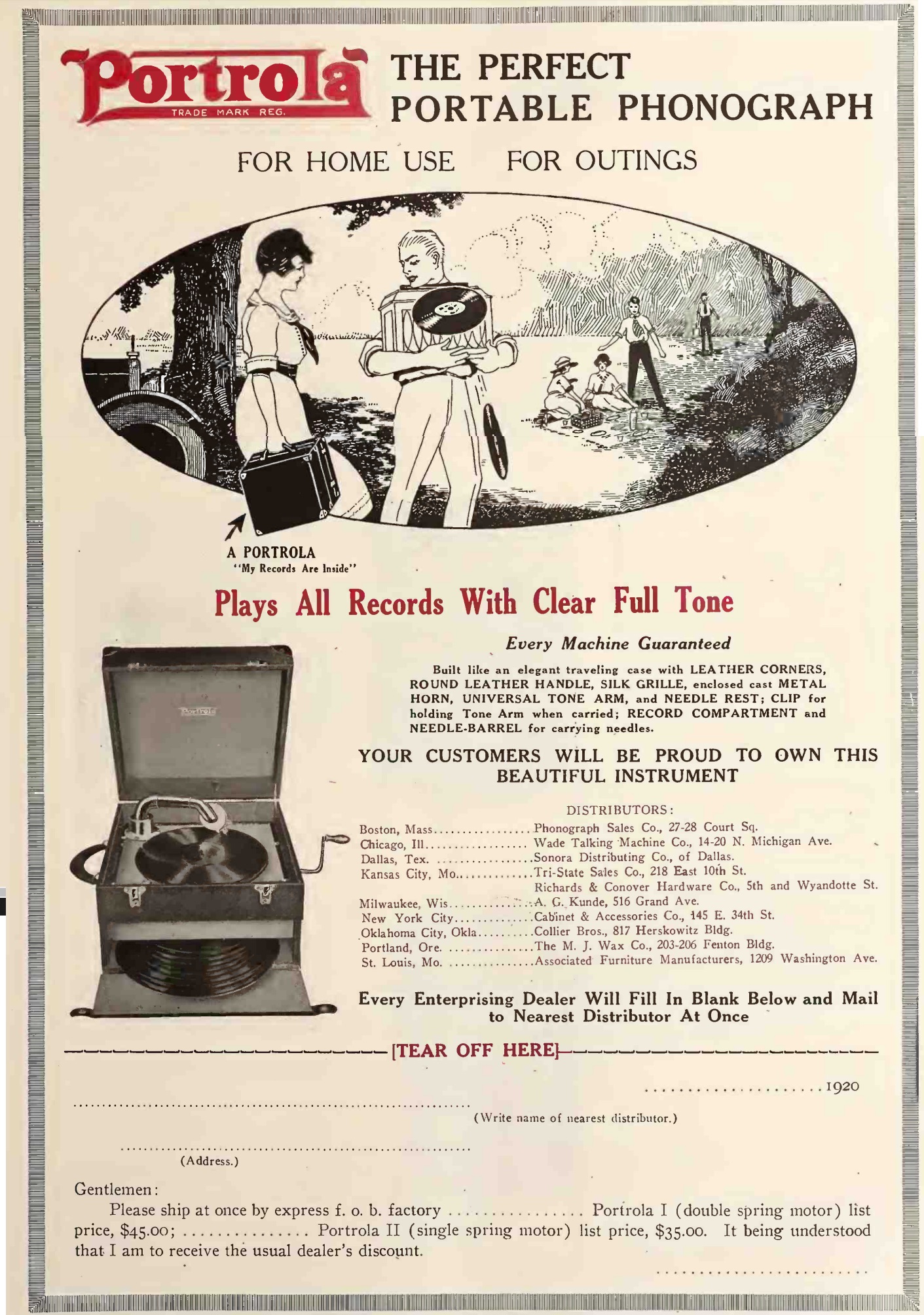 One hundred years ago, these two were tasked with bringing along the recorded music to their respective outdoor gatherings. The gentleman simply grabbed the phonograph from the parlour, along was as many records as he thought he could carry. As you can see, the results were anything but sastifactory.
The woman, however, was much more savvy, and brought along her Portrola Portable Phonograph. She undoubtedly used it at home, but it was also perfect for outings, particularly since the carrying case had a convenient compartment for holding the records. The instrument had a list price of $35 with a single spring motor or $45 for the double spring model.
The ad appeared a hundred years ago this month in the August 1920 issue of Talking Machine World.
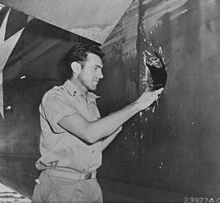
Louis Zamperini in 1943. Wikipedia photo.
Thankfully, nothing happened 75 years ago today, August 22, 1945. The war ended before the scheduled event could take place.
In 1944, the Japanese War Ministry issued orders to prison camp commandants for the “final disposition” of Allied prisoners of war. Under those orders, all POW’s were to be killed at such time as Allied forces landed in the territory in which they were being held. The rationale behind the order was to prevent the POW’s from being repatriated and becoming a part of the liberating force.
For example, on December 14, 1944, about 150 prisoners of war at Palawan in the Philippine Islands, were ordered to the air raid shelters, at first in apparent response to an actual air raid. But after the raid, because of a mistaken belief that an invasion of the island was underway, they were ordered to remain, at which time the wooden structure was doused with gasoline and set afire.
According to the book Unbroken

That book is the story of Louis Zamperini, a record-breaking track star of the 1930’s. Among his claims to fame was a personal meeting with Hitler at the 1936 Olympics. In 1943, his plane crashed in the Pacific and he drifted in a small raft for 47 days until his “rescue” by the Japanese. He remained a prisoner until the end of the war, enduring much torture. After the war, haunted by nightmares of his experience, he drifted into alcoholism until attending a Billy Graham crusade in California.
Because of the Japanese decision to surrender, motivated at least in part by the bombings of Hiroshima and Nagasaki, the orders to execute Zamperini and other prisoners in Japan were never carried out.
References
Read More At Amazon
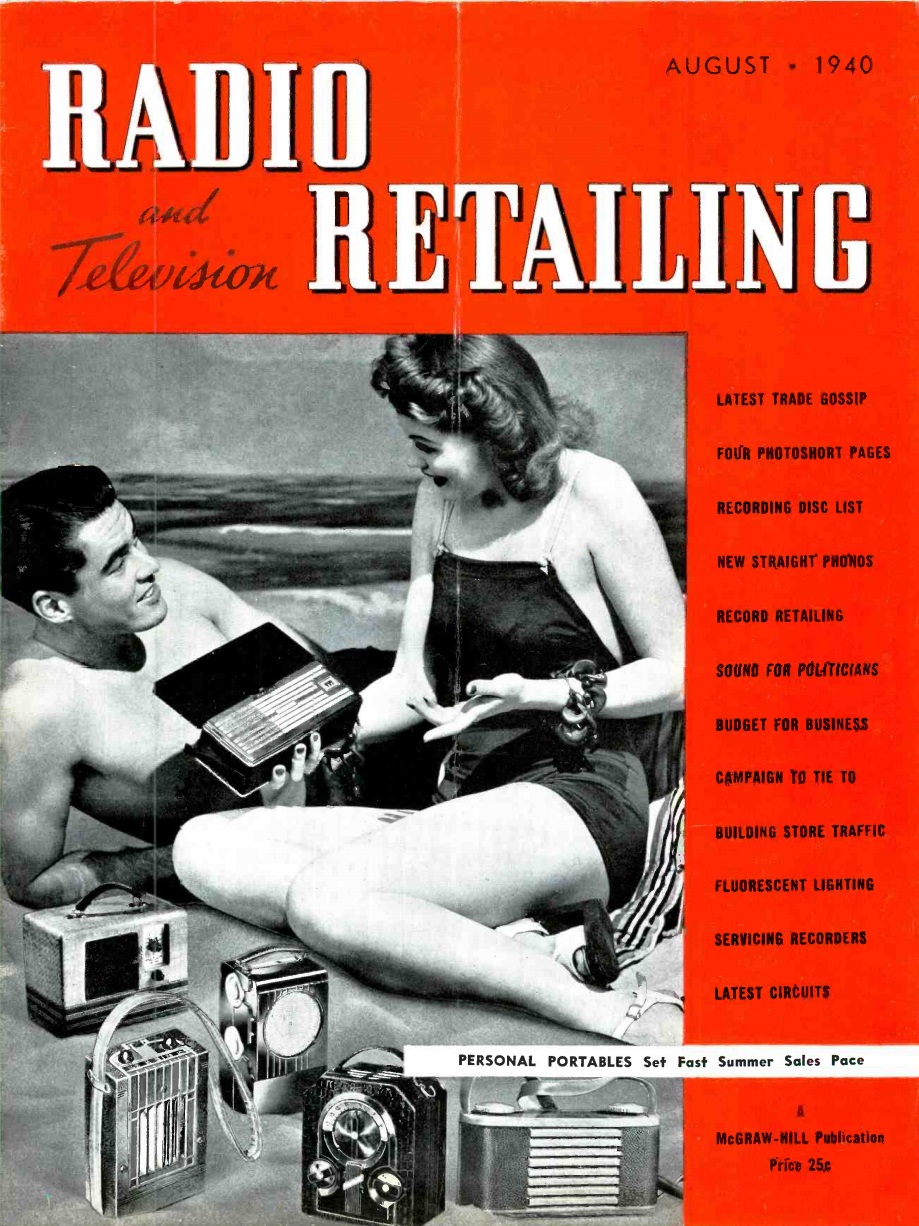 Eighty years ago, this couple couldn’t decide which portable set they were going to take to the beach, so they decided to take them all. The sets shown originated with RCA Victor, Automatic, Emerson, Sonora, Majestic, and Philco. The picture appeared on the cover of the August 1940 issue of Radio Retailing.
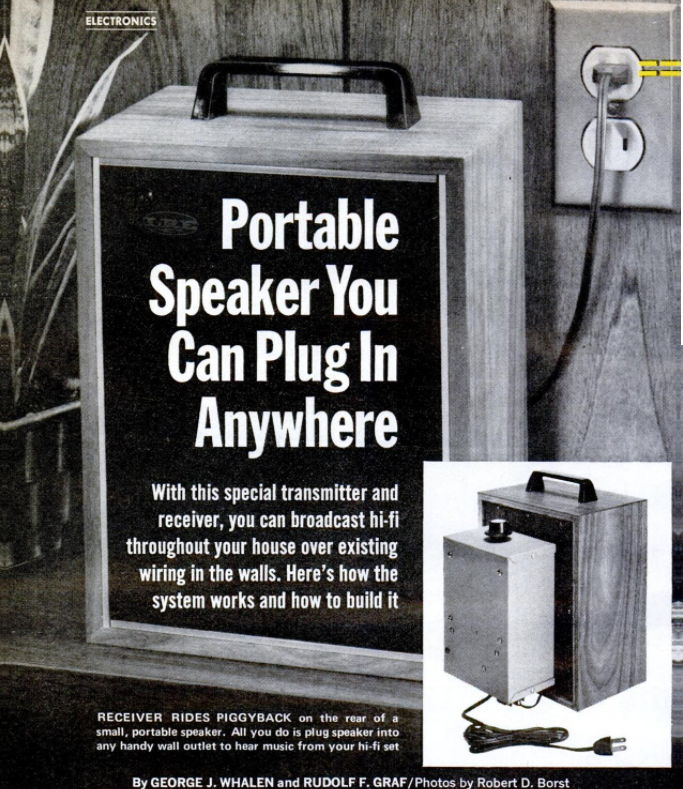 Fifty years ago this month, the August 1970 issue of Popular Mechanics showed how to put together this somewhat ambitious project, a remote carrier-current speaker for your hi fi. A one-transistor transmitter was hooked to the output of your amplifier, and the receiver could be plugged in to any outlet in the house to listen remotely. The project also gave you an easy method of having an outdoor speaker, as long as you had an outdoor outlet. If desired, you could construct additional receivers for use in other rooms, all tuned in to the same transmitter. The speakers were equipped with individual volume controls.
To simplify the project, the receiver used a pre-wired audio amplifier available from Lafayette Electronics. The electronics all mounted in a small box that could be affixed to the back of the speaker.
Both transmitter and receiver used a standard 455 kHz IF transformer for their tuned circuit. These were tweaked to get them down to about 400 kHz, the frequency used by the system. That signal was transmitted through the power wiring. This “antenna” was coupled to the circuit on both ends through capacitors.
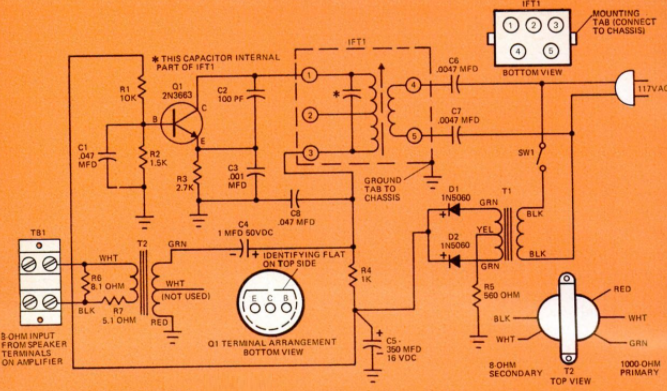
Transmitter schematic.
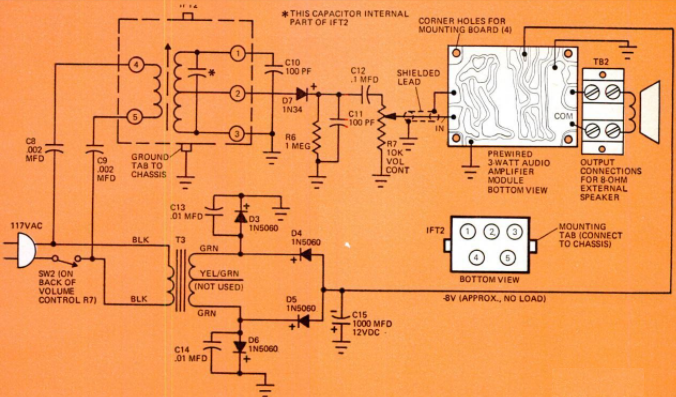
Receiver schematic.
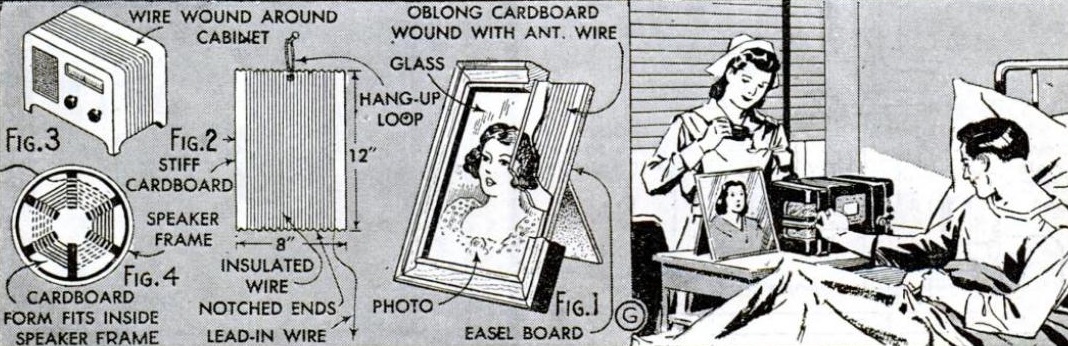 I was a little unclear on the concept when I first saw this illustration in the August 1945 issue of Popular Mechanics, and I suspect that whoever wrote the caption might have been similarly confused.
The caption is “emergency antenna for individual hospital patients,” and is then followed by some details for each of the illustrations. I believe that what they really mean to say was that these were four different ideas for emergency antennas.
I guess I was confused because of the picture on the left. It appears that these wires are to be attached to the antenna terminal of the radio. I was confused because a similar idea, wrapping the radio with wire, can be used to connect an antenna to an external antenna, even though the set doesn’t have an antenna connection. The loop of wire couples inductively to the internal antenna coil. But in this case, the coil of wire apparently is the antenna.
Figure 2 is simply a loop of wire wound around a piece of cardboard and, again, hooked to the radio’s antenna connection. Figure 1 is the same antenna, but cleverly concealed behind a photograph. Figure 4 looks like a lot of work, since it consists of a spider web coil hidden inside the speaker.
It seems to me that a more suitable solution would be to toss a length of wire out the window when the nurse wasn’t looking, although she seems to be very watchful.
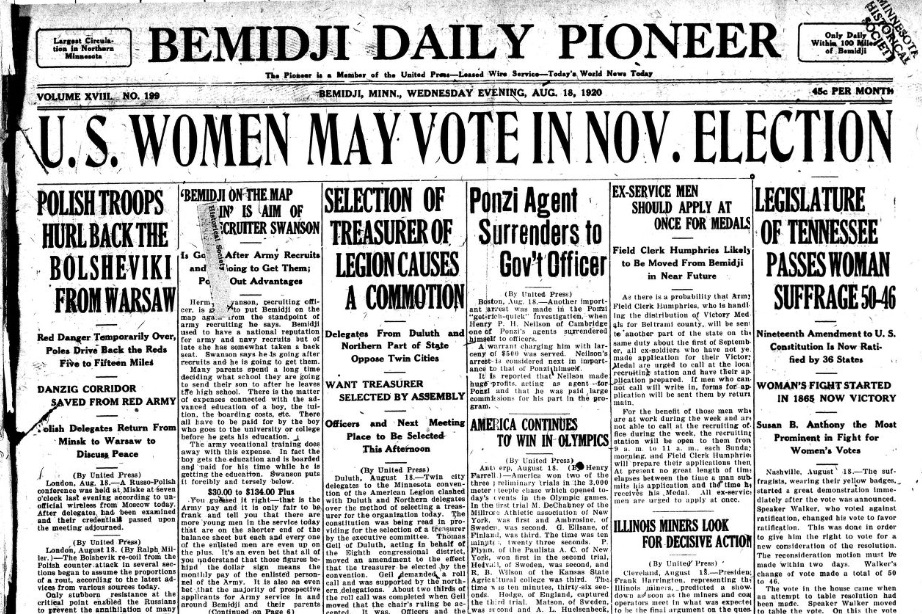
One hundred years ago today, August 18, 1920, American women got the right to vote, with the ratification of the 19th Amendment to the U.S. Constitution. Tennessee was the 36th of the 48 states to ratify the amendment, and as the headline here notes, it happened in time for the 1920 presidential election.
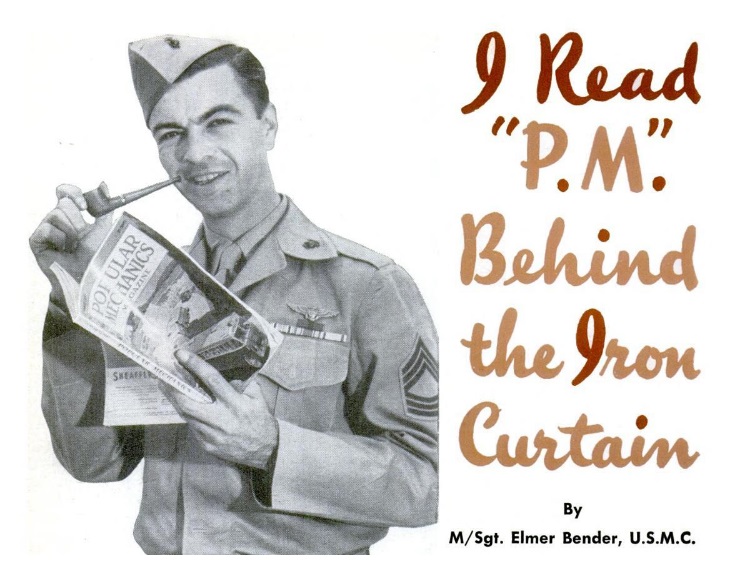
 Our readers enjoy perusing old issues of Popular Mechanics and other magazines, so we understand the excitement of U.S. Marine M/Sgt. Elmer C. Bender in finding the magazine’s August 1947 issue. The flyer, stationed at Tsingtao, China, took off the morning of October 1948 to get in some hours in a training flight.
Due to a faulty fuel gauge, he and Navy Electrician’s Mate William C. Smith were forced to land on a beach only 15 miles from their base, where they were quickly surrounded by Chinese Communists who surmised that they were spies. They were held for over a year until their eventual release.
The two men reported that they weren’t mistreated, but were taken from village to village. Their main problem was boredom, but the Lieutenant charged with their custody would occasionally bring English reading material. The highlight of their stay was when he showed up with the magazine, which both men devoured. Bender reports, in the magazine’s August 1950 issue, that he was especially interested in the issue’s feature on how to solder. When the men were eventually released, the Communist Lieutenant, noting their enthusiasm for the magazine, asked them to send him some more copies upon their return to the U.S.
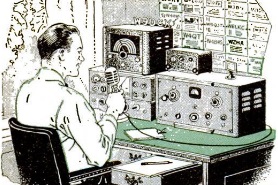 While there’s no evidence that either man became a ham, it’s likely that they passed many hours reading about the 5-band AM-CW transmitter shown here. When their families got an FM radio, they probably both instinctively knew the trick of placing a folded dipole antenna under a carpet, as shown in the magazine.