A hundred years ago today, the December 3, 1921 issue of the Washington Evening Star carried this ad for Radio Receiving and Transmitting Apparatus, “an ideal Xmas gift.” Receiving sets started at $7.50, which works out to about $116 in 2021 dollars, according to this online inflation calculator.
The ad was for White & Boyer, 812 13th St. NW, Washington. Like many early radio retailers, the company was also a radio station, transmitting music on Tuesday and Friday evenings from 7:30 to 9:45 PM. Shortly after this ad appeared, the station’s call sign changed from 3NR to WJH.
Eighty years ago, this young woman is pulling in a favorite program with this camera-style portable radio. The brand is not stated, but it has five tubes, including the rectifier, and can operate either from battery or, as she is using it here, standard household current. It had the option of use with a separate window antenna to increase the sensitivity. It was finished with gray plastic, with a dark blue covering of simulated leather.
A few days after this picture appeared in the December 1941 issue of Popular Science, she was probably using the same set in a more somber mood to pull in the latest bulletins from Pearl Harbor.
These days, there’s really no excuse not to have a multitester. Even if you only rarely dabble with electronics, every household should have one, as it will tell you things such as whether your outlet voltage is OK or if an outlet is dead. You can check batteries. (Even if a voltmeter doesn’t have a specific battery testing option, if you just check the voltage, you can tell if a battery is completely dead. And if it shows more than 1.5 volts, you can be pretty sure that the battery is good.) In the car, you can diagnose many problems simply by seeing whether 12 volts appears at a certain spot. And they are cheap. The digital model shown below (whose price includes free shipping) rivals a fine laboratory instrument 70 years ago:
I am old school, and I prefer an analog meter movement, which is also available at a very reasonable price for a basic model, such as this one, which you can also get with free shipping on Amazon:
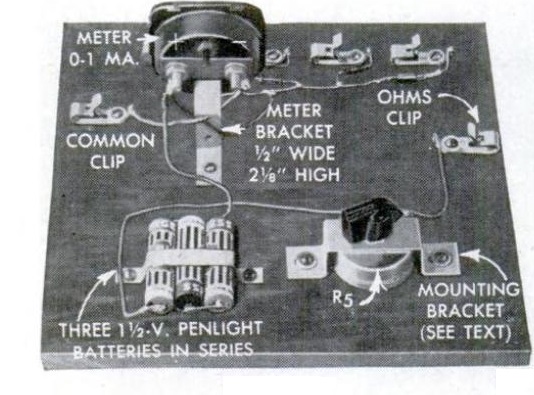
But it hasn’t always been this way, and 70 years ago, the December 1951 issue of Popular Mechanics pointed out that many beginning radio experimenters were temporarily handicapped by the inability to make measurements, since expensive test instruments were required. But fortunately, the magazine solved that problem by showing how to build test equipment, such as the volt-ohm meter shown above. An analog meter movement, a few resistors, a battery, and a few Fahnestock clips were all that were needed to make a fully functional meter suitable for most ordinary radio work. The magazine showed a similar design for a meter for AC voltage or checking capacitors. That meter also included a bridge rectifier, as well as a filament transformer for powering the capacitance meter.
The meter movement sold for $3.16, and was the most expensive component required.
Keep an eye open for coupons from the usual discount houses (the places with names such as Harbor Tool and Northern Freight). They often have the digital meters for free or practically free as a loss leader. If you need pointers on using your new meter, this classic book from Radio Shack is available on Amazon, and used copies are available at a reasonable price:
Some links on this site are affiliate links, meaning this site earns a small commission if you click on the link and make a purchase.
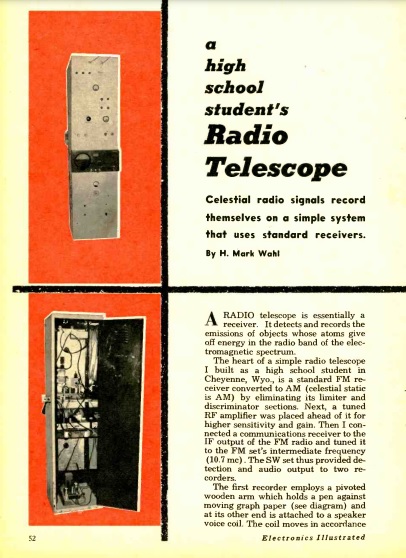
Sixty years ago this month, the November 1961 issue of Electronics Illustrated featured this radio telescope constructed by high school student H. Mark Wahl of Cheyenne, Wyoming. The rack containing the electronics was a school locker. The door of the locker was removed to form the door, and the equipment was mounted facing what used to be the back.
The equipment consisted of a standard FM broadcast receiver which had been converted to AM by eliminating the limiter and discriminator. A tuned RF amplifier, apparently for 108 MHz, was added to beef up the sensitivity. The IF output was connected to what looks like a Hallicrafters S-30B tuned to 10.7 MHz. This fed two recorders, one connected to the voice coil of the receiver’s speaker, and the other one connected to the S-meter. The recording of the audio output was accomplished with a pivoted wooden arm. The other end held a pen which recorded on a strip of paper driven by a motor.
The recorder hooked to the meter consisted of a straw from a broom, which recorded a trace on a soot-covered cylinder turned by a wind-up alarm clock, creating a 12 hour record.
The antenna consisted of two folded dipole antennas, probably made out of TV twin lead, mounted horizontally and parallel to each other, about a hundred feet apart. With identical lengths of feed line, the signals would arrive in phase, and be identical. The antenna pattern would have a number of lobes, one of which was straight up. However, if an additional half wavelength of feedline was added to one side, the two signals would arrive out of phase. The pattern would be similar, but the signal from straight up would be nulled out. By using the difference of these two signals, the interferometer was able to null out everything but the signal from straight up. Thus, any terrestrial interference would be eliminated, and the antenna would see only the cosmic noise coming in from directly overhead.
While we think of most radio astronomy taking place at higher frequencies, there’s no reason why frequencies just above the FM broadcast band can’t be used. For example, this 2014 experiment used 38 European radio telescopes to detect radio signals from a distant galaxy on 115 MHz. Those 38 dish antennas probably provided a better signal than two folded dipoles a hundred feet apart, but they used the same principles to combine the signals.
Unfortunately, the article doesn’t give too many practical details on the construction of the set. And other than the author’s assertion that it was “relatively simple, but it works,” there’s little detail on what observations he made.
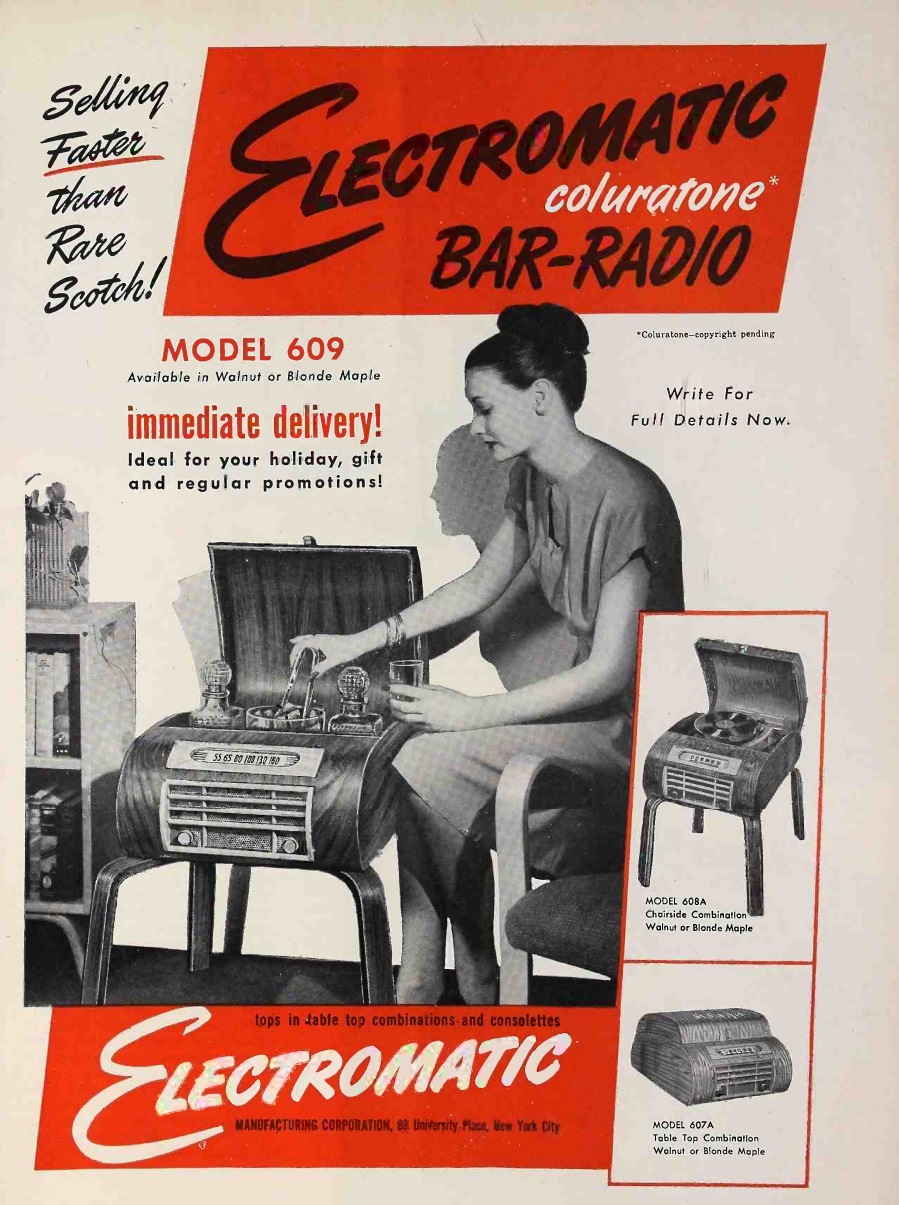
Seventy-five years ago this month, the November 1946 issue of Radio Retailing
carried this ad for the Electromatic model 609 Bar Radio. As you can see, the company sold the same style of radio-phonograph as either a chairside or tabletop model. It looks like they did a run without the phonograph, but there was a void under the lid where the phonograph was supposed to go. Who needs to listen to records if they have booze, so the logical thing to do with that spot was to turn it into a bar. The company reported that the model was selling faster than rare scotch.
You would want to be careful not to spill into the radio, although I suppose if the contents were high enough proof, they would do little other than give the chassis a good cleaning.
I’ve found references to the Model 608A and 607A, but haven’t found any evidence that any of the Model 609 Radio-Bars ever made it into production.
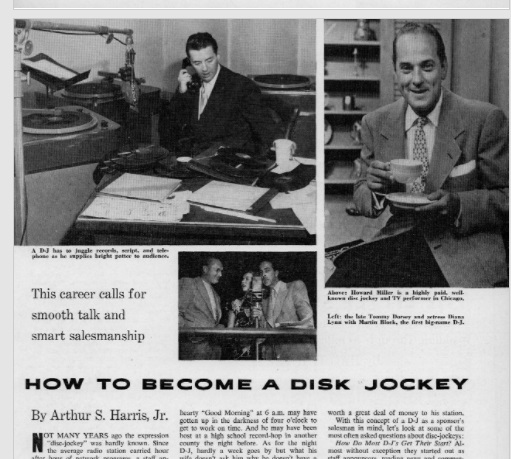
Sixty years ago this month, the November 1961 issue of Boys’ Life carried this article about what was probably the dream job of many a young man–a radio station DJ. The job meant odd hours and working weekends and holidays, but it was still a sought after position, and stations were hiring.
The author, DJ Arthur S. Harris, Jr., noted that in earlier years, the local station typically just carried network programs, with the staff announcer earning his pay merely by giving station ID. But programming was becoming local more and more, and the position of announcer often became that of DJ, spinning the records.
A few DJ’s in big cities could get salaries of over $25,000 per year, but starting pay was about $65 to $70 per week, which could probably grow to $150 a week.
To get started, the main advice was to practice. A tape recorder was an indispensible tool to record examples off the air to study, and to make practice tapes. Finally, audition tapes could be sent to radio stations. Schools and libraries might have a recorder that could be used, or a second-hand recorder could be had for about $50.
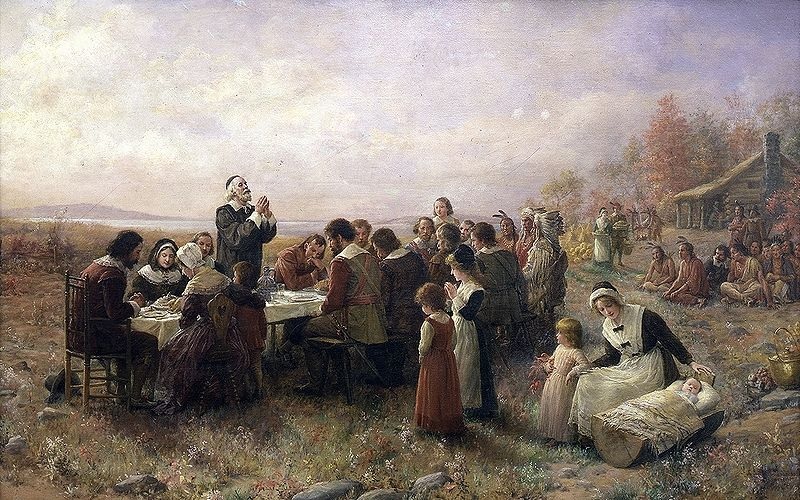
“The First Thanksgiving at Plymouth” (1914) By Jennie A. Brownscombe. Wikipedia image.
Thanksgiving this year celebrates the 400th anniversary of Thanksgiving in North America. I’m somewhat appalled that nobody seems to have mentioned that the first Thanksgiving took place in 1621, 400 years ago. Clearly, it didn’t happen on the same day in November that we now commemorate. And clearly, it didn’t look much like the celebration that most of us learned about in grade school. But we did learn about it in grade school, it was a big deal, and this is the quadricentennial.
Last year was a horrible year, and for the Pilgrims of the Plymouth Colony, 1620 was also a horrible year. Forty-five of the 102 passengers from the Mayflower died in the winter of 1620-21. But at the end of the following year, there was much for which they could give thanks. The harvest of 1621 was bountiful. There was peace in the land, thanks largely to a forgotten hero of American history, Squanto, an English-speaking Native American man who providentially appeared to the colonists to broker peace and teach survival.
I suppose the reason nobody talks about this anniversary is because of the way Native Americans have been treated over the following centuries. Clearly, much of that history is shameful. But the first Thanksgiving was not a part of that shameful history. The version we learned in grade school isn’t accurate in many of its details, but it is right about one thing: The colonists and the Native Americans they encountered lived in harmony. Rather than sweep this history under the rug, I think this is exactly the kind of history we should celebrate and learn from. We shouldn’t ignore people who did the right thing 400 years ago just because other people later did the wrong thing.
Here is the account of the first Thanksgiving, written by Governor William Bradford (you can find it reprinted in this 1841 text at pages 231-33)
Our harvest being gotten in, our governor sent four men on fowling, that so we might, after a special manner, rejoice together after we had gathered the fruit of our labors. They four in one day killed as much fowl as, with a little help beside, served the company almost a week. At which time, amongst other recreations, we exercised our arms, many of the Indians coming amongst us, and among the rest their greatest king, Massasoyt, with some ninety men, whom for three days we entertained and feasted; and they went out and killed five deer, which they brought to the plantation, and bestowed on our governor, and upon the captain and others. And although it be not always so plentiful as it was at this time with us, yet by the goodness of God we are so far from want, that we often wish you partakers of our plenty.
We have found the Indians very faithful in their covenant of peace with us, very loving, and ready to pleasure us. We often go to them, and they come to us. Some of us have been fifty miles by land in the country with them, the occasions and relations whereof you shall understand by our general and more full declaration of such things as are worth the noting. Yea, it hath pleased God so to possess the Indians with a fear of us and love unto us, that not only the greatest king amongst them, called Massasoyt, but also all the princes and peoples round about us, have either made suit unto us, or been glad of any occasion to make peace with us; so that seven of them at once have sent their messengers to us to that end. Yea, an isle at sea, which we never saw, hath also, together with the former, yielded willingly to be under the protection and subject to our sovereign lord King James. So that there is now great peace amongst the Indians themselves, which was not formerly, neither would have been but for us ; and we, for our parts, walk as peaceably and safely in the wood as in the highways in England. We entertain them familiarly in our houses, and they as friendly bestowing their venison on us. They are a people without any religion or knowledge of any God, yet very trusty, quick of apprehension, ripe-witted, just. The men and women go naked, only a skin about their middles.
I encourage you to watch this short video from PBS The American Experience. This is an anniversary we ought to celebrate:
If Junior wants to perform a somewhat contrarian and controversial science fair experiment, he or she can perform an experiment to answer the following question:
The science teacher won’t be able to react immediately, because he or she probably doesn’t know what “obliquity of the ecliptic” is. But after they consult Wikipedia, they’ll understand the concept, and they might have to grudgingly concede that there’s something to it. “Obliquity of the ecliptic” is just a fancy term for the angle at which Earth’s axis of rotation is tilted. Today, it’s about 23.4 degrees. But 8000 years ago, it was 24.2 degrees, and it’s been going down ever since.
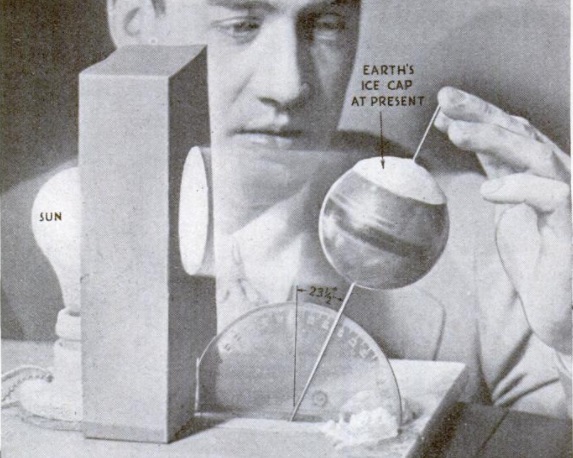
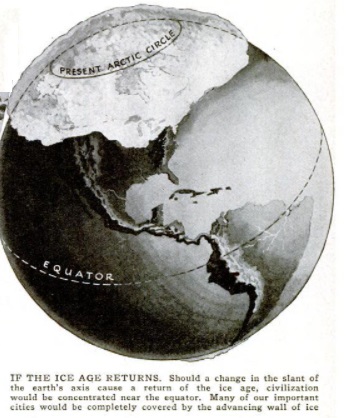
With this experiment from 85 years ago, Junior will be able to demonstrate that as the tilt decreases, the ice pack at the poles will increase. In the illustration above, the Earth is covered with “ice” to about the same extent that it is today–it’s north of the Arctic Circle. But if the tilt is increased, the extent of the ice pack covers much more of the hemisphere, as shown at left.
The experiment to demonstrate this appeared in Popular Science 85 years ago this month, November 1936. The Earth is represented by a rubber ball. A hole is drilled through the center and a knitting needle is inserted, to serve as the axis. The earth is then dipped in melted paraffin wax and covered to a depth of about 1/16 inch, representing ice. A high-wattage light bulb serves as the sun, and the ball is mounted as shown and rotated. After about a half hour, a layer of wax covers the area north of the Arctic Circle. The remaining wax drips off onto the mounting board. In the real world, this melted ice would enter the oceans.
The experiment is then repeated with a larger angle, and the “ice” covers much of the hemisphere. Junior has demonstrated that the extent of arctic ice increases as the obliquity of the ecliptic increases, and decreases as the obliquity of the ecliptic decreases. Since the obliquity of the ecliptic is currently decreasing, it stands to reason that this is a cause of the arctic ice decreasing. And if the teacher believes that some other cause is at work, then he or she can come up with an experiment. Junior can remind the teacher that this is how science works.
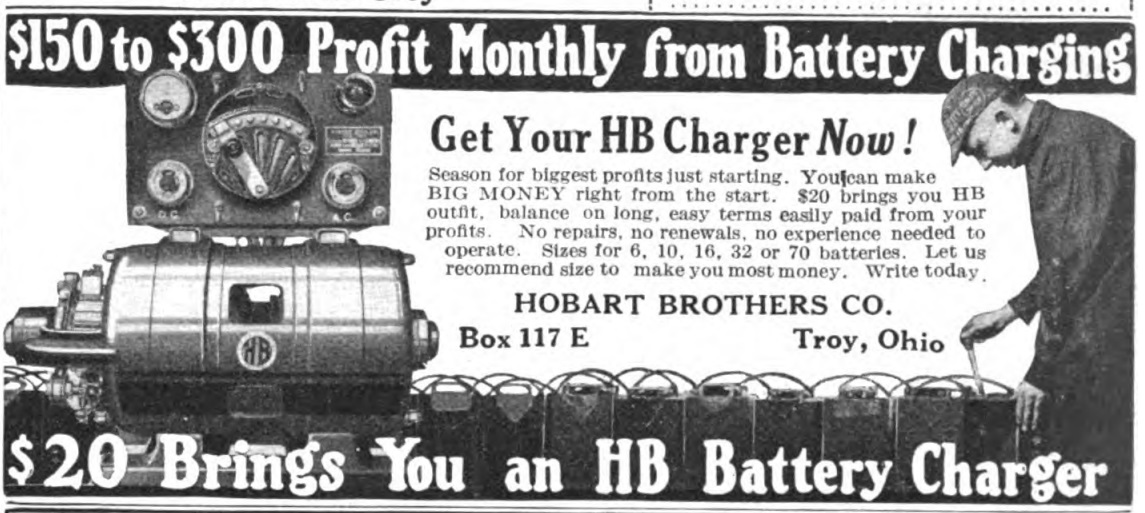
A century ago, there was big money to be made in charging batteries, and this ad in the November 1921 issue of Science & Invention told you how to get started. For just $20 down, you could purchase from Hobart Brothers Co. of Troy, Ohio, a battery charger.
The company would recommend the size of charger, from 6 to 70 batteries, to make the most money, and you could get started right away. The profits would allow you to pay the easy terms for the balance of the equipment’s price.
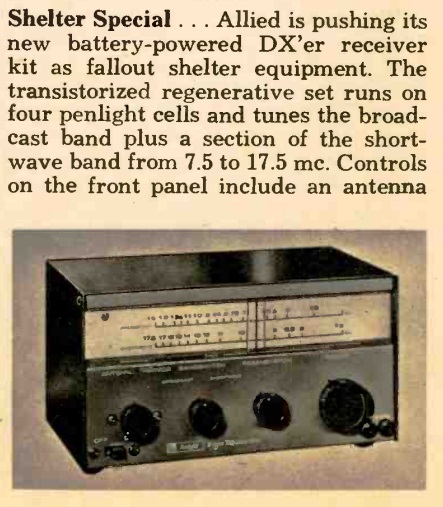
The May 1962 issue of Electronics Illustrated showed this smart-looking regenerative receiver kit from Allied, the Knight Kit “DX’er”, a three-transistor regenerative receiver for the broadcast band and one shortwave band. It operated with four penlight cells, and Allied touted the receiver as ideal for the fallout shelter.
It does seem like an ideal choice. The set undoubtedly had a low current drain, and with a few extra sets of batteries stored away, it would probably be a good source of information for the duration of the stay. The standard broadcast band could be used to pull in the local CONELRAD station, and the shortwaves would probably give some indication of what was going on in the outside world.
According to the magazine, the kit sold for $19.95, but in the 1963 Allied catalog, the price had been reduced to $14.95.

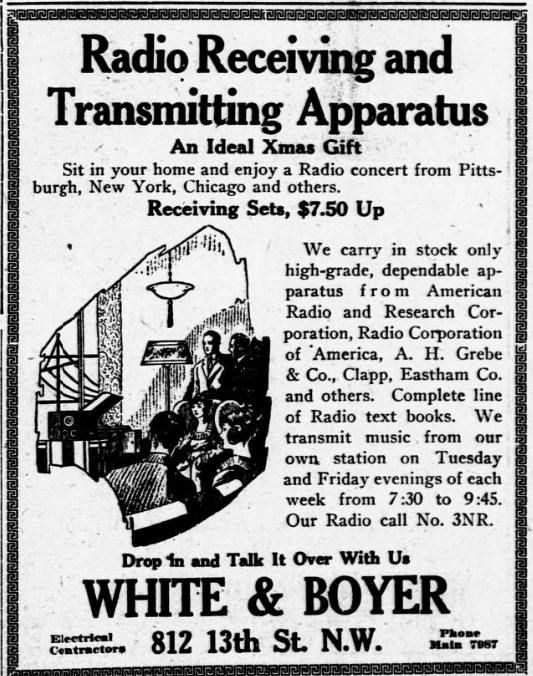 A hundred years ago today, the December 3, 1921 issue of the Washington Evening Star carried this ad for Radio Receiving and Transmitting Apparatus, “an ideal Xmas gift.” Receiving sets started at $7.50, which works out to about $116 in 2021 dollars, according to this online inflation calculator.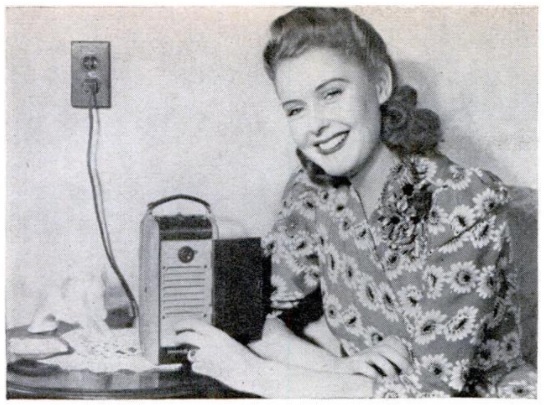

 The recorder hooked to the meter consisted of a straw from a broom, which recorded a trace on a soot-covered cylinder turned by a