Category Archives: Scouting

1955 Boys’ Life Radio Contest

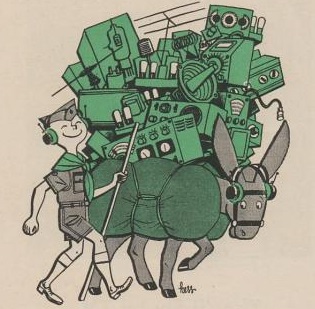
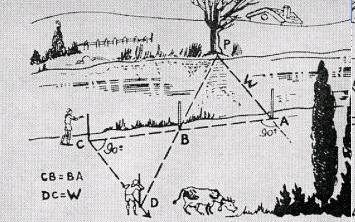
Pedro delivering prizes to lucky winners in BL radio contest.  June 1955 Boys' Life.

Pedro delivering prizes to lucky winners in BL radio contest. June 1955 Boys’ Life.

60 years ago this month, Boy Scouts were busy trying to win valuable prizes, including a Hammarlund HQ-140-X receiver, a Hallicrafters S-85 receiver, or a National NC-88 receiver. Unlike prior years, licensed amateurs were not eligible for prizes (probably because they swept them earlier years). But these prizes were available for logging as many stations as possible. Each station counted for one point, each country and U.S. call area 10 points, each state 10 points, and each continent 50 points. There were also bonus points for logging all continents, all states, and all call areas.

There were two classes of entries: one for commercial or surplus receivers, and one for homemade receivers. The contest was in effect during the month of February, 1955. The full rules were contained in that month’s issue of Boys’ Life.

The winners were announced in the June issue.  In “Class A” (manufactured receivers), the HQ-140X went to Ralph Overton of Mechanicsville, NY. Norb Harnegie of Berea, Ohio won the S-86.Henry Weir of Charleston, West Virginia, John Bryant of Stillwater, Oklahoma, John Tull of Kansas City, Missouri, and Francis Jacobs of Anson, Maine, won either a Hallicrafters S-38D or a National SW-54.

In “Class B” (homemade receiver), the winner of the Hammarlund was Gary Dobbs of Arlington, California, and Jay Hall of Maplewood, New Jersey took the second place prize of a National NC-88. Winning either an S-38D or SW-54 were Walter Piper of Ravenna, Ohio, Paul Stein of Uvalde, Texas, Don Cannon of Lubbock, Texas, Howard Ferber of Brooklyn, New York, and Bob Samson of Chicago, Illinois.

Over 200 other prizes were awarded to some of the 1049 entrants.


Unlike earlier contests, licensed hams were not eligible for prizes in this run of the contest.  However, at least two of the winners went on to become licensed hams.  As explained on my website, only a few call books are available for online searching, and the first one after this contest is from 1972, sixteen years later.  There might have been more, since some had common names, and some might have moved to different call areas.  But Norb Harnegie of Berea, Ohio, who won the S-86. was licensed in 1972 as W8FCV.    And Francis Jacobs of Anson, Maine, was licensed in 1972 as W1EST.

It would be interesting to know how these rather generous prizes affected the winners.  If you Googled your name and found this page, I would love to hear from you in order to write a follow-up.  You can reach me at clem.law@usa.net, or leave a comment below.

Click Here For Today’s Ripley’s Believe It Or Not Cartoon


A Scout is Kind: George Salak, Racine, WI

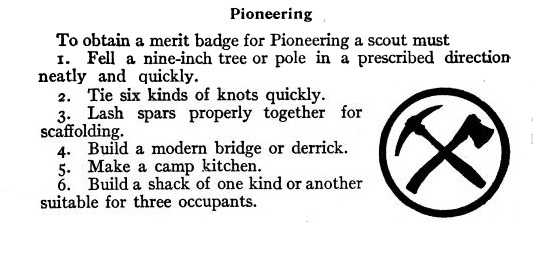
PioneeringRequirements for various Boy Scout merit badges change over the years.  Pioneering merit badge is still current, but the requirements have changed since the original ones, shown here from the original 1913 Scout Handbook.  The current requirements can be found at meritbadge.org.

For 16-year old Scout George Salak of Racine, Wisconsin, the first requirement rubbed him the wrong way.  It didn’t feel right cutting down a live tree just to earn a merit badge.  Therefore, he sent the following letter to the editor of Boys’ Life, which appeared in the January 1915 issue:

Being a First-Class Scout my chief desire has been to become the first Eagle Scout in this city. So far I have managed to pass satisfactorily nineteen Merit Badges and have entered upon Pioneering which I have completed with the exception of the first question, which requires a Scout to fell in a prescribed direction a 9-inch tree.

I am writing you with the purpose of finding out whether the felling of such a tree is not a direct violation of our Scout Law number six, also if it would not be just as sufficient to demonstrate what cut to take or write a statement on how to fell a tree. As far as I am informed there are approximately 500,000 Scouts in the United States. Can you imagine what a tremendous destruction of trees would result if each of these boys were possessed with a desire to fell one tree apiece? In all my years of service, this being the sixth, I have always been opposed to the wilful destruction of trees. Kindly inform me what course to pursue.

Thanking you for giving this matter your prompt attention, I remain,

–George Salak, Racine, Wis.

The editor responded:

For the benefit of other Scouts who may be puzzled with the same problem, it is announced that the Committee on Badges Awards have already had this matter under consideration and the test as now required omits this item.

Mr. Salak went on to become an Eagle in May 1915, probably the first in Racine.  That accomplishment is recorded in the July 1915 issue of Boys’ Life.

George Salak, 1930 photo.

George Salak, 1930 photo.

The following year, he became a postal clerk and served in that capacity for two years.  During the First World War, he  served in France as a member of Battery C, 121st Field Artillery, when that unit of the Wisconsin National Guard was called to federal service.  After the war, in 1919, along with his brother Charles he formed the Salak Music Company.  In 1922, the company moved to a larger location at 306 Fifth Street, a location currently housing a storefront church.   He died in 1937 at the age of 38.

Click Here For Today’s Ripley’s Believe It Or Not Cartoon



National Radio School, 1915, Forerunner of the “CONAR Twins”

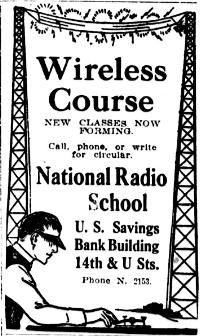
NatlRadioSchool1915This small ad for the National Radio School appeared a hundred years ago today, in the Washington Times, January 24, 1915.  The ad announces the upcoming wireless course.  This school had recently been formed, and went on to have a long history.  If you were involved in radio or electronics over the next several decades, you probably heard of them.

At some point, the name changed to the National Radio Institute.  It was founded in Washington in 1914 by James E. Smith, who headed up the school until 1968, when it was purchased by McGraw-Hill.  Smith continued as the school’s chairman until his death in 1973.  McGraw-Hill began to phase out the school in 1999, and it ceased operations in 2002.

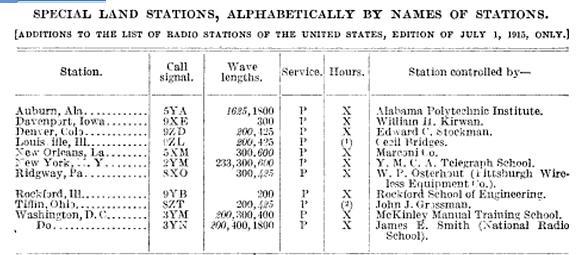
1915 and 1921 call books show the call 3YN assigned to Smith and to the school.  This 1915 listing shows the school’s station as licensed to operate on 200, 400, and 1800 meters:

19153YNcallbook


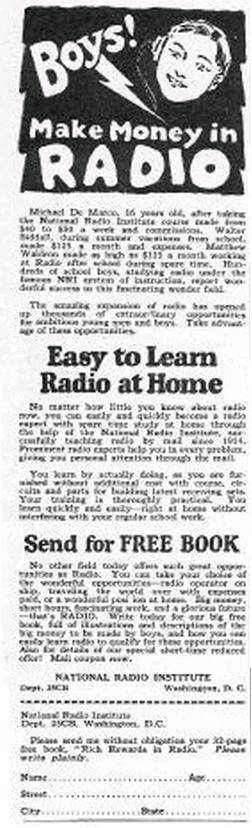
NRIBLad1925Over the years, the school advertised extensively, and virtually any magazine relating to radio or electronics for several decades contained an ad for NRI.  The ad shown here is from Boys’ Life magazine, January 1925, and offered boys the promise of making money in radio.

If the name NRI only vaguely rings a bell, then the name CONAR will probably sound more familiar.  The school sold a wide variety of electronic kits (and some assembled products) under that name.  The CONAR name was never as famous as Heathkit, but it had almost as wide a variety of products.  You can view the 1966 catalog at this link at americanradiohistory.com.

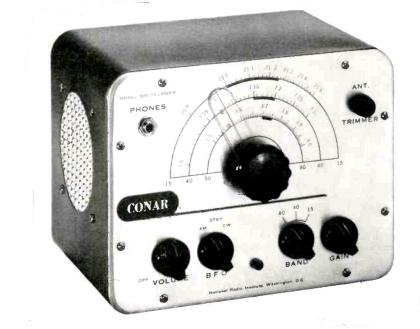
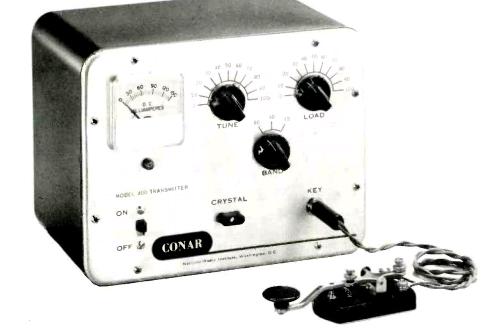
Among hams, one of the most famous (or perhaps infamous) of these products was the “CONAR Twins,” a transmitter and receiver designed for the novice ham.  These radios were available in kit form (along with a copy of the ARRL license manual and a key) for $64.  They were also available assembled.  The transmitter used a single tube, a 6DQ6, which put out 15 chirpy watts on 80, 40, and 15.  The receiver, while basic, was actually fairly good.  It was a four-tube superheterodyne covering the same bands.  The two units were available separately as well, with the transmitter selling for $32.50 in kit form, and the receiver for $37.50.  One way the costs were kept down was the use of the same cabinet as most of CONAR’s test equipment.  KB8TAD’s site shows a nice example of the sets in excellent condition.  The images from the 1966 catalog are shown below.

ConarRCVRConarXMTR


References

Click Here For Today’s Ripley’s Believe It Or Not Cartoon
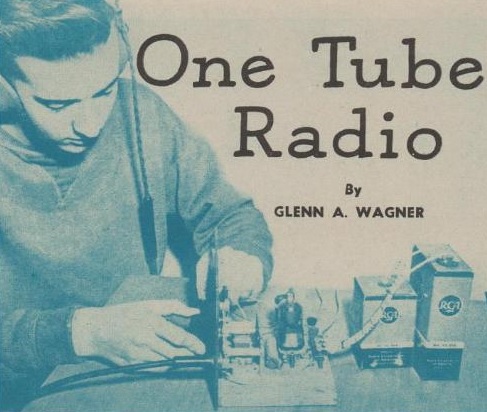


1965 Emergency Crystal Set from Boys’ Life

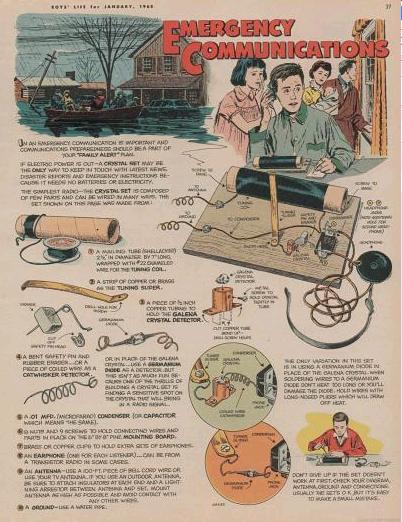
BL1965XtalSet

In an earlier post, we looked at a one-transistor CONELRAD receiver featured in Boys’ Life magazine in 1956.  And today, we look at a simpler variation on the same theme, this time from 50 years ago this month, in Boys’ Life magazine January 1965.

Once again, the Scout’s obligation to Be Prepared is inspiration for this electronic construction article.  It’s a basic crystal set, but the focus is on being prepared, under the title EMERGENCY COMMUNICATIONS.

A terrified family, clad in pajamas, is apparently confronting rising flood waters. The text warns that “in an emergency, communication is important and communications preparedness should be a part of your ‘family alert’ plan.” It goes on to warn that if electric power is out, a crystal set may be the only way to keep in touch with latest news, disaster reports, and emergency instructions.

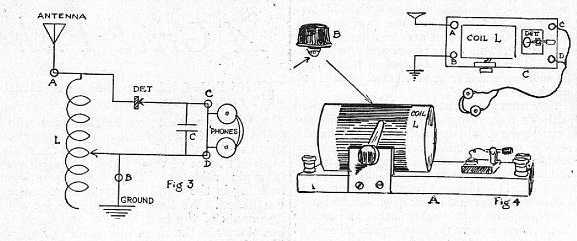
The page details how to build the radio using a galena detector with either a safety pin or piece of coiled wire. It acknowledges that a germanium diode can also be used but “isn’t as much fun” because it lacks the thrill of finding a sensitive spot on the crystal.

No author is listed, and the construction details are a bit lacking in detail. (In particular, no mention is made that the insulation has to be removed from the top of the coil in order to contact the slider.)

If you were a Scout 50 years ago, you were prepared. And a flood was nothing. You needed the additional thrill of finding the sweet spot on the crystal.

All of the parts for this set are readily obtainable.  If you’re having trouble finding any, you can find them on my crystal set parts page.


1956 Boys’ Life CONELRAD Receiver

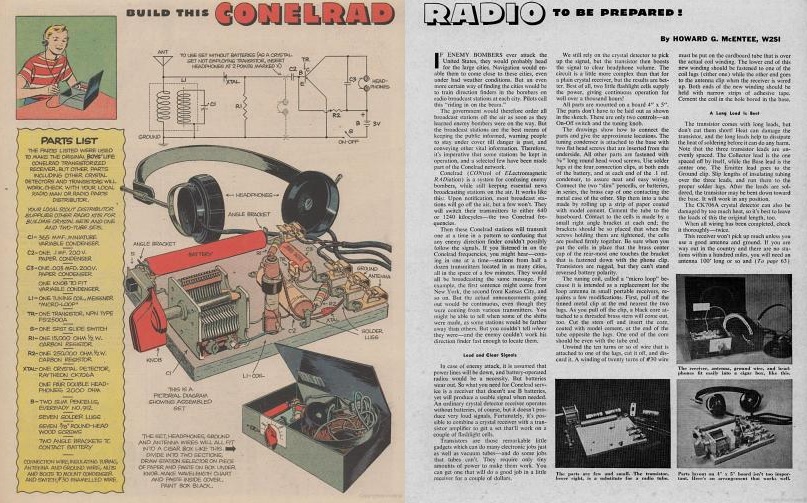
BLConelradRadio

In the mid-1950’s, a transistor radio was an expensive luxury. This presented a problem for an impecunious Boy Scout who wanted to Be Prepared for anything. In the words of Boys’ Life magazine for January 1956, “in case of enemy attack, it is assumed that power lines will be down, and battery-operated radios would be a necessity. But batteries wear out. So what you need for Conelrad service is a receiver that doesn’t use B batteries, yet will produce a usable signal when needed.”

The article pointed out that a crystal set might be pressed into service, but wouldn’t produce very loud signals. Fortunately, Boys’ Life had a solution to the problem, in the form of this one transistor set that was well within the construction abilities and budget of a Scout. The set shown here would run on two penlight cells with clear headphone volume for well over a thousand hours. And in a dire emergency, since the set consisted of a crystal detector with one-transistor audio amplifier, the article gave instructions on how to bypass the amplifier and simply use it as a crystal set with reduced volume.

The set is build on a board, with instructions to mount it in a cigar box (painted black, according to the directions), which left ample room for storing the antenna wire, ground lead, and headphones. Since the set was designed for CONELRAD use, the article instructed to find the local broadcast stations closest to 640 and 1240 on the dial, tune them in, and then mark the dial position for future emergency use.

The circuit calls for a FS2500A transistor, which is a general purpose NPN transistor, apparently manufactured by Bogue, also known Germanium Products Corporation.  (See the substitution guide in the 1957 RCA Transistors and Semiconductor Diodes.)

The article was reprinted for a number of years in the Boys’ Life Radio and Signaling reprint booklet. Occasionally, the “Hobby Hows” column of Boys’ Life would answer a letter from a Scout asking where to find the plans for the receiver, who was directed to the reprint booklet. Therefore, I suspect more than a few scouts built one of these receivers, and I’m sure they were put to good use for entertainment purposes. The builders of these sets were undoubtedly the first kids on their block to own a transistor radio. Fortunately, none ever had to be used for the intended purpose of tuning in to CONELRAD alerts.

The author of the article was Howard G. McEntee, W2SI. McEntee was the author of the Radio Control Handbook, published by Gernsback Publications in 1955 and updated over the years.


Merry Christmas Hans: 1939

Dec1939BL

The December 1939 issue of Boys’ Life magazine carries an interesting short story, “Merry Christmas Hans” by Philip Lightfoot Scruggs. It’s full of technical inaccuracies, the author’s unfamiliarity with Amateur Radio, and even countless FCC rule violations. But it’s an interesting look at how Amateur Radio was viewed 75 years ago, and it pretty conclusively puts to rest the assertion that the Boy Scouts are somehow designed to militarize boys.

The hero of the story is Dave Smith, W2KSM. (It looks like the call was really in use, as shown by what looks like a Sweepstakes entry in this 1938 QST. And it was held in 1954 by one Howard M. Ames Jr.)

Young W2KSM, a 17-year-old Eagle Scout, decided to get on the air on Christmas Eve to wish a Merry Christmas to his DX friends in France, England, Belgium, or Holland. Much to his surprise, he heard the voice of Hans Schuler in Germany, where Amateur Radio was not allowed. (Amateur Radio actually did exist in Germany, and even continued somewhat during the war. Germany was one of the few belligerent countries where there were still a few hams on the air, even during the war. For more information, see my earlier post.) The story contains an editor’s note pointing out that the story was written before war was declared. Dave asked Hans what would happen if he was caught, and Hans replied, “the concentration camp at least.”

Still, the two continue their conversation, as Dave tells of freedom, and Hans tells of the repression in Germany, and even explains how he can quickly dismantle the station and antenna if the Gestapo got too close. Another Scout in New York City just happens to be listening to the contact, and alerts his father, a network executive, who spontaneously decides to broadcast the contact nationwide where millions, including Dave’s parents, listen to the boys talk.

Dave tells about Boy Scouts, and Hans tells of his experience preparing for war in the Hitler Youth. Dave concludes the contact by reciting the Scout Oath and Law, “that is our Scout Oath and Law, Hans–what we try to live by,” as Hans prepares to hastily disassemble his clandestine set.

Dave walks downstairs wondering whether his family will believe it, only to hear the end of the broadcast in which he and Hans had a starring role.


Click Here For Today’s Ripley’s Believe It Or Not Cartoon


1914 Boy Scout Human Cannonball

ScoutHumanCanonballI don’t believe that “human cannonball” is currently an approved activity in the BSA Guide to Safe Scouting.  But a hundred years ago, these Scouts were apparently preparing to shoot one of their number (or at least pretending to) from a cannon at Fort Independence, Massachusetts.  The photo appeared in the December 1914 issue of Boys’ Life.


ASK YOUR PARENTS to explain this, if you do not understand it.

StampsAndCoinsI suspect many aspiring young philatelists and numismatists got their start as I did on the pages of Boys’ Life Magazine. This clip comes from the November 1974 issue. I earned my first merit badge, Coin Collecting, about this time, and I’m sure I carefully examined this page when it came out. I was a good customer of many of those advertisers, including the Littleton Coin Company, the Littleton Stamp Company, and the Mystic Stamp Company. It turns out that those companies are very much still in business, but Littleton acquired Mystic along the way. Today, coins are sold under the Littleton name, and stamps are sold under the Mystic name.  The Littleton Coin ad shown here notes that it is for serious coin collectors only, and I certainly fit that description.

I still have many of those treasures tucked away, such as the Hong Kong One Cent Note, and the Japanese Invasion Currency.  (Although it wasn’t until many years later that I learned that the money was never intended for Hawaii, as I think I was led to believe.  It turns out the notes denominated in dollars and cents were actually used in Malaya.)

As was customary, most of these companies sold “on approval.” An offer was advertised at a very reasonable price, and the buyer also received “approvals,” meaning additional coins or stamps that had to be either paid for or sent back. This was undoubtedly the source of great confusion by many young scouts, so each issue of Boys’ Life carried the explanation shown here. In case the explanation wasn’t understood, it concluded with the admonition: “ASK YOUR PARENTS to explain this, if you do not understand it.”

Interestingly, this issue’s cover story is a feature about a sports hero named O.J. Simpson. It details the inspiring story of how he managed (up to that point) to avoid a life in crime, and concludes, “when he still asks, ‘tell me what You want me to do,’ you feel that he already knows the answer and now is searching only for the means.”


Click Here For Today’s Ripley’s Believe It Or Not Cartoon


Eagle Scouts, Class of 1944

1944EaglesSeventy years ago today, November 19, 1944, these four young men were featured in the Chicago Tribune after having become Eagle Scouts.  For the first time in the history of their community, five Scouts had become Eagle at the same time.

The Scouts were John L. Guyer, George L. Otis Jr., Harrison C. Stearn Jr., Richard Wallace Jr., and John H. Hafner.  Mr. Hafner, who was a student at a military academy at the time, was not pictured.

If you know one of these Scouts, or you are one of them, I would love to hear from you about your reminiscences about Scouting and your experiences over the years.  You can contact me at clem.law@usa.net.


Radio Detector for a Dime

10centdetector

Radio and Boy Scouting share a long history, and in the early days of Scouting, radio played an important role. The October 1914 issue of Boys’ Life magazine shows this detector, guaranteed to bring in stations from 100 to 500 miles away, for only a dime.  All that was needed was a telephone receiver and a wire on the roof.  Even though this seemingly arcane piece of technology (consisting mostly of a lump of galena) would set the aspiring young wireless enthusiast back only a dime, he would probably find that the more familiar telephone receiver would be harder to come by.  But that too was available, for fifty cents.  But for sixty cents, the scout would have a radio that would pull in a strong signal.