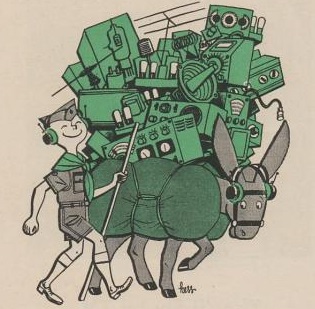
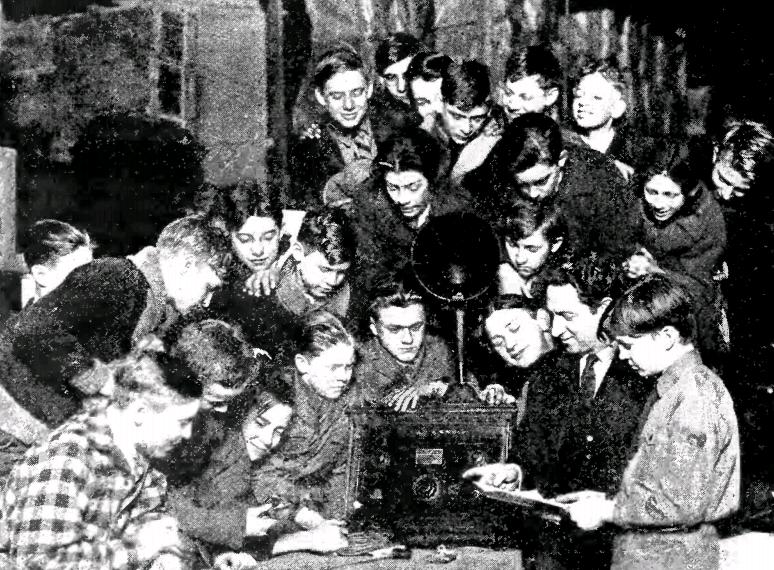
Photo courtesy of W8KBF, Yahoo War Emergency Radio Service group.
During World War II, Boy Scouts in both America and Britain were called upon to serve as volunteers in civil defense. In the July 1942 issue of Boys’ Life, BSA Chief Scout Executive James E. West wrote an editorial encouraging Scouts to volunteer in the Messenger Service of the Citizens Defense Corps. The Office of Civilian Defense recommended that six messengers and two adult leaders be recruited for each 1000 persons in a community. Even though others were eligible to join, both the BSA and the Office of Civilian Defense believed that Scouts, due to their training and qualifications, would be ideal. The editorial stressed that during an emergency, other means of communications could be disrupted, and that written messages might be the only means of communication. West concludes:
This is one of the most important national service projects that has been requested of the Boy Scouts of America. It requires the utmost effort on the part of our organization to fulfill the responsibility which has been assumed. Let us face resolutely whatever the enemy has in store for us, and BE PREPARED to do what we are asked to do to the best of our ability.
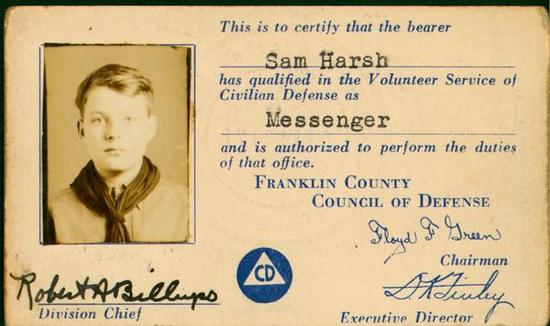
Franklin County, Ohio, identification card for Boy Scout CD messenger. worthingtonmemory.org photo.
British Scouts Tour America
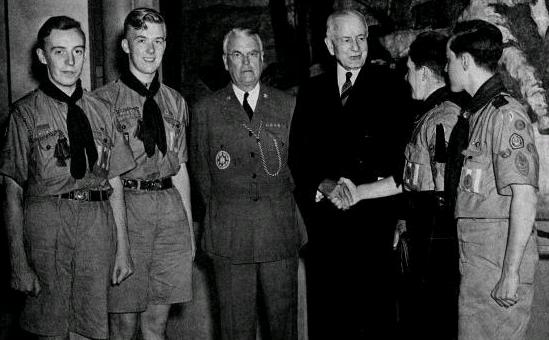
Visiting British scouts with James E. West and BSA foreign relations chairman Thomas J. Watson.
A few months later, a group of British Scouts who had served in civilian defense roles during the Battle of Britain made a tour of Canada and the United States, including a meeting with West, and their heroic tales were written up in the magazine’s September 1942 issue. These Scouts represented four towns that had been heavily hit by bombing. Scout Stanley Newton of London explained:
Our Troop went through six months of heavy bombing in London. I cannot say that we came off unharmed. Our two Troop headquarters were wiped out, one was burned down and the other was blown to pieces. Several of the boys lost their parents and their homes and two of the younger boys were killed in those raids. But we were glad that we could go through them and do something to use our training as Scouts in helping some way or another.
Another of the Scouts, John Bethell of Birkenhead, describes the work the messengers did during the Blitz:
When a bomb drops one of the first people on the spot is either the head warden or one of the senior wardens. He always has a messenger with him; one of us Scouts. What he does as soon as he gets there is to make out a report on what has happened, give it to that messenger and the messenger rides down to the post, which we call the pill box.
Inside the pill box there is a telephone. That is the only telephone we are allowed to use during an air raid. But sometimes the telephone lines get broken when a bomb hits the road. Then instead of just having to ride to the post and telephoning, we messengers have got to ride down to the control center. Sometimes it is a long way and sometimes it isn’t. In my case it is three miles; that’s three miles there and three miles back, maybe ten times in one night. Not only do we send one messenger but three minutes after the first messenger is gone we always send another one so if the first one gets bumped off the second one may get through.
Derrick Belfall (1926-1940): I Have Delivered My Message
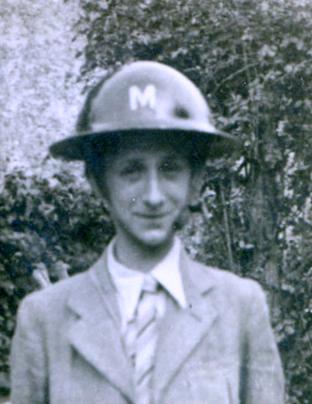
Derrick Belfall. Photo courtesy of Mrs. Rita McInnes.
Indeed, one of those Scouts, Derrick Belfall, was “bumped off” in the course of his duties as a civilian defense messenger. Fourteen year old Belfall lived at 109 Bishop Rd, Bishopston, Bristol. He was the only son of Cecil Ernest and Mary (née Miller) Belfall, who died in 1983 and 1964, respectively.
The official minimum age for messenger service was sixteen, but due to his insistence, Derrick was allowed to join the service. On the night of December 2, 1940, he was dispatched with a message. He delivered it successfully, and upon returning to his post, he found a house beginning to burn and he stopped to put out the fire. He then heard cries from another house where he rushed in to save an injured baby. Shortly after effecting these rescues, the air raid still underway, Derrick was injured by an exploding bomb and taken to the hospital with injuries that proved fatal. As one of the visiting Scouts confirmed, his last words at the hospital were: “Messenger Belfall reporting. I have delivered my message.”
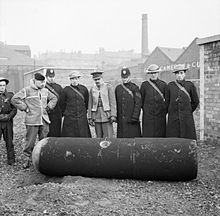
Defused German parachute mine. Wikipedia photo.
A Narrow Escape
Bethell, one of the British Scouts touring America, also recounted his own tale of being thirty yards away from an exploding parachute mine which killed two other civil defense workers:
A warden and I were riding along the streets on our bikes and saw a couple of parachutes coming down. Well, first we thought they were German airmen bailing out and we were just going to run towards them and give them something like what we would like to give Mr. Hitler–a kick in the pants or something like that–and then we realized that they were what are known as parachute mines…. We started to ride towards them to see if we could help in the rescue work we knew would follow….
We saw a couple of chaps running up in front of us also going on the same job. Just then we heard something flapping. It was only very faint but we realized that it was another parachute with a mine coming down. We knew if we were able to hear that flapping we must be pretty close to it. We got down on the ground and shouted to the other two chaps. But unfortunately they didn’t hear us. The roar of anti-aircraft fire drowned out our shouts. They went on. The mine went off just thirty yards ahead of us. We were just blown across the street but otherwise all right. But those other two chaps standing up under the full blast–it got them right in the chest and blew their lungs out and killed them.
American Scouts In Action
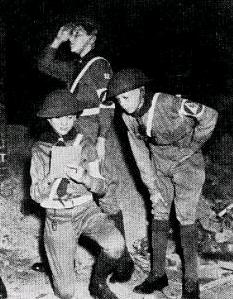
The American Scouts shown here in the February 1943 issue of Boys’ Life are participating in a civil defense exercise. The display shown at the top of the page is the uniform of a Scout as he would have appeared in 1943 as a civil defense messenger in Mercer County, Pennsylvania. It was put together by W8KBF of the Yahoo War Emergency Radio Service group.
While American Scouts and other civilians escaped the harrowing experiences of their British counterparts, it is clear that they lived up to the Scout Motto to Be Prepared. And as the British Scouts proved, a scout is brave.
As Scout Executive West wrote, these Scouts “were not specialists but were equipped only with such knowledge as is normally given to Scouts through our Advancement Program. Yet how nobly these Scouts lived up to our Scout Motto ‘Be Prepared.’ We, too, have a job to do!”
Acknowlegments
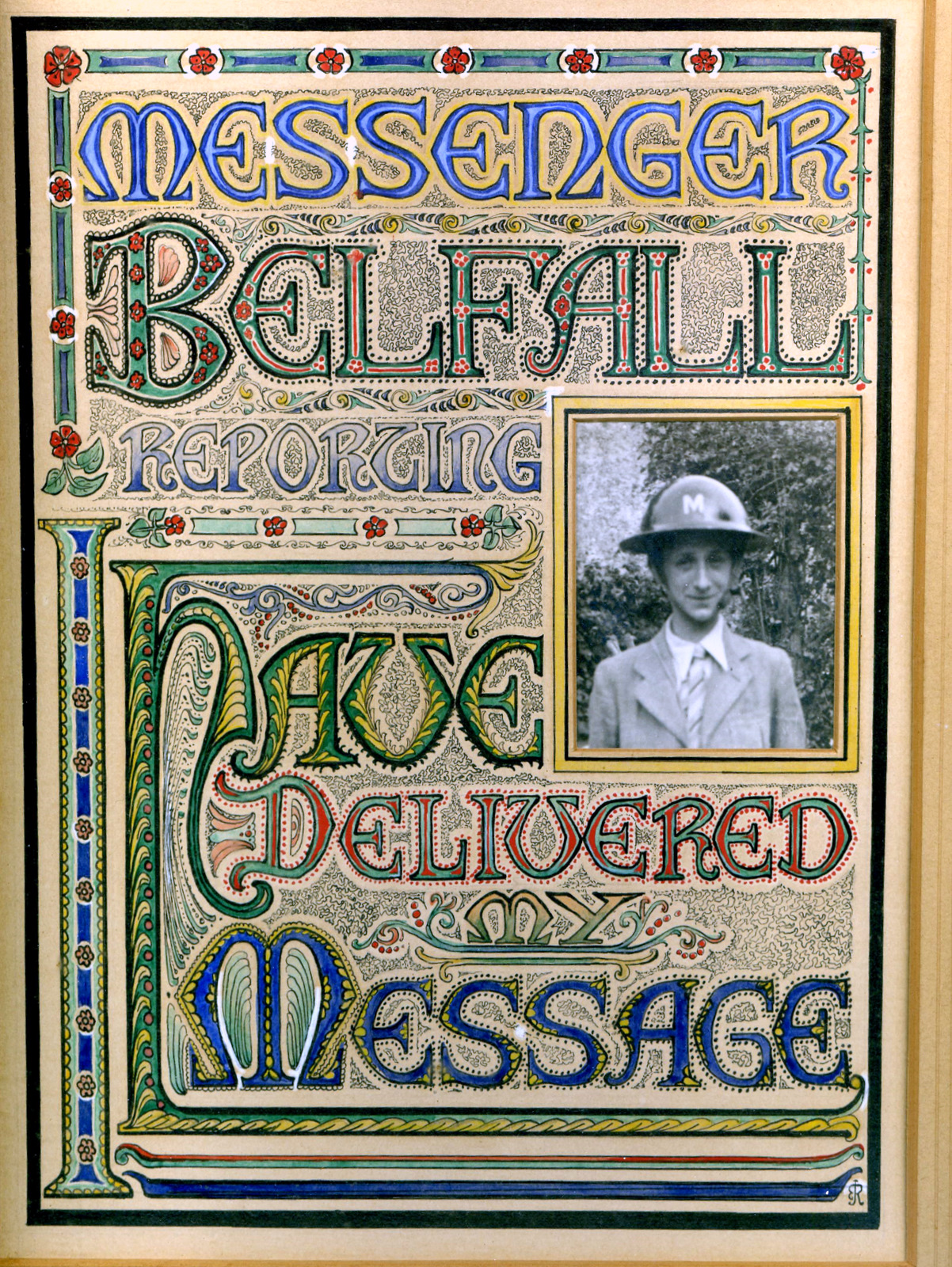 I would like to thank Mrs. Rita McInnes, a neighbor of the Belfall family, for providing the photograph of Derrick Belfall. This photograph hung for many years in the Belfall home as part of the illuminated photo shown here containing Derrick’s last words. (Click on the small image to view the full image.)
I would also like to thank Sam Hevener, W8KBF of the Yahoo War Emergency Radio Service group for allowing me to use the photo of the American Scout messenger’s uniform at the top of the page.
Additional References
- Scouting Heros Minute
- Boys’ Life, March 1942
- Monument at Gravestonephotos.com
- Derrick Cecil Belfall at Findagrave.com
- Their Finest Hour
- Bishopton at War
- Evening Post (New Zealand)
- Night Blitz – November 1940 to June 1941
- The Left Handshake, 1948
- Bristol Museums, correspondence between Derrick’s father and Lord Mayor
Read More at Amazon
- Sure as the Dawn
, page 275.
- B. P.’s Scouts : An Official history of the Boy Scouts Association
, page 140.
- Day by Day with William Barclay: Selected Readings for Daily Reflection
, page 220.