Category Archives: Science fair ideas

Science Fair Idea: Repulsion Coil Resonance Engine

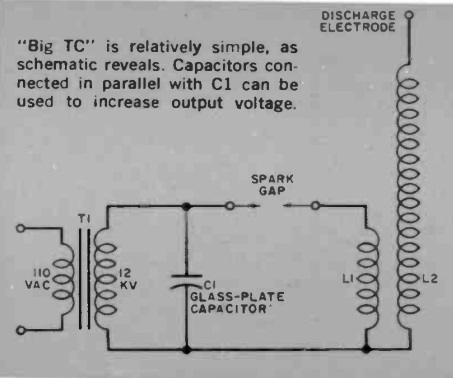
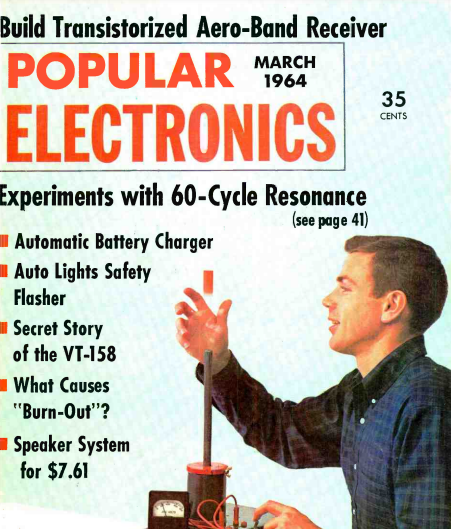
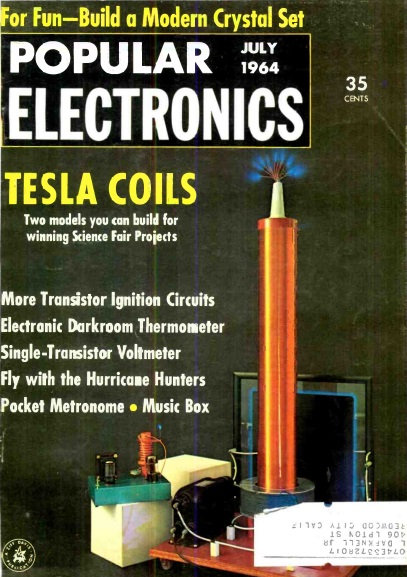
Screenshot 2024-03-08 8.24.36 AMScreenshot 2024-03-08 8.23.23 AMThe advanced student looking for a spectacular science fair project can’t go wrong by constructing the 60-cycle repulsion coil resonance engine described in the March 1964 issue of Popular Electronics. Essentially, it’s a coil and capacitor tuned to be resonant at exactly 60 Hz. The cover photo above shows the coil being used to repel a two-inch piece of aluminum tubing.

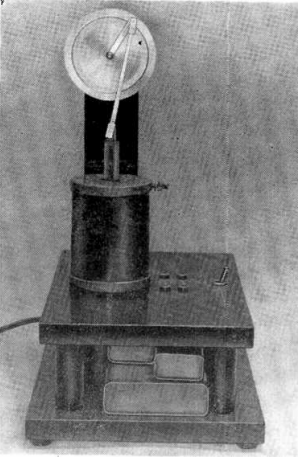
The device is called an engine because it can be used as shown to the left, with a reciprocating piston driving a flywheel. As with any single piston engine, to get started it requires a spin to get started, unless it happens to be in just the right spot.

The author suggests a number of other experiments that can be done with the device, all of which we guarantee will bring home the blue ribbon.


1944 Time Zone Converter

1944FebQST

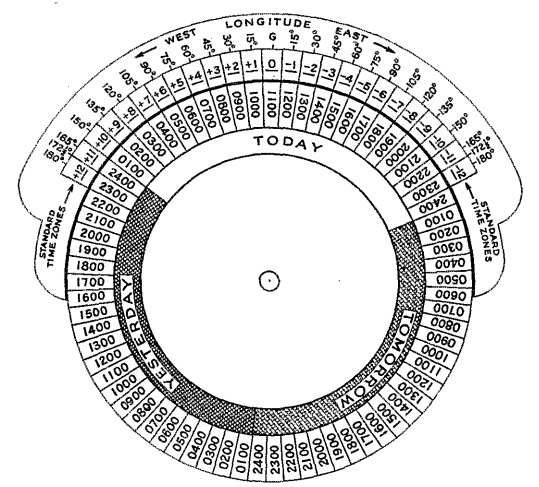
If you are looking for a simple analog computer to calculate time zone differences, you can’t go wrong with this one, from the February 1944 issue of QST. It had been sent in to the magazine by one Lt. I.E. Slutzky, who found the need for a simple device for changing time at one location to any other location on the globe. Since this one had scales for “yesterday” and “tomorrow”, it would also simplify those vexing questions surrounding the International Date Line.

In 1944, you would have had to meticulously re-draw the design (or perhaps cut up your magazine). Today, however, you can easily print the image above on two pieces of cardstock. If Junior is in need of a science fair project, this one will allow him or her to construct an analog computer.


Science Fair Idea: Weighing Gas

Screenshot 2023-12-31 4.08.04 PMIf Junior is looking for an easy-to-construct science fair project, this one from the January 1939 issue of Popular Science is certain to bring home the blue ribbon. It answers the question of whether gasses can be weighed.

Junior should carefully construct two boxes made of paper, and make them into the balance shown here, so that the slightest weight tips the scale. Then, some invisible gas is poured into one of the boxes, and that side of the scale moves down, demonstrating that the invisible gas is, indeed, heavier than air and can be weighed.

As for the gas to use, the magazine recommends carbon tetracholoride. Of course, that’s dangerous stuff, and would result in the hazmat team shutting down the science fair. Instead, for almost as good a reaction, some carbon dioxide gas can be quickly produced by mixing a little vinegar and baking soda in a tall glass. We showed how to do a similar experiment in an earlier post, and Junior might want to do both.


Science Fair Project: Drop of Water Evaporating on Red-Hot Metal

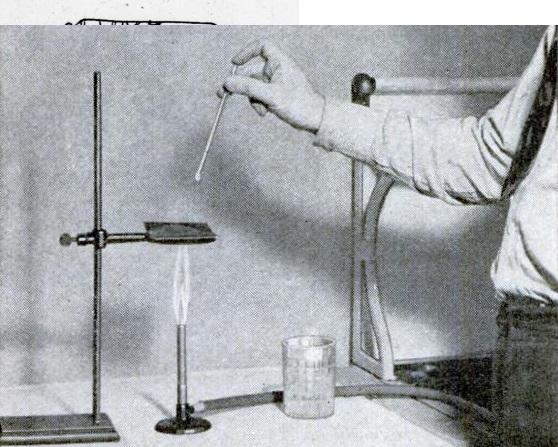
1938SepPSIf Junior has a science fair project that’s due soon, and he or she likes playing with fire, then this simple project form 85 years ago is just the thing to take home the blue ribbon.

Like any good science fair project, this one answers a question, namely, “will a drop of water evaporate faster on a red-hot piece of metal, or on one that is only moderately hot?” The classmates, and probably the teacher, will undoubtedly place their bets on the one that’s red hot, but Junior will prove them wrong.

The reason is that on the red hot surface, a cushion of steam forms, and the drop of water mostly retains its shape as it dances about. But if the surface is only moderately hot, the water spreads out and evaporates immediately.

Most schools have probably turned off the gas to the bunsen burners in the science lab, but you can bring your own from home. You can get this handy propane bunsen burner from Amazon.  In fact, the science teacher will probably be a little bit jealous and want to get one for themself.  The school probably has the lab stand, but if not, you can also get that on Amazon.

This project appeared in the December 1938 issue of Popular Science.


Some links on this site are affiliate links, meaning that this site earns a small commission if you make a purchase after using the link.

Homemade Photocell

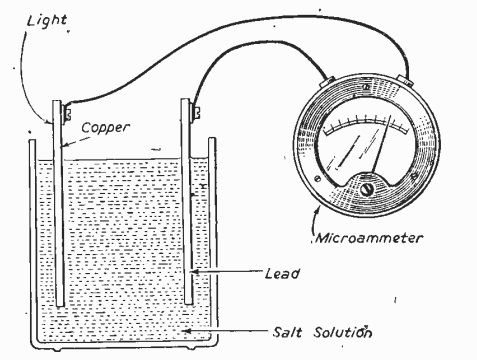
1948NovPracWirToday, we have another science fair project suitable for students who like to use dangerous chemicals. It’s a homemade photoelectric cell. It won’t provide large amounts of current, but it is measurable, and it can probably be used to receive a signal from a modulated beam of light, simply by connecting it to an audio amplifier (similar to this previous project).

The cell consists of a beaker of water in which a “pinch” of salt has been added. Into this are inserted strips made of copper and lead. The copper is heated with a torch to oxidize it, after which it is scrubbed with nitric acid. There is some current even in darkness, but when the copper strip is exposed to light, the current increases.

The project appeared in the November 1948 issue of Practical Wireless.


Science Fair AC Generator

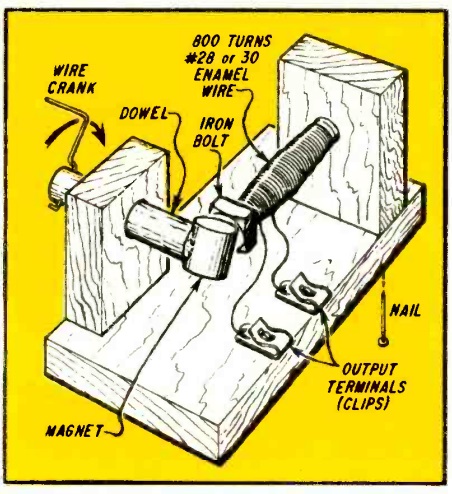
1963NovEIIf Junior is looking for a simple science fair project, albeit one that probably can’t be whipped together at 10:00 PM the night before it’s due, he or she can’t go wrong with this simple AC generator from the November 1963 issue of Electronics Illustrated.

The design is very straightforward. To avoid having to worry about brushes, the coil stays stationary, and the permanent magnet turns. The coil consists of 800 turns of number 28 or 30 enameled wire on a 2 or 3 inch iron bolt.

The magazine recommends using a DC ammeter, with the calibration set so that 0 is mid-scale. As the crank is turned slowly, the needle will deflect first one direction, and then the other.

Another possibility would be two LED’s in parallel, each pointing a different direction. As Junior slowly cranks the handle, the lights will alternate, and as the speed picks up, they will both appear lit.

For more projects, some of which can be whipped together at the last minute, browse our other science fair ideas.


1963 Student Experimental Licenses

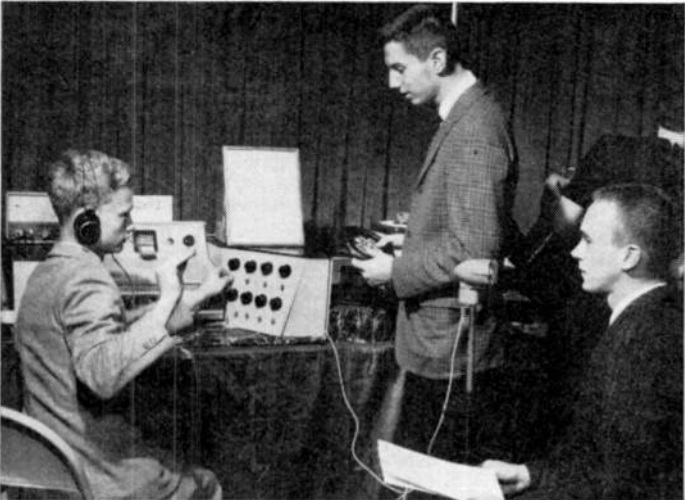
1963SepPEShown here, in the September 1963 issue of Popular Electronics, is Albert Pabin (I believe with the headphones) and two other students demonstrating an audio console by using it during an actual broadcast. Pabin was a ninth-grade student at Utica Free Academy, Utica, NY. His science project was the console he designed and built, and he wanted to demonstrate it under actual broadcast conditions.

To do so legally, he procured an experimental license from the FCC, and was able to go on the air, on 27 MHz, with the call KF2XGJ. According to the magazine, the FCC rules made provision for student experimental licenses for students, seventh grade and above, who had “a good idea of what he is trying to show, and that he have older and more knowledgeable persons available to help him in case of difficulty.” In particular, “the FCC believes that a student’s instructors are fair judges of his motives and sincerity, and looks favorably on projects endorsed by an instructor.” Notice to the FCC Engineer-In-Charge for the district was also required.

The application required various technical descriptions of the transmitter, as well as a statement from the principal or faculty member, on school letterhead, stating that the project had he approval of the school. The magazine noted that the frequencies generally available were 27.23-27.28 MHz., 460-461 MHz, 462.525-467.475 MHz, and 2450-2500 MHz. Power was often (but not always) limited to 5 watts.

While experimental licenses are still provided for in Part 5 of the FCC Rules, there is no specific provision today for student experimental licenses.


1963 Homemade Microphone

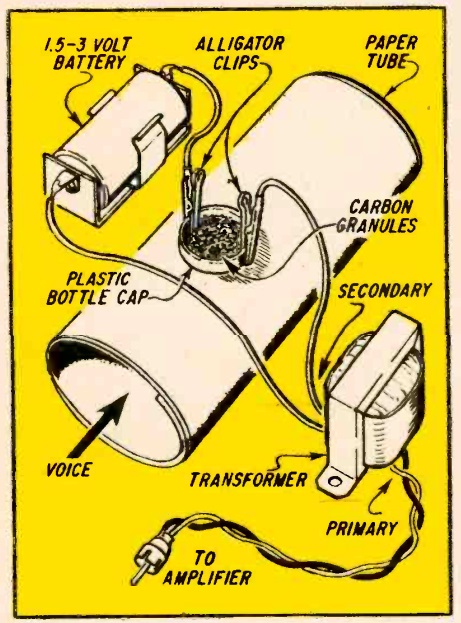
1963SepEIWe’ve previously shown (here, here, here, and here) other homemade microphones. This idea for a carbon mike appeared in Electronics Illustrated, September 1963. The mike element itself is made of carbon granules. These are obtained by cutting open an old carbon-zinc battery and removing the carbon rod.
You grind them up finely with a file, or by using a metal rod as a rolling pin. The resulting granules are placed in a plastic bottle cap, and wired to a battery and transformer. Almost any type of transformer can be used, either an audio transformer or power transformer. The larger winding is connected to the mike element. The cap is set on top of a paper tube 2-3 inches in diameter, into which you speak.


1963 Science Fair Ideas

1963AugBL

If Junior is looking for ideas for the science fair, here are some oldies but goodies, from the August 1963 issue of Boys’ Life. Any of these will certainly earn Junior a nice participation ribbon. But if you’re looking for more spectacular ideas, some of which are very easy, and some of which are very complicated, be sure to check out our full category of Science Fair Ideas.


Last Minute Science Fair Ideas

1943MayPS3If you’re getting ready to go to bed, and Junior just remembered that the science fair project is due tomorrow, there’s no need to panic. Any of the projects on this page will provide a suitable demonstration of some scientific principle, and you–er, I mean Junior–can whip them together in a few minutes with materials found around the house.

1943MayPS2The first one, shown at right, demonstrates static electricity. A glass jar with a metal cap contains a few bits of tissue paper, and Junior can make them “dance” without moving the jar. This is done by shuffling his feet along the carpet to get an electric charge. Instead of touching an unsuspected family member as he would usually do, he touches the lid of the jar. This causes the paper to be attracted and leap from the bottom of the jar.

The next experiment, shown at the top of the page. demonstrates the relationship between magnetism and electricity. A closed coil of copper wire is suspended next to a magnet. Another magnet is moved inside the coil. The magnet induces a current in the coil, which causes the coil to become an electromagnet. It is then repelled from the hanging magnet.

1943MayPS1The third experiment, at left, demonstrates indirectly the acceleration due to gravity. A liquid is poured, and it is noted that the column becomes thinner toward the bottom. This is because the liquid is moving faster at the bottom.

Finally, Junior can demonstrate the concept of surface tension with the experiment shown below. A cork is carefully connected to a metal ring, and placed in a cup of water so that the cork is just barely submerged by the surface tension of the water. When a bar of soap is touched to the water, the surface tension is reduced, and the cork pops to the surface.

The science teacher will be suitably impressed, and won’t have any idea that the experiments actually came out of the May, 1943, issue of Popular Science.

1943MayPS4