Category Archives: Radio history

1976 Light Communications

We’ve previously reported on projects involving light-beam communication. It’s relatively simple to modulate an electric light, and receive it at a distance.

Fifty years ago, the February 1976 issue of Popular Electronics carried an interesting article by Forest Mims on the same general subject. But this project recreates the work of Alexander Graham Bell in 1880, the photophone. Bell was the first to communicate a voice wirelessly, but his transmitter (and the one shown in this article) is powered only be the sun. It consists of a mirror, to which is glued a short tube into which one can speak. The mirror is mechanically vibrated by the sound.

The receiver is essentially identical to the ones we’ve shown in the past. It consists of a photocell fed into an audio amplifier. With the use of a parabolic mirror at the receiver, or a Fresnel lens, ranges of hundreds or even thousands of feet can be achieved.

Students looking for an interesting science fair project couldn’t go wrong duplicating Bell’s early accomplishment.


Early AI Images, 1966

When unusual pictures are posted these days, someone is sure to quickly point out, whether or not it’s true, that they are AI. But many of us have honed our healthy skepticism over the years, since it’s long been possible to make misleading photos.

This cartoon illustrating one such possibility appeared sixty years ago this month in the February 1966 issue of Popular Electronics


1956 One Transistor Audio Amplifier

Seventy years ago this month, the February 1956 issue of Popular Electronics showed how to make this little audio amplifier. The problem of finding a chassis to mount the circuit was solved by using an aluminum battery holder. They were readily available in various sizes, including one for four AA cells. The circuit, using the venerable CK722, used only three volts. Therefore, half the holder was available for mounting the other components, and there were four spare solder lugs that could be pressed into service.

The magazine noted that the circuit would come in handy for things such as amplifying the output of a crystal set.

To avoid favoritism (or maybe that’s just what they happened to have handy), the circuit is shown with one Ray-O-Vac and one Eveready cell.


1941 Home Recorder

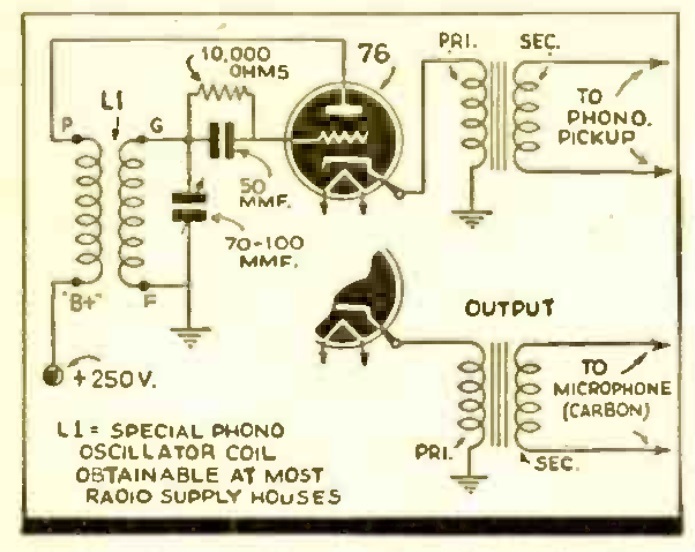
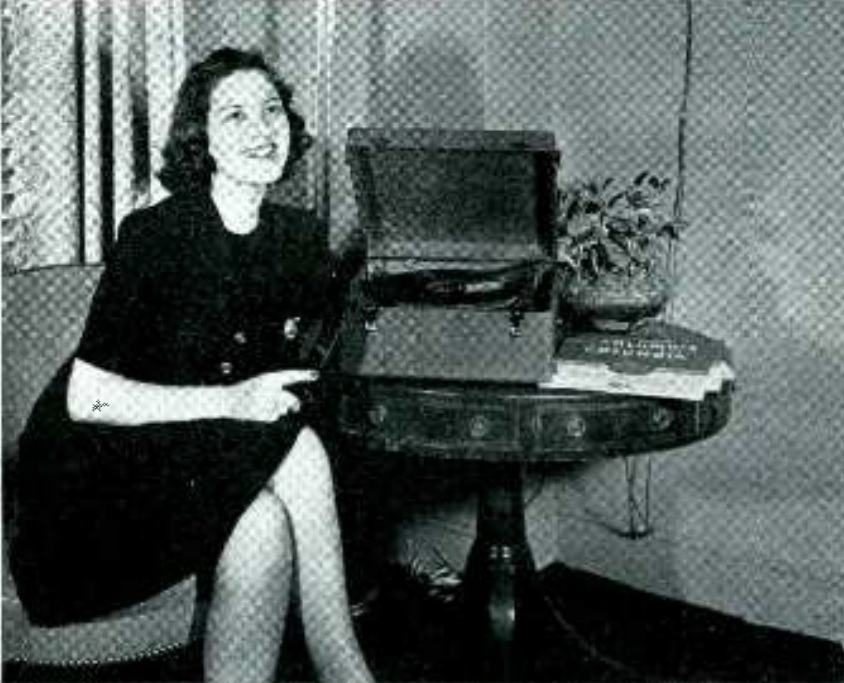
Eighty-five years ago this month, the February 1941 issue of Popular Science showed how to put together this home recorder, which also doubled as a phonograph. The two-tube (plus rectifier) circuit could be connected to a microphone, or it could tap into the family radio to record programs. In that function, it could also serve the boost the volume of a weak station to play through the speaker.

The only part, of course, which is unobtainium today (along with the blank records) is the recording head.


Radio Scouting 1976

We were unaware that Pedro, the longtime mascot of Boys’ Life magazine until his retirement in 2022, apparently had his ham ticket, although he had become somewhat inactive in the 1970s. But when he read in Boys’ Life that there was going to be a Scout radio net, he decided to get back on the air, as documented here, in the February 1976 issue of Boys’ Life.

Elsewhere in the magazine, it was noted that the suggested time was 8:00 – 10:00 PM local time on Wednesdays, and 10:00 AM to noon Saturdays on 3940, 7290, and 14290 kHz. Scouts were encouraged to call CQ SCOUT RADIO NET.


Adding an FM Tuner to Your TV: 1951

Seventy-five years ago, if you wanted to upgrade your television, you could add FM reception, as detailed in the January 1951 issue of Popular Mechanics. As we’ve noted previously, it wasn’t unheard of to swap out the front end of the set and put in a rebuilt tuner.  Thanks to Dumont, you could buy a tuner that included, nestled in between channels 6 and 7, the FM broadcast band.  As an added bonus, you would probably get a better picture, since the tuner exhibited more gain, especially on the upper channels.

The article explained which models were candidates for the swap.


Radio Hardware Co., Salt Lake City, 1926

Shown here 100 years ago in the January 1926 issue of Talking Machine World is the storefront of Radio Hardware Co. 342 South State St., Salt Lake City. The magazine noted that this display evidenced neatness and simplicity, which were all that was necessary in many cases. The two window display was of Music Master radio receivers. Fifteen different items were shown artistically, with no crowding. The store noted that thousands viewed the display daily, and there had been a gratifying amount of sales resulting directly from it.


1956 Three-Tube Amplifier

Seventy years ago, this aspiring musician was able to play the electric guitar thanks to the three-tube amplifier she constructed from plans in the January 1956 issue of Popular Electronics.  In addition to use as a guitar amp as shown here, it could be used as a phonograph amplifier, or simply as a general-purpose amplifier in the lab.

It was built on an aluminum chassis made of soft aluminum that could be cut with ordinary household shears.  A speaker baffle formed the cabinet.


1951 Muntz TV

If you were looking for a home entertainment system 75 years ago, you couldn’t go wrong with this 19 inch Muntz TV, AM-FM radio, and phonograph combination, for only $399.95, which could be paid over 15 months.

The ad appeared in the January 28, 1951, issue of the Washington Evening Star.


1956 GM Delco Wonder Bar Radio

Seventy years ago, the January 23, 1956, issue of Life magazine carried this ad from Delco touting the “Wonder Bar” radio that could be had in your new General Motors car. You would preset the sensitivity, and then by touching the Wonder Bar (or a foot switch), the radio would automatically seek the next station.