Category Archives: Radio history

1921 Transatlantic Tests

1922JanQSTx
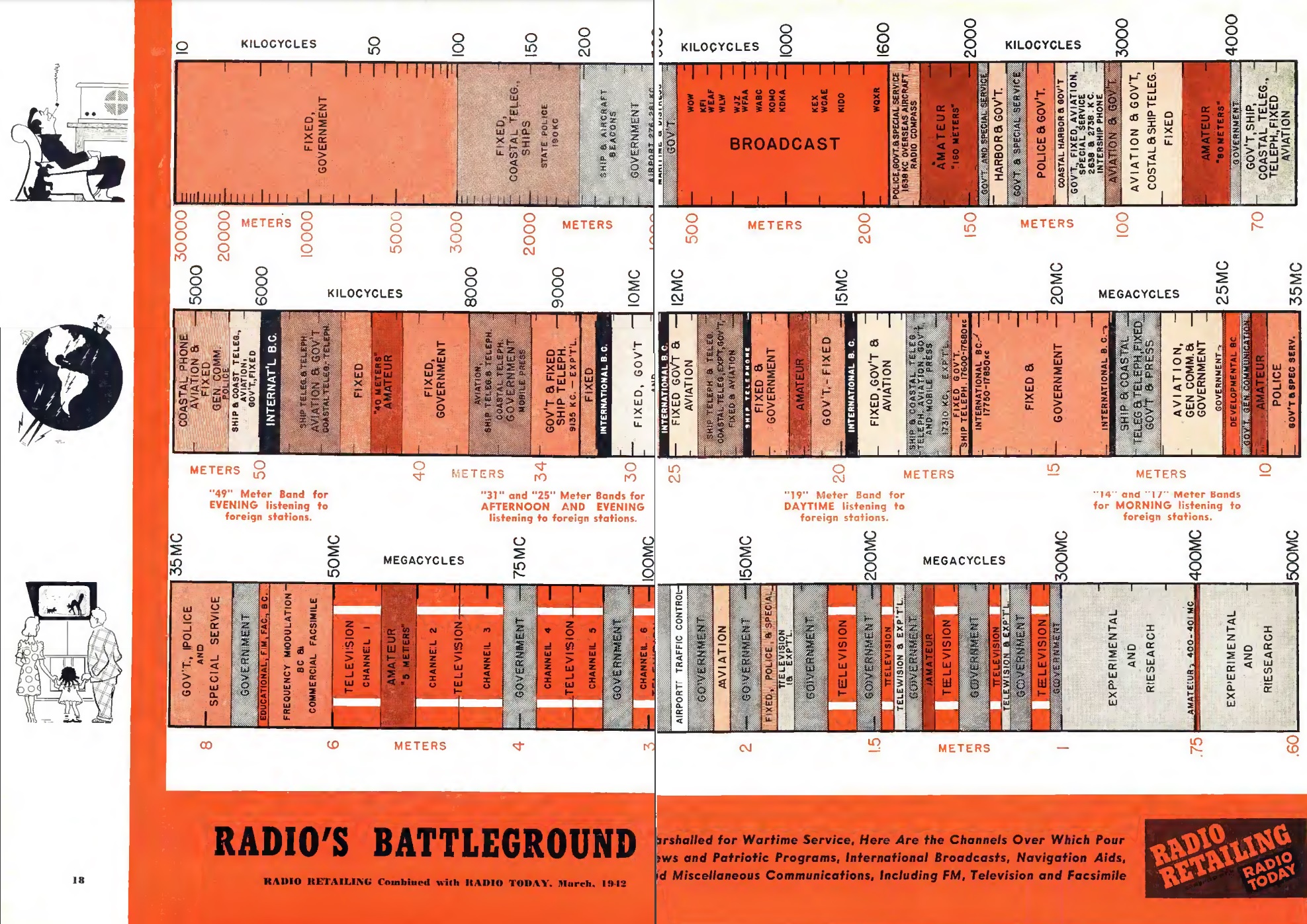
1921Dec12NYHeraldAmateur Radio signals first crossed the Atlantic 100 years ago the night of December 11/12, as documented here in the December 12, 1921, issue of the New York Herald.

An attempt the year before had been unsuccessful, and in 1921, the American Radio Relay League pulled out all the stops to ensure success. In addition to European operators who would be listening in, American Paul Forman Godley, 2ZE, was sent to England with the latest in American receiving equipment. He set up in a field at Ardrossan, Scotland, with only a tent to house himself and the receiver.

Transmissions from North America followed a pattern. Between 7:00 and 9:30 PM Eastern Time, all stations were invited to send, with a 15 minute period designated for each call area. These stations simply called TEST and their call sign. Starting at 9:30 until 1:00 AM, about two dozen pre-selected stations took turns calling. Each of these stations sent a five-letter cipher which had been given to them in a sealed envelope.

My personal connection to the tests is the fact that one of these stations, 9XI at the University of Minnesota is one I personally operated many times, and of which I served as trustee for several years. In those early years, there was a fuzzy line between amateur stations and broadcast stations. At some point there was a split, and the broadcast side of 9XI became licensed as WLB, and later as KUOM, under which call it still operates.

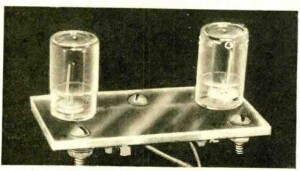
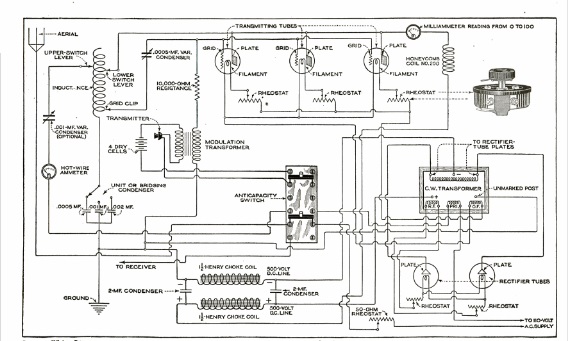
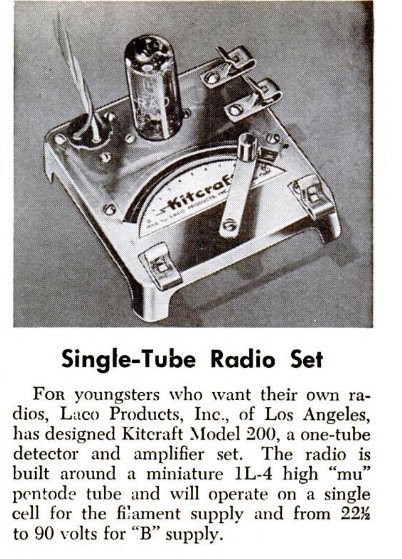
1921DecQST1Amateur station 9XI became 9YC, later W9YC, and after the war, W0YC, the call it held when I was a member and later the licensee. With the exception of 6XH at Stanford University in California, 9XI was the furthest west station participating. It was not heard in Europe, but the station sent the cipher SFLJT on 300 meters (1000 kHz) using CW. The transmitter was undoubtedly the one shown at left, described by Prof. Cyril M. Jansky, Jr., in the December 1921 issue of QST.

Numerous stations were heard the night of December 11, the most notable being 1BCG, as reported in the news clipping above. The signals from Connecticut were heard not only in Britain, but also on the Continent. A full message was picked up by Godley from the station at 3:00 AM GMT, or 10:00 PM in America.

Through special arrangements with the Marconi Company, word was sent back to America on the high powered commercial station MUU. Even though Marconi used automated high-speed code, it allowed this message to be sent by hand so that it could be copied by Amateurs in America directly. The message was acknowledged by Marconi’s American station, WII, also hand keyed for the occasion, to make sure that the word was heard throughout North America that the tests had been successful

Back in Hartford, ARRL officials were gathered around the longwave set tuned to MUU. According to the account in the February 1922 issue of QST, the air was so thick with tobacco smoke that it was hard to see how a signal could get into the room.

Today, communicating across the Atlantic is a pretty routine occurrence. We’ve learned over the years that even higher frequencies work even better than the ones used in 1921–most of which were in what we today consider part of the AM broadcast band. When I operate portable from a park using 5 watts, I made numerous contacts with Europe. It’s pretty easy now, and it’s something that’s been going on for a century now.

Various events will be taking place this weekend to commemorate the event.  Most of these are listed at the ARRL website.  In particular, I want to do my best to listen to a recreation of 1BCG’s transmitter, and you can read details of that event at this link.


Dr. Philip Weintraub, W9SZW

1951DecBLSeventy years ago this month, the December 1951 issue of Boys’ Life carried a feature entitled “SWLing is Swell,” pointing out all of the fun that can be had by shortwave listening, primarily to the ham bands. The article began with an incident shown in this dramatic illustration, of the robbery of dentist and ham radio operator Dr. Phillip Weintraub.

The two well-dressed robbers barged into Dr. Weintraub’s office, in which he luckily had his ham station set up. In a stroke of luck, he was in the middle of transmitting, and left the transmitter turned on while the robbery was taking place.

The thieves were disappointed that the dentist had no money other than five dollars in his wallet, and there was no gold on the premises. The tied him up, stashed him in a closet, and departed.

As luck would have it, however, the dentist’s wife, Evelyn Weintraub, was at home, and just happened to be listening to her husband’s station. She quickly called the police, and then raced to the office, arriving before the first squad car. She pounded frantically at the closet door, and one of the responding officers was able to take the door off its hinge. The police sergeant later told her, “you’d be a widow right now if you hadn’t heard those holdup men over the radio and reported it.”

The story sounds a bit suspect, but there’s enough corroboration to say that it is probably true, and probably took place in about 1937. There was indeed a Philip and Evelyn Weintraub in Chicago, as shown in the 1940 census.  Indeed, his house at 3252 W. Victoria Street is a Chicago landmark complete with its own Wikipedia page.

And the 1952 call book shows Philip Weintraub listed twice, once as W9SZW at 3252 Victoria, and as W9TMQ at 201 South Pulaski Road.  That address is currently a vacant lot, but it’s in a commercial district, and it seems like a plausible spot where a dental office would have been located 70 years ago. The callbook also lists a Royd L. Weintraub as being licensed as W9PZO at the home address. In the 1940 census, Royd is listed as being 2 years old, so he would have been about 14 years old in 1952. You can see the younger Weintraub’s biography at this link.

Thus it appears the doctor had a secondary station location licensed at his office, and the story sounds more plausible. Indeed, the incident is recorded in more detail in the 1941 book Calling CQ by Clinton DeSoto, W9KL, which includes much the same story, with the added detail that Weintraub was in QSO with W9JFF or (or possibly W9JJF), who was “frantic but impotent,” as his heart pounded madly listening to the drama unfold. DeSoto’s account notes that the doctor stayed late at the office, having told his wife, reportedly a dark haired sultry beauty, that he would be late, and invited her to listen in, as she often did.

The other reference I found to this story was a brief mention in the July 1937 issue of Radio News.  Apparently, WMAQ ran a midnight program consisting of dramatic reenactments of “important events in amateur radio,” sponsored by Hallicrafters. The magazine shows a reenactment of the holdup, and notes only that “Dr. Weintraub was saved due to the presence of a transmitter in his office.”

I would stay up until midnight to listen to that program, and it’s a shame that it’s no longer on the air.


1946 Stromberg-Carlson Ad

1946Dec9Life

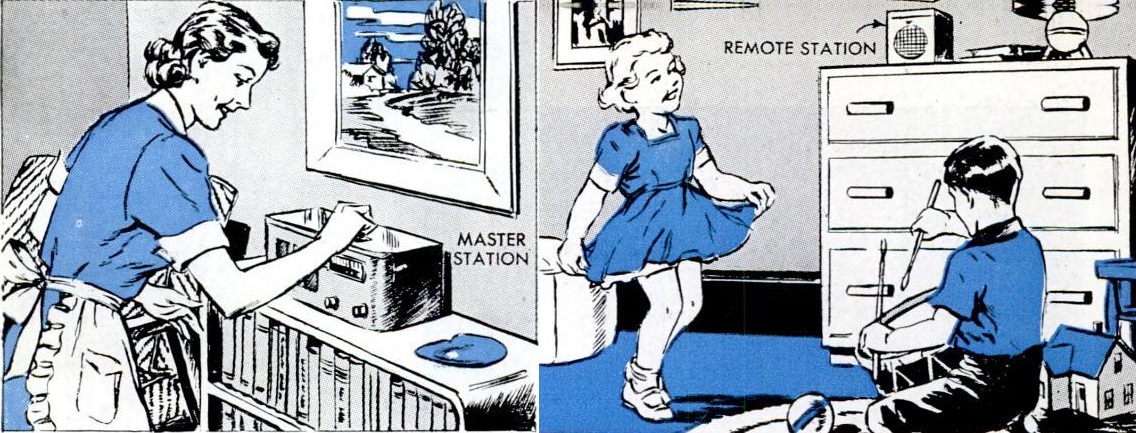
We’ll just cut to the chase. If you love your kids, then you should buy a Stromberg-Carlson radio. This ad appeared in Life magazine 75 years ago today, December 9, 1946.


Meissner Model 10-1163 Receiver Kit

1941DecRadioNews1

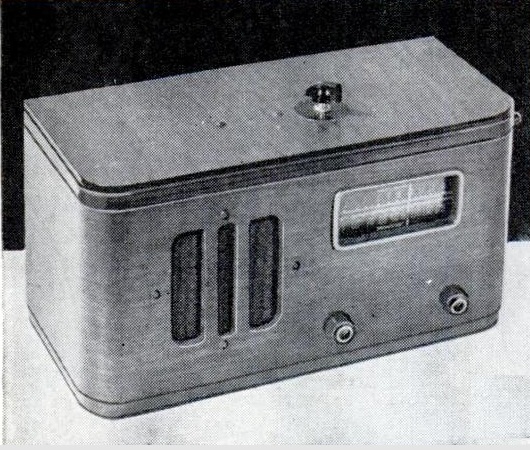
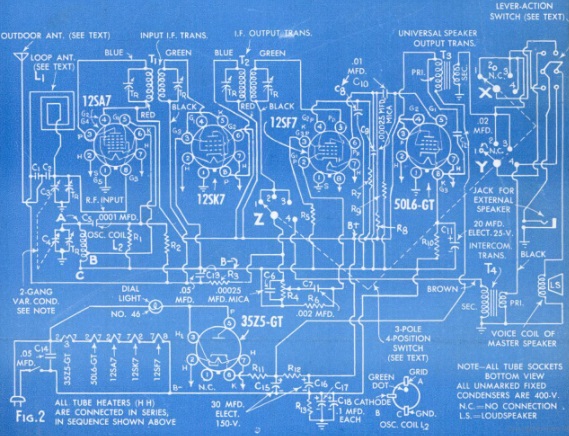
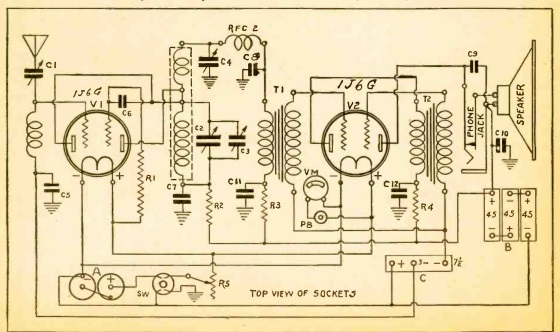
This handsome receiver kit was advertised in the December, 1941, issue of Radio News.  Meissner Manufacturing of Mt. Carmel, Illinois, was a manufacturer of components, and also sold manufactured radios and kits. Shown here is a three-tube receiver, but it was also offered as a one or two-tube version. After mastering the one tube set, it was possible to upgrade. The three-tube set, model 10-1163, sold for $5.15, not including battery, tubes, and headphones. The one-tube set, model 10-1161, sold for $3.30, and the two-tube model, 10-1162, was priced at $3.96.  They came with a coil for the standard broadcast band, and additional coils for the short waves were available.


White & Boyer, 3NR/WJH, 1921

1921Dec03WashEveStarA hundred years ago today, the December 3, 1921 issue of the Washington Evening Star carried this ad for Radio Receiving and Transmitting Apparatus, “an ideal Xmas gift.” Receiving sets started at $7.50, which works out to about $116 in 2021 dollars, according to this online inflation calculator.

The ad was for White & Boyer, 812 13th St. NW, Washington.  Like many early radio retailers, the company was also a radio station, transmitting music on Tuesday and Friday evenings from 7:30 to 9:45 PM. Shortly after this ad appeared, the station’s call sign changed from 3NR to WJH.


1941 Five Tube Portable

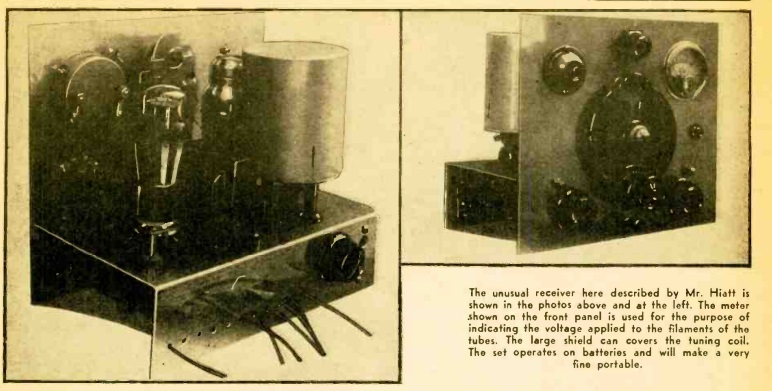
1941DecPSEighty years ago, this young woman is pulling in a favorite program with this camera-style portable radio. The brand is not stated, but it has five tubes, including the rectifier, and can operate either from battery or, as she is using it here, standard household current. It had the option of use with a separate window antenna to increase the sensitivity. It was finished with gray plastic, with a dark blue covering of simulated leather.

A few days after this picture appeared in the December 1941 issue of Popular Science, she was probably using the same set in a more somber mood to pull in the latest bulletins from Pearl Harbor.


1951 Volt-Ohm Meter

1951DecPMThese days, there’s really no excuse not to have a multitester. Even if you only rarely dabble with electronics, every household should have one, as it will tell you things such as whether your outlet voltage is OK or if an outlet is dead. You can check batteries. (Even if a voltmeter doesn’t have a specific battery testing option, if you just check the voltage, you can tell if a battery is completely dead. And if it shows more than 1.5 volts, you can be pretty sure that the battery is good.) In the car, you can diagnose many problems simply by seeing whether 12 volts appears at a certain spot. And they are cheap. The digital model shown below (whose price includes free shipping) rivals a fine laboratory instrument 70 years ago:

I am old school, and I prefer an analog meter movement, which is also available at a very reasonable price for a basic model, such as this one, which you can also get with free shipping on Amazon:

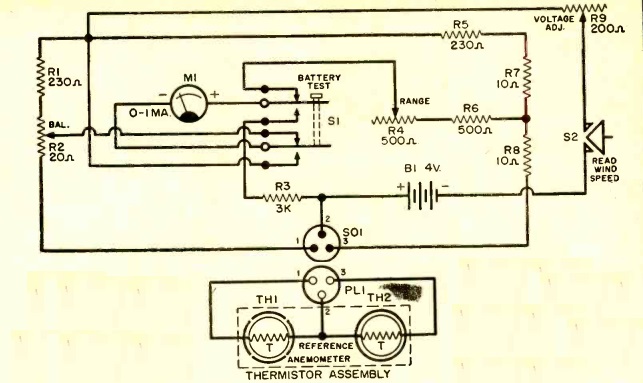
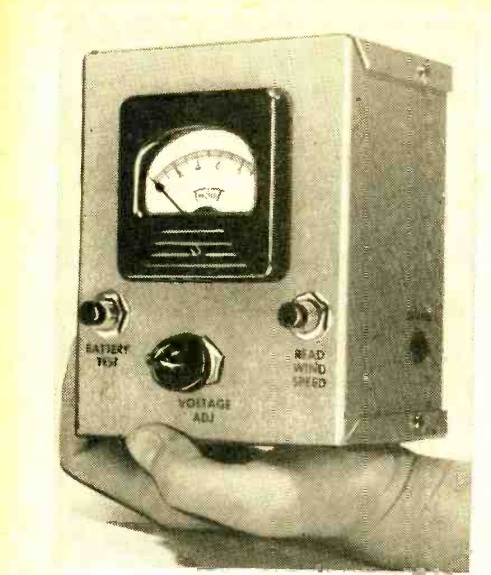
But it hasn’t always been this way, and 70 years ago, the December 1951 issue of Popular Mechanics pointed out that many beginning radio experimenters were temporarily handicapped by the inability to make measurements, since expensive test instruments were required. But fortunately, the magazine solved that problem by showing how to build test equipment, such as the volt-ohm meter shown above. An analog meter movement, a few resistors, a battery, and a few Fahnestock clips were all that were needed to make a fully functional meter suitable for most ordinary radio work. The magazine showed a similar design for a meter for AC voltage or checking capacitors. That meter also included a bridge rectifier, as well as a filament transformer for powering the capacitance meter.

The meter movement sold for $3.16, and was the most expensive component required.

Keep an eye open for coupons from the usual discount houses (the places with names such as Harbor Tool and Northern Freight). They often have the digital meters for free or practically free as a loss leader. If you need pointers on using your new meter, this classic book from Radio Shack is available on Amazon, and used copies are available at a reasonable price:


Some links on this site are affiliate links, meaning this site earns a small commission if you click on the link and make a purchase.

1961 Student-Built Radio Telescope

1961NovEISixty years ago this month, the November 1961 issue of Electronics Illustrated featured this radio telescope constructed by high school student H. Mark Wahl of Cheyenne, Wyoming. The rack containing the electronics was a school locker. The door of the locker was removed to form the door, and the equipment was mounted facing what used to be the back.

The equipment consisted of a standard FM broadcast receiver which had been converted to AM by eliminating the limiter and discriminator. A tuned RF amplifier, apparently for 108 MHz, was added to beef up the sensitivity. The IF output was connected to what looks like a Hallicrafters S-30B tuned to 10.7 MHz. This fed two recorders, one connected to the voice coil of the receiver’s speaker, and the other one connected to the S-meter. The recording of the audio output was accomplished with a pivoted wooden arm. The other end held a pen which recorded on a strip of paper driven by a motor.

The recorder hooked to the meter consisted of a straw from a broom, which recorded a trace on a soot-covered cylinder turned by a wind-up alarm clock, creating a 12 hour record.

The antenna consisted of two folded dipole antennas, probably made out of TV twin lead, mounted horizontally and parallel to each other, about a hundred feet apart. With identical lengths of feed line, the signals would arrive in phase, and be identical. The antenna pattern would have a number of lobes, one of which was straight up. However, if an additional half wavelength of feedline was added to one side, the two signals would arrive out of phase. The pattern would be similar, but the signal from straight up would be nulled out. By using the difference of these two signals, the interferometer was able to null out everything but the signal from straight up. Thus, any terrestrial interference would be eliminated, and the antenna would see only the cosmic noise coming in from directly overhead.

While we think of most radio astronomy taking place at higher frequencies, there’s no reason why frequencies just above the FM broadcast band can’t be used. For example, this 2014 experiment used 38 European radio telescopes to detect radio signals from a distant galaxy on 115 MHz. Those 38 dish antennas probably provided a better signal than two folded dipoles a hundred feet apart, but they used the same principles to combine the signals.

Unfortunately, the article doesn’t give too many practical details on the construction of the set. And other than the author’s assertion that it was “relatively simple, but it works,” there’s little detail on what observations he made.

We’ve previously written about another group of students in Britain who built a radio telescope in 1959.  This website specializes in science fair projects that a student and frazzled parents can whip together in one evening, and we have many that fit that category.  Building your own radio telescope is definitely not in that category. But students were doing so 60 years ago, and there’s really no reason why an advanced student (or maybe a student who’s not so advanced, but just likes to tinker with electronics) can’t do the same thing today.


Some links on this site are affiliate links, meaning this site earns a small commission if you click on the link and make a purchase.

1946 Electromatic Chairside Radio Bar

1946NovRadioRetailing3Seventy-five years ago this month, the November 1946 issue of Radio Retailing
carried this ad for the Electromatic model 609 Bar Radio. As you can see, the company sold the same style of radio-phonograph as either a chairside or tabletop model. It looks like they did a run without the phonograph, but there was a void under the lid where the phonograph was supposed to go. Who needs to listen to records if they have booze, so the logical thing to do with that spot was to turn it into a bar. The company reported that the model was selling faster than rare scotch.

You would want to be careful not to spill into the radio, although I suppose if the contents were high enough proof, they would do little other than give the chassis a good cleaning.

I’ve found references to the Model 608A and 607A, but haven’t found any evidence that any of the Model 609 Radio-Bars ever made it into production.


How to Become a DJ: 1961

1961NovBLSixty years ago this month, the November 1961 issue of Boys’ Life carried this article about what was probably the dream job of many a young man–a radio station DJ. The job meant odd hours and working weekends and holidays, but it was still a sought after position, and stations were hiring.

The author, DJ Arthur S. Harris, Jr., noted that in earlier years, the local station typically just carried network programs, with the staff announcer earning his pay merely by giving station ID. But programming was becoming local more and more, and the position of announcer often became that of DJ, spinning the records.

A few DJ’s in big cities could get salaries of over $25,000 per year, but starting pay was about $65 to $70 per week, which could probably grow to $150 a week.

To get started, the main advice was to practice. A tape recorder was an indispensible tool to record examples off the air to study, and to make practice tapes. Finally, audition tapes could be sent to radio stations. Schools and libraries might have a recorder that could be used, or a second-hand recorder could be had for about $50.