Category Archives: Radio history

1962 One Tube Radio

1962SpringRadioTVExp3Some of our readers are beginners, but we have no doubt that they are serious beginners. Therefore, we are sure that this one-tube broadcast receiver from 1962 will be of interest. The chassis is made of plywood, and empploys a singe 6SN7 tube. Half of the tube serves as a regenerative detector, with the other half amplifying the audio. A “dry” rectifier is used in the power supply, although a semiconductor diode could just as easily be substituted. The chassis was made of plywood, handsomely stained, and the result was an effective personal or bedside receiver, sure to provide the maker with many pleasant experiences. The project appeared in the Spring 1962 issue of Radio-TV Experimenter.


Don Leary’s Record Store, Minneapolis, 1947

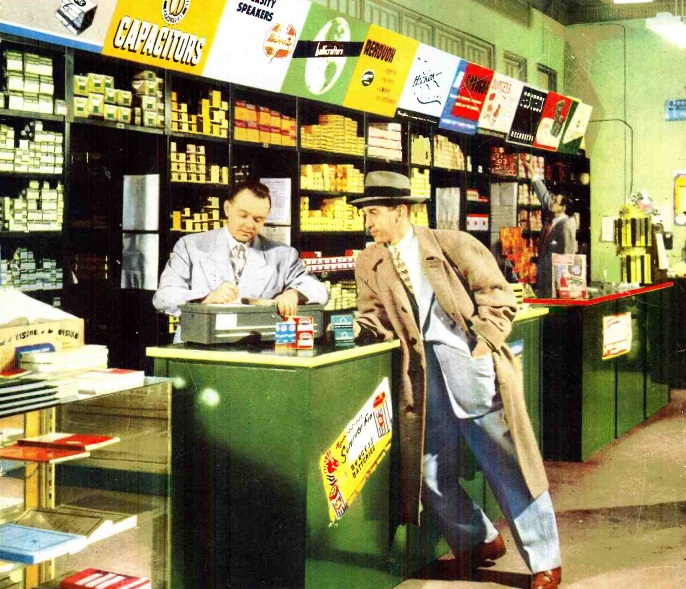
1947AprRadioRetShown here from 75 years ago are some views of Don Leary’s record store in Minneapolis. These images appeared originally in an issue of the store’s 12-page Don Leary Record News, which went out to over 25,000 people every month.  The image was reprinted in the April 1947 issue of Radio Retailing., and that magazine highlighted the store’s ongoing advertising campaign, and the monthly newspaper was a key part of that advertising. The emphasis was on records bulletins and lists, but also highlighted the other aspects of the store’s business, namely, radio, appliances, and service.

The store had over a quarter million records in stock, and its business philosophy was that the logical place to buy a radio or phonograph was where you bought your records. It was good business, since the satisfied customer would keep coming back for records.

In addition to its own newspaper, Leary reported that the store was the largest user of newspaper advertising space of any record store in the region. He also made a point of having friendly relations with reporters, who came to quote him as the expert in all things involving records. For example, he had recently been quoted in the Minneapolis Star-Journal regarding juke boxes, which he viewed as a good thing for the welfare of city youngsters. (Incidentally, it was an industry in which he was also involved.)

More biographical information about Don Leary can be found at this link.  The store was opened in 1941 at 56 East Hennepin Avenue, on Nicollet Island. That address doesn’t really exist any more, but would be at the spot indicated on the Google Maps image below:

NicolletIsland

Nicollet Island, 2022 (Google maps) and 1940

The aerial view at the right was taken in 1940, and shows a business district along East Hennepin, the street connected to the mainland by the two bridges. Over the years, East Hennepin was paired up with First Avenue Northeast as complementary one-way streets. On the island, they form a short four-land divided road, and there are no lots directly adjoining it. To the North, there is now a view of De La Salle High School, and to the South, there is now a view of the Nicollet Island Inn, both of which would have been obscured by buildings on East Hennepin in the 1940’s.  Leary’s store would have been one of the buildings on the South side of the street, probably the fourth one from the left.

I write about a lot of people on this site, and I think this is the first time I’ve written about someone who I personally met back in the day. I believe East Hennepin got its current configuration through the island in the early 1970’s, and Don Leary’s was long gone by the time I remember being there. However, from 1971 through 1979, he owned a record store in a small suburban strip mall at 2927 NE Pentagon Drive, St. Anthony, MN.

Despite the small size of that store, he probably still had a quarter of a million records in stock, of all genres. I was looking for something by Jimmie Rodgers, the Singing Brakeman (1897-1933).  I asked Leary, who seemed to run the store as a one-man operation whether he had anything, and he asked me whether I actually meant the unrelated Jimmie F. Rogers, who was born the year the elder Rodgers died. When I let him know that it was the Singing Brakeman I was after, he commented something to the effect that he went way back, but showed me an assortment of his records.

Leary died in 2000 at the age of 92.


End of Civilian Radio Production: 1942

1942AprRadioRetAs we’ve previously reported, civilian radio production in the United States ended for the duration of the war on April 22, 1942.  The graph above, which appeared on the cover of the April 1942 issue of Radio Retailing, showed how critical the radio repairman would be to keep the nation informed.  As of that date, there were 57 million radios in American homes.  In the years prior to the war, about 10 million new sets were made each year, but about 5 million old sets were scrapped by their owners each year, for a net increase of about 5 million.

With the end of production, the supply would remain at 57 million for the duration–but only if every radio was kept in service.  If the prewar trend of 5 million radios per year being scrapped continued, then the number would be as shown in the graph at the right.  And if repair parts became unavailable, then the situation would be even worse.  The supply of radios would plummet, as shown by the steeply declining graph.

The message was clear:  To keep the American public informed, dealers would need to concentrate their efforts on repairs, and manufacturers and the government would need to make sure that repair parts remained available.


1962 One Tube/One Transistor Broadcast Set

1962AprPE1Sixty years ago this month, the April 1962 issue of Popular Electronics carried the plans for this hybrid one-tube/one-transistor receiver for the broadcast band. According to the magazine, the set would provide room-level volume on local broadcast stations, and while not hi-fi, was more listenable than one would expect from such a simple circuit.

The detector used a 12AE6-A tube as grid-leak detector. Since the tube was intended for hybrid car radios, it could run on a very low B+ voltage. In this case, that was 12 volts supplied by a filament transformer. The audio amplification was handled by a 2N231 germanium PNP transistor. The final semiconductor component was a 1N34 diode serving as rectifier.

The tuning coil was wound honeycomb style on a cardboard form. The set was said to pull in the local stations with an 8 foot antenna tucked behind a bookcase.

1962AprPE2


Prismatone Organ: 1947

1947AprRadioCraftThis musician is playing the Prismatone electronic organ, what the April 1947 issue of Radio Craft asserted “promises to be by far the most attractive of all the lower-priced electronic music instruments.” The musician here was highly skilled, as the magazine noted that the instrument required a skilled operator.

The instrument consisted of a projector sending a beam of light through a translucent disc, which projected a rapidly altering pattern. The colors are solely for the benefit of the operator, as the instrument instead depended on the frequency of the pulsating light beam caused by the disc. The two wands contain photocells, and their output is the same frequency as the portion of the light at which they are aimed. Volume can be changed by altering the angle at which each wand was held. The outputs were fed into a high-fidelity audio amplifier.

The magazine noted that for an even more spectacular effect, the musician can wear finger rings with small selenium photocells in lieu of the wands.

The instrument was created by one Mr. Leslie Gould, a “well known Connecticut inventor of many electronic devices,” including “the Sonicator, a radar-like instrument for small boats.” One of Gould’s earlier inventions, part of a tuning mechanism, was at issue in Levy v. Gould, 87 F.2d 524 (C.C.P.A. 1937).


April 1957 Multiband Antenna

1957AprQSTQST often contains cutting-edge technical articles, and the magazine’s April issue often contains the finest. It was no exception 65 years ago, and the April 1957 issue contained an article by prolific contributor Larson E. Rapp, WIOU, regarding the antenna shown above. Rapp noted that ferrite “loopstick” antennas worked well for AM radios, and surmised that they would make excellent multi-band transmitting antennas. He hoisted the model shown here atop his flagpole, and found that it performed exceptionally well.

But Rapp, being the technical genius that he was, carried the idea a step further. He noted that many antenna books depicted an antenna, along with its “image” directly underneath, below the ground. He surmised that if he buried the antenna, then the image would appear above the ground, without the need for any unsightly visible structure. He was able to get down to 35 feet, where he hit bedrock, and he buried the antenna there. He then hoisted a field strength meter up the flagpole, and sure enough, the maximum signal strength was achieved at 35 feet.


90 Year Old Radio Fan: 1922

1922Mar31WilmingtonIn 1832, Andrew Jackson was re-elected President of the United States. It would be twelve years before Morse would demonstrate his electric telegraph between Baltimore and Washington. Slavery still existed in half of the United States, and would for more than thirty years. Abraham Lincoln wasn’t yet a lawyer, but held a bartending license and was about to make an unsuccessful bid for the Illinois General Assembly. Communications with other towns took days, if not weeks. In short, it was a long time ago. But people born that year would listen to the radio in their lifetime. But people born that year would listen to the radio in their lifetime.

But a lot was about to change. The news clipping above appeared in the Wilmington Daily Commercial.

Mrs. Sarah Frederick of Turtle Creek, Pennsylvania, was an avid radio listener. The paper noted that she was an avid listener to the radio chapel services from KDKA, and that she had recently celebrated her 90th birthday. She was totally blind but had frequently expressed her wonder and delight at this product of modern science.

And she was born in 1832.


Future of Wireless: 1947

1947MarBLSeventy-five years ago this month, the March 1947 issue of Boys’ Life offered scouts some predictions about what wireless communications might look like in the future. The words “handi-talkie” and “walkie-talkie” had entered the lexicon, thanks to military use of portable transceivers, and the magazine predicted that civilians would soon be enjoying their widespread use.

It starts by noting how a radio-equipped newspaper reporter could easily scoop the other papers, but the equipment was getting lighter, smaller, cheaper, and simpler, and the magazine predicted that use would be widespread.

The FCC had already authorized the citizens’ radio service on UHF, and the magazine noted that the FCC had allocated a full “10,000 kilocycles” of spectrum to the service.

The magazine hinted that a link to the telephone network wasn’t far off, and you would soon be able to “make, or receive, phone calls from your family car as you drive along.” You could even call another car!

The magazine did get some things right:

As the things come into common use, there will be a field day for cartoonists and gag writers. All kinds of funny new situations will arise when all of us begin to walk around, carrying on phone conversations as we go.

But, funny or not, the day is bound to come. As someone once remarked, ‘the world do move.’

And they got one more thing mostly right:

Taking one hand off the wheel might constitute a traffic hazard, so there is room for improvement in the equipment. Perhaps our engineers will soon be able to give us a radio telephone that works like a radio microphone and loud speaker. Then the motorist would be able to carry on his conversation simply by touching a button with his left foot, leaving both hands on the wheel. Automatic transmissions are foot eliminating clutches anyway, so the driver’s left foot will be free to take on a new job beside that of just dimming the lights.


Radio Repairmen: Carrying the Whole Load

1942MarServEighty years ago, the radio servicemen of America were rolling up their sleeves, because as of April 22, 1942, as we’ve previously reported, they would carry the whole load of making sure Americans had access to the vital information and entertainment provided by their radios. Just as before, they would have to keep doing minor repairs. But in the past, there had been some sets that were so far gone that they would just be thrown away and replaced.

But the last new radio would roll off the assembly lines on April 22, so throwing away an old set was no longer an option. Many of the sets needing repairs would be older, so this ad encouraged dealers to order a full set of Rider manuals, which consisted of schematics and service data for virtually every radio built in the USA.

The ad appeared in the March 1942 issue of Service magazine.


1952 Radio-Intercom

1952MarPM11952MarPM2Traditionally, the March issue of Popular Mechanics carried a radio project dubbed the “Little Giant,” a project aimed at advancing students who could make something serving a useful purpose. The March 1952 issue carried on the tradition with the set shown here. It was the customary five-tube superheterodyne, but it also included an intercom.

The magazine noted that a good radio combined with an intercom was an instrument of pleasure as well as utility. It could allow you to listen to the radio in two places, or it could be used as a monitor to send programs to or listen in to the kids in the nursery.

All of the controls were on the master station. The remote consisted of just a speaker, which also doubled as the microphone.

1952MarPM3