Category Archives: Radio history

1942 One Tube Receiver

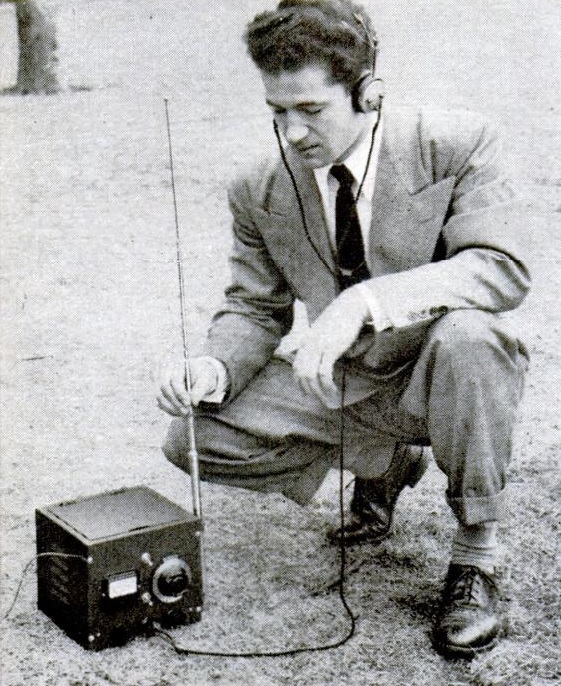
1942MayRadioCraftpEighty years ago this month, the May 1942 issue of Radio Craft showed how to put together this simple one-tube receiver. Being a battery set, there was no need to worry about hum, and the batteries were inexpensive. The B+ voltage was only 7.5 volts, so even with a large dry cell for the filaments, the battery cost was only 58 cents.

The set used a 1S4 tube as regenerative detector. It had two bands, which were switched by moving an alligator clip on the antenna coil. The overall tuning range was 480 kHz through 2.5 MHz, meaning that it covered the entire broadcast band, plus a little bit above and below. Thus, the set could also be used to pull in ships as well as police broadcasts.

1942MayRadioCraftS


1947 Three-Tube Regen

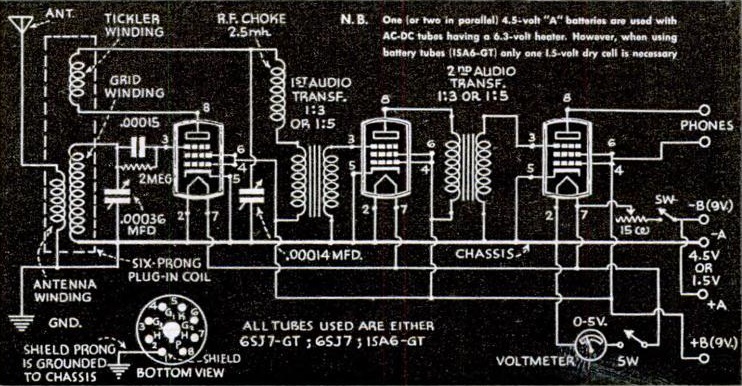
1947AprRadioNews6Seventy-five years ago this month, the April 1947 issue of Radio News, showed how to construct this three-tube (plus rectifier) regenerative receiver for the broadcast band and shortwave. Five plug-in coils covered the standard broadcast band, as well as the 160, 80, 40, and 20 meter ham bands, as well as adjoining shortwave broadcast frequencies.

The article noted that since the war ended, interest in shortwave had reached a new high, and this set provided a simple way to catch these signals. Due to scarcity of power transformers, and AC-DC design was used, with a 35Z5GT rectifier.

The radio itself consisted of a 12SJ7 regenerative detector, 12J5 first audio stage, and 50L6GT output, which provided loudspeaker volume to a dynamic speaker.

1947AprRadioNews7


1962 Stereo Headphones

1962SpringRadioTVExp

Among the youth of America, headphones are more than a means of delivering music. They are now a status symbol, to the point where there have been murders over popular brands of headphones. Here are some popular brands, and note the price tags:


Sixty years ago, this young man was a trendsetter, and we can only conclude that he was the coolest kid in class, since he was the first to have a pair of stereo headphones. Since there was no such thing on the market, he made his own. In addition to undoubtedly being a chick magnet, they probably sounded better than the expensive ones today. The plans were contained in the Spring 1962 issue of Radio-TV Experimenter.

The speakers were actually 3-inch replacement speakers for a transistor radio, but since they were driven at such a low level, there was very little distortion. And the response could be adjusted by means of a cardboard baffle. Bass notes went through the cardboard just fine, but to adjust the response at the high end of the range, the size of the hole could be varied. The stylish design was made with plastic cups, cardboard, foam rubber, and tempered brass wire. It was all held together with a little bit of contact cement.

1962SpringRadioTVExp2


Some links on this site are affiliate links, meaning that this site earns a small commission if you make a purchase after clicking the link.

1932 Grocery Prices

1921Apr25AandPFor a snapshot of grocery prices during the Great Depression (and a look at what was on the radio), this ad for A&P appeared in the Washington Evening Star 90 years ago today, April 25, 1932.

FDR had just taken over as President the month before, and the Bank Holiday of March 6-13 was still fresh on everyone’s minds. The prices look low, but there’s been a lot of inflation since then. According to this online inflation calculator, one dollar in 1932 is the same as $20.99 in today’s money. So the ground beef for 17 cents a pound is the same as $3.57 a pound in today’s money. Bacon was 13 cents a pound, the equivalent of $2.73 a pound today. Those prices weren’t too bad, but the can or corn or beans sounds like a bargain at 4 for a quarter, but that’s the same as $1.31 a can. Coffee was 19 cents a pound, and cigarettes were 12-1/2 cents per pack.

For those who didn’t like to cook, you could buy a 16 ounce jar of freshly prepared chicken and noodle dinner for 29 cents, ready to heat up at home. But you would pay a premium for not knowing how to cook, since that was the equivalent of over $6 in today’s money.

If you were shopping for your family’s dinner, what would you buy?

The ad also points out a time change for two radio programs.  Apparently, New York, where the programs originated, had just switched to Daylight Savings Time, resulting in a time change for the live program in Washington.  The store sponsored “Our Daily Food,” a program for tips for homemakers, at 8:45 AM.  And on Monday evenings at 8:00, they were the sponsor of the A&P Gypsies, which ran from 1924-36.


1937 Philco Phone Intercom

1937AprRadioTodayEighty-five years ago this month, the April 1937 issue of Radio Today contained this Philco ad reminding dealers of the profits to be made selling intercom systems, specifically the Philco Phone.

A set of two stations sold for $49.50, and additional stations were available for $10 each. The ad noted that even small offices, such as one or two doctors or dentists and a receptionist, could benefit from the set. And businesses such as garages, restaurants, and theaters could put themto good use.

And it was an easy sale for the dealer, with no trade-ins, no expensive installation, or service worries.

And there was even an untouched market in the “better homes” in the community.


Last Prewar Radio

1942MayRadioRetToday marks the 80th anniversary of the end of civilian radio production in the U.S. for the duration of World War II, and shown here is the last radio to roll off the RCA assembly line before the company switched over exclusively to defense production.

RCA was actually ahead of schedule, and this radio-phono was manufactured in Camden, N.J., on April 7, 1942. The chassis had been completed on March 5.

This last set was donated to the Georgia Warm Springs Foundation, where it would uplift the spirits and morale of the young patients there.

The picture appeared in the May 1942 issue of Radio Retailing.


1947 One-Tube Regen

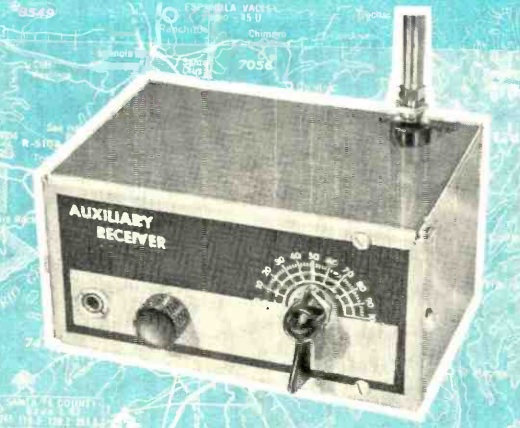
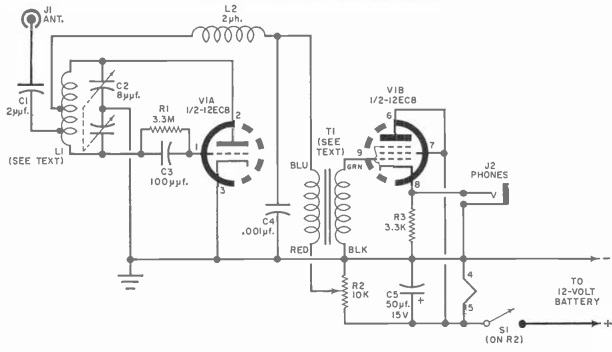
1947AprRadioNews1947AprRadioNews2The plans for this handsome little one-tube receiver appeared 75 years ago this month in the April 1947 issue of Radio News.

The magazine noted that this simple circuit was one of the most useful pieces of equipment you can build. Obviously, it could be used as an extra receiver, but could also be put to other uses as well.

One half of the 1G6-GT tube served as regenerative detector, with the other half serving as audio amplifier to drive a pair of magnetic headphones. (The article points out that crystal earphones wouldn’t work with this circuit.) It is mounted on a 5 by 7 inch plywood base, with a front panel made of sheet steel. With four plug-in coils, the set would tune from below the broadcast band up to 18 MHz.

1947AprRadioNews3


1922 Crystal Set

1922SciInv1A hundred years ago this month, this receiver was the winner of first prize in a contest run by Science and Invention magazine, and appeared in the April 1922 issue. The set was said to be adequate for pulling in stations 15-20 miles away. The only tools required to construct it were a knife and small nail, it could be built in about 30 minutes, and the cost was only $30, including headphone and antenna. The phone receiver was the most expensive component at about $2, and the cost of the set itself was only 21-1/2 cents.

With a 25 foot antenna in New York, the set was said to pull in stations WDY and WJZ. In fact, the author reported that on several occasions, the phone could be held about six inches from the ear with music and voices clearly distinguishable.

The author, and winner of the $100 first prize was James Leo McLaughlin. You can see some more of his receivers at this link.


All of the parts are readily available, if you don’t have them around the house already. The chassis is a 4-inch diameter cardboard container. You can probably ask a friendly restaurant to give you one of their takeout containers, or you can use the time-honored crystal set chassis, namely, an oatmeal container.  The terminals are brass paper fasteners and paper clips.  You’ll need some 26 gauge enamel wire for the coil, and wire of any size for the antenna. In lieu of the headphone, it’s easiest to use a high-impedance crystal earphone.

Finally, the article calls for a piece of silicon or galena for the detector. The gift shops of most science museums have an assortment of minerals for sale, galena being one of them. Or, like everything else, you can order it from Amazon.

1922SciInv2


Some links on this site are affiliate links, meaning this site earns a small commission if you make a purchase after clicking the link.

Texas City Disaster: 1947

Parking lot a quarter mile from the blast. Wikipedia photo.

Saturday marks the 75th anniversary of the deadliest industrial accident in U.S. history, the Texas City disaster of April 16, 1947, which started as a fire aboard the French-registered vessel SS Grandcamp docked at Texas City, Texas, with 2200 tons of ammonium nitrate. The disaster killed at least 581 people, including all but one member of the Texas City fire department.

Smoke was spotted in the cargo hold of the Grandcamp at about 8:00 AM. The captain ordered his crew to steam the hold, which probably made matters worse by converting the ammonium nitrate to nitrous oxide.

Spectators gathered, believing that they were a safe distance away. The sealed hold began to bulge, and water splashing against the hull began to boil.

The cargo detonated at 9:12 AM, with a blast leveling over a thousand buildings on land and destroyed the Monsanto chemical plan and ignited refinery and chemical tanks on the waterfront. Bails of twine from the cargo were set afire and hurled around the city. People in Galveston, 10 miles away, were forced to their knees, and the shock wave was felt as far as 250 miles away.

The ironically named SS High Flyer was docked nearby, and the blast set fire to that ship’s cargo of ammounium nitrate. Fifteen hours later, that ship exploded.

Hams Take To The Air

As might be expected, the blast destroyed much of the city’s communication infrastructure, and amateur radio operators quickly responded to fill the gap.  Many of these stories are detailed in the July 1947 issue of QST (pages 38-40).

B.H. Standley, W5FQQ, on the air at city hall, along with city clerk Ernest Smith, Nurse Mrs. E.L. Brockman.

B.H. Standley, W5FQQ, on the air at city hall, along with city clerk Ernest Smith, Nurse Mrs. E.L. Brockman.

By noon, the first amateur portable and mobile stations had moved into the city and were on the air, working in conjuction with Army, Navy, Coast Guard, U.S. Engineers, FBI, and local and state police. Links were quickly set up between City Hall and stations in Houston and San Antonio. Most traffic was handled on 75 meter phone and 80 and 40 meter CW. W5KMZ reportedly handled over 200 messages, mostly involving needed medical supplies. As the hours went on, additional traffic was handled by W5FQQ at the mayor’s office, with over 300 messages passing on behalf of city officials, the Army, Red Cross, and Salvation Army.

An impromptu three-way net was established on 3989 kHz between Texas City, Galveston, and Houston.  The FCC issued an order clearing the frequencies between 3840-3860 kHz, as well as 7050 for emergency use.

Two hams, W5FQQ and W5EEX, had been advised to evacuate but remained at their stations. They narrowly escaped death when the High Flyer lived up to its name with its explosion. W5FQQ was on the air at the time of the blast, and the blast was heard by W5IGS in Houston. 21 seconds later, the Houston station experienced his windows shaking.

W1AW declared the emergency to be over 11 days later, on April 17.

Broadcasters Cover the Disaster

Broadcasters also did their part to provide emergency relief.  The FCC allowed broadcast stations to carry personal messages, ordinarily not permitted by the rules.  According to the April 21, 1947, issue of BroadcastingKPRC, the Houston NBC affiliate, was the first to announce the explosion of the French ship. A mobile crew was rushed to Texas City, and the station was able to feed live descriptions of the tragedy. It also broadcasts lists of wounded at hospitals in Galveston, Houston, and other nearby towns.

Another Houston station, KTHT, similarly acted in the public interest. The Texas Highway Patrol used the station as an unofficial traffic control outlet, warning away sightseers and directing public service vehicles. The station was on the air on a 24 hour basis, and no commercials were aired for two days. In fact, when the High Flyer exploded, the sound was carried live over the station’s report.

KXYZ and KTRH in Houston, as well as KRLD Dallas broadcast emergency information.

In Galveston, KGBC aired the first bulletin minutes after the first explosion, and aired 24 remote broadcasts. Normally a daytime station, it was granted authority to broadcast 24 hours.

KLUF in Galveston also remained on the air on a 24 hour basis, with emergency messages given priority. Long lists of the dead, missing, and injured were also aired.

KPAC in Port Arthur, a station we’ve previously featured, also carried emergency announcements and instructions from police and other officials. Another Port Arther station, KOLE, chartered a plane to get newsmen to the scene.

In San Antonio, WOAI received a request from the NBC network to charger a plane, fly over the area, and report back in a broadcast from San Antonio. Their description was aired on the network broadcast that evening.

Litigation Ensues

As might be expected, considerable litigation followed, much of it under the Federal Tort Claims Act for alleged negligence of the U.S. Government. The case ultimately made its way to the U.S. Supreme Court, Dahelite v. United States, 346 U.S. 15 (1953), in which the court held that the Government was not liable, since all of the claimed government negligence amounted to discretionary acts.


1947 Two-Tube Transmitter for 80 and 40

1947AprRadioNews4From the April 1947 issue of Radio News, this three-piece unit is a simple transmitter for 80 or 40 meters. The transmitter itself is the center chassis, using two tubes to put out 10-30 watts with a crystal-controlled oscillator and one stage of amplification. It will load up into a longwire, a tin roof, or just about anything that’s available. The main advantage of the additional RF stage is to keep the antenna from loading down the oscillator, and the author notes that the RF stage is untuned, so you don’t have to worry about it breaking into oscillation.

If desired, the modulator stage will turn the set into a ‘phone rig, but for the CW man, this can be dispensed with.

The author, Byron Lindsey, Jr., W4BIW, an engineer at WSB, reported that the transmitter could be put together on a single rainy day, and that a similar design had been use at his station for ten years.

1947AprRadioNews5