Category Archives: Radio history

Boy Scout Broadcasts, 1941

1941FebScoutingMag

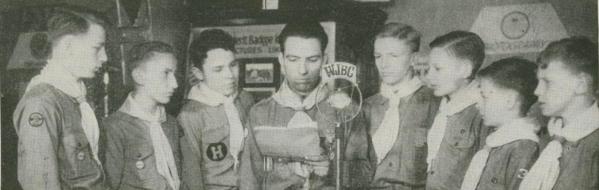
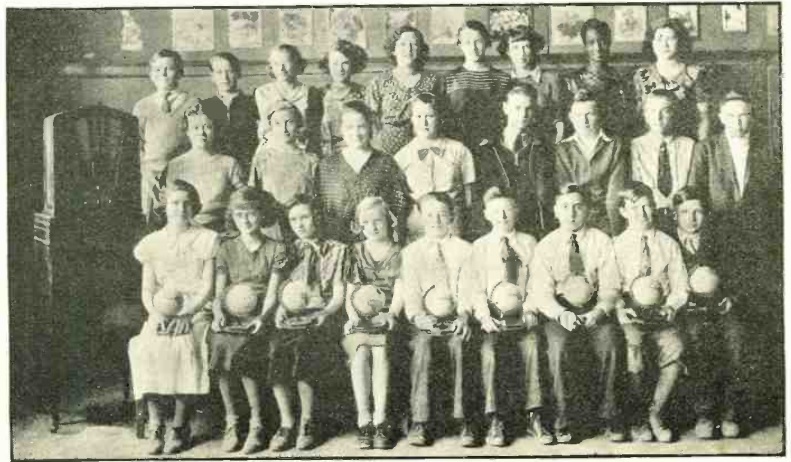
Shown here are the Scouts and Scoutmaster of Troop 3, Bloomington, Illinois, presenting a radio broadcast over station WJBC, Bloomington-Normal Illinois. The photo appeared in the February 1941 issue of Scouting magazine, along with pointers for troops and local councils to put on Scout broadcasts. The article stressed that putting on a broadcast was not a small undertaking, and would require a great deal of effort by the Scouts and Scouters involved. It did note, however, that stations could be receptive to the idea: “Local stations in all parts of the country make a practice of devoting a certain amount of their time on the air to educational sustaining programs. It is generally very easy therefore, for Boy Scouts to secure free time on the air.”

The National Council of the BSA made available scripts for use by local units, and the U.S. Office of Education made available additional scripts that might be appropriate for Scout programs.

Because of the scope of such a project, the article recommended that such efforts were probably best accomplished by local councils, rather than individual troops. In any event, the article stressed that approval from the council must be obtained prior to approaching any radio station asking for air time.

Click Here For Today’s Ripley’s Believe It Or Not Cartoon


RCA “Foreign Correspondent” Model 14-X Shortwave

1941RCAforeigncorrespondent

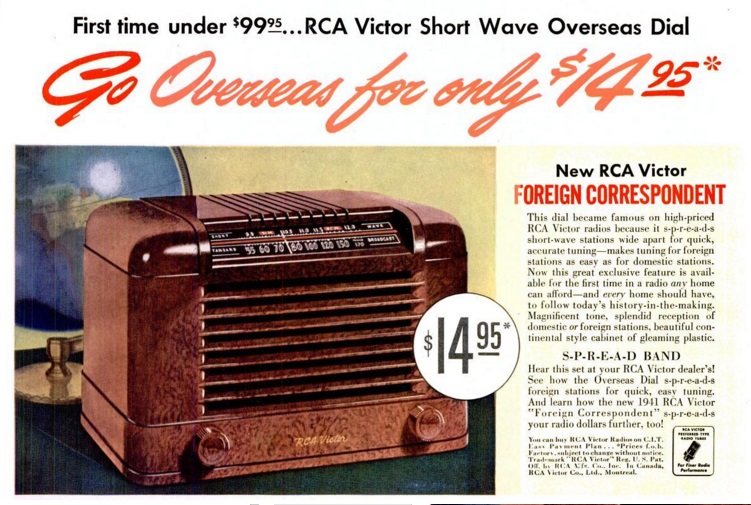
75 years ago, this date’s issue of Life Magazine, February 24, 1941, carried this ad for the RCA Victor “Foreign Correspondent,” also known as RCA model number 14-X.  As the name implies, this set received shortwave as well as standard broadcast, and as the ad points out, the shortwave band was s-p-r-e-a-d for easy tuning.  The set covered 9.5-12 MHz, meaning that it did have reasonably easy tuning of the popular 31 and 25 meter bands.  In the evenings, the set probably did a good job of pulling in war news from Europe.

The set had a price tag of only $14.95, and looks like it was a fairly good performer for the price.  The set was a basic “All American Five,” with a tube lineup of 12SA7 12SK7 12SQ7 50L6GT 35Z5GT.  It had provision for an external antenna.  The limited shortwave frequency coverage probably did make it considerably easier to tune those bands.

A nicely preserved version can be found at the Radio Attic Archives.


1956 Boys’ Life Radio Contest

1956FebBL

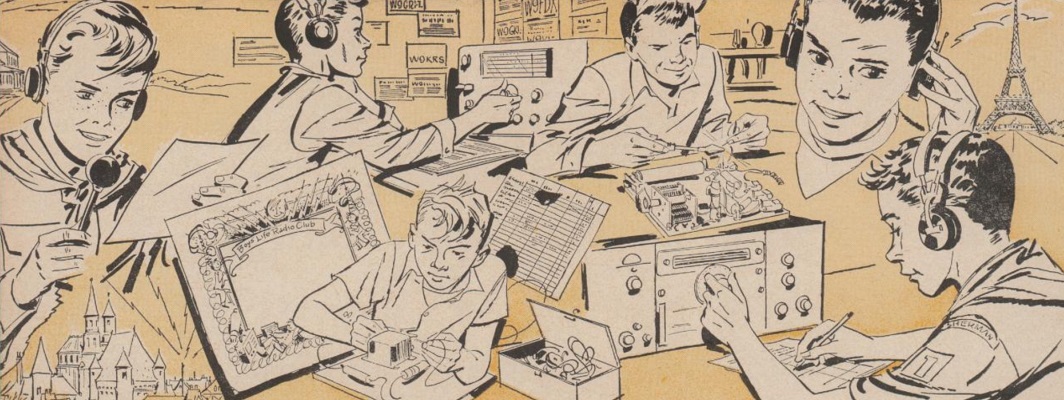
Sixty years ago this month, another Boys’ Life radio contest was underway, as shown by these scouts pictured above in the February 1956 issue of the magazine.

The issue carried an extensive article detailing how scouts could pull in numerous stations, both amateur and broadcast, from around the world.


1936 World Explorers

1936FebRadioNews

Shown here in the February 1936 issue of Radio News are the members of the World Explorers Club of Kern Road Junior High School in East Detroit, Michigan. According to the magazine, the club’s purpose was to enjoy and understand transmissions of the people of foreign lands over shortwave radio. The magazine noted that the list of stations they received regularly was too long to publish.


Washington’s Birthday Relay, 1916

Screen Shot 2016-02-19 at 10.31.59 AM

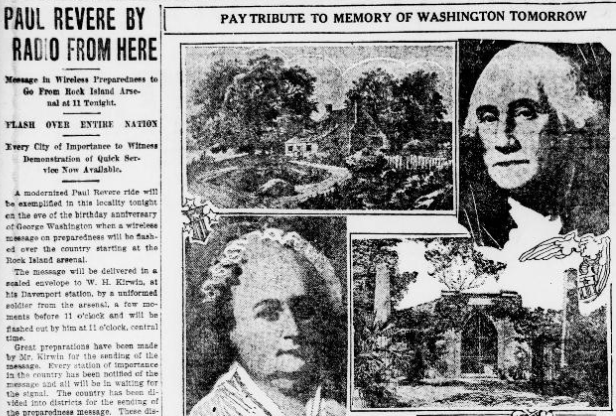
A hundred years ago today, American radio amateurs showed that they could successfully relay a message coast to coast, as part of the Washington’s Birthday relay.  At 11:00 PM Central Time on February 21, 1916, a soldier from the Rock Island Arsenal delivered a sealed envelope to W.H. Kirwin, 9XE, in Davenport, IA. By pre-arranged routing, the message was flashed across the country in a matter of minutes.

The message from the commander of the arsenal was delivered to the governors of the several states, to the mayors of large cities, and even to the White House.  The message read as follows:

QST QST QST DE 9XE

A Democracy requires that a people who govern and educate themselves should be so armed and disciplined that they can protect themselves.

(Signed) Colonel Nicholson, U.S.A.

References


Hallicrafters S-29 Sky Traveler

HallicraftersS29

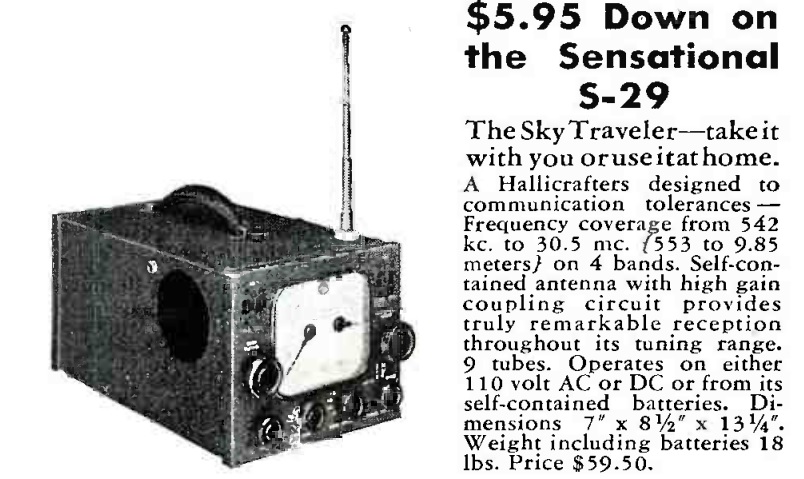
The advertisement shown here for the Hallicrafters S-29 receiver appeared 75 years ago in the February 1941 issue of Radio News.  This early portable communications receiver, dubbed the Sky Traveler, covered the broadcast band through 30 MHz in four bands.  It could run either on internal rechargeable batteries or from AC power.  It had a lineup of 9 tubes, including the 50Y5GT rectifier.  All other tubes were one volt filament types.  The set did have a BFO for listening to code, with one tube (a 1G4GT) dedicated to that purpose.

The full manual for the receiver is available online.  You can see a restored version in operation at the following video:

https://www.youtube.com/watch?v=DOMNPVFMcb8

Click Here For Today’s Ripley’s Believe It Or Not Cartoon


Guernsey Occupation Crystal Set, 1944

Imperial War Museum image, © IWM (COM 501).

Imperial War Museum image, © IWM (COM 501).

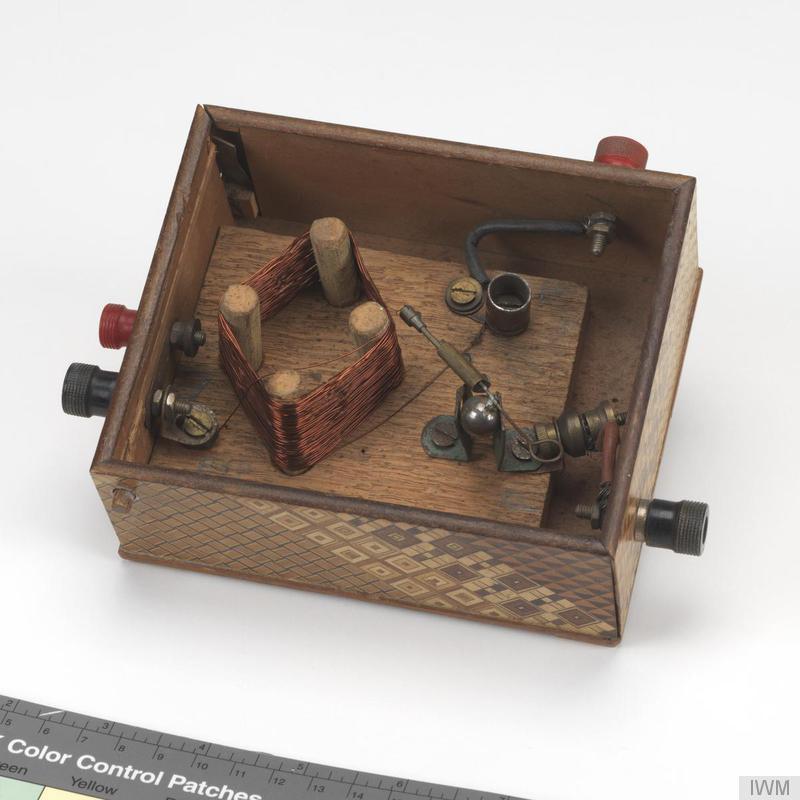
The crystal set shown here is from the collections of the Imperial War Museum.

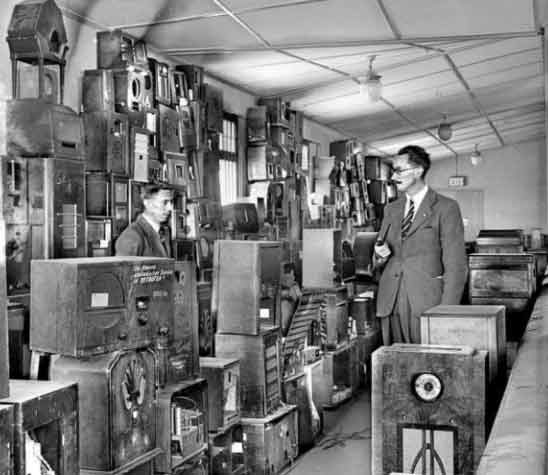
The Channel Islands were the only part of Britain that were under German occupation during World War 2, and while islanders were initially allowed to keep their radio sets, they were eventually confiscated. In response, many residents obtained crystal sets such as the one shown here. This one was manufactured in Guernsey in 1944.

Evening Post photo of confiscated radios in Guernsey, via TheIslandWiki.org.

Evening Post photo of confiscated radios in Guernsey, via TheIslandWiki.org.

The plans for the set were broadcast by “Colonel Britton” of the BBC. This set, along with about 50 others, was manufactured by the person who donated the set to the museum. The coil was made of wire stolen from a German car, and the crystals were made by mixing sufur and lead, baked in a fire in a German rifle cartidge case.

Occasionally, the wavelength of the BBC broadcast would change, at which time “Colonel Britton” would announce that more windings would need to be added to the coil. Either a radio headphone or a telephone receiver could be used to listen.

Read More at Amazon


Click Here For Today’s Ripley’s Believe It Or Not Cartoon


A Montana National Parks On The Air Activation

Big Hole Battlefield, Wyoming. NPS photo.

Big Hole Battlefield, Wyoming. NPS photo.

Tim, AE7PJ posted an interesting video showing his experience as an activator in the ARRL National Parks On The Air (NPOTA) event. He was operating from near Wisdom, Montana, at a point where three National Park Service units converge: The Big Hole Battlefield, the Nez Perce Historic Park, and the Lewis and Clark Trail.

The Lewis and Clark Trail traces the route of the 1804-06 Corps of Discovery from Illinois to Washington.  This particular spot was along the route of Clark’s return journey, following the Yellowstone River and then along the route of modern day Interstate 94. The Big Hole National Battlefield is the site of the August 9, 1877, Battle of Big Hole between the U.S. Army and the Nez Perce encamped there.  The National Battlefield is one of six units in four states of the Nez Perce National Historic Park, devoted to the history and culture of the Nez Perce (Nimiipuu) people and the 1877 conflict.

Tim condensed his two-hour operation into a nine-minute video, and it sounds like he listed all of the call signs he worked and has a brief snippet of everyone’s audio.  You can see my call, W0IS, scroll by at 5:46, and you’ll hear me saying “59 Minnesota” at 6:08.

Tim was running a Hamstick vertical antenna on his vehicle, the same antenna that I’ve used for my activations so far.  It has the advantage of being inexpensive and convenient to carry around.  It’s not particularly efficient, but as you can see from the video, it gets the job done.  He was running about 100 watts.  My activations have used a Yaesu FT-817, running only 5 watts.  While the 5 watts is adequate for CW contacts, the added power really makes a difference in being able to make voice contacts.

The video references the NPOTA Facebook group, which has become a very active forum for discussing NPOTA, and also providing spots to help other chasers find the stations in the parks, some of which can be quite weak.  In Tim’s case, he had posted his plans, and a number of us kept tuning the band looking for his signal.  I think I was the first one to spot him, but he was too weak to work when he first came on.  While waiting for him to show up, I did have the pleasure of working WC8VOA, the ham station located at the former Voice of America relay station in Bethany, Ohio.  For many decades, that station broadcast worldwide, as documented in the video below.   Two historic sites in one night–not a bad use of radio.

Click Here For Today’s Ripley’s Believe It Or Not Cartoon


Hallicrafters S-31 AM/FM Tuner, 1941

HallicraftersS31

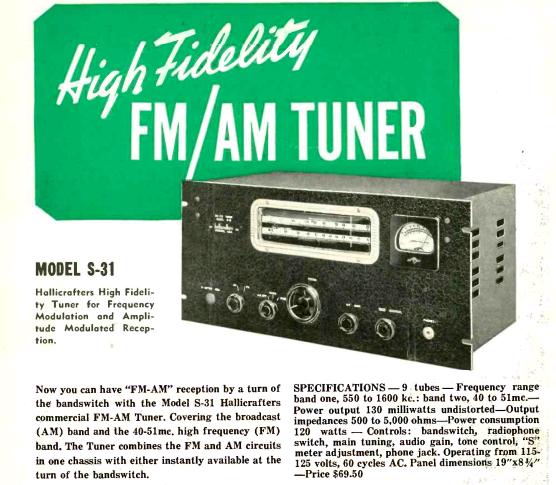
Seventy-five years ago this month, the February 1941 issue of Radio Craft carried this ad for an unusual Hallicrafters receiver, the S-31 AM-FM tuner.

It’s difficult to figure out the exact market this receiver is intended for.  It’s designed for a rack mount, and requires an outboard audio amplifier, since it is just the tuner.  It tuned the standard AM broadcast band, as well as the prewar 42-50 MHz FM band.  It was obviously a high-end piece of equipment.  According to the 1941 Hallicrafters Catalog, the set had a retail price of $69.50.  The matching 25-watt high fidelity audio amplifier retailed for $49.50.

The set’s 9-tube complement consisted of 6SK7, 6SA7, 1852, 1853, 6SJ7, 6H6, 6SK7, 6SR7, and 80.  The standard broadcast IF was 455 kHz, with an FM IF of 4.3 MHz.

Not surprisingly, few seem to be in existence today.  One nice example can be found at LA5KI’s site.


Click Here For Today’s Ripley’s Believe It Or Not Cartoon


Kathleen Wilson, NBC Radio

1941Feb8RadioGuide

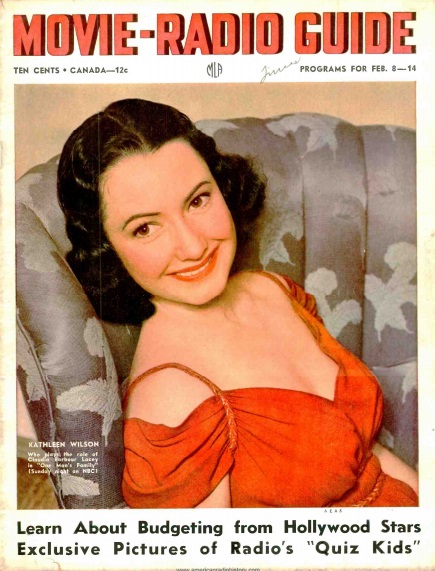
Shown here on this week’s issue of Movie Radio Guide 75 years ago, February 8, 1941, is radio actress Kathleen Wilson, who appeared on the NBC soap opera One Man’s Family.  The program originally aired from San Francisco, but later originated from Los Angeles.  It was one of the first West Coast network programs to be heard on the East Coast.

The series was radio’s longest running serial, spanning 27 years between 1932 and 1950. It also ran on television from 1949-52 on prime time, and again in 1954 and 1955 as a daytime show. The plot centered on Henry Barbour, a San Francisco stockbroker and his family. Kathleen Wilson played daughter Claudia, and continued in the role until 1943 when the character was written out of the story. The character returned in 1945, this time played by Barbara Fuller.

According to the magazine, Wilson was 29 years old.  She married Rawson Holmes, but later divorced and was living with her son in Hollywood.

Claudia, a student at Stanford, was rebellious, and plots often focused on her romances.  The episode “Claudia Says Goodbye to Her Family” is available online.