Category Archives: Radio history

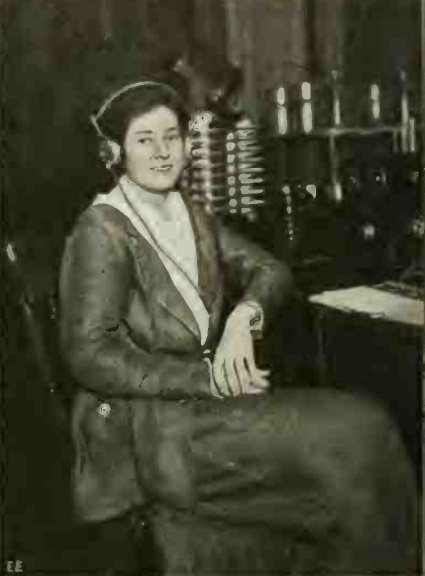
Bernice Ozmuh, WIBO Chicago, 1927

1927SepRadioDigestShown here on the cover of the September 1927 issue of Radio Digest is Miss Bernice Ozmuh of WIBO, Chicago.  According to the magazine, she was the sweet contralto voice that was especially loved by the little folks who listened to her twilight lullabies.  She reported that her favorite role at the station was as gypsy story teller.

The station shared a frequency with two other Chicago stations, WCRW and WHT. In 1928, it carried the audio portion of an early television broadcast from WCFL.  It apparently went dark in 1933, as reported by the Chicago Tribune, May 23, 1933,  when the frequency was assigned to a station in Indiana.


Transistor Radio Repair, 1967

1967SepRadioElectronics1Fifty years ago this month, the September 1967 issue of Radio Electronics gave some pointers for servicemen to tackle the repair of small transistor radios. The article acknowledged that many radio men were unwilling to take on such a small job: “Don’t look at that small pocket transistor set and say, ‘We don’t fix them.’ Why let Joe’s Radio Repair down the street have the job?”

But there was money to be made, as long as the repairman could work efficiently. And more importantly, the customer probably owned other radios and televisions:

Why learn transistor radio servicing? One of our customers–Mr. Jones—has eight of them in his household. We repair them and make money doing it. Oh, yes . . . I almost forgot: Mr. Jones also has two automobiles with a radio in each, two TV sets, one small table radio, and I just sold him a big stereo set last Christmas.

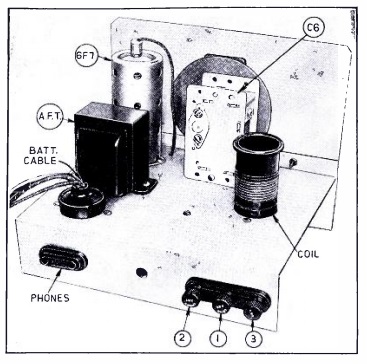
1967SepRadioElectronicsThe key philosophy of repair was that “basic equipment with knowledge beats elaborate equipment and no knowledge.” After checking for obvious problems, the best starting point was at the volume control, where an AF signal was injected. Then, the serviceman would work his way back injecting AF, IF, or RF until the bad stage was found.

Stubborn little culprits were sometimes the source of trouble. For example, the author encountered one set that was going through batteries much faster than expected. The problem turned out to be a short across the power switch–the radio was never completely turned off. Instead, it was just turned down all the way to minimum volume.

Radios sometimes got dropped, resulting in a cracked printed circuit board.  Of course, the ideal method of repair would be to order a new board and move all of the parts.  But no customer would want to go to the time and expense of doing this.  And it was a relatively simple matter to locate the break and jumper the broken traces (and a few others, for good measure) with hookup wire.


Staff Sergeant Staff Sergeant Gerald W. Wagner, Japanese POW 1942-45

1942Aug8RadioGuideA few months after the fall of Corregidor,  this letter appeared in the August 8, 1942, issue of Radio Guide.

An earlier issue of the magazine had carried an item about Army nurses who had escaped from Bataan. This was spotted by one Mrs. G.C. Wild, originally of Rapid City, South Dakota, who was then in Richmond, Kentucky, on a defense project. Mrs. Wild was the sister of Staff Sergeant Gerald W. Wagner, who had been assigned to the Sternberg General Hospital in Manila. She and her mother had no word from Sgt. Wagner since February, 1942. After reading about the nurses, she wrote to the magazine asking if they could pass along her request for information about her brother, in the event that one of the nurses could provide some information as to his fate.

While the magazine had no way to contact the nurses, it published the letter, and asked any readers who knew any of the nurses to pass along the plea.

While it’s unlikely that the letter writer received any reply to her plea, it appears that Sgt. Wagner survived the war. He is listed as having been liberated from the Cabanatuan prison camp, and the report of the liberation appears in this February 2, 1945, newspaper report.  He was later awarded the Bronze Star.


American POW’s in China, 1942

1942Sep14LifeSeventy-five years ago today, the September 14, 1942, issue of Life magazine carried some of the first photographs of American prisoners of war, both military and civilian, held by Japan.  The photographs appeared in an English-language magazine published in Japanese-occupied China with the unlikely title of “Freedom,” which detailed the supposedly benevolent intentions of the Japanese toward the Asiatic people.

The photographs of the American prisoners were published to show the supposedly humane conditions the prisoners were experiencing.  Included were the photos shown below, which supposedly depicted the prisoners receiving radio receivers for entertainment during their confinement.

1942Sep14Life2This first photo shows the gift of the receivers to three representatives of the prisoners, standing at attention while they accept the alleged gift.  The recipient on the left is not identified.  Shown in the center is U.S. Marine Maj. James Patrick Sinnot Devereux, who later served in the U.S. House of Representatives from Maryland.  At right is civilian engineer Raymond R. Rutledge, who was working on a construction project at Wake Island when it fell to the Japanese.  The military-style hat he is wearing is actually an American Legion cap.  In another photo in the magazine, the cap is visible and reveals that he was a Californian.  The photo below shows Maj. Devereux (seated at right) with his unenthusiastic men allegedly listening to the radio in their barracks:

1942Sep14Life3

Despite the upbeat text of the Japanese propaganda article, most of the photos depict obviously unhappy men such as those shown below, in which they are shown signing phonograph recordings which were later broadcast in POW broadcasts from station JOAK in Tokyo:

1942Sep14Life4


Getting A Job In Two-Way Radio, 1967

1967SepEEFifty years ago this month, the September-October 1967 issue of Elementary Electronics told a young man just how to build the impressive resume shown here, in order to “make a mighty buck as a ticketed tech.” The article explained how possession of the “ticket,” a second class radiotelephone operator license, along with a bit of skill, could open the possibilities of a career as a two-way radio technician.

Jobs were available with service shops, manufacturers, police and fire, railroads, or other employers. Or, with a bit of experience, a young man could start his own shop and go into business for himself. Five million licensed transmitters were in operation, and all of them required service by a licensed technician.

For those with some electronics knowledge could study for the exam by themselves. Or those starting from scratch could enroll in a correspondence course.

To build experience, the article advised “get a novice ham license (very easy to do), buy a second-hand FM mobile radio unit or base station, and modify it for operation in the two-meter ham band. Also, but a ham rig kit–preferably an SSB transceiver, because SSB will be in wide use in the future. In short, get plenty of practice building, tuning and using two-way radio and thus get the most mileage from your ham ticket.”

The result of this preparation would be an impressive resume similar to the sample shown above. What employer wouldn’t jump at the chance to hire a general class ham, complete with membership in the ARRL.

With those preliminaries out of the way, it was time to get a job. Those who didn’w want to relocate could send resumes to shops in town, to the police and fire departments, and other large two-way radio users. Or for those who wanted to venture out to the possibility of relocating, the article provided addresses of where those resumes could be sent. It even suggested putting a “situation wanted” ad in a professional magazine.


1917 Spy Antennas Everywhere!

1917SepEEA hundred years ago this month, there might not have been a spy behind every tree. But there very well could have been German spies using those trees to conceal secret antennas, and the editors of Electrical Experimenter, in the September 1917 issue, were doing their public duty to warn Americans of the potential threat. Some possible secret spy antennas are shown here, along with the warning:

In preparing this article we have endeavored to show the unsuspecting
public how an enemy agent may either send or receive radio messages
by means of the most innocent appearing objects.

The Editors thought it best to give the article wide publicity, in order
that patriotic citizens may the better apprehend possible spies, who might be using secret aerials of the types illustrated.

The article is intended for public enlightenment, as well as for the
country’s safety.

According to the article, there could be a spy cleverly using your shade tree as an antenna, and it was a good idea to go out and check: “Have you examined your shade trees closely this summer? Don’t be surprised if you find a wire cleverly painted to match the bark on the tree and leading up to the various branches. It is readily possible for a persistent member of the enemy espionage squad to thus rig up a tree areial, and it is not necessary to travel very far to find a sufficiently large tree, which would serve as a framework for several hundred feet of insulated wire.”

A similar warning was warranted for those hanging their laundry out to dry: “If you live in the city (or even in the country) and have occasion to use a metal clothes-line of any appreciable size, it might pay you to closely scrutinize the supporting framework to see whether or not some alien enemy has been at work in an effort to use it for wireless communication purposes.”

These spy antennas could be anywhere, as shown in the illustration above.

Elsewhere in the same issue is the report of the U.S. Government blowing up the wireless tower at Shoreham, Long Island, erected at the cost of $200,000 by Nikola Tesla some twenty years earlier. The structure was no longer in use, but “during the past month several strangers had been seen lurking about the place.” Those lurking strangers could very well have been German spies, hanging around the 185 foot tower to use it as an antenna to contact Germany. Therefore, the Government blew it up.

1917SepEE2


Eico 711 Space Ranger, 1967

1967SepEI

Fifty years ago this month, the September 1967 issue of Electronics Illustrated carried a review for a handsome shortwave receiver that I had never seen before, the Eico 711 Space Ranger.

The set tuned 550 kHz to 30 MHz in four bands, and included a BFO, S-meter, and bandspread. The power supply included a transformer, making the set somewhat safer than the AC-DC supply included in many budget receivers of the day. It was available for $49.95 in kit form, or $69.95 assembled.

The review warned that the set probably wasn’t an easy project for someone who hadn’t built a kit before, and noted a few shortcomings in the assembly instructions. But for someone with some kit building experience, the set went together fairly easily, and the author reported that he had it assembled in about 20 hours.

The author did warn that the set was not aligned, and would require a signal generator for alignment. Performance was described as comparable with other receivers in the price class, with sensitivity dropping off sharply above 10 MHz.

I do agree with the author’s observation that the set “is smartly styled; you wouldn’t hesitate to leave it in your living room.”

You can find pictures and description of a nicely restored specimen of the set at this link.


How to Unplug Appliances, 1942 or 2017

1942SepPMToday, as a public service, we bring this illustration from the September 1942 issue of Popular Mechanics, which is just as relevant today as it was 75 years ago.

The drawing, which is clearly labeled “WRONG,” shows the housewife unplugging the radio by yanking on the cord.  The illustration in the lower left corner, shows the correct way, namely, by firmly grasping the plug.

The artist perfectly captures what appears to be a cavalier attitude on the woman’s part.  While she was probably otherwise the pinnacle of efficiency, the magazine pointed out that bad connections and broken power cords were the result of such treatment. It was a particularly bad idea in the case of the table radio, since it probably had a “curtain burner” cord, which would withstand few such jerks before causing the receiver to develop crackly noises or simply refuse to work. But even with plain line cords, then or now, the plug was easily damaged.

veracruzflagThe magazine even noted that rubber-covered plugs were not plentiful, so this woman’s treatment of the strategic material was practically unpatriotic in wartime.

As far as we’re concerned, it’s still unpatriotic.  If you love your country, then you should unplug appliances by firmly grasping the plug.


1942 Radio Census

1942Sep7BC1

Seventy-five years ago today, the September 7, 1942, issue of Broadcasting magazine included a supplement with the radio figures from the 1940 census, as well as a complete log of all U.S. broadcast stations as of 1942, and figures showing the numbers of radio retailers and sales figures. The map above shows the percentage of radio homes in 1940. Since there was a freeze on new stations during the War, and since no new radios were being produced, the issue provides an interesting snapshot of radio in the United States during the War years.

Massachussetts led the nation with 96.2% of its homes being equipped with a radio. Within that state, the county with the highest percentage of radio households was Norfolk County, with 98.1% of the households having at least one radio. The last place honors went to the State of Mississippi, with only 39.9% of homes having a radio, despite twelve broadcasting stations in the state. Within that state, the county with the lowest percentage of radio households was Issaquana County, where only 320 households out of 1779 had a radio, or only 18%.

Of Minnesota’s 728,359 households, 664,296 had at least one radio, for a percentage of 91.2. Lake of the Woods County had the lowest penetration of radio receivers, with 1150 radio households out of 1501 total, for a percentage of 76.6%. Minneapolis and St. Paul had very high percentages of radio households, 96.6% and 96.7% respectively. They were edged out, however, by Rochester, with 96.8% of the households having a radio. The other city included in the listing of cities over 25,000 was Duluth, with 95.7% of the households having a radio.

1942Sep7BC2The station listing shown here reveals that during the War years, Minneapolis and St. Paul were served by seven stations. Both KSTP, 1500 kHz, and WCCO, 830 kHz, had 50,000 watt signals full time.

Three stations had 5000 watt signals during the daytime: WDGY on 1130 kHz, reduced its power to 500 watts at night, but the hours were determined by local time in Albuquerque, since it protected a station there. WLB, which later became KUOM, was daytime only, and also shared time on its 770 kHz frequency with WCAL in Northfield, an arrangement that continued in later decades. WTCN reduced its power on 1280 kHz to 1000 watts at night.

WLOL on 1330 kHz was licensed for 1000 watts, and WMIN ran 250 watts at 1400 kHz.

Duluth was listed as the home to KDAL on 610 kHz and WEBC on 1320 kHz. The other station serving the Twin Ports, WDSM, was licensed to Superior, Wisconsin, and appeared in the Wisconsin listings.

Cities with 250 watt stations included Albert Lea (KATE, 1450 kHz), Fergus Falls (KGDE, 1230 kHz, with 100 watts nighttime power), Mankato (KYSM, 1230), Moorhead (KVOX, 1340), Rochester (KROC, 1340), St. Cloud (KFAM, 1450), Virginia (WHLB, 1400), Willmar (KWLM, 1340), and Winona (KWNO, 1230).

Another station covering Minnesota but not listed was WDAY in Fargo, which corrected the oversight by purchasing two full-page ads, one in the Minnesota listing and another in the North Dakota section, pointing out that it had a large service area in both states, and including a story, that must have seemed just a bit risque in 1942, about a traveling soap salesman and a farmer’s daughter.

1942Sep7BC4

1942Sep7BC3


1977 President CB

1977SeptEE

Forty years ago this month, the September-October 1977 issue of Elementary Electronics carried this ad showing a typical CB’er at the mike of her President CB rig, from President Electronics, Inc., of Irvine, California. While the ad doesn’t tell why she’s on the radio, she’s undoubtedly engaged in some form of public service, such as providing motorist assistance as a REACT member. But the ad makes clear that she does know that every single President radio is thoroughly tested, and doesn’t leave the factory if not working perfectly. She also knows that the radio was engineered with quality features such as variable mike gain and a sophisticated compression circuit to give her maximum “talk power.”

According to the ad, the set contains a gigantic “100 mm” digital channel readout. It’s unclear exactly how they are measuring this, since the digits don’t look four inches tall.