Category Archives: Radio history

1960 CONELRAD Monitor

1960JanRadioElecThe plans for this CONELRAD monitor appeared in the January 1960 issue of Radio Electronics magazine. As part of the nation’s civil defense structure, the CONELRAD system was designed to alert Americans to an incoming attack, but also make sure that broadcast signals did not serve as beacons for incoming bombers.

To prevent this from happening, all radio stations ceased broadcasting. Selected stations then resumed broadcasts, but only on two frequencies, 640 and 1240 kHz, in order to confuse the navigators of those incoming bombers.

1960JanRadioElecSchematicWhen the station first left the air, this would serve as the first warning to the public. And this device sounded a bell when the monitored station left the air. In some more remote areas, a more sensitive and selective receiver might be required. But in most areas, the ubiquitous “All American Five” receiver could be used. This alarm tapped into the receiver’s AVC circuit. If the incoming carrier disappeared, the bell would sound.


1942 Kate Smith & Jell-O

1942Sep28LifeThis Jello ad appeared in Life magazine 75 years ago today, September 28, 1942.

Kate Smith, whose program was heard Friday evenings on CBS, reported that she was tickled pink when she learned that Jell-O and Jell-O puddings would be her sponsor. She loved to eat real lucious food and loved to talk about it.

And when she thought of all of the marvelous things that could be made with Jell-O and Jell-O puddings, she said that she could write a book, and just might write one.

She reported that she was busy rounding up her favorite recipes and figuring out new tricks. A few of those recipes appeared in the ad, and she was crazy about every one of them.  And Kate wasn’t one to jump on the all-natural bandwagon.  “Jell-O’s Strawberry, Raspberry, and Cherry flavors seem better than ever to me these days.  Richer, with a real fresh-picked taste.  And they tell me it’s because they’ve found a way to artificially enhance the flavor and then keep it ‘locked-in.'”

Here’s Kate Smith singing the White Cliffs of Dover in 1942:


GE Touch Tuning, 1937

1937Sep27LifeEighty years ago today, the September 27, 1937, issue of Life magazine showed this woman freed, once and for all, form the tyranny of dial twisting, as her heroic man lets her know that from now on, all she need do is “press a button–that’s all.”

The GE ad explained that she could now enjoy the greatest radio luxury, namely Touch Tuning. A double row of buttons was plainly marked with the call letters of her favorite stations. All she had to do was push the correct button, and the program was there, “automatically, silently, tuned to hairline precision.” With this advancement, General Electric finally “ended the long quest of the radio industry for completely automatic tuning.”

A mere $10 down payment would see one of these sets in your living room. Eighteen models were available for 1938, raning from personal radios to armchair sets to beautiful new consoles.

Typically, these pushbutton sets had a separate L-C circuit tuned by the serviceman for the desired stations, and setting the buttons and marking them was taken care of when a new set was purchased.  For those who desired, dial twisting remained an option.  Typically, one button was marked “dial,” and allowed the big tuning dial to be set in the conventional manner.


Dr. Brinkley Answers: 1937

1937Sept25RadioGuideShown here from the September 25, 1937, issue of Radio Guide is an article written by radio pioneer and questionable physician Dr. John Brinkley.  Shown in the upper left is his radio station, XERA, Villa Acuna, Coahuila, Mexico.  At the upper right is a picture of his home in neighboring Del Rio, Texas.

The station was famous not only for promoting the doctor’s dubious cures, but also for causing interference with U.S. broadcast stations.  We previously wrote about how another of Dr. Brinkley’s stations, XEAW, Reynosa, interfered with WCFL, Chicago.

In an editorial published a few months earlier, the editors of Radio Guide opined that Brinkley’s Mexican stations operated “regardless of the codes which keep one nation from interfering with another,” and that “sooner or later, Mexican broadcasters will have to abide by American laws.”

The editors agreed to allow Brinkley to publish a response, and the result is shown here. Brinkley began by noting that he resented the editorial as an unwarranted attack upon his professional and personal character. He did acknowledge that the opportunity to offer a rebuttal showed that the editor “cannot be a wholly bad fellow.”

Brinkley spent most of his time championing the cause of broadcasters in the Mexican Republic, noting that of the 89 channels available on the broadcast dial, 83 had been “appropriated by the United States, and the remaining six by Canada, leaving none for Mexico.

In Brinkley’s mind, the good citizens of Mexico were entitled to radio stations. And those radio stations just happened to be his, broadcasting in English to audiences in the same country that had “appropriated” the rest of the dial.

Brinkley then concludes by testifying as to his own good character, noting that he was the son of a pioneer physician whose life was spent in unselfish, often uncompensated, ministry to the sick, in the rugged and sparsely settled Appalachian mountains. This inspired his “unusual research,” motivated by his “innate, inalienable, perhaps undue, ambition to serve his race.” This drove him to the air, in the service of more than 10,000 patients who found relief in his hospitals.

He concludes by noting that he had recently been elected as President of the Rotarians, and was on his way to Nice, France, to serve as their delegate.


1937 One-Tube Shortwave Regen

1937SeptSWTV

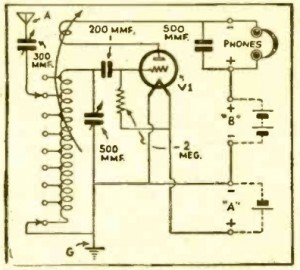
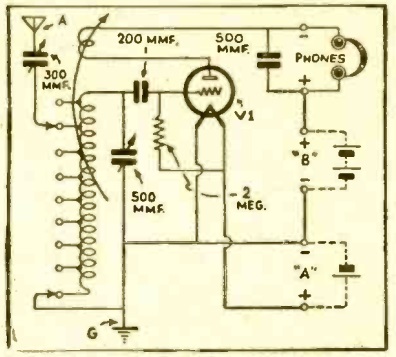
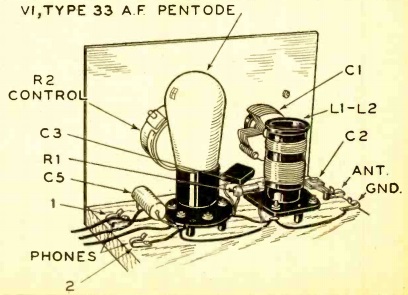
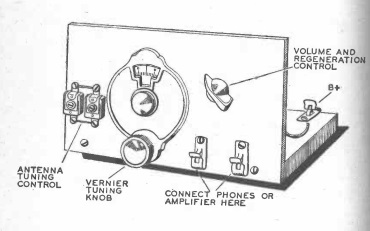
The plans for this handsome little one-tube regenerative shortwave receiver appeared 80 years ago this month in the September, 1937 issue of Short Wave and Television magazine.

The simple circuit was designed for the beginner, and could be put together even by “the man without previous experience in set-building.”

It employed a type 30 tube, although many other triodes could be substituted. The filaments were powered with two 1.5 volt dry cells, and the B+ was supplied by a 22.5 volt battery, although up to 135 volts could be used for added volume.

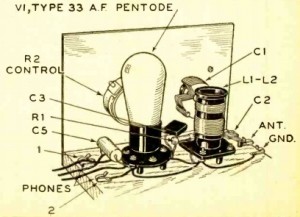
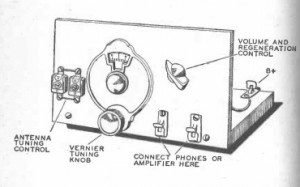
Band switching was accomplished by a tapped coil, with the wire running to the appropriate tap running up through the angled front panel. From there, it could be connected to a Fahnestock clip for the appropriate tap. Tuning and regeneration controls were on the front panel, as well as a connection to rotate the tickler coil.

As is evident from both the schematic and pictorial diagrams shown here, the set was easy to contruct, and could easily be duplicated with modern parts.  Sources of many of the required parts can be found on my parts page.

1937SeptSWTV2


Fern Sunde 1918-1991

FernSundeFern Sunde (née Blodgett) was born in Regina, Saskatchewan in 1918, and grew up in Cobourg, Ontario. When Canada entered the war, she was a secretary at a life insurance company in Toronto, and enrolled in a night school to learn radio telegraphy. She received her certificate on June 13, 1941, and was the first Canadian woman to do so.

No Canadian lines were willing to take her, and she eventually signed on with the Norwegian freighter MS Mosdale as radio operator. She was initially the only radio operator aboard, but when regulations changed, she became one of three, working four hour shifts with eight hours off.

While she was the first woman to serve aboard a Norwegian merchant ship, 23 other women followed in her footsteps, 21 Canadians and two Americans.

The ship’s captain was Gerner Sunde, and the two eventually wed. She was awarded the Norwegian krigsmedaljen (war medal) in 1943.  She died in Norway in 1991.

References


1942 Two-Tube Broadcast/Shortwave Receiver

1942SepPM1The father-daughter team shown here are putting the finishing touches on the plug-in coils for the two-tube broadcast/shortwave receiver described in the September, 1942, issue of Popular Mechanics.  The set was designed to build upon a one-tube receiver described in the magazine’s July issue.

1942SepPM3

Most of the parts, as well as the chassis, of the earlier set were re-used to make the more complex receiver shown here. The 1Q5GT detector was re-used, and another 1Q5GT was used as audio amplifier. On strong local broadcast stations, the set would provide loudspeaker volume. For weak distant shortwave stations, the set would provide excellent headphone volume. The five homemade plug-in coils would provide the regenerative receiver with coverage from the broadcast band through 20 meters.

Three power supplies were required. A 1.5 volt dry cell was used for the filament voltage, and four flashlight batteries were used for the bias voltage. The B+ was supplied either by a 45 volt battery or a battery eliminator which was also shown.

1942SepPMschematic


Buzzer Converted to Telegraph Sounder

1917SeptPMThis illustration appeared in Popular Mechanics a hundred years ago this month, September 1917, and illustrates a clever solution to a problem that no longer exists.  It shows a simple way to convert a buzzer into a telegraph sounder.

At first blush, it seems rather obvious how to use a buzzer as a telegraph:  Simply hook it up, as shown, in series with the key and the battery.  If that’s how it were hooked up, that’s how I, or just about anyone who knows Morse Code these days, would be able to listen with ease.

It took me a few minutes to realize what was going on.  This was a simple way to create a sounder that would sound like a landline telegraph.  That kind of telegraph didn’t produce a continuous tone, as Morse Code does when sent by radio.  Instead, it produces clicks and clacks as the arm of the sounder hits the coil.  The landline telegrapher is listening for those clicks and clacks, the same way that I would be listening to the buzz of the buzzer.  But the buzzing would be just as incomprehensible to the landline telegrapher, just as the clicks and clacks would be incomprehensible to me.  The code being used is very similar (but not quite identical, since American telegraphers used American Morse, while radio operators use International Morse Code).  But the medium being used is very different.

The secret of the diagram above is the wire run from point C to point F.  Normally, a buzzer makes noise because the coil energizes and pulls the arm down.  But in the process, it breaks the electrical contact between the arm and point C.  This causes the coil to de-energize, and the arm swings back.  When it gets back in position, the coil is powered up again, and the cycle repeats.  This happens fast enough that a buzzing sound is produced.

In this diagram, the vibrator contact is shorted out.  So when the arm is pulled toward the coil, it stays there until the key is released, just as would happen in a landline telegraph sounder.  So instead of buzzing, the buzzer now clicks and clacks, and the aspiring landline telegrapher can use the modified buzzer to practice the trade.

According to the magazine, the idea was sent in by one Clarence F. Kramer of Lebanon, Indiana.  Interestingly, Mr. Kramer apparently knew both versions of the code, since he was also a radio amateur. He is listed in the 1921-23 call books as being licensed as 9AOB, with an address of 414 E. Pearl St., Lebanon, Indiana.  The April 1923 issue of Wireless Age shows that he pulled in, on a crystal set, 27 different broadcast stations, his best DX being 825 miles, WBAP in Ft. Worth, Texas.  Another one of the stations he pulled in was WLAG in Minneapolis, the forerunner of WCCO.  In the December 30, 1925 issue of the Indianapolis Star, he describes himself as an “ardent radio bug.”

He also appears to have been a Boy Scout, since one Clarence Kramer of Indiana, with various interests including wireless and telegraphy had a penpal request in the January 1915 issue of Boys’ Life magazine.  While it could be another person with the same name, one Clarence F. Kramer was an engineer with Ford, holding a number of patents.  If he went to work for Ford, then he is probably the Clarence Frank Kramer who died in Michigan in 1994 at the age of 92.


1957 Self-Powered Radio

1957SeptRadioElectronicsThe little circuit shown here appeared sixty years ago this month in the September 1957 issue of Radio Electronics magazine. Almost anyone who has experimented with electronics has probably tried a variation of this circuit. It’s simply a way to run a small electronic device from the “free” energy of a nearby broadcast station. The signal is picked up by the antenna, is rectified by a diode, and the resulting energy is used to provide power to a transistor audio amplifier.

The example shown here appears to use a single diode to both provide power to the transistor, and the signal. According to the magazine, the diagram comes from U.S. Patent 2777057, issued to one  Jacques J. Pankove, and assigned to RCA.  While the patent contains drawings for circuits that are slightly more complex, the diagram here does not appear in the patent itself.


Capt. Hawthorne C. Gray, 1889-1927

1927SepPopRadio

Shown here in the September 1927 issue of Popular Radio is Capt. Hawthorne C. Gray of the U.S. Army Air Service, preparing for the flight in which he achieved the record for the highest altitude from which radio broadcast reception had ever been made.  According to the magazine, Capt. Gray’s balloon was equipped with an Atwater Kent Model 32, a seven-tube receiver with single dial control and loop antenna.  During the flight, he was able to pull in stations KMOX and KSD, and he was able to determine bearings to the stations at all times during the flight.  “Up to the time that the aviator became unconscious at 31,000 feet, the receiver was working satisfactorily, with a total lack of interference.”

The date of the flight is not stated in the magazine, but it appears to be the same flight that Capt. Gray recounted in the August 1927 issue of Popular Mechanics.

In that account, Capt. Gray notes that he was listening to a jazz orchestra playing in St. Louis, “the music coming in clear and loud on my radio, without a single trace of static.”

Gray made another attempt at an altitude record on November 4, 1927. On this attempt, his luck ran out. The barographs aboard the craft showed that he had reached an altitude of over 43,000 feet, but his lifeless body was found in the balloon basked in a tree near Sparta, Tennessee. He was posthumously awarded the Distinguished Flying Cross, and he is buried at Arlington National Cemetery.