Category Archives: Radio history

1959 One Tube FM Portable

1959JanPESixty years ago this month, the January 1959 issue of Popular Electronics showed how to put together this portable one tube FM receiver. The set used a single 1AG4 tube as a superregenerative detector, and used a penlite cell for the filament and two 22.5 volt batteries to supply the B+.

Even though a superregenerative receiver is best suited for AM signals, it does an excellent job on FM with slope detection. The tendency of the set to radiate was put to advantage in the instructions for calibrating the dial. The article suggested using a second receiver, tuning it to 88, and then tuning the portable until the rushing sound was heard on the other receiver.

1959JanPEschem


1959 Crystal Set

1959RadioTVexp

The young man shown here (quite possibly the son of article author T.A. Blanchard) is probably getting ready to collect his first Social Security check. But sixty years ago, he was shown in the 1959 issue of Radio-TV Experimenter operating this simple crystal set.

The antenna and ground leads are soldered to “frictioned” paper clips, which could be connected to a convenient antenna such as the dial stop on a telephone. Tuning was accomplished with the adjustable ferrite antenna coil. The set would not tune the entire broadcast band, but the article included values for the fixed capacitor to cover various portions.1959RadioTVexpSchem


1949 Custom Installation

1949JanRadiotvnews

This handsome home entertainment installation appeared on the cover of Radio Television News 70 years ago this month, January 1949. While it appears to be a single console, it’s actually a custom installation of discrete components, a television, radio, and record player.

The issue provided guidance for dealers looking to move into this field, and suggested that thoughtful design and installation of such custom designs could be a lucrative proposition.


1944 Crystal Sets With Homemade Parts

1944JanPM1

Wartime parts shortages were undoubtedly the inspiration for these two crystal sets from the January 1944 issue of Popular Mechanics. While commercial parts could be used, from the junk box, salvaged from an old radio, or from a mail-order house, the article showed how to make most of the parts. The article notes that the newcomer needed only a good set of headphones to build either set from scratch.

1944JanPMcapacitorThe first set, shown above, omitted a variable capacitor, as it used a variometer for tuning. It did require one fixed capacitor, but the article shows how to make one using copper foil and either mica or wax paper.

A commercial fixed crystal can be used, but the article also shows how to make one. The crystal is mounted inside an old tube base and sealed with wax. The use of an old 4-prong tube socket meant that a commercial fixed crystal could be substituted at a later time.

1944JanPMxtal

1944JanPM2

The second set, shown above, featured a variable capacitor for tuning, which was constructed “book” style. The top plate, made of spring brass, was hinged and moved up and down from the lower plate.

1944JanPMvariablecap

The sets were said to have a range of about 25 miles.

1944JanPMschem11944JanPM2schem


Radio in Education: 1939

1939JanRadioRetailingEighty years ago this month, the January 1939 issue of Radio Retailing devoted most of its pages to the use of radio in education. Of course, the focus was on how the dealer could tap this market. The most basic use of radio, of course, is shown above. A set is brought into the classroom for these Midwestern students to listen to a program of educational value.

Wiring the school with a public address system would be, of course, a lucrative sale. In addition to being able to make announcements immediately, the magazine suggested educational uses for the equipment. Below, for example, students who handed in the best writing are allowed to broadcast their work over the PA.

1939JanRadioRetailing2


1959 Hamming Is Fun

1959JanBL
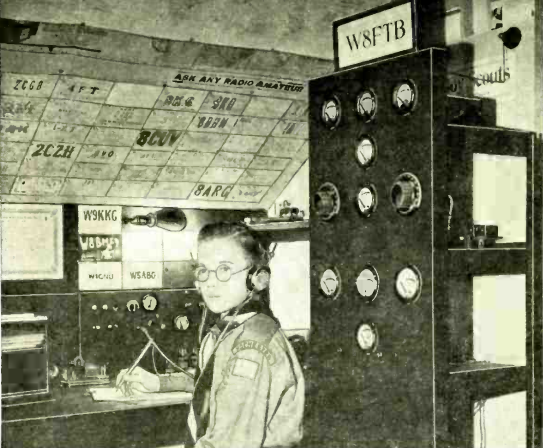
Sixty years ago this month, amateur radio made the cover of Boys’ Life magazine’s January 1959 issue, which featured an article entitled “Hamming is Fun” by long time ARRL staffer Perry Williams, W1UED.

The article featured the radio adventures of a number of young hams, including Jules Madey, K2KGJ, of Clark, NJ, who apparently inspired the cover. Madey, a high school student, put in as many as 49 hours a week running phone patches for men at the McMurdo base in Antarctica. Since the best conditions were in the middle of the night, Madey made a habit of going to bed right after supper and setting the alarm for 10:30 PM.

1959JanBL2The magazine contains two more radio features.  First of all, the Tracy Twins comic shows the boys receiving a radio control airplane that Grandpa insists on operating without a license.  Of course, he gets busted as an FCC helicopter and car swoop in.  Fortunately, he gets off with a warning.

Finally, the Boys’ Life Radio Club had three offerings.  For just 20 cents, they would send out the Radio reprint book containing reprints of earlier articles, along with a free log book.  One dollar would get 60 QSL cards.  And for no cost, the club would send any licensed ham operator scout or scouter a card identifying the bearer as an emergency service ham.

1959JanBL3


1959 Auto Dialer

1959JanEESixty years ago this month, the January 1959 issue of Electronics Illustrated showed how to put together this convenient autodialer for a telephone. It was designed to be used with a burglar alarm or fire alarm, to place a call to a pre-designated number.

1959JanEE2The heart of the unit was the lever which went over the phone. In case of alarm, a solenoid released to let the phone off the hook. Then, the same lever was used to dial the phone by pushing the hook buttons. This was driven by the wheel shown here, which rotated thanks to a phonograph motor.

A bell or buzzer would sound over the phone, alerting the owner to the alarm.  The article did note that if the line was busy, the message would not go through.


1939 Winking Radio

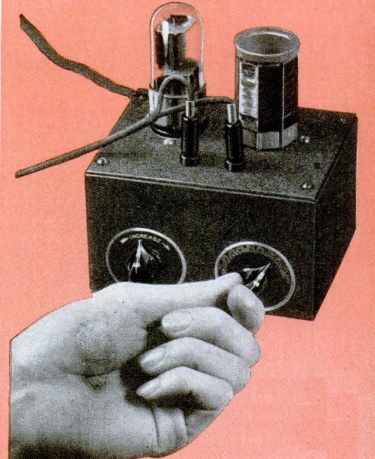
1939JanPSThe plans for this slightly creepy looking radio appeared in Popular Science 80 years ago this month, January 1939. Billed as an “ideal playroom radio,” the set contained two magic eye tubes that winked when the regenerative tuner was tuned to a station. The mouth served as tuning dial, with the nose taking care of volume.  The set used headphones “so it cannot disturb the rest of the household.”

The 6N5 magic eye tubes were used in the circuit, one as regenerative detector and one as audio amplifier. A type 37 tube was used as a rectifier.

As long as C6 didn’t short out, the set could provide hours of safe fun for the youngsters in the playroom.

1939JanPSschematic


1948 Apartment Antenna

1948DecRadioElec2Seventy years ago, W2YSF’s landlord didn’t allow an antenna on the roof of the ham’s Brooklyn apartment building, so improvisation was necessary.

He finally settled upon the design shown here for his 10 meter rig.  A telescoping antenna was mounted to a wooden bracket bolted to the window sill.  When it was time to get on the air, he swung the antenna outside and extended it.

The author notes that the same system should work well for 6 or 2 meters.

The design is shown in the December 1948 issue of Radio Electronics.


1948 Coin Operated Radios

1948DecRadioElecSeventy years ago this month, the December 1948 issue of Radio Electronics featured this serviceman’s account of his successful diversification into the coin-operated radio business.

While the author pointed out that potential markets included lunchonettes, beauty shops, and hospitals, he had so far exclusively provided radios to hotels.

While the radios were adjustable, the author had his set to play one hour for 25 cents. The average income from each set was about $3 per day, of which 25% was shared with the hotel owner.

To deal with the “familiar towel-and-soap stealers,” the set was fastened to a small table, which was in turn bolted to the floor. In addition, the author added a burglar alarm, which consisted of a microswitch in the radio’s case. If the radio was removed from the table, a bell would sound, and a lamp indicating the offending room would light in the manager’s office.