Category Archives: Radio history

1959 Sleep Learning

1959FebPEThe February 1959 issue of Popular Electronics carried this handy device to facilitate sleep learning.  As a youth, my attempts at sleep learning were frustrated by (in addition to the fact that it apparently doesn’t work) that the only tape recorder I owned had a very limited amount of record time.  So chances are, the tape would have played to completion before I even fell asleep.  And it would play only a single time.

One of these devices would have solved that problem.  The exact details (as well as the price) were lacking, but the Electronic Educator, sold by the Sleep Learning Research Association of Olympia, Washington, allowed the use of a continuous tape cartridge with between 1 minute to 2 hours of tape.  In other words, the lesson would play all night, and you would wake up having mastered the material.


Electronics in the Classroom: 1959

1959FebRadioElec

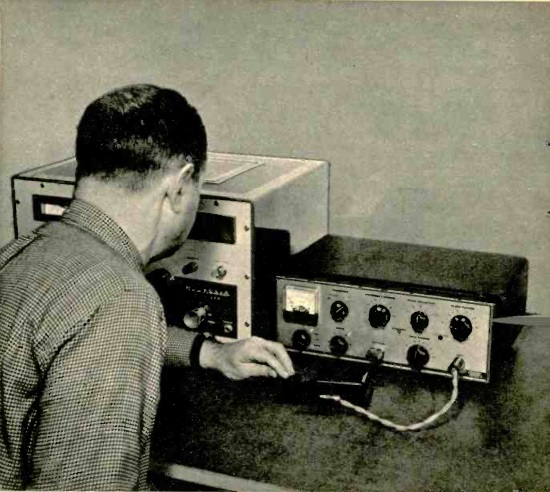
The student and instructor shown here are demonstrating properties of sound, thanks in part to $300 million in federal funds made available to high schools by the Science Education Bill. The February 1959 issue of Radio Electronics gives some ideas of how electronic equipment can be worked into the curriculum. The article suggested that many phenomenon, such as sound, can be converted into electrical energy by appropriate transducers. Here, a scope, audio amplifier, and giant VTVM are used to demonstrate properties of sound.


RCA Model 97K2, 1939

1939Feb6LifeEighty years ago, people still dressed up to listen to the radio, as shown by this RCA ad from the February 6, 1939, issue of Life magazine. This listener is tuning in a standard broadcast station on her RCA model 97K2.  The set also tuned two shortwave bands, 2.3 – 7 MHz and 7 – 22 MHz, but we can see that she is pushing one of the six preset buttons, which were for the standard AM band. In fact, we see that she is pushing one of the two rightmost buttons, which could cover approximately 890-1500 kHz. The first two buttons could be set for 550-950 kHz, and the middle two buttons could be set for 690-1225 kHz.

The set had the following tube lineup: A 6K8 served as first detector and oscillator, with a 6K7 serving as IF amp. A 6H6 served as second detector and AVC, with a 6F5 and 6F6G as audio amplifiers. A 6U5 “magic eye” tube served as tuning indicator, and a 5Y5G in the power supply served as full-wave rectifier. The set featured a dynamic speaker.


1934 “Globe Trotter” Two Tube Regen

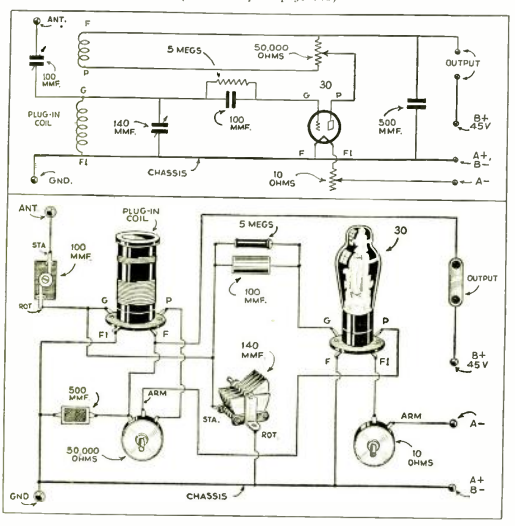
1934FebSWEighty-five years ago this month, the February 1934 issue of Short Wave Radio magazine carried the plans for this two tube (plus rectifier) receiver.  Dubbed the “Globe Trotter,” the set covered shortwave and the standard broadcast band thanks to plug-in coils.

The set used a type 57 tube as regenerative detector, with a type 2A5 tube serving as audio amplifier to drive a speaker. A type 80 full-wave rectifier rounded out the tube compliment.

The set would be difficult to duplicate today. It employs a transformer which is probably unobtainium. The hardest to find component might be the dynamic speaker. Instead of a permanent magnet, this type of speaker used a field coil, which magnetized the speaker, and also served as a filter inductor for the power supply.

1934FebSWschematic


1944 Tape-Operated Code Sender

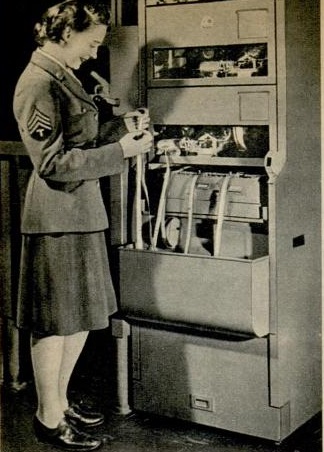
1944FebPM1944FebPM2The gentleman shown here is practicing copying Morse Code that the woman is literally cranking out for him, thanks to this automated code sender from the February 1944 issue of Popular Mechanics.

Today, it’s a relatively trivial matter for a computer to generate code, such as with this online code generator. But 75 years ago, saving a message for later replay probably involved paper tape. This machine allowed you to play such tapes, using a contact made of distributor points from a car. The tape could be prepared (using ticker tape) with a hole punch, or you could use commercially available tapes (probably Instructograph tapes).

The device could be powered with a crank, or with a sewing machine motor controlled by a rheostat.


KFAB Lincoln, NE, 1944

1944Jan31BCSeventy five years ago today, the January 31 issue of Broadcasting carried this ad for KFAB, then in Lincoln, Nebraska, and on 780 kHz.  As we noted earlier, KFAB shared the frequency with fellow CBS affiliate WBBM in Chicago, and the two stations coordinated their signals.

The station made the move to Omaha and to its present frequency of 1110 kHz in 1948.  The move allowed both WBBM and KFAB to boost their transmitter power to 50 kW.


1939 Admiral Aeroscope

1939JanRadioTodayThe handsome receiver shown here is the Admiral Aeroscope model 163-5L.  The fine print reveals that the price of the set shown is actually $15.95.  The set was available in three different Plaskon cabinets:  Walnut (model 161-5L) for $9.95, Ivory (model 162-5L) for $13.95, and Onyx (model 163-5L) for $15.95.

The set was billed as 6 tube (including ballast), meaning that it was a 5-tube (“All American Five”) receiver with an additional “tube” containing a dropping resistor.

The ad appeared 80 years ago this month in the January 1939 issue of Radio Today.


1969 Radio Shack “P-Box” Shortwave Kit

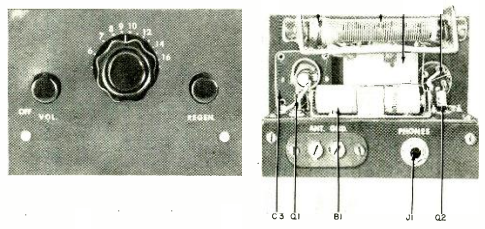
1969JanEEFifty years ago this month, the January-February 1969 issue of Elementary Electronics reviewed the Science Fair “P-Box” shortwave receiver.  The three-transistor set used one transistor as regenerative detector, with the remaining two serving as audio amplifiers.  With interchangeable coils, the set covered 3-40 MHz.

I had one of these, and even though it made sound, I never did pull in any shortwave stations. I did manage to get some overload from local FM stations. I suspect if I had been more patient with the regeneration control, I actually would have received some shortwave.


1925 Multi-Tool

1925JanExperimenterHere’s the 1925 version of the Swiss Army knife, especially for radio fans. This 16=in-one tool was advertised in the 1925 issue of The Experimenter, and was sold by the Radio Specialty Company of New York.

A similar idea, in credit card size for easy wallet storage, but with a different selection of tools, is shown here and available at Amazon.


1924 Trego Baby Grand

TregoBabyGrandIn 1924, the Trego Radio Mfg. Co., 1427 Chestnut St., Kansas City, MO, offered this one-tube set, the “Baby Grand” in their catalog.  For $28.75, you got everything you needed, including the tube, batteries, and even antenna and ground wire. The batteries even came installed inside the set, which was said to have a range of 500 to 1000 miles.

The set was also available without tube, batteries, or other accessories, for $15.35.