Category Archives: Radio history

Television Controlled Machine Gun: 1944

1944DecRadioCraftCover

This self-explanatory “television controlled machine gun” appeared on the cover of the December 1944 issue of Radio Craft.  It was not, however, an existing weapon system.  Instead, it was the vision of publisher Hugo Gernsback, who wrote the accompanying article describing the system.

It was intended for a defensive position, and Gernsback admitted that it might eventually be overrun.  But when that happened, he noted, there would be no casualties.  And a second and third layer could then take over.

Gernsback also anticipated active night vision equipment.  He pointed out that his system could be used at night simply by installing some infrared floodlights, which the TV camera would pick up with no difficulty.


1944 Boys’ Life Hallicrafters Ad

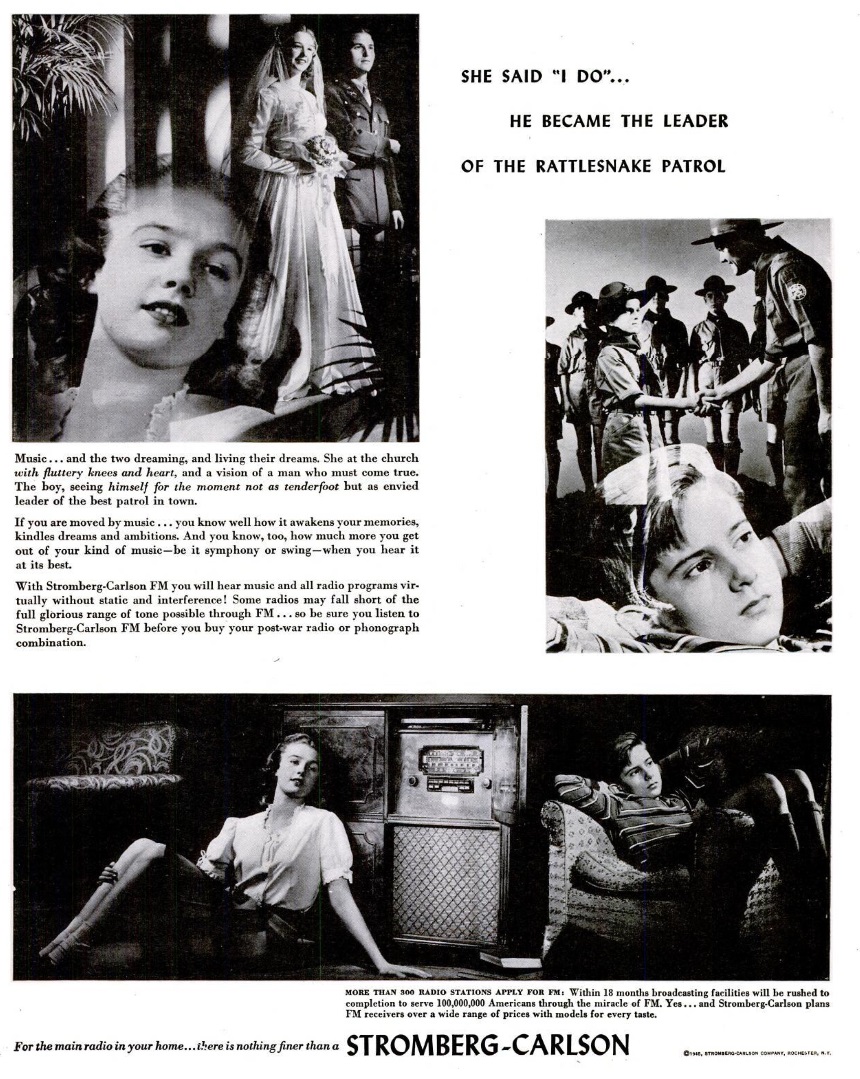
1944DecBLIn 1944, with wartime bans in place, Hallicrafters didn’t have any equipment for sale to civilians. But they were gearing up for a postwar boom, and they figured a lot of Boy Scouts would be in the market for radio equipment as soon as the war was over.

This ad appeared 75 years ago this month in the December 1944 issue of Boys’ Life. It encourages young radio fans to send 25 cents to the ARRL to get the most recent edition of “How to Become a Radio Amateur,” a splendid book.


Maurice Goldberg: Minnesota Radio Pioneer

1944DecRadioRetailingShown here in 1944 is Maurice G. Goldberg, the owner of Beacon Radio Service Shop, 142 East Fourth St., St. Paul, MN. The shop had been in business for 20 years, and even before the war had concentrated on service. Indeed, the sign outside read, “if we can’t fix it, throw it away.”

Even with wartime parts shortages, the shop was living up to its reputation of being able to fix anything. And since new sets were not available for sale, his decision to concentrate on service proved profitable.

Goldberg had been able to keep many radios operating by interchanging tubes, with often meant having to rewire the set. He was so flooded with business that backlogs ran about three weeks. He did, however, prioritize oldtime customers. His reasoning was that when conditions returned to normal after the war, many customers would return to local dealers. But the long-term customers would appreciate the loyalty shown to them.

Greenberg also taught at the Dunwoody Institute in the Army training program. He did occasionally get students who were available to help out in the shop, but he did the bulk of the work himself, working long hours.

Goldberg was indeed a Minnesota radio pioneer. He’s listed as of 1924 as the licensee of KFOY, with broadcast 250 watts on 1350 kHz (222.1 meters). This frequency was shared with WAMD Minneapolis, licensed to one Stanley E. Hubbard. The stations were bought in 1928 by the National Battery Company, which merged them together under the new call sign KSTP, with Hubbard as general manager. Power increased to 25,000 watts, and Hubbard re-acquired a controlling interest in 1941.

The photo above appeared 75 years ago this month in the December 1944 issue of Radio Retailing.


Printed Circuits: 1959

Screen Shot 2019-12-04 at 11.45.38 AM
These two television servicemen, pictured on the cover of Radio-Electronics, December 1959, realize that printed circuits are here to stay.  Fortunately for them, as the magazine explains, the boards are becoming very reliable, and are designed to make servicing of television sets easier.


Skiing With the Portable Radio, 1939

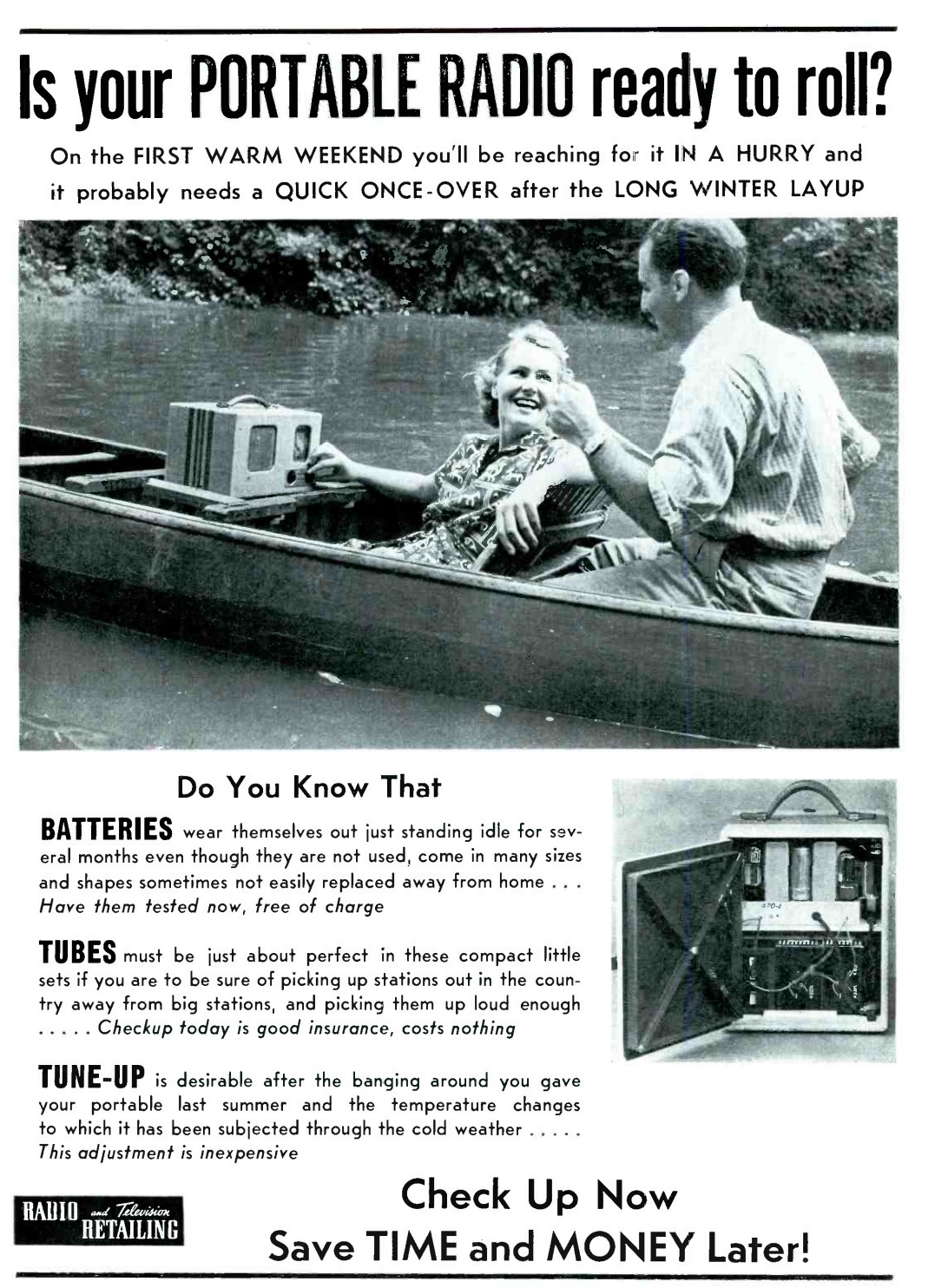
1939DecRadioToday2Eighty years ago, this skier didn’t want to be out of the loop when she hit the slopes, so she brought along this Philco portable radio.  She appeared in the December 1939 issue of Radio Today, which noted that the well-equipped ski fan now carries along a portable radio.  It also pointed out that such persons are a new prospect for dealers.


Radio: A God-sent mission that all other man-made wonders have totally failed to do.

Oak Point School, Oak Point, MB.  Manitoba Historical Society.

Oak Point School, Oak Point, MB. Manitoba Historical Society.

Seventy-five years ago this month, the December 1944 issue of Manitoba Calling, the program guide for CKY Winnipeg, carried this reminiscence of the early days of radio and what it meant to rural residents.

What Radio Means To Me

By Mrs. R. Howard, Oak Point, Man.

It all began with a tiny crystal set, and a couple of pairs of headphones, back in the days of depression, when owning a radio was simply out of the question. Even that little set brought untold pleasure to a couple of country dwellers, in the evenings when the children were quietly abed. It brought in only one station, but that suited us alright, and we were satisfied except when it suddenly went off sometimes when a joke was just getting to the point.

We always enjoyed the hockey games most, because Foster Hewitt‘s voice was one you could always hear. But this is developing into rambling reminiscences when I merely want to say that even the simplest form of radio can bring a great deal of pleasure into life, especially when you live where there is no other form of amusement. Now that we do possess a real radio, of course, the enjoyment is doubled many times, and the children, growing up, can share in it, too. It would be impossible for me to cover the whole territory of its meaning in one short essay.

Radio has banished the “hick” from rural life. Radio is the connecting link which is being forged between country and city, and it should establish much greater unity and understanding between the two, and eventually, let us hope, between all peoples of the world. If radio can -and I believe it can -play a major role in creating that understanding throughout the world which is necessary to the establishment of peace and goodwill on earth, it will indeed have accomplished a God-sent mission that all other man-made wonders have totally failed to do. Let us wish it God-speed on this greatest of all services to mankind!


1944 Code Practice Oscillator

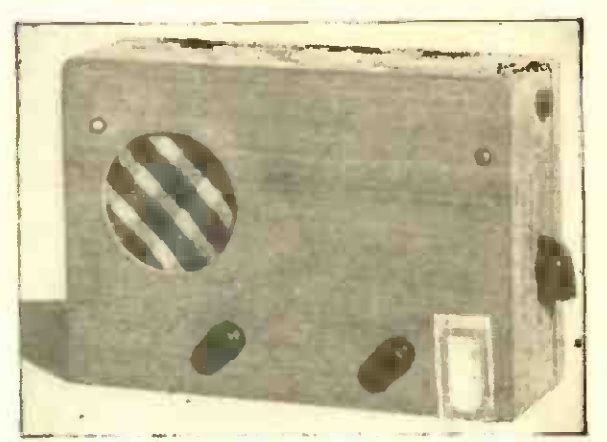
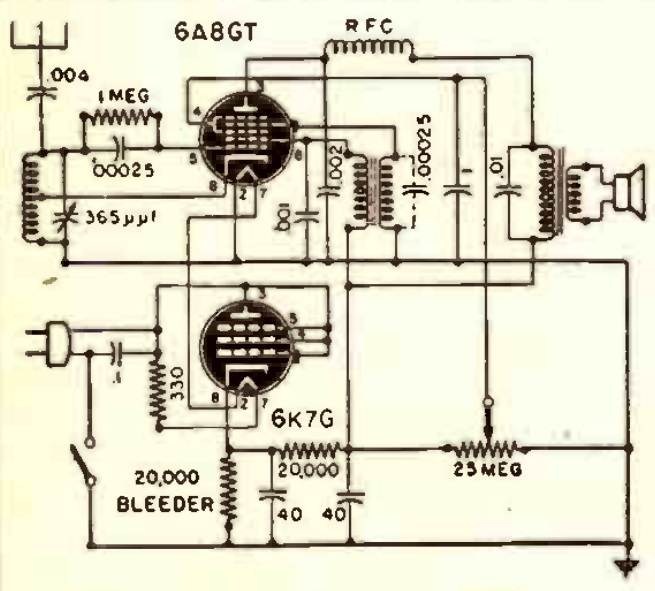
1944DecRadioCraftThis simple code practice oscillator appeared 75 years ago this month in the December 1944 issue of Radio Craft. The idea was sent in to the magazine by William McGee of Baltimore, MD, who noted that the idea required fewer parts than most other oscillators. The idea was self-explanatory, as it used “the principle of feedback which all sound men have to combat.” It consisted of a microphone set in front of the speaker of a radio. If the set had a phono jack, it could be connected there. If not, the submitter showed where to wire it into the radio.


Modernizing the Radio Store: 1944

1944DecRadioServiceDealerCoverNo, this is not the scene from a horror movie of giants attacking a radio store. These women are working out a modern store layout, shown on the cover of the December 1944 issue of Radio Service Dealer. With the war still going, radios and appliances were not available. But the end was in sight, and the magazine admonished dealers that it was time to think about how best to display those items when they became available. These women are working out the best display thanks to a demonstration scale model of an average radio-appliance store, commissioned by the Admiral Corporation, 444 N. Lake Shore Drive, Chicago, and realized by George Locks, a “Chicago specialist in miniatures.”

The four by ten foot scale model store represented a store measuring 35 by 90 feet. It came complete with scale models of radios, appliances, fixtures, and furniture.

1944DecRadioServiceDealer


Pearl Harbor

imgHandler

USS Shaw at Pearl Harbor. Defense Department Photo.

Today marks the 78th anniversary of the Japanese attack on Pearl Harbor, December 7, 1941. Here are links to some of our earlier posts marking that event:


1939 Photocell Burglar Alarm

1939DecPM
1939DecPM2
The young person shown here is about 80 years old, and was probably never kidnapped, thanks the the alarm shown in the December 1939 issue of Popular Mechanics.

The child’s safety was the result of the photocell operated burglar alarm, manufactured by the National Company (yes, the same company that made radio equipment) of Malden, Mass. The light source, photocell, and amplifier were located in a single unit, and made a beam reflected off a mirror. The beam could be up to 30 feet long, and any break operated a relay which could activate a chime, bell, or light.