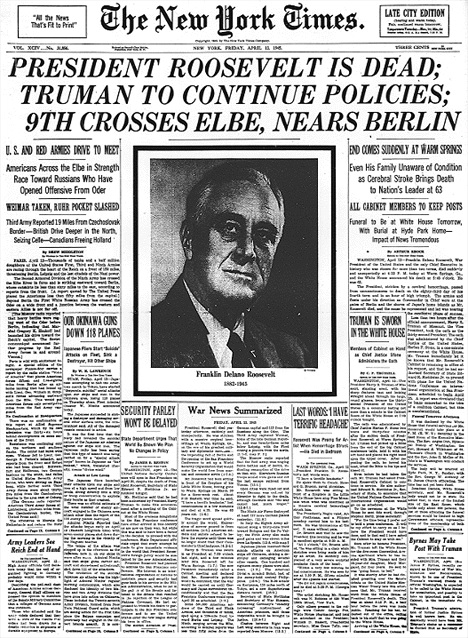
On this day 75 years ago, April 12, 1945, President Franklin Delano Roosevelt died, and President Harry S Truman was sworn in.
You can hear some of the radio coverage at this video:
https://www.youtube.com/watch?v=djcuHhg6PRQ

On this day 75 years ago, April 12, 1945, President Franklin Delano Roosevelt died, and President Harry S Truman was sworn in.
You can hear some of the radio coverage at this video:
https://www.youtube.com/watch?v=djcuHhg6PRQ
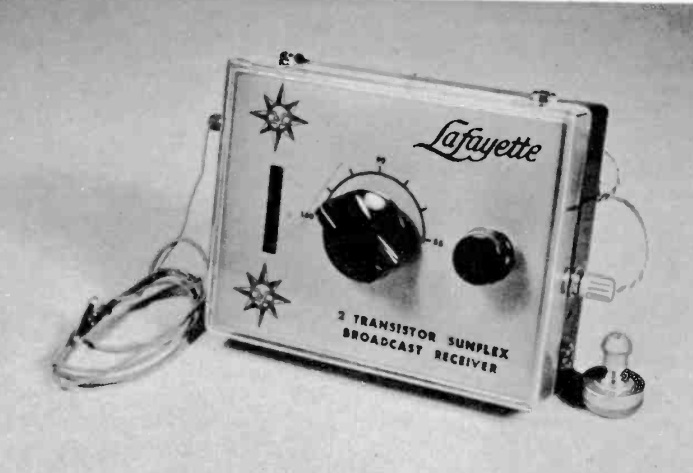
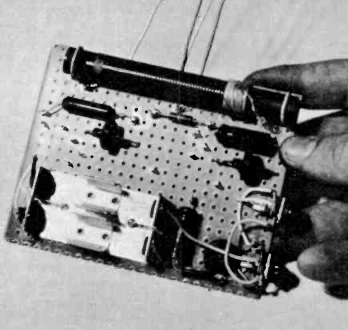 Sixty years ago this month, the April 1960 issue of Electronics Illustrated carried a review of the Lafayette Sunflex radio kit (model KT-132). It derived its name from the fact that the two transistors did the work of three, thanks to reflexing, and that the set could be powered by the sun, using an optional solar battery. The set was said to be very sensitive, and also ran off two penlite batteries. Power switching was done by plugging the earphone into the appropriate jack–one for the internal battery, and the other for the solar battery.
The kit retailed for $11.95, with the solar battery selling for $7.75. According to the magazine, the kit took about six hours to put together.
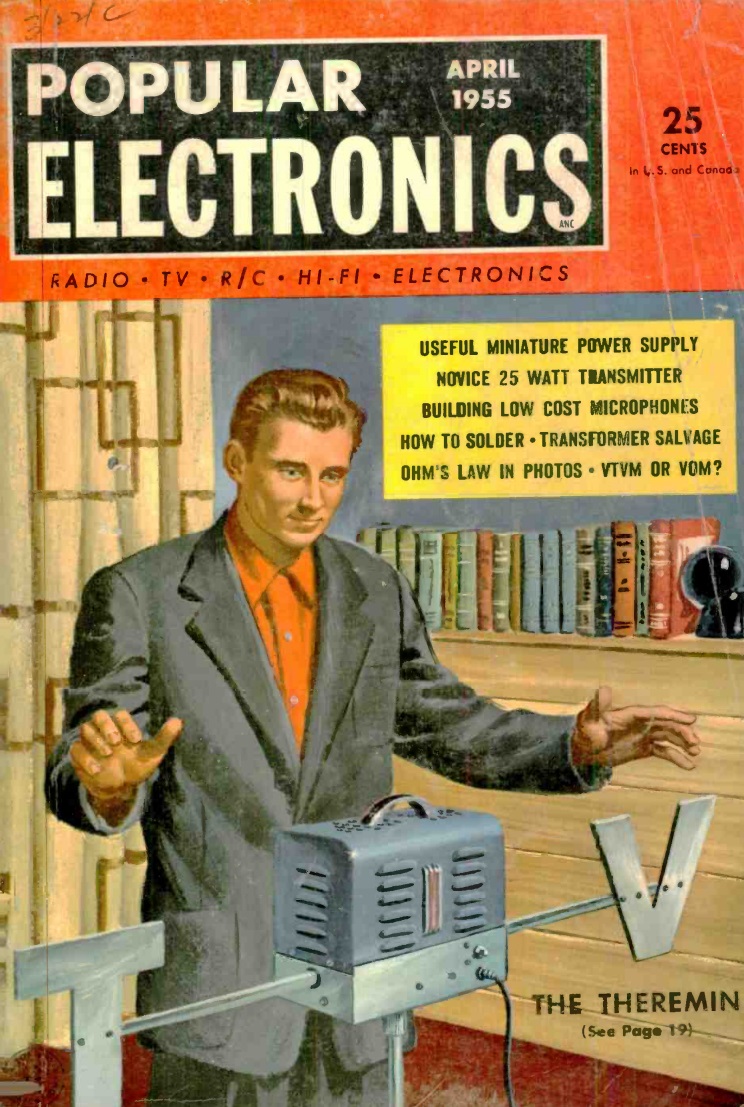
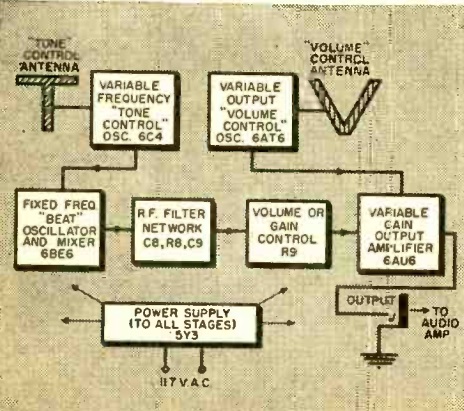 This musician-electronic hobbyist, shown on the cover of the April 1955 issue of Popular Electronics is playing the Theremin that he built according to the magazine’s plans. The magazine stressed that the project was not for beginners, but for those with some electronic experience, it was fairly easy to assemble.
Once built, the owner could use the instrument to play music, or to provide background sound effects for amateur theatricals. “A complete show can be produced by combining its abilities to emit both music and sound effects.”
The instrument depended on hand capacitance on the two antennas. The one marked “T” was the tone. The variable capacitance changed the frequency of an RF signal generated by an oscillator. This was mixed with another oscillator to produce a heterodyne which was amplified. The “V” antenna controlled the volume.
Several column inches were devoted to instructions on how to play the instrument, the final one being: “Practice! Practice! Practice! Practice!” To give an idea of what the instrument sounds like for someone who did practice, here’s what a 1929 Theremin sounds like:
Building the Theremin today with modern solid-state components would probably be simpler, and definitely much cheaper than 65 years ago. You can buy a Theremin already assembled. If you just want to experiment with the concept, you can start with this inexpensive kit.
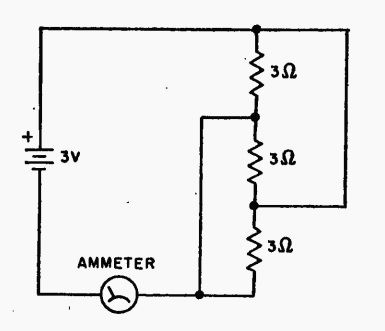 Yesterday, we showed this diagram from the April-May 1970 issue of Science & Electronics magazine and asked what current is shown on the ammeter.
The puzzle is easier than it appears, once you see the trick. The answer is 3 amps. Despite the confusing diagram, the three resistors are wired in parallel, so the total resistance is 1 ohm. You can do the math in your head using the “reciprocal of the reciprocals” method. 1/3 + 1/3 + 1/3 = 1, and 1/1 = 1. To get the current, it’s 3 volts divided by 1 ohm, which equals 3 amps.
Today’s quiz appeared 50 years ago this month in the April-May 1970 issue of Science & Electronics magazine. What is the current shown on the ammeter?
This was sent in to the magazine by a reader who was given the question during a job interview for a position as an electronic technician. We’re guessing he didn’t get the job, since he wrote to the magazine to explain it. If you’re also stumped, we’ll have the answer tomorrow.
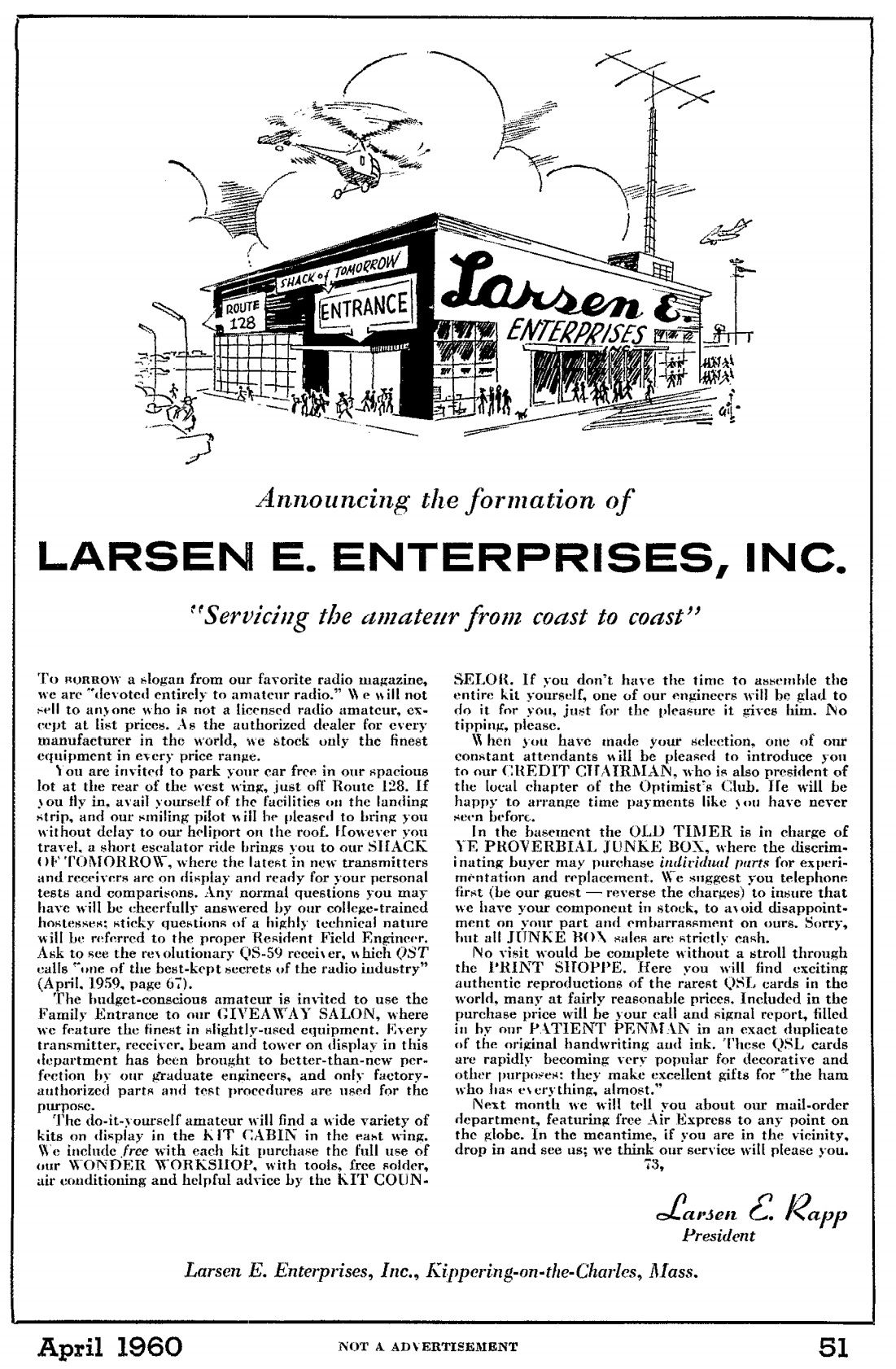 I’ve never had the opportunity to visit yet, but my bucket list certainly includes a trip to the headquarters of Larsen E. Industries. The company was founded by technical genius Larsen E. Rapp, WIOU, sixty years ago this month. This announcement of the momentous event appeared in the April 1960 issue of QST.
From most browsers, clicking twice on the image will show you an enlarged version.
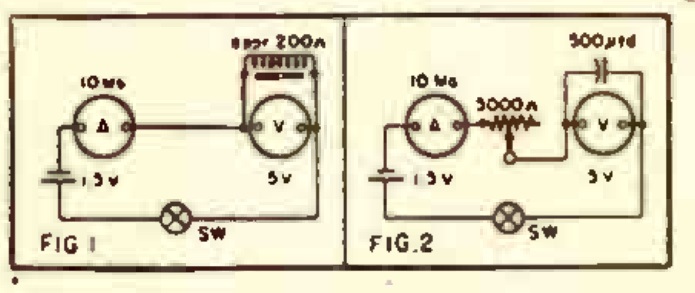 If you ask any serious student of electricity to name their favorite ice man, they’ll undoubtedly tell you that it is Eli. Eli the Ice man (a friend of Roy G. Biv) is a mnemonic to help you remember that in an inductive circuit (L), the voltage (E) leads the current (I). And in a capacitive circuit (C), the current (I) leads the voltage (E).
You can prove this concept with this simple experiment shown 75 years ago this month in the March 1945 issue of Radio Craft. In addition to the capacitor and inductor and a few miscellaneous parts, you’ll need a voltmeter and ammeter. During the war, those analog meter movements would have been hard to come by, but these days, you can get buy with two cheap multimeters. Stores sometimes give digital meters away for free, but this experiment will look a lot cooler with an analog meter.
You wire up the circuits and then observe the meter when the current is turned on. In the capacitive circuit, the ammeter will move before the voltmeter. In the inductive circuit, it will be the other way around.
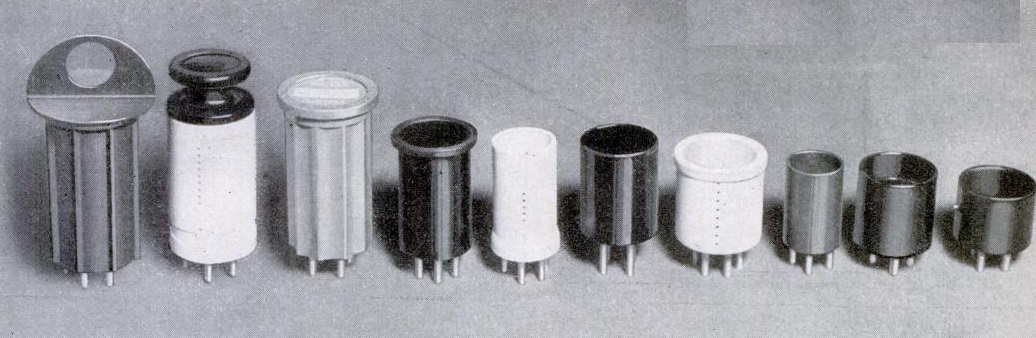
 According to the March 1935 issue of Popular Science, if you had asked any constructor of a shortwave receiver what the most difficult step was, you would have been told that it was winding the coils. Fortunately, the magazine had some pointers. And since, today, you can’t just walk into the local radio store and buy a set of pre-wound coils, the advice is timely for those who want to build an old-time set.
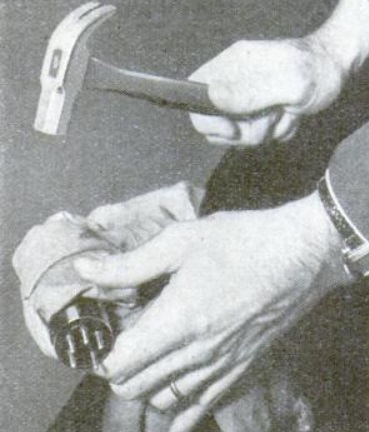
The first step is obtaining the coil forms. Of course, they’re also unavailable today. But during the depression, there was economic incentive to save a few cents wherever possible, and the magazine showed you how to make your own. You did that by finding an burnt out tube and using its base for the coil. The first step was to remove the glass, and for this, there were two methods. You could soak the tube in water to loosen the cement, and then twist out the bulb. There was also the tried-and-true method of taking a hammer to the glass, as shown in the illustration. The magazine cautioned that covering the tube with cloth first was an important safety precaution.
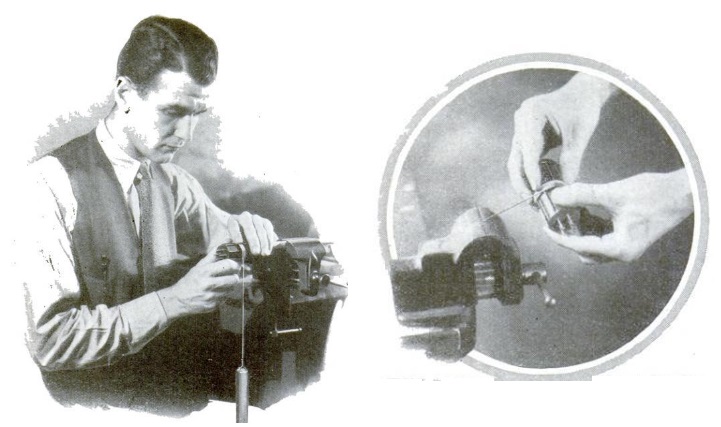
As for the actual winding, the magazine showed two methods to maintain tension but still have two hands available to wind and guide the wire. You could put a weight on the end of the wire, or use the “walking up” method by putting the end of the wire in a vice, and then walking toward the vice while winding.
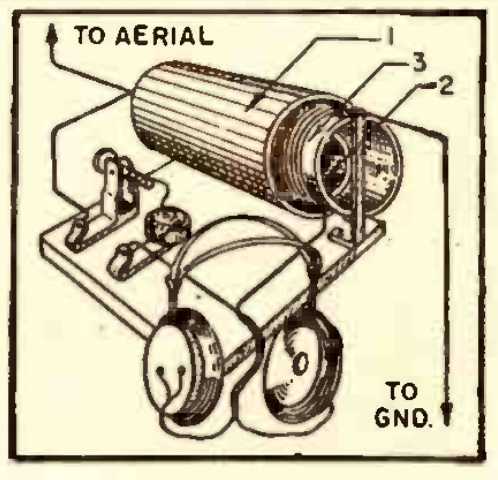
Seventy-five years ago this month, the March 1945 issue of Radio Craft showed this crystal set idea, sent in to the magazine by John Haynes of Doe Run, Missouri. The coil, consisting of about 125 turns of wire, was mounted on a coil form slipped over an old shield can, and snugly affixed with gummed paper. A second can slid over the coil, and was adjusted to tune the set.
The magazine noted that a similar idea appeared in the January 1943 issue of the magazine.
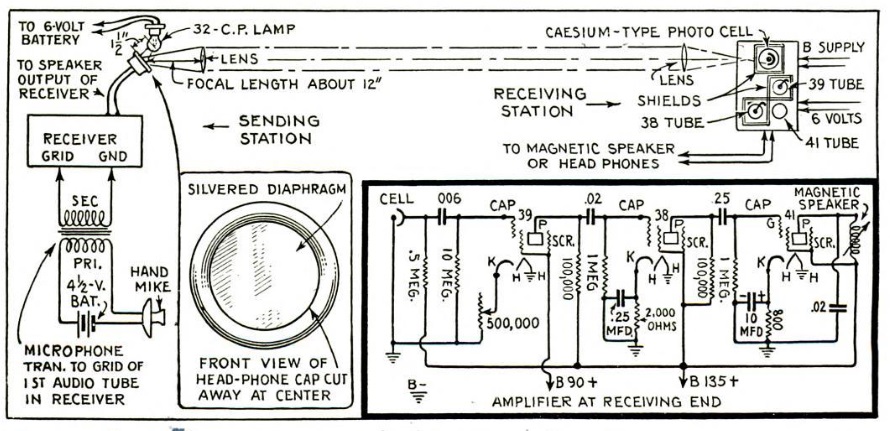
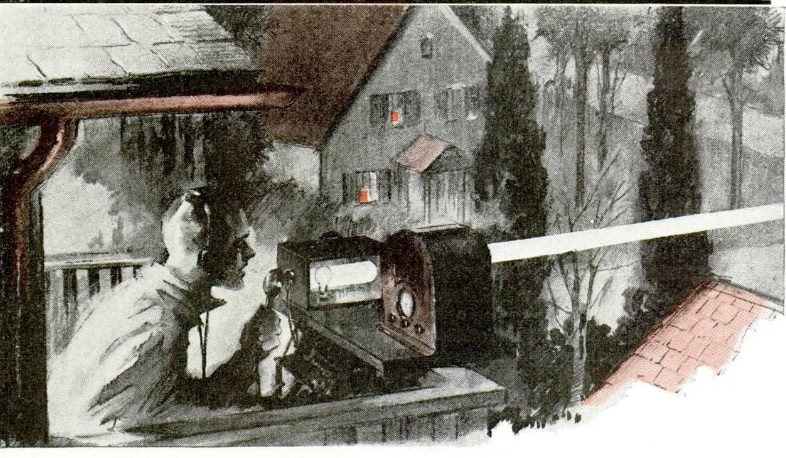 85 years ago this month, the March 1935 issue Popular Mechanics showed how to make this light communicator, said to have a range of about a half mile.
The receiver used a caesium photo cell, which the magazine said could be had for about $3. This was fed into a two-tube amplifier which could drive a speaker or headphone.
For audio amplification at the transmitter end, the system used the household radio receiver, and the magazine explained how to hook up the microphone. The the light beam generator used a system I’ve never seen before. Instead of electrically modulating the light bulb, a mechanical approach was used. The speaker was disconnected and the output was instead connected to a magnetic headphone that had been modified. The outer cap of the headphone was unscrewed and cut so that most of the metal diaphragm was visible. Then, the “diaphragm is slipped off and taken to any plating firm to be finished in the same manner as an audio headlight reflector.” The headphone was reassembled, and the result was a mirror that would vibrate in time with the sound. An auto headlamp was used to illuminate the mirror, and this was focused through a lens with a focal length of about 12 inches.
The result would have been a narrow beam of light that was modulated. At the receiving end, another lens was used to focus the beam on the photo cell.
For a unique science fair project, the advanced student could adapt this project using modern materials. When I was a kid, I built a similar system using a flashlight as the transmitter. The bulb was wired in series with the secondary of an audio transformer. The primary was fed by the output of an amplifier.
For the receiver, I used a solar cell fed directly to the input of an audio amplifier.