Category Archives: Radio history

1920 Boys’ Life Radio Ad

1920FebBLA hundred years ago this month, the February 1920 issue of Boys’ Life asked the boys of America if they had a wireless station, and offered these two receivers. Both tuned 200 – 2500 meters (120 – 1500 kHz). Each included the loose coupler, radiometer, headphones, and hardware for the antenna and ground. The Moded 4007, selling for 28.00, included a crystal detector. Model 4008 was identical, but used an audion tube for the detector. It sold for $48.

The ad promised that the set could be up and running within hours. The crystal set was said to have a range of 300 miles under ordinary conditions, with the audion set being capable of pulling in stations up to a thousand miles away.

The manufacturer, the A.C. Gilbert Company, is the same one which is famous for erector sets, chemistry sets, and other tools for young scientists.  While the company no longer exists, the brand name is still in use.  The set in operation here is similar to, or possibly the same, as the one we previously featured,  delivered by Santa Claus in 1919.


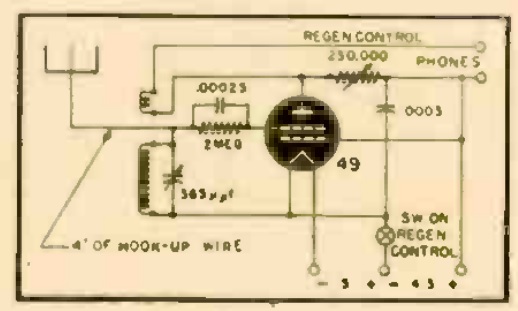
1945 One-Tube Shortwave Superregen

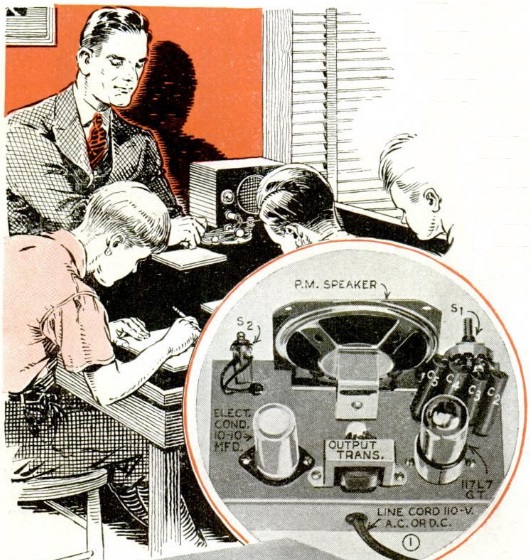
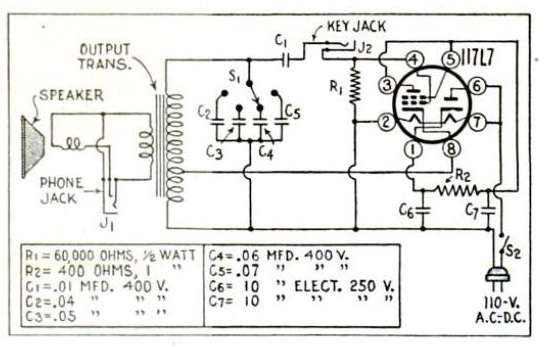
1945FebRadioCraftShown here, from the February 1945 issue of Radio Craft, is a compact one-tube shortwave set dubbed “The Ultra.” It’s a superregenerative set covering 10-120 meters using a 117ZP7-GT tube. One half of the tube is the rectifier, with the other half serving as the superregenerative detector. The magazine notes that the set features post-war details such as phosphorescent panel marks. These are made from glow-in-the-dark paper coated with calcium sulphide which is carefully applied to the panel. After being exposed to the light, the markings will then glow in the dark with a purple hue.

The set is shown here with a bent antenna, and the author notes that this antenna is sufficient for strong stations. He cautions against use of an outdoor antenna, as the set will radiate and interfere with other nearby receivers. He suggests the use of one stage of RF amplification if an outdoor antenna is used.

One shortcoming of a superregenerative receiver is that it’s practically impossible to listen to code. When the key is down, the receiver is silent, and when the key is up, the receiver is making a loud rushing noise. Since this is the exact opposite of how it should sound, the author acknowledges that this is a shortcoming. But for AM signals, it would appear that this little set would really pull in the stations.

1945FebRadioCraft2


Canadian Women Needed to Assemble Radio Tubes: 1945

1945Feb7TorontoWith Canada’s men off to war, it was up to the women to work in war industries, as shown by this ad from the Toronto Daily Star 75 years ago today, February 7, 1945.

The ad doesn’t identify the company, but it’s a well-established organization that manufactures radio tubes.  Women were needed full time to work as assemblers, and the work promised to continue after victory.

Application was to be made at an agency located at 832 Bay Street, Toronto.


1960 One-Tube Shortwave Tuner

1960FebEI1Sixty years ago this month, the February 1960 issue of Electronics Illustrated carried the plans for this one-tube regenerative shortwave tuner. The article was part 6 in the magazine’s build-it course, and the new tuner was designed to plug into the existing projects, which already included AM and FM tuners. For that reason, this receiver contains no power supply or audio amplifier. The cord with the 8-pin plug was keyed to fit the rest of the project, and the shortwave tuner took the place of the FM tuner.

The circuit used a 6BC5 tube. One notable feature is that the regeneration was taken from the screen grid of the tube, rather than the plate. The regeneration control was a voltage divider which varied the positive voltage to the screen.

Since the article was part of a course, in addition to the exact schematic diagram, it also included a simplified diagram along with an explanation of each part of the circuit.  From most browsers, click twice on the image for an enlarged version.

1960FebEI3

Here is the actual schematic for constructing the receiver:

1960FebEI2


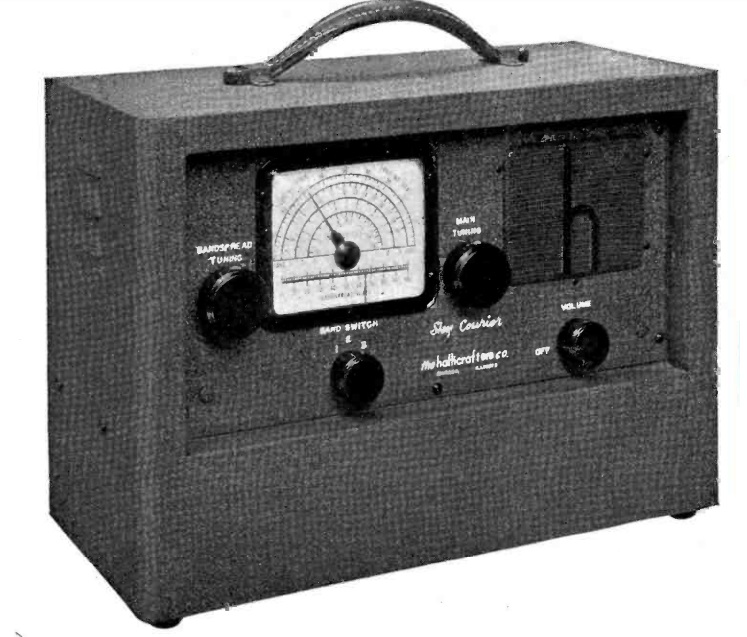
1950 One Tube Loudspeaker Set

1950FebRadioElec

This little broadcast set looks nondescript, but it was also something of a holy grail. As the February 1950 issue of Radio Electronics put it, “the one-tube loudspeaker receiver has long been the goal of constructors and experimenters.” And this set fits the bill. And as an added bonus, the addition of a single capacitor turned it into an excellent code practice oscillator.

The circuit, using a 3B7 tube, is described as a “special type of utraudion with a certain amount of superregeneration.” An outdoor antenna was recommended, but near powerful stations, the article noted that 25-50 feet were adequate. In remote areas, a hundred feet might be necessary.

The set used a permeanility tuner, which is likely unobtainium. However, the circuit could probably be modified to use a fixed inductor and variable capacitor.

1950FebRadioElecSchem


1955 One Tube Transmitter

1055FebPESixty-five years ago this month, the February 1955 issue of Popular Electronics carried the plans for this CW transmitter especially designed for the Novice. The rig used a single 6AQ5 tube to put out a signal on the 80 or 40 meter bands. Tuning up was accomplished by using a 6 volt bulb attached to a 1-1/4″ loop of wire. This was held near the transmitter’s coil and the rig tuned for maximum brightness.

To keep the circuit as simple as possible (and keep hum producing components at bay), the transmitter did not contain its own power supply. Instead, it required about 250 volts DC at 1 amp. “Most experimenters keep a small power supply of this type on hand for general use.” For those who didn’t, the magazine suggested that they were cheaply available as surplus. For portable use, batteries could even be used.

One interesting feature was the use of an octal tube socket for the crystal socket. The pins were such that a crystal would fit. The unused pins were used as a terminal strip for other components.

1055FebPEschematic

1055FebPEpictorial


1945 Radio Circuit Tester

1945JanPS3Seventy-five years ago this month, the January 1945 issue of Popular Science showed this simple tester for troubleshooting radio circuits if problems “can’t be located by guesswork”. The top portion was an audio or radio-frequency circuit tracer. You worked backwards from the speaker to locate the source of the trouble. The bottom section was a continuity tester. If you heard a click in the headphones, then you knew there was continuity. To test a capacitor, you would connect it and hear a click. If you waited a few seconds and repeated the process, a weaker click would tell you that the capacitor was holding its charge.


1920: Radio Communications With Mars?

1920Jan28WashTimesThis article appeared in the Washington Times a hundred years ago today, January 28, 1920.  For a more recent summary of what the Martians would be able to hear, see our earlier post.

Mars May Be Signaling Us On Our Radios, Scientists
Here Agree With Marconi


Two Washington scientists in interviews today agreed with Marconi, the Italian who perfected wireless communication, that if Mars is inhabited there is a possibility of Martians attempting to get into communication with the earth.

May Get Our Messages.

James Harris Rogers at his laboratory.  Wikipedia photo.

James Harris Rogers at his laboratory. Wikipedia photo.

With the scientific world today engaged In discussions of Marconl’s suggestions of signals from Mars, causing “interruptions” to our earthly radios, Dr. James Harris Rogers, inventor of the underseas and underground wireless, whose laboratory is at Hyattsvllle. Md. and Admiral W.H.G. Bullard, in charge of the Naval Communication Service at Potomac Park, declared it their opinion that If Mars is inhabited it is possible that the Martians are getting our messages and may be trying to signal us.

“If Mars is really inhabited,” said Dr. Rogers, “it being so much older than the earth, there is reason to suppose the Martians are far more advanced that the inhabitants of the earth.

Waves Obey Laws of Light.

“I believe in the theory of the propagation of electro-magnetic waves, and that these waves obey all the laws of light, and that this energy thrown off from an aerial passes through the upper layers of atmosphere and is propagated in straight lines toward the other planets. So, if Mars is inhabited and the Martians have highly developed wireless receivers, it is within range of the possibility they are receiving signals or messages from the earth.

“Many scientists believe in what is known as the Heaviside theory; that is, that the upper regions of the atmosphere is so thoroughly ironized by the violate rays of the sun that it acts like a vast concave mirror, and that electro-magnetic waves sent from aerials do not pass through, or penetrate through, this layer, but are reflected back to the earth. This theory would preclude the possibilities of us talking or receiving messages from Mars.

“I do not believe in this theory.

No Satisfactory Explanation

“Marconi has state he has observed ‘strays’ at regular intervals–certain signals which possibly emanated from Mars. In my experience, in ‘listening in’ for many years, and studying all kinds of disturbances, I never have observed any regularity or anything to indicate that these signals were sent by intelligence.

“Scientists, however, have not found a satisfactory explanation for these ‘strays.” Of course some of them are attributable to atmospheric electrical conditions–such as from lightning, clouds charged with electricity. But the scientific world cannot today explain these ‘strays’ so satisfaction.

“I do not attempt to state that these ‘signals’ or ‘strays’ noted by Marconi are not emanating from the other planets. Great study and records should be kept of these ‘signals,’ as it were, to cause reasonable assuredness that they come from another planet.

“The ‘strays’ have not been of a single character. But, this could be explained that possibly senders from Mars, or some other planet, are using all sorts of characters in attempts to communicate with the Earth.

“But, if there are powerful transmitting instruments in Mars, going on the theory that the planet is inhabited, there is no reason why we cannot ‘receive’ their message here. Light received on this planet is nothing more than electro-magnetic waves, and the same applies to the transmission of wireless messages.

Earth’s Surface A Conductor.

“Due to the fact that the surface of the earth is a conductor, atmospheric conditions and disturbances such as lightning, or ‘strays’ which are caused at times by reaction between different layers of rarified air at extreme altitudes, do not penetrate through the earth’s surface to any extent and thus, by the use of underground wires, radio signals are received to the exclusion of a great amount of these disturbances.

“It may be further explained that the surface of the earth has a shielding effect on the underground wires and thereby prevents to a great extent the action of atmospheric disturbances on the system. Under no conditions when using underground system has a receiving operator been compelled to discontinue receiving because of nearby electrical storms, as aerial operators have been.”

Lets Visitor Hear “Strays.”

Dr. Rogers demonstrated the ‘signals’ and ‘strays’ that are received through his wireless apparatus. The visitor was permitted to “listen in” to a message being sent from the Navy to Lyons, France. The “strays” or what Marconi calls “signals from another planet,” were distinctly heard at frequent intervals.

“I have no doubt, if Mars is inhabited, that with the use of powerful receiving instruments it will not be long before we will be in communication with the planet. It may not be in my time, but it will come. But, I am not prepared to say that these ‘strays’ are signals from another planet. They will have to be further investigated. And, I will not say they are not signals from Mars. That’s just the situation. Time will tell, but it is not a thing of the impossible that if Mars or other planets are inhabited the earth will be in wireless communication with them some day.”

Investigating Phenomena.

Portrait of William H. G. Bullard.jpg

Admiral Bullard. Wikipedia image.

The wireless phenomena, to which Marconi called public attention, are being investigated by Admiral Bullard and his associates. He is not ready to make positive statement of belife that Mars is trying to get in touch with this planet, but he sees no reason why this should not be a possibility.

“I will not say that Mars is trying to communicate by wireless with us,” said Admiral Bullard, “and I cannot say that the Martians are not. For years scientists have been studying these phenomena, and I do not give up hope that they will be made plain. We have no reliable data today how far the earth’s ether is disturbed when you set up one of the atmospheric oscillations by means of which we not communicate throughout the world-wide field. The whole business of radio communication has advance at an astounding rate of speed.

Experts Not Surprised.

“This generation may get into touch with the other worlds. Realizing that with the recent discovery that communication can be made by radio through a water surface–that our seaplanes can talk as freely with our submarines as you can talk with the suburbs–what are the possibilities of the radio communication?

“Many persons may laugh at the idea, but those in close contact every day with the world wonders of radio transmission are not greatly surpised at what may happen. I may not be able to call or talk to the Martians, but the man who takes my place may see this possible wonder of radio trasmittion.

A Ridiculed Washingtonian

“I see no limit to radio inventions. I do not fear ridicule, but I will not set a limit to the possibilities of man’s many inventions. A Washington dentist, long before Marconi was born, perfected a good system of air transmission. I understand he was laughed out of Congress when he asked for an appropriation of $50,000 to help him perfect the invention.

“As a matter of fact, however, we do not really know whether Mars is inhabited. If it is, all depends upon the intervening spaces, about which we now know nothing. The essence and composition of these air spaces, or whatever they may be called, may absolutely negative the idea of word or sound transmission. However, these air spaces may be of a favorable nature and make it possible for interplanetary intercourse.”

Sees No Code Difficulty.

Admiral Bullard said if Mars be inhabited and wireless or radio communication with the Martians be possible, he did not believe there would be any great difficulty over arranging a code. “Anything can be deciphered today,” he said.

“The final destination of the world’s shock oscillations is known to no one,” he said, “particularly the sound waves sent out from the earth today. I am not prepared to say what would happen if they should reach Mars. But, who can tell? We did not know only a few years ago how far radio messages could be carried, nor foresee its marvelous development up to the present time. No, I will not say it is not possible that the world communication with Mars by radio.”


1970 Hallicrafters Ad

Screen Shot 2019-12-17 at 12.17.48 PMFifty years ago this month, the January 1970 issue of Popular Electronics carried this Hallicrafters ad for the company’s solid state Model S-120A Star Quest receiver, which covered the broadcast band through 30 MHz.

An earlier AC-DC tube version, the S-120 had been sold a few years earlier, but this one was solid state, and could run off household current or 12 volts.  The ad identifies Hallicrafters as a subsidiary of Northrop Corporation, and it’s likely this was one of the last pieces of radio gear sold under the Hallicrafters name.

My guess from the picture is that dad bought the receiver for his son for Christmas, but it doesn’t look like Junior is getting a chance to use it, as dad discovered the fun of SWLing.  But Junior could have made the best of the situation by putting together the simple three transistor regenerative receiver shown elsewhere in the magazine.

Screen Shot 2019-12-17 at 12.31.35 PM


Service Radio School, Washington, 1920

1920Jan25WashTimesIf you wanted to earn a big salary and see the world a hundred years ago, one way of going about it was to become a radio operator.  And one place where you could learn how to do that was just seven blocks away from the White House, at the Service Radio School, 900-2 Pennsylvania Ave. N.W., Washington.  Day and night classes, as well as correspondence classes, were available.  Average daily attendance at the school was 400, from nearly every state in the Union.

This ad for the school appeared a hundred years ago today, in the January 25, 1920, issue of the Washington TImes.