Author Archives: clem.law@usa.net

Walter Camp’s Daily Dozen

WalterCampDisclaimer:  Don’t get fitness advice from random bloggers, talk to your doctor before starting any exercise program, and please don’t sue us if you get hurt exercising.

We previously wrote about Walter Camp’s Daily Dozen, an exercise regimen devised and promoted by Walter Camp, American football player and coach.  When the U.S. Army discovered that many conscripts in World War I were badly out of shape, it turned to Camp to come up with an exercise program for sedentary city boys.  He came up with the “Daily Dozen,” a series of twelve simple exercises that could be performed in about twenty minutes.  Camp also recommended an hour of outdoor play, but the Daily Dozen were seen as a method of getting ready for the day.  Camp had observed zoo animals who, like office workers, were unnaturally confined, and his exercises mimicked some of the stretches he had seen these animals instinctively perform.

I recently suffered a broken arm, and as a result, was sent to physical therapy to get the function back.  They gave me exercises to do, and as an old out-of-shape sedentary person, I did get in the habit of exercising.  When my physical therapy ended, I decided that I ought to take some small step to remain active.  And since I had written about an exercise program, I figured that one was as good as any.

WalterCamp2As we previously wrote, Camp produced a set of records with his exercises.  While a band plays, Camp barks out his instructions, and you exercise along with the record player.  Undoubtedly, Camp was standing next to the band as it played, shouting his commands into the cone of the recording equipment.  So a few months ago, I decided to start doing the Daily Dozen.  Human physiology hasn’t changed much in the last hundred years, and if Camp could make people more fit in 1922, there’s no reason why he can’t do the same thing today.

Even though the exercises are very simple, the 20 minute routine does seem to have a positive effect on my health.  For one thing, it has gotten easier after a few months.  At first, it wasn’t exactly hard, but it did seem like drudgery.  But as time goes by, the routine goes quickly, and quite easy.  I do feel more energetic after doing it.  And more importantly, I’ve noticed that if I miss doing it for one day, I don’t really feel as well the next day.  So it doesn’t do any harm, and it’s probably a benefit.  I also try to take Camp’s advice and do some outdoor recreation every day.

If you want to give it a try, Camp’s 1922 record set is available on YouTube:

If you want to see the exercises being done, you can see them in this video.  You can find a modern-day discussion and critique in this book at Amazon.  You can also find Camp’s own book at this link at Google Books.  You’ll notice that the exercises in the videos and books are somewhat different, as the plan changed a bit over the years.  I’ve been following the plan from the 1922 record set.

If you’re looking for a modest exercise program to start getting yourself back into some semblance of physical fitness, then you can’t really go wrong with the Daily Dozen.


Some links on this site are affiliate links, meaning that this site earns a small commission if you make a purchase after using the link.
Kids with Bicycles Wanted for Wartime Deliveries

1943JuneBLThis interesting ad appeared in Boys’ Life magazine eighty years ago this month, June 1943. It encouraged boys and girls to do their part toward the war effort by making themselves and their bicycles available to local retailers for deliveries, since they were “finding difficulty in getting grown men for delivery work.”

For kids who already had a bike, they could start offering their services.  But if they didn’t have one, they could “go to their nearest Roadmaster Bicycle (Cleveland Welding Company) dealer and ask him to help you fill out an application to get a bicycle.”

The application was necessary because bicycles, like many wartime commodities were being rationed, and were available only to those in critical occupations.  Specifically, they were not being made as children’s toys.  But if the kids were willing to be the last mile of the wartime supply chain, then presumably they qualified.

The wartime models were bare bones, without many features.  So the ad encouraged kids to  invest their earnings in war bonds, and buy a post-war model as soon as they became available.


1943 “Gibson Girl” Transmitter

Screenshot 2023-05-22 12.39.02 PMScreenshot 2023-05-22 12.39.39 PM

Eighty years ago this month, the June 1943 issue of Radio News showed the transmitter that was to become known as the “Gibson Girl.”  The two downed airmen had nothing but hope, and their potential rescuer was beyond the horizon, with no way of knowing they were there.

But that was soon to change, and the men would have with them a hand-cranked transmitter capable of summoning help over long distances, thanks to an automated message sent on 500 kHz.  Rescuers would be able to hear it for hundreds of miles, and zero in on their location through radio direction finding.

The antenna was to be made out of Belden wire, and they were justifiably proud of it.


1963 6 Meter Handheld Transceiver

1963JunQST2The June 1963 issue of QST carried the plans for this five-transistor transceiver for 6 meters. The author, David Light, K4IQU, reported a QSO of 15 miles between two of the units, in hilly terrain, presumably on two peaks within sight of each other. He also reported being heard 30 miles away (but not a two-way QSO) with a well equipped station with a beam at the other end.

As shown by the emblem on the set, the goal of the unit was for use in local emergencies.  But chances are, most of the use involved the secondary purpose, “having plenty of fun on 50 Mc.”

The superregenerative detector, the oscillator, and the RF amp were 2N1745 transistors.  Two stages of audio amplification were used for both transmitter and receiver, and used 2N43A transistors.  Power was supplied by a 9-volt battery.

For modern hams, the humble Baofeng handheld can be had for about $30, and almost certainly outperforms (on 2 meters and 70 cm) the humble little rig here.  So yes, if all you have is a Baofeng, there’s no reason why you can’t work another Baofeng 15 miles away, or a well equipped station 30 miles away.  There are much better radios, but if that’s what you got, there’s no reason why you can’t use it for having plenty of fun on 144 Mc.


1963JunQST


1953 OARAC Computer


1953JunPM

Shown here 70 years ago is Mrs. Connie Hodgson of Syracuse, NY, one of six “intelligent adults” who pitted their multiplication skills against General Electric’s OARAC computer, shown behind her.

The computer was on its way to the U.S. Air Force, but before it left, it showed off its skills by competing against the human contestants in calculating 8,645,392,175 x 8,645,392,175, to get the right answer of 74,742,805,859,551,230,625.

Of course, someone armed with a slide rule would have been able to come up with the right answer of 7.474 x 10^19 almost as fast as OARAC

None of the human contestants got the right answer. Mrs. Hodgson came the closest, but she is pointing to the spot where she forgot to carry a 1, making her final answer be off by a trillion. And, as they say, a trillion here and a trillion there, and pretty soon you’re talking real money.

And OARAC was much faster, crunching the numbers in about 1/1000 second. The humans took between 4-1/2 and 8 minutes to get the wrong answer.

Bill Gates will be glad to know that the Windows calculator got the same answer as OARAC, and it seemed a little faster than 1/1000 second, although I wasn’t able to time it.

CalculatorScreenshot

The photo appeared in Popular Mechanics, June 1953.


Electric Sentry for Air Raid Warden: 1943

1943MayPM5Eighty years ago, this west coast air raid warden was subject to call at any moment, but he might need to be somewhere in his house other than next to the telephone. His solution was to use something called an “electric sentry” to alert him.

As near as I can tell, an “electric sentry” was a one-way intercom, which used the house wiring to transmit the signal. The transmitter was plugged in near the telephone ringer. He could then carry the receiver to another room in the house, or even a neighbor’s house, with the assurance that he would hear the ringing phone.1943MayPM6

Here, he appears to have the sentry receiver nearby while he repairs a radio. His daughter assists him by trying on his warden’s helmet. The transmitter is shown at right.

The item appeared in the May 1953 issue of Popular Mechanics.


1938 One Tube Loop Receiver

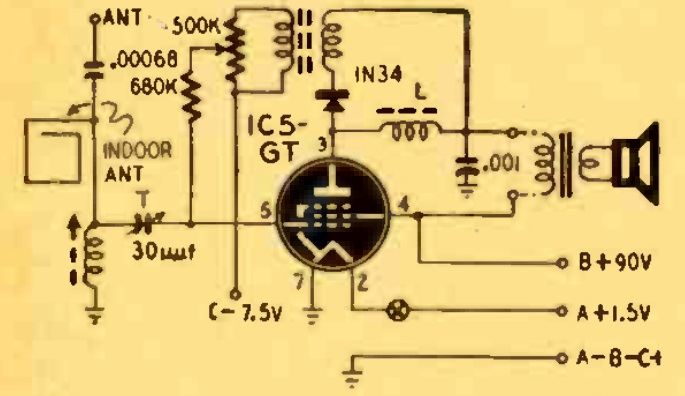
Screenshot 2023-05-08 11.32.01 AMThe plans for this one-tube loop set appeared 85 years ago this month in the May, 1938, issue of Radio Craft. While the tuning range is not specified, it appears to be for the broadcast band, and the set was said to give the beginner many hours of enjoyment both putting it together and using it.

According to the magazine, the set was able to pull in signals inside a steel framed building, with enough volume to rattle the headphones.

While it was not primarily intended for use as an interference finder, the directionalScreenshot 2023-05-08 11.41.22 AM characteristics of the loop antenna made it well suited for that purpose.

The same issue of the magazine also showed how to make the one-tube all wave receiver shown at the right.  It also included instructions for adding an additional AF stage.

Screenshot 2023-05-08 11.33.24 AM


1938 Audio Amp

1938MayRadioNews1Eighty-five years ago, this young woman was preparing to have her voice amplified with this 30-watt amplifier. We don’t know whether she’s a ham modulating her transmitter to almost 100% modulation, or if she is going to address a crowd through the loudspeaker. The circuit shown here, from the May 1938 issue of Radio News, is suitable for either purpose.

The power output was provided by two 6L6 tubes, and the circuit’s main feature was automatic volume limiting, which would provide distortion-free audio, even at maximum power. This was important for modulating, since the FCC required that modulation be limited to 100%. And for PA work, this meant that the output would be not only loud, but also crystal clear.

1938MayRadioNews2


1943 Toy Sidewalk Tank

1943MayPMtankWartime toy shortages didn’t mean a shortage of war toys 80 years ago. And even if our leaders get us into another war, Junior can still have the coolest (but most politically incorrect) toy on the block, courtesy of this homemade sidewalk tank from the May 1943 issue of Popular Mechanics.

Realistic machine gun sounds are courtesy of a hardwood ratchet hitting two bamboo splints. Four roller skates are pressed into service as the wheels. Even Fido gets in on the action as these two young soldiers go after the enemy.


Death of Edsel Ford,1943

1943May26DetroitNewsToday marks the 80th anniversary of the death of Edsel Ford, as shown here in the May 26, 1943, issue of the Detroit Times. Ford died at the age of 49, having served as the President of Ford Motor Company. Upon his death, his father Henry Ford took over temporarily, until after a few months, Edsel’s son Henry Ford II took over.