Author Archives: clem.law@usa.net

Expedient Phono Cartridge: 1943

1943NovRadioCraftEighty years ago, wartime parts shortages meant you couldn’t just walk into the store and buy parts for your radio or phonograph. Occasionally, substitutions were necessary, and they sometimes required a bit of ingenuity to make them work.

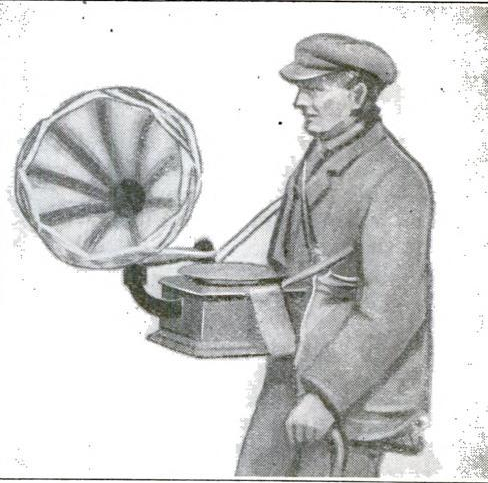
Such was the case for one John J. Leap of New York City, who sent this idea in to the publishers of Radio Craft, where it was published in the November 1943 issue. The pickup on his phonograph had gone bad, and the replacement was unobtainium. Therefore, he made his own, using a headphone and the reproducer from an old mechanical phonograph.

The stylus was soldered to the diaphragm of the headphone, which was used in the place of the original mica piece in the reproducer. The combined unit was then mounted to the original tone arm.

The editors of the magazine decided to duplicate the idea, and they found it to give good results both in quality and volume.


Ergonomic 1938 Radio

1938NovPSThis young woman is now a centenarian, but in November 1938, she was shown in that month’s issue of Popular Science showing off the latest in ergonomic radio receivers. This pushbutton set (the brand name of which is not shown) could be used in two configurations. With the radio sitting on one side, the controls were handy to those who were seated. But tipped up, the radio was easily tuned by a person standing.


Happy Halloween!

1923Oct31OmahaBeeOn Halloween a hundred years ago, if you were in Omaha, you could use the occasion to buy a phonograph for your family at the Burgess-Nash Company.  While you were there, you could get your Halloween dinner for 65 cents.  Or, if you were on a budget, you could get a lunch of chicken a la king in the mezzanine for 35 cents.

The ad appeared in the Omaha Bee, October 31, 1923.


Wigwag Signaling

1963OctBLSixty years ago this month, the October 1963 issue of Boys’ Life magazine showed Scouts the art of wigwagging, which is the “other” method of sending a message with signal flags. The most common method, semaphore, uses two flags, and each letter is sent by holding the flags in a certain position. Wigwag, on the other hand, uses a single flag, and uses Morse code. For a dot, the flag is waved in a figure eight to the sender’s right. The dash is formed by waving the flag to the sender’s left.

For a break between letters, the flag is held upright. After each word, the flag is held down.


The Importance of Owning a Radio

File:Damage in Gaza Strip during the October 2023 - 10.jpg

Gaza, 2023. Wikimedia image.

We’ll refrain from taking sides for the moment. (We definitely have a side, which we’ll undoubtedly explain later), but the the recent headlines from the Israel-Gaza war highlight the importance of having, at a minimum, some sort of radio receiver as part of your preparations for disaster.

According to this news report, the cutoff of telephone and internet service in Gaza means that “for those who have them, radios have become the sole link to the outside world.”  Even though I’ve come to expect it, the words “for those who have them” highlights a fundamental misunderstanding that much of the public has.  They have, in their pocket, a device that will bring them all of the information in the world.  So perhaps it’s not surprising that an inferior device, a simple AM-FM radio receiver, is viewed as not necessary.

But as the current situation in Gaza makes clear, your receipt of information via the internet depends upon the kindness of strangers.  If the internet is cut off, then so is your source of information.  But in the meantime, hundreds of radio signals, some of which contain reliable information, are landing at your feet.  You simply need a receiver to pick them up.

To get some idea of what you would be able to hear on a radio in the Middle East, this link goes to an internet-connected receiver in Kuwait,  and this link goes to one in Cyprus, which seems to be the closest one available.  But most of the strong medium wave stations you hear on that receiver could also be picked up in Gaza  at night.  And if you tune the shortwave dial, there are many more stations available.  Undoubtedly, some of the stations you pick up will be filled with propaganda.  But reliable information is available from sources such as the BBC.

In short, you needn’t be in a total information blackout, but it requires some minimal preparation.  An inexpensive shortwave receiver like the one shown here would let you know what’s going on in the outside world, no matter how much the other side tries to cut you off.  It doesn’t draw much current, so a box of batteries would keep it running more or less indefinitely.  And there are also many solar and hand crank radios available.

And even if you don’t prepare, remember that most cell phones sold in the United States include an FM receiver, which doesn’t require any kind of connectivity.

Incidentally, it’s interesting that the article equates listening to the radio for news with burning furniture for heat.  I wonder if they got that idea from us.


Postal Zones Introduced: 1943

1943OctNRNEighty years ago, the U.S. Post Office Department introduced postal zone numbers in the 124 American cities shown here. These were the predecessors of the ZIP Code, introduced 20 years later in 1963.

The number was written after the city, but before the state. When the ZIP code was introduced, these zone numbers became the last two digits of the ZIP.

This list appeared in the October 1943 issue of National Radio News, which reminded readers to use add the code 9 between “Washington” and “D.C.” when mailing lessons and other items to the National Radio Institute.


1938 Desktop Calculator

1938OctPracMechIf you needed a desktop calculator 85 years ago, you couldn’t go wrong with the one described in the October 1938 issue of the British magazine Practical Mechanics.

It was a literal desktop calculator, since you affixed it to your desk. It consisted of three logarithmic scales, and could perform multiplication and division, and even square roots. To multiply, you placed your straightedge on the numbers on the outer scales. At the point where it crossed the middle scale, that was the product.

You could use any ruler, but the magazine recommended as the best option a strip of celluloid. You would carefully score a line down the middle, fill it with ink, and then polish away the excess ink.

With practice, the calculator was accurate out to three figures.


1953 One-Tube Novice Receiver

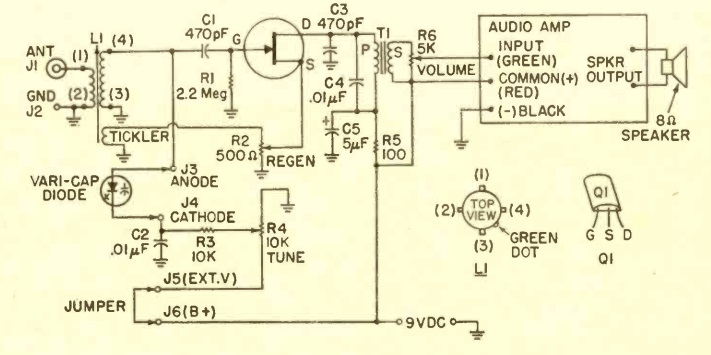
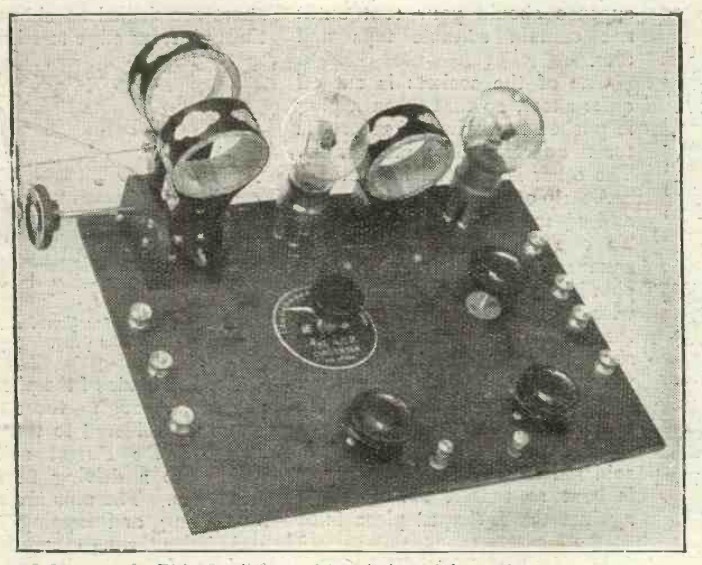
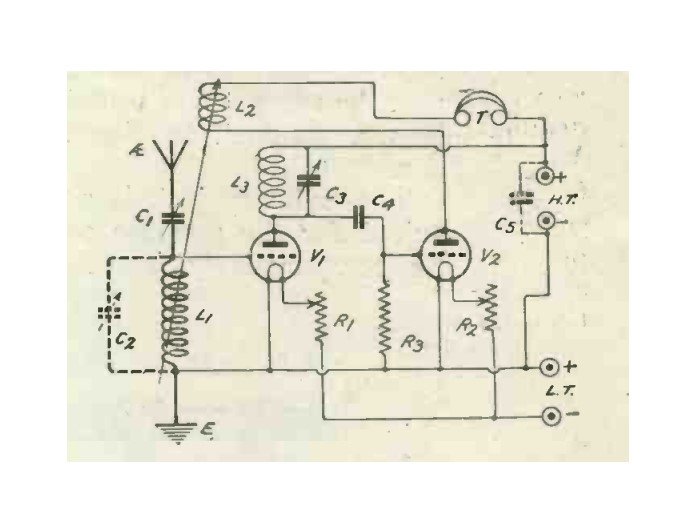
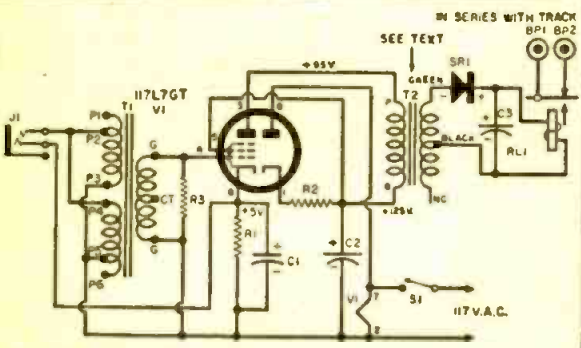
1953OctRadioNewsSeventy years ago this month, the October 1953 issue of Radio News showed how to build this one-tube regenerative receiver, especially designed for the Novice. It used a single 6SN7 dual tube, which served as regenerative detector and audio amplifier.

The previous month’s issue of the magazine had showed a companion transmitter and power supply, and the receiver used that same power supply. Since the power supply was regulated, the receiver was extremely stable, and the article pointed out that a crystal-controlled signal sounded like it was crystal controlled, unlike many regenerative receivers, where you couldn’t really tell the difference.

1953OctRadioNews2


1938 Two-Tube Pushbutton Set

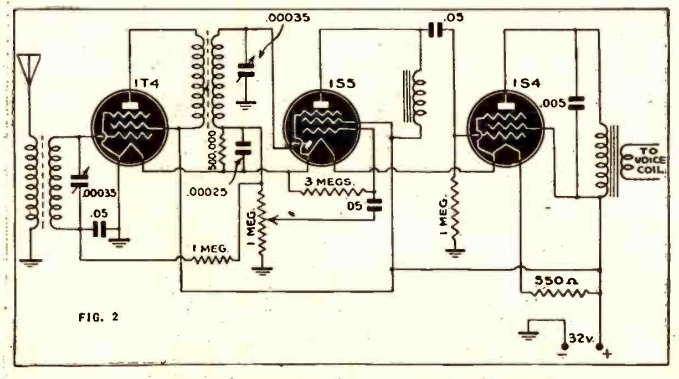
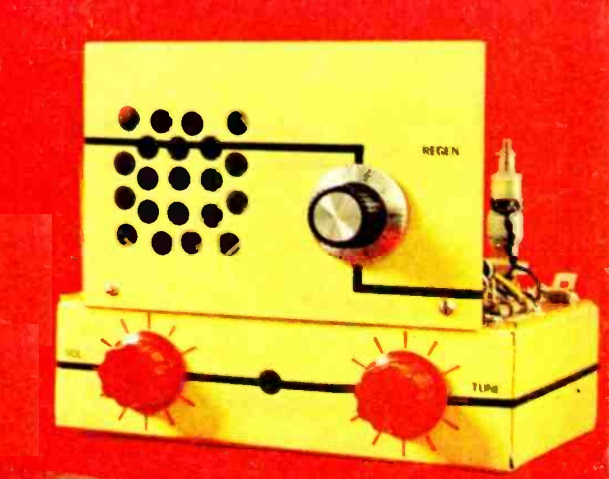
1938OctPM2This handsome little two-tube receiver graced the pages of Popular Mechanics 85 years ago this month, October 1938. It uses two dual tubes, so it has the performance of a four-tube set. One tube appears to serve as RF amplifier and detector, with the other one providing two stages of AF amplification to drive the speaker. The set was billed as being perfect for an extra set around the house, as a traveler’s companion, for the sick room, or for the office desk.

Tuning was accomplished with a (now unobtainium) pushbutton unit, which contained trimmers for individual stations. An alligator clip connected to the antenna (through a fixed capacitor and without a ground, as the chassis was hot).

1938OctPM1


2023 Post-Eclipse Report

image000000 (3)My son and I were in Corpus Christi, Texas, for the annular eclipse on Saturday, October 14, 2023.  Our original plan was to view it from the Padre Island National Seashore, which we had scoped out the day before.  But when we woke up Saturday morning, it was cloudy in Corpus Christi, and weather maps showed clouds over most of the region.

There was a large break in the clouds to the north, and we decided to head that direction.  Weprojected decided to head to Rockport Beach, and this proved to be an excellent spot to view the eclipse.  This was the first time I experience an annular eclipse.  Basically, it’s a 99% partial eclipse, with the remaining 1% of the sun forming a “ring of fire”.  The photo above was taken with my son’s cell phone, using the filter from a pair of eclipse glasses.  The photo at right is using an expedient projection method.  With the pair of “cheaters” reading glasses in my pocket, I simply projected the image onto the picnic table.

rockportbeachThe phenomenon was very different from total eclipse.  It was worth the trip, but considerably less dramatic.  I could tell that it didn’t seem as bright outside as usual, but if I hadn’t known there was an eclipse in progress, I might have dismissed it as haze.  No stars were visible, although the sun didn’t seem as hot as it should.  As you can see from the photo at the left, it’s still obviously daytime.  This is very different from the total eclipse, where at least one star (the planet Venus) was visible, and there was a sunset on the horizon for 360 degrees.

The moral of the story is that if you are in an area with a 99% total eclipse, you should definitely drive a few miles to where it is 100%.  It’s worth the drive.

There was a fairly large crowd at Rockport Beach.  It was obviously smaller than they would have on a hot summer day, but I’m sure it was much larger than a typical windy October morning.  Everyone seemed to have eclipse glasses, and one group played “Ring of Fire” during annularity, which seemed like a nice touch.
image000000 (4)After annularity, most other eclipse chasers on the beach started packing up to head home, even though the partial eclipse was still ongoing.  I made an effort to operate on the radio during the Solar Eclipse QSO Party on 40 meters CW.  Unfortunately, I had an extremely marginal antenna, as there wasn’t much to attach an antenna from my location.  As you can see, I used two broomsticks taped together as the center support.  The ends, I staked into the ground.  In Minnesota, there are always plenty of sticks on the ground to use to tie down the antenna.  South Texas, with its palm trees, doesn’t have convenient sticks on the ground.  Fortunately, I had two pencils in the car, and I used them.

But my makeshift antenna was only a few feet off the ground, and I didn’t manage to make any contacts, nor was I heard by the Reverse Beacon Network.  I made a list of calls heard, and I guess I’ll submit them.