Author Archives: clem.law@usa.net

ASK YOUR PARENTS to explain this, if you do not understand it.

StampsAndCoinsI suspect many aspiring young philatelists and numismatists got their start as I did on the pages of Boys’ Life Magazine. This clip comes from the November 1974 issue. I earned my first merit badge, Coin Collecting, about this time, and I’m sure I carefully examined this page when it came out. I was a good customer of many of those advertisers, including the Littleton Coin Company, the Littleton Stamp Company, and the Mystic Stamp Company. It turns out that those companies are very much still in business, but Littleton acquired Mystic along the way. Today, coins are sold under the Littleton name, and stamps are sold under the Mystic name.  The Littleton Coin ad shown here notes that it is for serious coin collectors only, and I certainly fit that description.

I still have many of those treasures tucked away, such as the Hong Kong One Cent Note, and the Japanese Invasion Currency.  (Although it wasn’t until many years later that I learned that the money was never intended for Hawaii, as I think I was led to believe.  It turns out the notes denominated in dollars and cents were actually used in Malaya.)

As was customary, most of these companies sold “on approval.” An offer was advertised at a very reasonable price, and the buyer also received “approvals,” meaning additional coins or stamps that had to be either paid for or sent back. This was undoubtedly the source of great confusion by many young scouts, so each issue of Boys’ Life carried the explanation shown here. In case the explanation wasn’t understood, it concluded with the admonition: “ASK YOUR PARENTS to explain this, if you do not understand it.”

Interestingly, this issue’s cover story is a feature about a sports hero named O.J. Simpson. It details the inspiring story of how he managed (up to that point) to avoid a life in crime, and concludes, “when he still asks, ‘tell me what You want me to do,’ you feel that he already knows the answer and now is searching only for the means.”


Click Here For Today’s Ripley’s Believe It Or Not Cartoon


12 Volt Appliances on Sale at Amazon


On my “how to make coffee without electricity” page, I’m sometimes asked whether it’s possible to make coffee (or cook other things) with 12 volts. The answer is a qualified yes. There are cooking appliances that run on 12 volts, and for some applications, they can work extremely well. But there are definite limitations, and you can’t expect 12 volts to provide an exact duplicate of your normal cooking experience. Amazon currently has a number of 12 volt appliances on sale, so now is a good time to look at the possibilities and limitations.

The most important thing to remember about cooking with electricity is that producing heat requires a lot of electricity. Sometimes, people look at their toaster, coffee maker, electric heater, or other device and decide that because it is small, it must not use much electricity. This is not the case. As a general rule, any device that creates heat will use a lot of electricity. Therefore, your coffee maker uses more electricity than your television–a lot more. Your toaster uses more electricity than your computer–a lot more. Anything that produces heat will require a lot of electricity.

This means that, in general, you can’t use a battery to do any type of cooking. There is simply not enough energy in the battery. The battery will go dead.

However, if you have 12 volts available from your running vehicle, then you might have some options. But the vehicle will need to be running. Otherwise, you’re very likely to wind up with a dead battery.

For this reason, you’re usually better off using some sort of combustion to do your cooking, such as a gas stove. I have many options available on my coffee page.

But if you want to cook and you have a running vehicle, then 12 volts might be an option, and you should look into the possibilities on this page. For example, if you are a trucker, your truck is running anyway, and there are 12-volt appliances that you can use to cook while the engine is running. Or if you are on the road all day, you can have a cooker plugged in while you are driving.

On the other hand, if you are an RV’er and your rig has a 12-volt battery, that battery is more than adequate to run the lights for a long period of time. However, it is not nearly big enough to run any of the appliances on this page for other than a very short period of time.

Now that we have that out of the way, we need to talk about another limitation. It will take longer to cook food using 12 volts–a lot longer. The amount of heat produced is proportional to the voltage times the current. This means that if a home appliance produces a certain amount of heat in 1 minute, it will take a 12 volt appliance 10 minutes to produce the same amount of heat. The heat will come, eventually, but it will take longer–a lot longer. So if you want instant gratification, you shouldn’t try to cook with 12 volts. But if you’re willing to put in the food and let it cook while you drive around, then you might be interested in the 12 volt appliances shown on this page. Many of these are currently on sale at Amazon, so if you’re in the market, this is a good time to buy.

The first of these appliances is the RoadPro 12-Volt Portable Stove. In this case, the word “stove” is a misnomer. Strictly speaking, this is a stove, because it’s a device used to heat food. But as you can see, it doesn’t look like a stove. It looks more like a tackle box with a 12 volt plug. It doesn’t look like the stove at home, and it doesn’t have the same function as the stove at home. It will slowly cook food as you drive around. Functionally, it will work more like a crock pot or slow cooker. For what it is, it’s very useful, as long as you understand the limitations. It’s great for having a warm meal while you’re driving. You can put the food inside it in the morning, and you will have a hot lunch after driving around for a few hours. But if you expect to quicly cook a meal for your family while camping, it’s a very poor choice.


If you just want to heat liquids, then the Roadpro Hot Pot is a very economical option. Again, however, you need to understand the limitations. This will not heat nearly as fast as the stove at home. This hot pot will bring 20 ounces of water to a boil in about 35 minutes. Again, if you’re driving around and want to make a hot beverage, this will be great. But remember that once you’ve used the 20 ounces of water, it will take another 35 minutes to make more.

This 12V Frying Pan is small. It can be used to fy one, or maybe two eggs, or perhaps a hamburger. Even though it can be used to fry food, keep in mind that it will take much longer than the stove at home. Of all of the appliances on the page, this seems to be the least practical, since frying food means that someone needs to keep an eye on it, which you probably can’t do while driving. But perhaps for some uses, it might come in handy, and at the current sale price, it’s economical even for occasional use.

This 12 volt Sauce Pan and Popcorn Maker suffers from the same limitations. As noted above, it can really only be used while driving, and it would be difficult for the driver to attend to the popping corn.

Finally, and probably most useful, is this 12-Volt Coffee Maker . It will make 3 cups of coffee, although it might take almost an hour to make the full amount. So if you like brewed coffee, this is a good option. The carafe is made out of metal, so it will endure a certain amount of abuse in the car. For occasional use during power outages, this might be a good option for those who want brewed coffee. You will need to run your car for the time that it takes to make the coffee. If you had to do that every day, it would be a huge waste of gas. But for occasional use, the convenience might outweigh the added expense.


Red Owl Makes a Cameo Appearance, 1964


MotorcycleRedOwlThis review for a Harley-Davidson 50 cc motorcycle appeared fifty years ago, in the November, 1964, issue of Popular Mechanics. The photo shows how easily the little bike can weave in and out of congested traffic.

But what caught my eye was the Red Owl truck in the background.  In the 1960’s, Red Owl was one of the big grocery chains in the Twin Cities,  At its peak, it had 441 stores in Minnesota, Michigan, Wisconsin, Iowa, and the Dakotas. The name was acquired by Supervalu in the 1980’s and eventually phased out.  The name and familiar logo lives on, however, at at least one store in Green Bay, Wisconsin.


Click Here For Today’s Ripley’s Believe It Or Not Cartoon



Remembering the Men of the HMCS Shawinigan, 1944

300px-Corvette_Shawinigan

HMCS Shawinigan (Wikipedia photo).

Seventy years ago today, during the night of November 24, 1944, or the early morning hours of the 25th, the Canadian Corvette the HMCS Shawinigan was sunk in Newfoundland waters by the German U-Boat U-1228, resulting the death of all 91 men aboard. The ship was sunk off Channel-Port aux Basques, Newfoundland, at the mouth of the Gulf of St. Lawrence. It represented the last casualties of the Battle of the St. Lawrence and the worst case of military deaths in Canadian or Newfoundland territory during the war.

The Canadian waters of the Gulf of St. Lawrence were very much a theater of war and Canadian shipping was constantly at risk. The Germans had no organized battle plan for Canadian waters, but German u-Boats took advantage of targets of opportunity within the Gulf. German U-boats were documented to have come within 172 miles of Quebec City.

Blackout regulations were in place along the coast, and “dim outs” were ordered further up the river.   Coastal residents would witness battles taking place, but military censorship prevented these from being reported in the press.  Most Canadians realized the threat, but ironically, despite the censorship, the general perception was that the situation was more serious than it actually was.  Nevertheless, there was a real battle raging, and there was a risk to shipping far inland.

In early October, 1944, U-1223 entered the Gulf of St. Lawrence. On October 14, it inflicted serious damage to the frigate HMCS Magog, killing three crewmen and injuring three. On November 2, it sunk the freighter SS Fort Thompson.

On November 24, the Shawinigan and the U.S. Coast Guard Cutter Sassafrass were assigned to escort the ferry Burgeo from Sydney, Nova Scotia, to Port aux Basques, Newfoundland. The Sassafrass (which remains in service today, as the Nigerian Naval Ship Obula) was detached from the escort, and the Shawinigan departed on an independent anti-submarine patrol and informed the ferry that it would meet her in the morning.  After the sinking of the ferry Caribou on the same route in 1942, with 137 deaths, all passenger ferries had military escorts.

The Burgeo left Port aux Basques in the fog, but could not find the Shawinigan. Radio silence prevented the ferry from making any notification, and she made the crossing to Sydney unescorted. It wasn’t until the Burgeo arrived at Sydney that the navy knew that the Shawinigan was missing.

Despite a search, only flotsam and six bodies were found.  Some of the bodies had bullet wounds, indicating that some men made it to lifeboats.

free-vector-poppy-remembrance-day-clip-art_106032_Poppy_Remembrance_Day_clip_art_smallThe wreck of the Shawinigan has never been found. The blast that sunk her was loud, and was reported by many on shore. Even the master of the Burgeo later reported that he heard a strange noise that shook his house, but never made the connection with the missing escort ship. Despite sonar searches over the years, the final resting place of the Shawinigan and the grave of most of her crew has never been located.

The U-boat returned to its home port in Norway in December and set out for another cruise in April 1945.  It saw no action prior to the German surrender, and on May 17, 1945, it surrendered to the U.S. Navy at Portsmouth, New Hampshire.

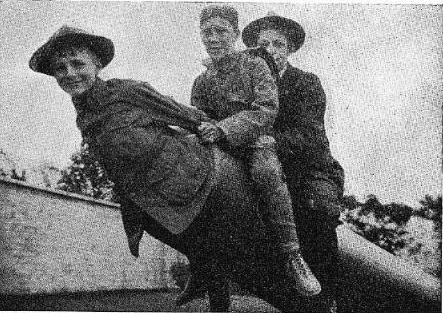
Crew of the Shawinigan (Naval Museum of Manitoba Photo).

Crew of the Shawinigan (Naval Museum of Manitoba Photo).

References

Read More at Amazon


1954: Stock Market Recovers from 1929 Crash

1954ChicagoTribuneSixty years ago today, the Dow Jones Industrial Average hit a high of $382.74. The Chicago Tribune notes that this is a “new high for 25 years,” and notes that the previous record was $381.17 on September 3, 1929.

That earlier record, of course, came shortly before the crash of 1929, as shown in the front page cartoon below from October 25, 1929.  It took a quarter century for the market to recover from the 1929 crash.

1929CrashCartoon


Happy Franksgiving!

Today is the 75th anniversary of the first Franksgiving, November 23, 1939.  The following week, November 30, was Thanksgiving. Since Lincoln, Presidents had declared the last Thursday of November as Thanksgiving. Believing that the short span between Thanksgiving and Christmas would harm retail sales, President Franklin Roosevelt on October 31, 1939, declared that November 23 would be Thanksgiving. The battle lines were drawn. Democrats favored the switch, 52% to 48%. Republicans opposed it 79% to 21%. It was up to state governments to set the actual day during which state employees would be off work, and the actual holiday varied throughout the country. Franklin Roosevelt’s new holiday was quickly dubbed Franksgiving.

Fortunately for the nation, the U.S. Department of Agriculture announced that the nation’s turkey crop was “the largest crop in turkey history.” For those families, such as the one shown here, who wished to be non-partisan and celebrate both days, the bounty of the harvest would be able to provide. The caption of this photo notes that “to the children in the household, two Thanksgivings spell double delight, perhaps two turkeys, and tables loaded with cranberries, pies and fruits.”


Click Here For Today’s Ripley’s Believe It Or Not Cartoon


Our Newest Advertiser: Ripley’s Believe It Or Not!

Ripley1921

OneTubeRadio.com is pleased to announce a new advertiser, Ripley’s Believe It or Not!,  which was founded by iconic cartoonist and world explorer Robert Ripley in 1918 with his famous cartoon feature. Nearly a century later, the cartoon is still in production and can be viewed online .

The cartoon shown here appeared in the Washington Evening Star on November 15, 1921. The early cartoons often focused on sports, but also included other interesting oddities such as the gentleman who caught a 710 pound tuna in Nova Scotia.

Today, the Ripley’s empire includes “odditoriums” and aquariums worldwide in tourist destinations. When I was growing up, our local paper didn’t carry Ripleys’ Believe It Or Not!, but I took advantage of the various books. Young readers will especially enjoy the
RBI books
, containing the fictional adventures of young members of the “Ripley’s Bureau of Investigation.” The first book in the series is available as a free Kindle book.


Click Here For Today’s Ripley’s Believe It Or Not Cartoon


Discovery of Meteor Burst Communications, 1944-56

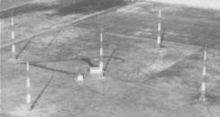
VHF Antenna at FCC Allegan, Michigan, monitoring station, 1944.

VHF Antenna at FCC Allegan, Michigan, monitoring station, 1944.

Seventy years ago, the November 1944 issue of Radio News carried a story of a phenomenon that was baffling radio engineers, and was under investigation by the FCC monitoring station at Allegan, Michigan. The station was reporting strange bursts from distant FM broadcast stations, then operating in the 42-50 MHz band. The FCC station had receivers tuned to the frequencies of distant stations, constantly making a record of the signal strengths as the distant stations came up out of the noise. The signals were bursts of a very short duration in the station’s signal strength. These bursts were rarely of a duration longer than a single spoken word or one or two notes of music.

The bursts have been observed at distances of up to 1400 miles, but were more common at distances of 300-700 miles.

The article was almost certainly describing meteor scatter.  A letter to the editor of QST, November 1946, from Gurdon R. Abell, Jr., W2IXK, seems to be the first reference by a ham to the same phenomenon. He noted hearing bursts of signals during the Perseids meteor showers on 144 MHz, which coincided with bursts from New York HF stations inside his skip zone. He concludes, “if this observation can be relied upon, it means that 144-Mc. signals can be refracted by the stronger meteor trails,” and he seeks further corroborating evidence.

This letter was probably inspired by a January 1946 QST article by Oswald G. Villard, Jr., W6QYT.  Villard detailed how to listen to meteors by monitoring short wave stations on 11, 15, or 18 MHz. A meteor would result in a signal being reflected, but with a doppler shift causing a change in frenquency. The two signals would result in a heterodyne, causing an audible whistle.  Villard followed up with another article in QST for July 1947,  but was still focused on the HF effects of meteors, the highest frequency investigated being 27 MHz.

Two follow-up letters to W2IXK’s appeared in QST in January 1947, from Villard, and also from Bruce Henke, W6TFJ, who noted a similar phenomenon on 10 meters. In April 1953, Villard, along with Allen Peterson, W6POH, wrote an article discussing the possibility of using “meteor scatter” for communications on 15 and 20 meters.

Between 1953 and 1956, VHF operators started to figure out the possibilities of this propagation mode. Many of these are detailed in the World Above 50 Mc column in October 1956.

With digital modes, able to make an entire exchange in less than a second, meteor scatter is now fairly routine. In the 1950’s, it required fast Morse code, and more than a little luck. It’s not impossible, however, with voice modes. From Minnesota, South Dakota is a difficult catch on 10 meters, since it’s well within the skip zone. I have South Dakota confirmed, and I’m pretty certain it’s courtesy of a meteor. During a 10 meter contest, I just happened to have the VFO on the frequency being run by W0SD in Salem, SD, a distance of 225 miles. (If you’re driving I-90 through South Dakota and wonder what those towers are as you pass Salem, now you know.)  He was calling CQ, and he came up out of the noise with a booming signal. I quickly called, we made the exchange, and then he disappeared. He was audible for only a few seconds, and it was dumb luck that I was on his frequency for those seconds. I can’t think of any explanation other than meteor scatter for this contact.

Note:  To view the QST articles linked above, you need to be logged in to your ARRL account.


Click Here For Today’s Ripley’s Believe It Or Not Cartoon


About Our Advertiser: Jameco Electronics

JamesElectronics1974AdWe are pleased to have as one of our advertisers Jameco Electronics.  One of their first advertisements, from the 1974 issue of Radio Electronics magazine, is shown here. The company was originally known as James Electronics, and is now known as Jameco Electronics. They were founded 40 years ago by Dennis Farrey, and have been based the entire time in Belmont, California, in Silicon Valley. They have always been responsive to the needs of hobbyists and do-it-yourselfers, and they are an excellent option for parts orders for electronics and robotics hobbyists. They’re geared up for small orders, and they are an economical option for electronic parts in small quantities. You can read more about their company history at their website.

You can request a copy of their free catalog by mail or download a copy. If any of the posts on this site inspire you to build a project or perhaps restore an older piece of equipment, Jameco is an excellent source for any needed parts. If you’re starting out as an electronics hobbyist and need to stock your “junk box” with high quality components, their grab bags provide an excellent value. They also have a large selection of electronic and robotic kits.

We welcome Jameco Electronics as an advertiser, and encourage you to support them.

Nazi Weather Station in Labrador

Weather Station Kurt on display at the Canadian War Museum (Wikipedia photo).

Weather Station Kurt on display at the Canadian War Museum (Wikipedia photo).

On October 22, 1943, Germany made its only armed landing on the North American continent of the Second World War. On that day, the U-boat U-537 anchored at the northern end of Labrador and its crew loaded ten cylindrical canisters, each weighing about 220 pounds, onto rubber rafts and then ashore. Together, these canisters constituted an automated weather station, which the Germans had given the code name Weather Station Kurt. The station was one of 26 manufactured by Siemens and deployed around the North Atlantic to give German meteorologists data on weather as it moved across the Atlantic. Other stations had been deployed in Greenland; Bear Island, Norway; Spitsbergen; and Franz Josef Land. Another such station was intended for North America, but the sub carrying it was sunk en route.

One of the canisters contained the meteorological instruments, and one contained a 150-watt  Lorenz 150 FK radio transmitter. (A specimen of this transmitter can be found in LA6NCA’s collection.)  The remaining canisters contained nickel-cadmium batteries to power the system. The system was designed to operate for up to six months, sending a two minute transmission every three hours on 3940 kHz. The data was sent in Morse, which was to be manually transcribed by German radio operators.  Some technical details, diagrams, and wartime photos of the station can be viewed at the links below.

The station was camouflaged, and components were  marked in English with the words “Canadian Meteor Service.” Not only was there no such agency, but Labrador was part of Newfoundland and not Canada.  The station was placed far enough North in the hope, apparently realized, that the Innuit of Labrador would not encounter it.  To confuse anyone who might stumble upon the remote site, empty American cigarette packages were strewn about.  A satellite image of the remote site can be viewed at Google Maps.

The station apparently worked flawlessly, but but was subject to jamming from a source that has never been identified. The Allies apparently never learned of the station’s existence, but It apparently provided weather data for only a few days.

The station was abandoned and not found until 1981. A German researcher working on an unrelated project stumbled onto records of the station in 1977. A retired Siemens engineer who was working on records of the company also stumbled upon references to the station about the same time. He contacted a Canadian Defence historian, who eventually sent a team to the site in 1981. Although some canisters had been disturbed, the station was still there. The station is currently on display at the Canadian War Museum.

References

Read More at Amazon