Author Archives: clem.law@usa.net
Free Download of 1962 Civil Defense Plan & Shelter Management Handbook
I now have available on my website a complete scan of the 1962 Civil Defense Operational and Survival Plan of the City of St. Paul, Minnesota. This 104 page document goes into great detail as to how the city planned to survive the aftermath of a nuclear attack. Of particular interest is the complete handbook for managers of public shelters. The handbook would give the fallout shelter guidance on all aspects of operating the shelter. There is some information in this document of practical guidance. For example, the section on radiological defense contains some useful information. However, the document’s main interest is as a fascinating historical look at civil defense plans fifty years ago.
Measuring Longitude Between Washington and Paris, 1914
In an earlier post,
we showed how radio was being used in 1924 for accurate measurements of longitude. And the newspaper a hundred years ago today, November 21, 1914, shows the work that was taking place then. This clipping from the New York Sun shows measurements of longitude being made between Paris and Washington.
The Eiffel Tower radio station continued in service throughout the war, and a hundred years ago, it was busy comparing time signals with its counterpart in Arlington, Virginia, station NAA. By comparing the instant of local noon at both locations, the tests were able to very accurately measure the difference in longitude. The time difference between the two observatories was found to be 5 hours, 17 minutes, and 36.658 seconds. This corresponds to a difference in longitude of 79.40274 degrees.
Today’s Ripley’s Believe It Or Not Cartoon
![]()
Eagle Scouts, Class of 1944
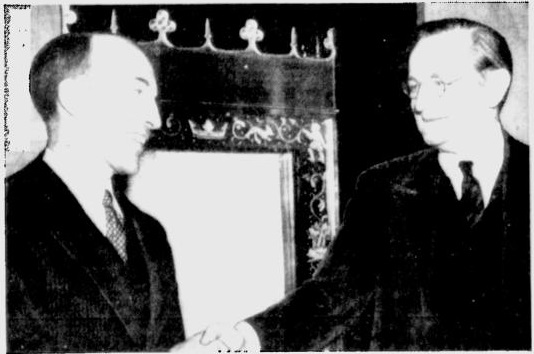
Seventy years ago today, November 19, 1944, these four young men were featured in the Chicago Tribune after having become Eagle Scouts. For the first time in the history of their community, five Scouts had become Eagle at the same time.
The Scouts were John L. Guyer, George L. Otis Jr., Harrison C. Stearn Jr., Richard Wallace Jr., and John H. Hafner. Mr. Hafner, who was a student at a military academy at the time, was not pictured.
If you know one of these Scouts, or you are one of them, I would love to hear from you about your reminiscences about Scouting and your experiences over the years. You can contact me at clem.law@usa.net.
Knight-Kit Star Roamer Receiver, 1964
Fifty years ago this month, November 1964, Electronics Illustrated reviewed Allied Radio’s Knight-Kit Star Roamer Receiver. I never had one, but this basic receiver was ubiquitous in the 1960’s and 1970’s, and many SWL’s got their start with the four-tube receiver.
According to the magazine, the kit sold for $39.95 and took about 20 hours to build. The receiver’s low tube count was courtesy of a selenium rectifier and solid-state diode detector. The radio did receive CW, but without a BFO. The final IF stage was designed so that it could break into oscillation, making the receiver quasi-regenerative. Interestingly, the radio included a key jack, since the oscillating stage could be used as a code practice oscillator for an aspiring novice to work on learning the code.
The receiver tuned 200 kHz to 30 MHz, but as the review points out, the longwave band was almost useless, and the overall performance left a lot to be desired. But in an environment filled with strong shortwave signals, even a simple receiver like this one would give hours of interesting listening to the new SWL.
Good specimens seem to go for about $50 on eBay. But if you’re in the market, there’s really no sense in getting a working one. The simple receiver is easy to work on, and the full assembly manual is readily available. This receiver would be a good candidate to “re-kit”: Take it apart, and keep the mechanical parts, IF transformers, and variable capacitors. Then, replace the resistors and capacitors with modern replacements. The selenium rectifier is probably best replaced with a more modern silicon rectifier. The old tubes are almost certainly good, and even if they are not, they are all easily obtainable as “new old stock.” Finally, put it back together according to the manual (and the cautions contained in the EI review).
Houdini’s Ice Escape Explained…Except for One Small Detail

Houdini going in to the Detroit River (from the 1953 Paramount movie)
Seventy years ago today, November 17, 1944, the Milwaukee Journal carried an interesting item about the escape artist Harry Houdini. The previous Sunday, November 12, the radio program John Nesbitt’s The Passing Parade had carried a description of Houdini’s famous escape from under the ice covered waters of the Detroit River. This stunt was immortalized in the 1953 Paramount Movie Houdini starring Tony Curtis as Houdini. A still from the movie of the great escape artist’s crate being dropped into the icy water is shown here.
The Journal’s radio editor recounts the broadcast describing the “famous occasion 35 or more years ago when Houdini jumped into the Detroit river through a hole cut in otherwise solid ice that covered the river.” According to the paper, Houdini “stayed under water for six–or was it eight?–minutes, well beyond the time limit of known human endurance.” According to the paper, the mayor of Detroit and a “good crowd of sober citizens” witnessed the stunt and had the scare of their lives.
According to Nesbitt, Houdini “knew something.” He knew that the river had fallen an inch or so, and that there was an air-filled void between the surface of the water and the ice. As famously depicted in the movie, Houdini merely went to the surface, breathing the air until he located the hole.
But the mystery was apparently solved by a mysterious letter that showed up at Milwaukee station WTMJ after the broadcast. The anonymous author of the letter was from Grand Rapids, Michigan, (It’s quite plausible that the Milwaukee station had listeners in Grand Rapids, since the two locations are separated mostly by the waters of Lake Michigan, over which the groundwave signal of the 620 kilocycle station would easily pass.) The mysterious author of the letter offered up what seemed to be a very plausible explanation for the stunt.
The radio editor Richard K. Bellamy, opines that “to us it sounds as though the writer of the letter knew what he was talking about.” It also sounded to me like the writer knew what he was talking about, since he included a number of corroborating details.
The anonymous letter writer stated that he was an “expert diver” and “one of Harry’s accomplices on that day” and that he was paid $350 for his part. According to the writer, a sheet metal worker in Brooklyn fabricated a can which was filled with compressed air. The letter writer’s job was to place that can in the river, which he says he did the Sunday prior to the stunt. “Harry and I carefully measured the distance” from the hole in the river to the can, says the writer. The can was attached to “a sort of head mask and some rubber hose.” “He could have stayed under 30 minutes,” opined the writer.
The mysterious letter writer does offer some corroborating details. He notes that there “probably is, or was, a tinsmith in Brooklyn who could corroborate part of my story.” He noted the exact location, noting that “if you will check today, you will find a quantity of concrete piling along the banks of the river,” and that the can and its anchor “is probably still at the spot” under the water. He concludes by noting that “a little research will probably bear me out.”
The letter writer says that he can’t divulge his identity “for ethical reasons.” But he believed that it “is hardly fair to the radio public to let the hoax explanation be unchallenged.”
That certainly seems like a plausible explanation. After all, anyone could have gone to take a look at those concrete pilings. And retrieving, or at least locating, a large cylinder and concrete anchor down at the bottom of the river doesn’t seem like a major undertaking. And the anonymous explanation certainly seems more plausible than breathing, for an extended period of time, the tiny bit of air trapped under the ice. So the radio columnist was apparently convinced. And I was almost convinced, but for one small discrepancy.
That discrepancy was that the supposed ice escape, with or without assistance, never took place. The mayor of Detroit didn’t witness it, the sober citizens of Detroit never witnessed it, and Houdini never did it. It simply never happened, as shown at some of the links below.
Fact checking was harder before the Internet. For a news story, a reporter might be expected to go down to the vault and find clippings about an event “35 or more years ago.” But this wasn’t a news article, and they didn’t have that Google thingie to help with the fact checking. It was just an account of an interesting letter sent anonymously to a radio station. And it was a good story, good for a few column inches. If I were the editor, I would print it, too.
Who sent it? It could just be some guy playing a practical joke. Or perhaps it was a publicist hyping a movie that wouldn’t come out for another nine years. It seems like a good way to reinforce the “ice escape” story: Plausibly explain how it was “really” done, without quite enough details to disprove the official version of the story. It seems to me that adds a little bit of credibility to an official story that never happened.
References
- Houdini, under ice in Detroit
- American Museum of Magic
- Seeking Michigan
- Wild about Houdini
- DynaMike Magic
Read More at Amazon
1934 Philco Ad
Eighty years ago today, November 16, 1934, the Milwaukee Journal carried this ad for this Philco “lowboy” console radio for $59.95. You could have the radio installed in your home for ten percent down.
The radio is Philco model 45L, and covered both standard broadcast and short wave. In fact, this package included a short wave antenna kit, a Radio Atlas of the World, and an “Admiral Byrd Revolving Globe.”
The receiver was probably a pretty good performer. It had six tubes, and two IF stages. You can find a schematic and more information at RadioMuseum.org.
Emergency 1943 Radio Receivers, Including Converting Lightbulb to Diode Tube
A wartime issue of Radio News, January 1943, includes an interesting article entitled “Emergency Radio Receivers.” The article notes that “‘horse and buggy’ receivers employing the simple detectors are just as workable today as they ever were.” With wartime tube and battery shortages, and the possibility of power line disruptions, “the present war emergency may yet recall these simple sets from their resting places on museum shelves.” Their greatest value in time of war was as emergency receivers. “Such sets may be placed into immediate service when power lines have snapped out and “B” batteries are not available for the family portable. They may be carried into bomb shelters where electric power is not available. Particularly unique is the fact that they may be made so small in size as to be carried easily in a pocket or handbag.”
This was not the last time that the usefulness of crystal sets was considered for emergency preparedness. A 1963 Office of Civil Defense report noted that for the “economy minded,” even a crystal set would be adequate for receiving local broadcasts after a nuclear war.
The article then describes a number of possible crystal detectors that could be used in an emergency receiver. (One not mentioned was the razor blade of the foxhole radio, which made its debut the following year, in 1944.)
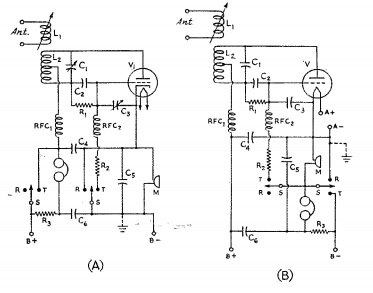
For those interested in experimenting with crystal sets, the article provides a good introduction to the subject. Three of the ideas shown are rather novel. The first is an “effective crystal circuit for fixed-frequency ultra-high-frequency reception,” shown here. The terminology has changed, and we would today call these VHF frequencies. It notes that this circuit provides “interesting possibilities for portable (personal) use in short-range civilian defense communications employing the ultra-high WERS (War Emergency Radio Service) frequencies” of 112-116 and 219-225 MHz. Contrary to popular perception, there’s no reason why a crystal set can’t be used on VHF. In fact, here’s one interesting example of a crystal set for the FM broadcast band.
The article also shows a method for receiving CW signals on a crystal set, a task I would have thought to be impossible without some active component such as a tube or transistor. The article explains that to receive CW, it is only necessary “to include in the circuit some form of continuously-running, high speed interrupter.” It shows how to do this with a motor-driven commutator which interrupts the RF circuit. This makes the CW signal audible, with a pitch proportional to the speed of the interrupter. A rheostat controlling the speed of the motor thus adjusts the CW pitch.
But the most remarkable idea in this article is making a homemade vacuum tube diode using a double-filament lamp. The article explains how a diode tube can be made from a type 1158 lamp. This lamp, which is still readily available, has two filaments, one brighter than the other. The brighter filament is intentionally burnt out by applying a high voltage. This leaves the other filament intact. The good filament is then used as a directly heated cathode. And the support rod for the burnt out filament acts as the plate of the tube. The result is that the automotive light bulb is converted into a diode vacuum tube. It is used in the circuit shown here as a radio receiver:
The article notes that the filament has a rather high current (about 750 mA for a modern example), but “this drawback should not be of monumental concern if the diode receiver is to be operated during rather short, emergency periods.”
Any dual-filament DC bulb should serve the same purpose, but the 1158 bulb specified in the article is still readily available. It’s probably available at a local hardware store, and it’s also available at a reasonable price from Amazon. Since six-volt automotive bulbs aren’t very common these days, it would probably be better to substitute the 12-volt version, the 1157, which should be available at a local auto parts store, or online at Amazon
or WalMart
. Another possible option would be to use a 120 volt 3-way light bulb
. In that case, of course, you should take care to keep the headphones isolated from the AC line.
For ideas on where to get other needed parts, you can check my crystal set parts page.
Burning of Atlanta, 1864
Today marks the 150th anniversary of the burning of Atlanta. On November 14, 1864, General Sherman began his march to the sea, with orders to burn the City of Atlanta, excepting only its courthouse, churches, and dwellings. This photo shows Atlanta’s Union Station in ruins.
Twelve Year Old Aspiring Architect Makes Good
A hundred years ago today, November 13, 1914, the Philadelphia Evening Ledger carried this illustration of this 12-year-old young man, one John Lane Evans of 5215 Chester Avenue in that city, with his model of the U.S.S. Oregon.

Ship upon which the model was based, 1898 (Wikipedia image)
As might be expected, Mr. Evans went on to become an architect. In 1961, he became the City Architect of Philadelphia, serving in that position until 1975, where he designed buildings such as this police station. He died in 1994. His papers are held by the Architectural Archives of the University of Pennsylvania.