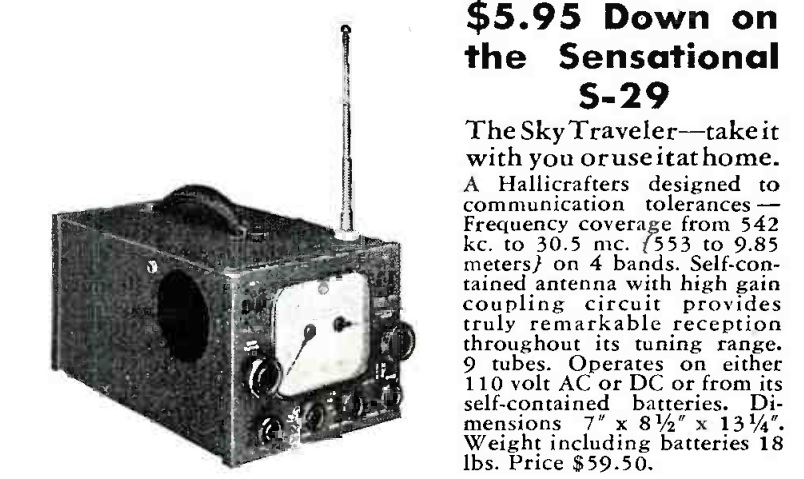
The advertisement shown here for the Hallicrafters S-29 receiver appeared 75 years ago in the February 1941 issue of Radio News. This early portable communications receiver, dubbed the Sky Traveler, covered the broadcast band through 30 MHz in four bands. It could run either on internal rechargeable batteries or from AC power. It had a lineup of 9 tubes, including the 50Y5GT rectifier. All other tubes were one volt filament types. The set did have a BFO for listening to code, with one tube (a 1G4GT) dedicated to that purpose.
The full manual for the receiver is available online. You can see a restored version in operation at the following video:
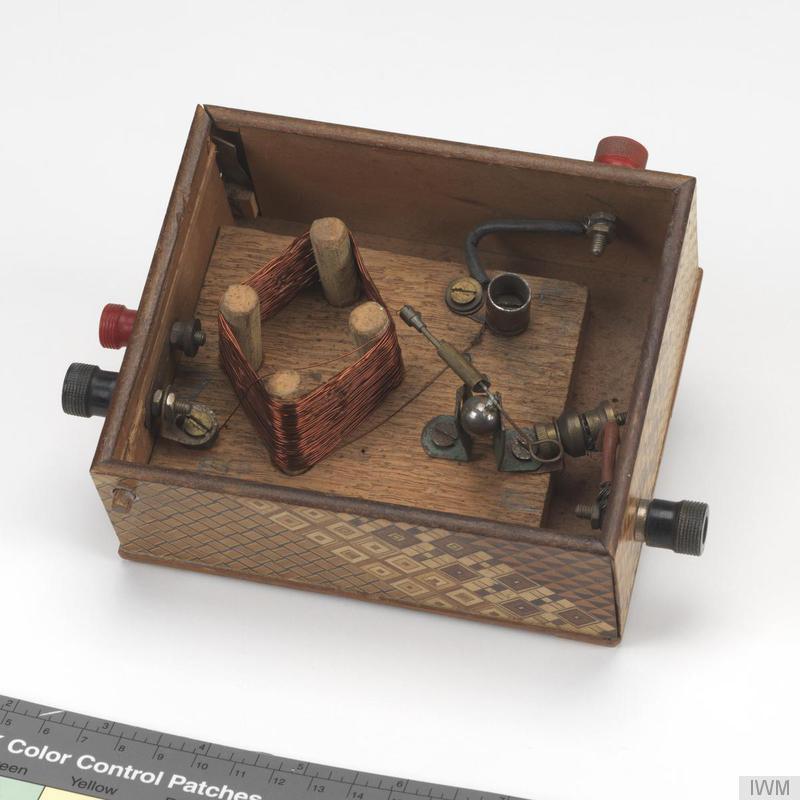
The crystal set shown here is from the collections of the Imperial War Museum.
The Channel Islands were the only part of Britain that were under German occupation during World War 2, and while islanders were initially allowed to keep their radio sets, they were eventually confiscated. In response, many residents obtained crystal sets such as the one shown here. This one was manufactured in Guernsey in 1944.
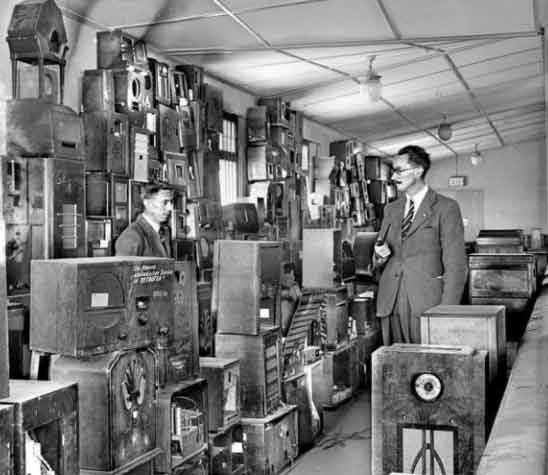
Evening Post photo of confiscated radios in Guernsey, via TheIslandWiki.org.
The plans for the set were broadcast by “Colonel Britton” of the BBC. This set, along with about 50 others, was manufactured by the person who donated the set to the museum. The coil was made of wire stolen from a German car, and the crystals were made by mixing sufur and lead, baked in a fire in a German rifle cartidge case.
Occasionally, the wavelength of the BBC broadcast would change, at which time “Colonel Britton” would announce that more windings would need to be added to the coil. Either a radio headphone or a telephone receiver could be used to listen.
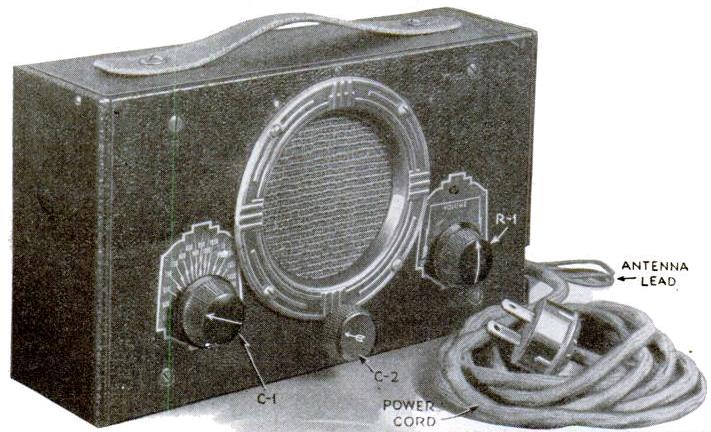
The February 1936 issue of Popular Science shows the plans for this simple portable receiver. “By careful planning and the use of midget parts and space-saving metal tubes, a complete three-tube circut, loudspeaker and all, has been crammed into an ordinary cigar box.” Despite the small size, it could “be built by anyone who boasts a jack knife, a pair of pliers, a screw driver, a soldering iron, and a small drill.”
The circuit consisted of a 6K7 serving as RF amplifier and detector, with a 6C5 serving as audio amplifier to drive a three-inch speaker. A second 6C5 was used as rectifier. A “curtain burner” cord was used to reduce the line voltage to 18 volts in order to light the filaments of the three tubes wired in series.
In testing, the set gave good volume on more than a dozen stations, with a sixty-foot outside antenna.
Tim, AE7PJ posted an interesting video showing his experience as an activator in the ARRL National Parks On The Air (NPOTA) event. He was operating from near Wisdom, Montana, at a point where three National Park Service units converge: The Big Hole Battlefield, the Nez Perce Historic Park, and the Lewis and Clark Trail.
The Lewis and Clark Trail traces the route of the 1804-06 Corps of Discovery from Illinois to Washington. This particular spot was along the route of Clark’s return journey, following the Yellowstone River and then along the route of modern day Interstate 94. The Big Hole National Battlefield is the site of the August 9, 1877, Battle of Big Hole between the U.S. Army and the Nez Perce encamped there. The National Battlefield is one of six units in four states of the Nez Perce National Historic Park, devoted to the history and culture of the Nez Perce (Nimiipuu) people and the 1877 conflict.
Tim condensed his two-hour operation into a nine-minute video, and it sounds like he listed all of the call signs he worked and has a brief snippet of everyone’s audio. You can see my call, W0IS, scroll by at 5:46, and you’ll hear me saying “59 Minnesota” at 6:08.
Tim was running a Hamstick vertical antenna on his vehicle, the same antenna that I’ve used for my activations so far. It has the advantage of being inexpensive and convenient to carry around. It’s not particularly efficient, but as you can see from the video, it gets the job done. He was running about 100 watts. My activations have used a Yaesu FT-817, running only 5 watts. While the 5 watts is adequate for CW contacts, the added power really makes a difference in being able to make voice contacts.
The video references the NPOTA Facebook group, which has become a very active forum for discussing NPOTA, and also providing spots to help other chasers find the stations in the parks, some of which can be quite weak. In Tim’s case, he had posted his plans, and a number of us kept tuning the band looking for his signal. I think I was the first one to spot him, but he was too weak to work when he first came on. While waiting for him to show up, I did have the pleasure of working WC8VOA, the ham station located at the former Voice of America relay station in Bethany, Ohio. For many decades, that station broadcast worldwide, as documented in the video below. Two historic sites in one night–not a bad use of radio.
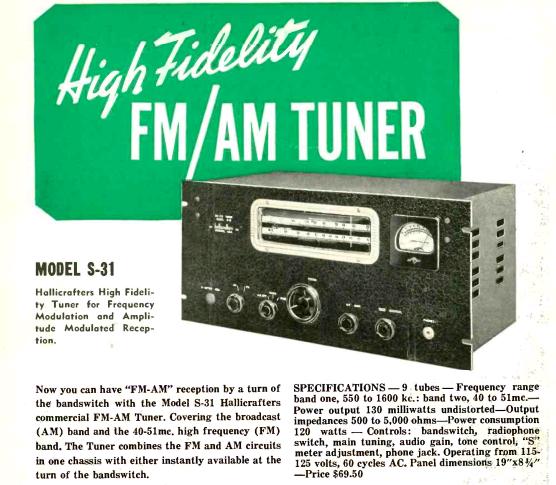
Seventy-five years ago this month, the February 1941 issue of Radio Craft carried this ad for an unusual Hallicrafters receiver, the S-31 AM-FM tuner.
It’s difficult to figure out the exact market this receiver is intended for. It’s designed for a rack mount, and requires an outboard audio amplifier, since it is just the tuner. It tuned the standard AM broadcast band, as well as the prewar 42-50 MHz FM band. It was obviously a high-end piece of equipment. According to the 1941 Hallicrafters Catalog, the set had a retail price of $69.50. The matching 25-watt high fidelity audio amplifier retailed for $49.50.
The set’s 9-tube complement consisted of 6SK7, 6SA7, 1852, 1853, 6SJ7, 6H6, 6SK7, 6SR7, and 80. The standard broadcast IF was 455 kHz, with an FM IF of 4.3 MHz.
Not surprisingly, few seem to be in existence today. One nice example can be found at LA5KI’s site.
Many of the vintage receivers described here require plug-in coils, such as the ones shown in the image at the left. Back in the day, these were readily obtainable in common sizes. And as the February 1941 issue of Popular Mechanics pointed out, “considerable effort can be saved by purchasing ready-wound coils.” However, he magazine also admonished that “the beginner should take the time to wind the coils for at least the first set he builds so that he will understand exactly how they are made,” as the young gentlemen shown at the top of the page are doing.
Today, since pre-manufactured coils are unobtainium, the builder of one of these sets has little choice but to make the coils at home. But as the experimenter 75 years ago learned, the process of making coils is quite simple. This article serves as a good guide for the modern recreator to make the coils. But there is still a slight problem, since the article simply advises purchasing “forms usually made of Bakelite or similar material.” And those coil forms are also unobtanium today.
Fortunately, modern materials come to the rescue, since it’s easy to recreate the forms themselves using readily available PVC tubing, along with the base of a defunct tube. Complete instructions can be found on AA8V’s page.
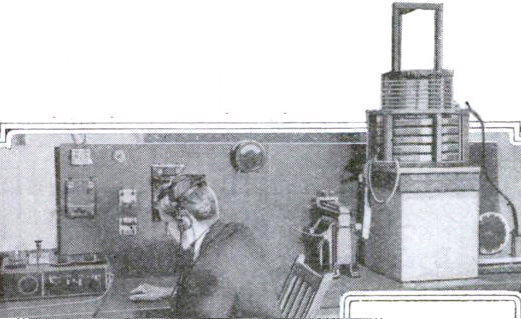
Shown here is the radio station at Kern County High School, Bakersfield, California, as depicted in the February, 1916, issue of Popular Mechanics. The accompanying article notes that the school has a course in wireless telegraphy, with a course in wireless telephony being added.
According to the 1916 call book, the station was licensed as 6GZ, under the control of one A.J. Ludden.
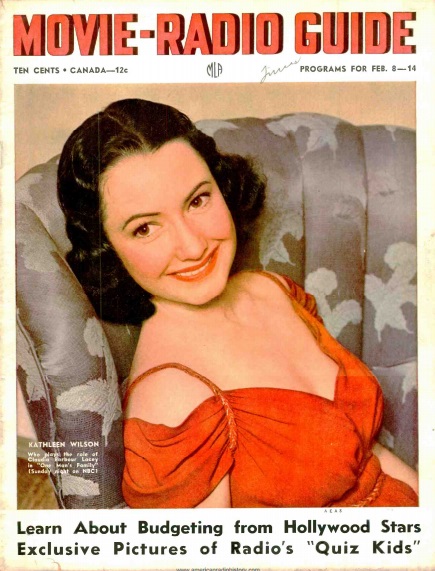
Shown here on this week’s issue of Movie Radio Guide 75 years ago, February 8, 1941, is radio actress Kathleen Wilson, who appeared on the NBC soap opera One Man’s Family. The program originally aired from San Francisco, but later originated from Los Angeles. It was one of the first West Coast network programs to be heard on the East Coast.
The series was radio’s longest running serial, spanning 27 years between 1932 and 1950. It also ran on television from 1949-52 on prime time, and again in 1954 and 1955 as a daytime show. The plot centered on Henry Barbour, a San Francisco stockbroker and his family. Kathleen Wilson played daughter Claudia, and continued in the role until 1943 when the character was written out of the story. The character returned in 1945, this time played by Barbara Fuller.
According to the magazine, Wilson was 29 years old. She married Rawson Holmes, but later divorced and was living with her son in Hollywood.
Claudia, a student at Stanford, was rebellious, and plots often focused on her romances. The episode “Claudia Says Goodbye to Her Family” is available online.



 on his vehicle, the same antenna that I’ve used for my activations so far. It has the advantage of being inexpensive and convenient to carry around. It’s not particularly efficient, but as you can see from the video, it gets the job done. He was running about 100 watts. My activations have used a
  , running only 5 watts. While the 5 watts is adequate for CW contacts, the added power really makes a difference in being able to make voice contacts.
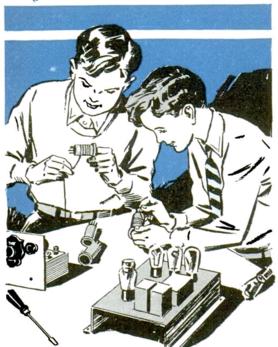
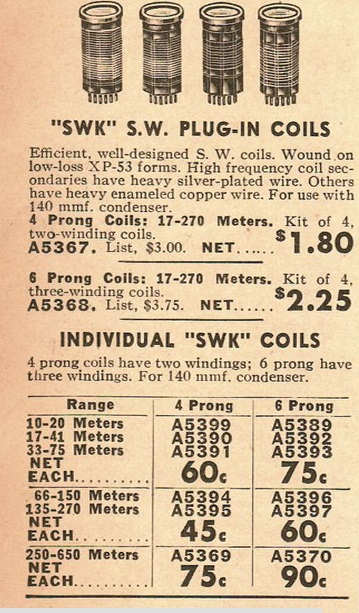 Many of the vintage receivers described here require plug-in coils, such as the ones shown in the image at the left. Back in the day, these were readily obtainable in common sizes. And as the February 1941 issue of