Author Archives: clem.law@usa.net

Hallicrafters S-31 AM/FM Tuner, 1941

HallicraftersS31

Seventy-five years ago this month, the February 1941 issue of Radio Craft carried this ad for an unusual Hallicrafters receiver, the S-31 AM-FM tuner.

It’s difficult to figure out the exact market this receiver is intended for.  It’s designed for a rack mount, and requires an outboard audio amplifier, since it is just the tuner.  It tuned the standard AM broadcast band, as well as the prewar 42-50 MHz FM band.  It was obviously a high-end piece of equipment.  According to the 1941 Hallicrafters Catalog, the set had a retail price of $69.50.  The matching 25-watt high fidelity audio amplifier retailed for $49.50.

The set’s 9-tube complement consisted of 6SK7, 6SA7, 1852, 1853, 6SJ7, 6H6, 6SK7, 6SR7, and 80.  The standard broadcast IF was 455 kHz, with an FM IF of 4.3 MHz.

Not surprisingly, few seem to be in existence today.  One nice example can be found at LA5KI’s site.


Click Here For Today’s Ripley’s Believe It Or Not Cartoon


Making Your Own Plug-In Coils

1941FebPMCoils

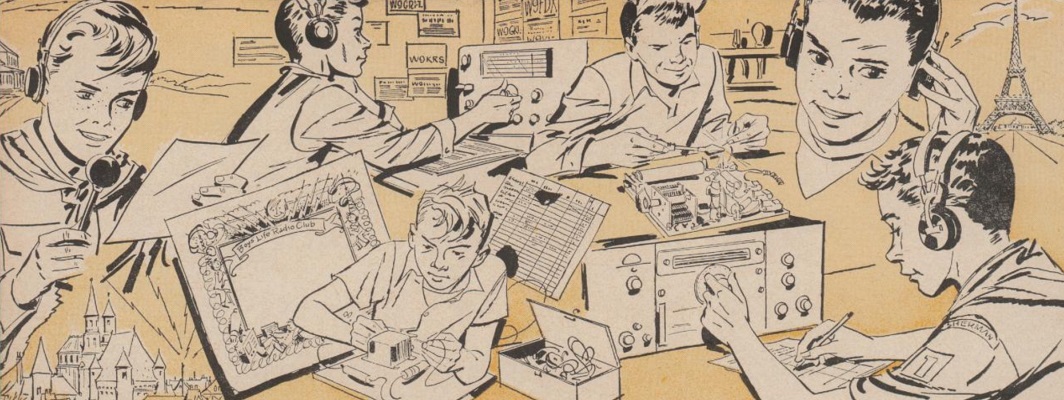
1940PlugInCoilsMany of the vintage receivers described here require plug-in coils, such as the ones shown in the image at the left. Back in the day, these were readily obtainable in common sizes. And as the February 1941 issue of Popular Mechanics pointed out, “considerable effort can be saved by purchasing ready-wound coils.” However, he magazine also admonished that “the beginner should take the time to wind the coils for at least the first set he builds so that he will understand exactly how they are made,” as the young gentlemen shown at the top of the page are doing.

Today, since pre-manufactured coils are unobtainium, the builder of one of these sets has little choice but to make the coils at home. But as the experimenter 75 years ago learned, the process of making coils is quite simple. This article serves as a good guide for the modern recreator to make the coils. But there is still a slight problem, since the article simply advises purchasing “forms usually made of Bakelite or similar material.” And those coil forms are also unobtanium today.

Fortunately, modern materials come to the rescue, since it’s easy to recreate the forms themselves using readily available PVC tubing, along with the base of a defunct tube. Complete instructions can be found on AA8V’s page.

Click Here For Today’s Ripley’s Believe It Or Not Cartoon


6GZ, Bakersifeld, CA, 1916

1916FebPM

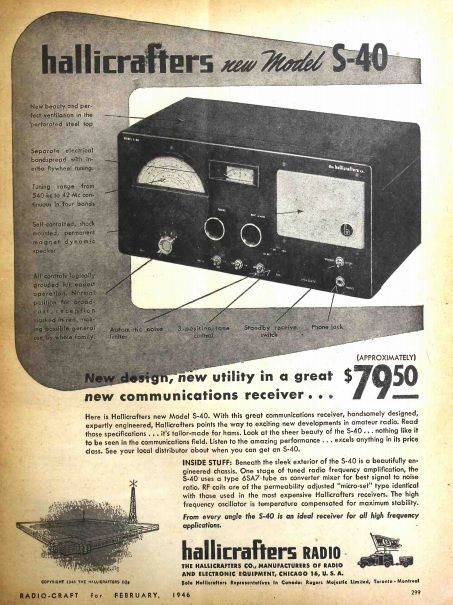
Shown here is the radio station at Kern County High School, Bakersfield, California, as depicted in the February, 1916, issue of Popular Mechanics.  The accompanying article notes that the school has a course in wireless telegraphy, with a course in wireless telephony being added.

According to the 1916 call book, the station was licensed as 6GZ, under the control of one A.J. Ludden.


Kathleen Wilson, NBC Radio

1941Feb8RadioGuide

Shown here on this week’s issue of Movie Radio Guide 75 years ago, February 8, 1941, is radio actress Kathleen Wilson, who appeared on the NBC soap opera One Man’s Family.  The program originally aired from San Francisco, but later originated from Los Angeles.  It was one of the first West Coast network programs to be heard on the East Coast.

The series was radio’s longest running serial, spanning 27 years between 1932 and 1950. It also ran on television from 1949-52 on prime time, and again in 1954 and 1955 as a daytime show. The plot centered on Henry Barbour, a San Francisco stockbroker and his family. Kathleen Wilson played daughter Claudia, and continued in the role until 1943 when the character was written out of the story. The character returned in 1945, this time played by Barbara Fuller.

According to the magazine, Wilson was 29 years old.  She married Rawson Holmes, but later divorced and was living with her son in Hollywood.

Claudia, a student at Stanford, was rebellious, and plots often focused on her romances.  The episode “Claudia Says Goodbye to Her Family” is available online.


National Parks On The Air “Park To Park” QSO

Photo of bridge at Chickasaw National Recreation Area

Chickasaw National Recreation Area, Oklahoma. NPS photo.

I had my first “park to park” QSO today in the ARRL National Parks On The Air (NPOTA) event.  On the way to do some grocery shopping, I decided to make a quick stop near the Mississippi River, at a parking lot just south of Summit Avenue on the St. Paul side of the river.  It’s at a fairly good elevation above the water, but it’s within the required 100 feet of the river.

I worked about 35 contacts on 20 meter CW in about a half hour, as shown in the log below.  When the pileup subsided, I decided to try phone.  In a previous “activation” from this location, I had managed to work about 50 contacts, but that was after I was “spotted” on the DX cluster.  Without that help, my 5 watt signal didn’t attract anyone’s attention on the crowded band, and I called CQ for about 10 minutes without any takers.  Before packing up, I decided to tune the band and look for any other strong signals.

After a few minutes, I heard Gary, N5PHT, who I had already worked a few times from home.  He was operating from a campground at the  Chickasaw National Recreation Area in Oklahoma.  He had a booming signal and easily pulled my weak signal out of the noise.

Gary’s station is described on his website.  The difference in signal is attributable to the fact that he is running 100 watts to a better antenna, with a nice station set up in his motorhome.  Even though he was portable, he had a formidable signal, and has worked about 2000 contacts in about a week from this portable location.


npota020716


1936 3-Tube Regenerative Shortwave Receiver

1936FebSWcraftEighty years ago, the SWL shown here was exploring the ether with her three-tube shortwave set, as featured in the February 1936 issue of Shortwave Craft magazine. It featured one stage of RF amplification with a 6L7 tube, a 6J7 serving as regenerative detector, and a 6C5 serving as audio amplifier. The article points out that the “operation of the set is perfectly simple.” The set would tune 14-200 meters (1.5 – 21 MHz) with four plug-in coils.

The schematic and pictorial diagrams of the set are shown below.

1936FebSWcraft2


1941: Army Surveys U.S. Hams

1941ArmyQuestionaireSeventy five years ago, the U.S. was clearly gearing up quickly for war, and the War Department turned its attention to the communications manpower that the war would entail. As reported here in the February 1941 issue of QST, the Army was sending out a questionnaire to all of the hams listed in the call book.

The War Department made clear that response to the survey in no way constituted “registration” and did not impose any obligation, the Army believed that the statistical knowledge was of utmost importance.

The questionnaire asked for data on code proficiency, military status, education, occupation, and dependents. For those respondents who were not fit physically for military service, it asked whether they would be interested in participation in an aircraft warning net, or whether they would be available for civilian positions as radio operators, instructors, or technicians.

In addition, the survey asked for a brief description of the station.

The ARRL opined that “this seems a needed study and we are confident that amateurs will cooperate and fill out the forms promptly.”


Radio Scouting, 1926

1926FebRadioAge

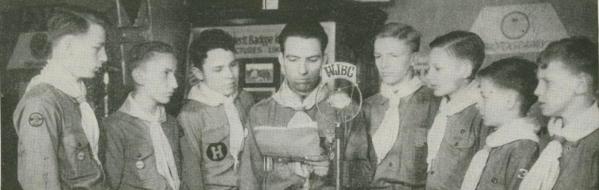
Shown here in 1926 is Lyman F. Barry, 2OH, the Scoutmaster of Troop 503, Manhattan. In an article in the February 1926 issue of Radio Age, he describes the radio scouting activities of that troop and the equipment used. He first notes that nationwide, 75% of all scouts had radio receiving sets, and that radio had played a role in scouting from the very start. “Away back in 1914 when radio broadcasting was little known, thousands of scouts were studying the scout handbook and wiring up crystal receiving sets and learning the code.”

His aim was to have every scout in the troop in radio communication with the troop, in a system totally independent of commercial telephones. The troop headquarters was equipped with a CW transmitter capable of reaching every part of the city, and at least half of the members of the troop already had a receiver. The scouts were currently in the process of revamping those sets to tune down to 176 meters (1705 kHz), the wavelength employed by the troop station.

From 2OH, a daily bulletin was sent out at about 8 words per minute, a speed at which even the new scouts could pick out a few letters. At weekly meetings, the messages were handed in, and points were awarded to scouts copying without mistakes. Scoutmaster Barry noted that if any emergency mobilizations could be communicated via these bulletins.

At least one neighboring troop had installed a transmitter and receiver, and intercommunications with that troop was being carried out.

The troop also had a portable station, consisting of a regenerative receiver with a single WD-12 tube. This station was capable of tuning 50-50,000 meters, and would pull in broadcast stations from 15-20 miles, as well as the troop station.

The troop also regularly monitored time and weather broadcasts from NAA in Arlington, Virginia.

Troop 503 is mentioned again in the June 1928 issue of Boys’ Life, where it reported that it was in direct contact with a troop in Buffalo.  At that time, Troop 503 held the call sign 2AAQ for its portable station.


Carol Bruce, NBC Radio and WKRP


1941CarolBruce

Shown here from the February 1941 issue of Radio Mirror is actress Carol Bruce.  In addition to her film and theater credits, she appeared on the Ben Bernie broadcast on NBC radio.

One of her most famous roles, however, also involved radio.  She played Lilian Carlson, the owner of WKRP in Cincinnatti and the mother of station manager Arthur Carlson.

She died in California in 2007 at the age of 87.


Radio Scouting 1916

1916WirelessAge

Shown here a hundred years ago are Scouts Bruce Clark and Roland D. Cosgrove, 1ON, of 14 Wright Street, Cambridge, Mass.  The photo appeared in the February 1916 issue of Wireless Age, and the caption reveals only that they “were operating a wireless set at the Boston Boy Scout rally.”